PM Viksit Gram Swaraj Yojana 2026: UPSC Analysis
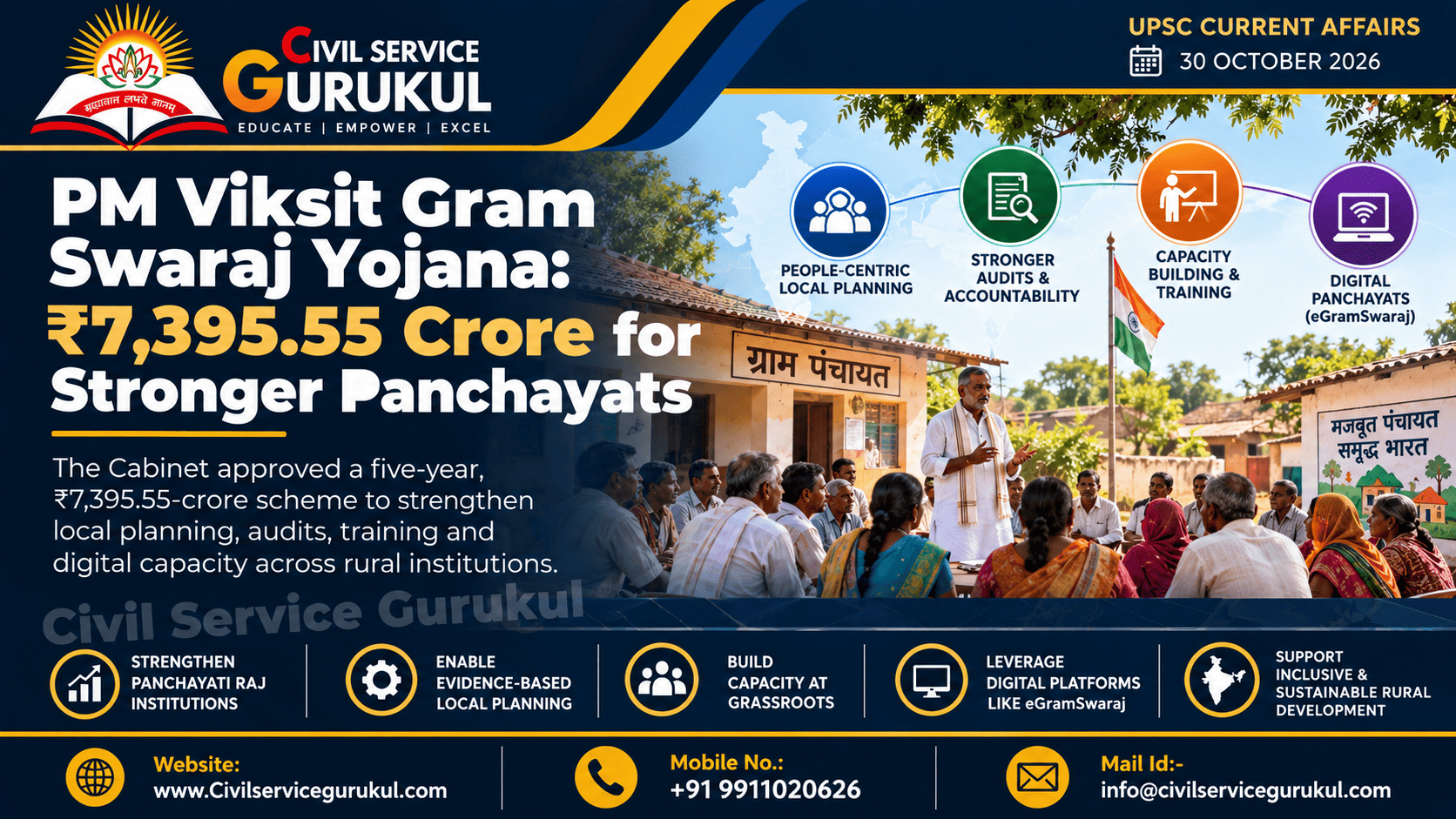
PM Viksit Gram Swaraj Yojana 2026: ₹7,395.55 Crore Plan to Empower Panchayats
An examination of rural local governance, constitutional decentralisation, institutional capacity, digital planning, financial accountability and the future of Panchayati Raj in India.
According to the supplied October 2026 report, the Union Cabinet approved Pradhan Mantri Viksit Gram Swaraj Yojana (PM-VGSY) on 28 October 2026. The scheme is described as a five-year Centrally Sponsored Scheme for 2026–27 to 2030–31, with a total outlay of ₹7,395.55 crore.
Its primary objective is to strengthen Panchayati Raj institutions through training, local development planning, digital financial systems, auditing and citizen participation.
For UPSC, the development is relevant to democratic decentralisation, the 73rd Constitutional Amendment, local self-government and public accountability.
GS Paper II: Constitution, federalism, devolution of powers, local self-government and governance.
GS Paper IV: Transparency, accountability, public service delivery and citizen-centric administration.
Prelims: Articles 243G and 243I, Part IX, Eleventh Schedule, Panchayati Raj and State Finance Commissions.
Why Is PM Viksit Gram Swaraj Yojana in the News?
The supplied report states that the Union Cabinet approved Pradhan Mantri Viksit Gram Swaraj Yojana on 28 October 2026 as a programme to improve institutional capacity at the grassroots level.
The initiative is presented as a successor to the capacity-building emphasis of the Rashtriya Gram Swaraj Abhiyan.
Its central premise is that democratic decentralisation requires more than transferring funds. Elected representatives and local officials must also possess the knowledge, tools and administrative support needed to use public resources effectively.
PM-VGSY is described primarily as an institutional and administrative capacity-building programme. It should not be confused with a direct cash-transfer scheme for individual rural households.
Key Features and Financial Structure of PM-VGSY
The reported scheme focuses on improving local planning, administrative skills, financial management and public accountability.
| Component | Reported Detail |
|---|---|
| Scheme | Pradhan Mantri Viksit Gram Swaraj Yojana |
| Abbreviation | PM-VGSY |
| Type | Centrally Sponsored Scheme |
| Period | 2026–27 to 2030–31 |
| Total Outlay | ₹7,395.55 crore |
| Central Share | ₹4,869.48 crore |
| State Share | ₹2,526.07 crore |
| Reported Reach | More than 2.55 lakh Panchayats and traditional rural bodies |
| Capacity-Building Beneficiaries | Approximately 32 lakh representatives and functionaries |
Capacity Building
Training programmes aim to strengthen the practical skills of elected representatives and rural administrative functionaries in planning, budgeting, monitoring and service delivery.
Local Development Planning
Gram Panchayat Development Plans can provide a structured framework for identifying community priorities and coordinating available resources.
Financial Accountability
The programme emphasises stronger financial reporting, online audits and improved local revenue mobilisation.
Citizen Participation
Gram Sabha engagement can make local development decisions more transparent and responsive to community needs.
Constitutional Background of Panchayati Raj
The 73rd Constitutional Amendment Act, 1992 introduced Part IX of the Constitution, providing a constitutional framework for Panchayats.
It also added the Eleventh Schedule, which lists 29 subjects relevant to Panchayat functions.
| Constitutional Provision | Significance |
|---|---|
| Part IX | Constitutional provisions relating to Panchayats |
| Article 243A | Gram Sabha |
| Article 243G | Powers, authority and responsibilities of Panchayats |
| Article 243H | Taxes and funds of Panchayats |
| Article 243I | State Finance Commission |
| Article 243K | Panchayat elections and State Election Commission |
| Eleventh Schedule | 29 subjects that may be entrusted to Panchayats |
The Principle of Democratic Decentralisation
Democratic decentralisation involves transferring appropriate decision-making authority to elected institutions closer to the people.
However, constitutional recognition alone does not automatically ensure complete functional or financial autonomy. The actual extent of devolution depends significantly on State legislation and policy.
Article 243G concerns Panchayat powers and responsibilities, while Article 243I concerns State Finance Commissions. The Eleventh Schedule contains 29 subjects, but their actual devolution depends on State law.
Digital Governance: eGramSwaraj and AuditOnline
eGramSwaraj
eGramSwaraj supports digital planning and financial management for Panchayati Raj institutions.
Digitised development plans can help administrators track activities, identify overlapping proposals and monitor financial information.
AuditOnline
AuditOnline supports digital audit processes for local government institutions.
Better audit trails can improve financial transparency and make it easier to identify reporting gaps.
PANCHAM Platform
The supplied report also mentions a proposed PANCHAM platform for multilingual communication and engagement. Its implementation details should be checked against the relevant official documentation.
Limits of Digitisation
A digital dashboard does not automatically create better governance. Technology must be accompanied by trained personnel, reliable connectivity, clear responsibilities and meaningful citizen oversight.
Why PM-VGSY Matters for Rural Governance
Stronger Grassroots Democracy
Capacity-building can help elected representatives participate more effectively in public decision-making.
Improved Development Planning
Evidence-based planning can help Panchayats identify local priorities in drinking water, sanitation, livelihoods and other essential services.
Greater Financial Transparency
Timely financial reporting and accessible audit information can strengthen public confidence.
Women's Participation
Training and institutional support can help women representatives exercise their elected responsibilities more effectively.
Better Use of Public Funds
Improved budgeting, monitoring and coordination can help reduce duplication and support better development outcomes.
Major Implementation Challenges
Incomplete Devolution
Panchayats may face difficulty delivering services where administrative powers remain with State departments.
Administrative Capacity Gaps
Shortages of trained staff and technical expertise can limit effective planning, procurement and reporting.
Digital Divide
Weak internet connectivity and inadequate digital skills can affect the practical use of online governance systems.
Limited Own-Source Revenue
Dependence on external transfers may constrain financial flexibility at the local level.
Unequal Participation
Social hierarchies and institutional barriers can prevent some groups from participating fully in Gram Sabha deliberations.
Compliance Without Outcomes
Counting uploaded plans and completed training sessions may not adequately demonstrate improvements in public services.
Way Forward: Making Panchayati Raj Institutions Effective
- Provide sustained, practical training in local languages for elected representatives and administrative staff.
- Strengthen block-level technical support for planning, budgeting and audits.
- Publish simplified Panchayat budget and audit summaries for public scrutiny.
- Encourage meaningful Gram Sabha participation, especially among women and marginalised communities.
- Link programme evaluation to service delivery outcomes, not merely administrative reporting targets.
- Improve coordination between State departments and local elected institutions.
- Support transparent own-source revenue practices where authorised by State law.
- Monitor improvements in water supply, sanitation, livelihoods and grievance resolution.
The long-term effectiveness of local self-government depends on combining funds, functions, functionaries and accountability.
UPSC Prelims Practice Questions
Question 1
Which Article of the Constitution provides for State Finance Commissions?
(a) Article 243G
(b) Article 243I
(c) Article 243K
(d) Article 280
Article 243I provides for State Finance Commissions to review the financial position of Panchayats and make recommendations as constitutionally prescribed.
Question 2
Consider the following statements:
- The 73rd Constitutional Amendment introduced Part IX.
- The Eleventh Schedule contains 29 subjects.
- Article 243G automatically transfers every Eleventh Schedule subject to all Panchayats.
Which statements are correct?
(a) 1 and 2 only
(b) 2 and 3 only
(c) 1 and 3 only
(d) 1, 2 and 3
Statements 1 and 2 are correct. Statement 3 is incorrect because the actual devolution of Panchayat powers depends on State legislation.
Question 3
Which of the following best describes the principal focus of PM-VGSY as presented in the supplied report?
(a) Direct cash transfers to all villagers
(b) Institutional capacity-building of rural local bodies
(c) Replacement of State Governments
(d) Exclusive construction of national highways
The reported programme focuses on training, planning, digital governance, financial accountability and stronger rural local institutions.
Question 4
Which of the following is associated with digital planning and financial management of Panchayats?
(a) eGramSwaraj
(b) DigiLocker only
(c) GSTN
(d) SWIFT
eGramSwaraj supports planning and financial management functions of Panchayati Raj institutions.
UPSC Mains GS Paper II Practice
Question: "Capacity-building is as important as fiscal devolution for democratic decentralisation." Discuss with reference to the reported PM Viksit Gram Swaraj Yojana, 2026. (250 words)
Suggested Answer Framework
Introduction: Explain the constitutional basis of Panchayati Raj and the importance of effective local self-government.
Institutional Capacity: Discuss training, planning, administrative skills, digital systems and audits.
Fiscal Devolution: Explain the importance of adequate resources, own-source revenue and State Finance Commissions.
Challenges: Examine incomplete devolution, administrative constraints, digital exclusion and weak public participation.
Conclusion: Democratic decentralisation requires the coordinated strengthening of local authority, financial resources, institutional skills and public accountability.
Frequently Asked Questions
What is PM Viksit Gram Swaraj Yojana?
The supplied report describes it as a five-year Centrally Sponsored Scheme to strengthen rural local institutions through capacity-building and better governance systems.
What is the reported budget of PM-VGSY?
The supplied article reports a total outlay of ₹7,395.55 crore, including Central and State contributions.
What is the reported duration of the scheme?
The reported implementation period is 2026–27 to 2030–31.
What is Article 243G?
Article 243G concerns the powers, authority and responsibilities of Panchayats.
What is Article 243I?
Article 243I provides for the constitution of State Finance Commissions.
Why is PM-VGSY relevant for UPSC?
It connects Panchayati Raj, constitutional decentralisation, rural development, financial accountability and governance reforms.
Key Takeaway for UPSC Aspirants
Effective grassroots democracy requires more than elected Panchayats and financial transfers. Local institutions must possess adequate powers, skilled personnel, transparent financial systems and meaningful citizen participation.
SEO Keywords and Tags
Prepare for UPSC with Civil Service Gurukul
Develop conceptual clarity through syllabus-oriented current affairs, Indian Polity analysis, Prelims practice and Mains answer-writing guidance.
Website: www.civilservicegurukul.com
Mobile: +91 9911020626
Email: info@civilservicegurukul.com
Editorial Note: This educational article is an original analysis based on the uploaded October 2026 source. The reported Cabinet approval, scheme financial figures, coverage and programme-specific details have not been independently verified against an official notification. The practice questions are educational material, not official UPSC questions.
Prepare with Mentors Who Cleared the Exam
Get personalized study plans, evaluated answer models, and test series access.