Plastic Waste to Clean Energy: Recycling, Pyrolysis & Hydrogen for UPSC
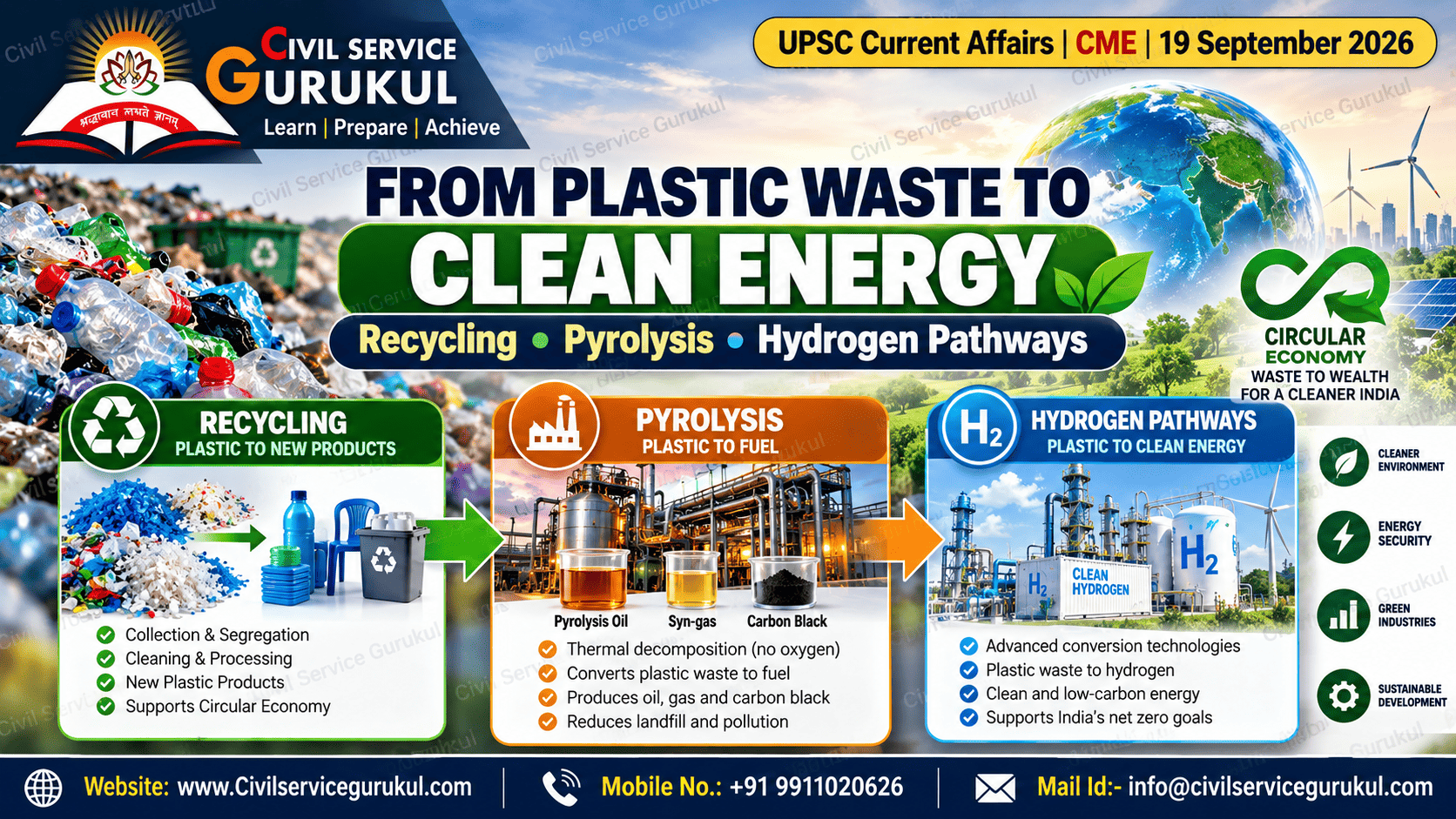
Plastic Waste to Clean Energy: Can India's Pollution Crisis Become a Circular-Economy Opportunity?
Plastic waste is increasingly being viewed not only as an environmental burden but also as a secondary resource. Mechanical recycling, pyrolysis, plastic-to-hydrogen technologies and waste-to-energy systems could recover materials and energy from discarded plastics—but their sustainability depends on technology, emissions control and sound waste-management policy.
Plastic waste can be transformed into useful products, fuels and potentially hydrogen through technologies such as mechanical recycling, pyrolysis and advanced thermochemical processing. These pathways offer opportunities for waste-to-wealth, circular economy and resource recovery while reducing the amount of plastic entering landfills and the environment. However, energy recovery should not become a substitute for reducing unnecessary plastic use, improving segregation and expanding high-quality recycling. For UPSC, the issue connects environmental pollution, clean energy, circular economy, technology and sustainable development.
GS Paper 3: Environmental Pollution, Waste Management, Science & Technology, Energy, Sustainable Development.
Essay: Circular Economy, Innovation for Sustainability, Waste-to-Wealth, Green Growth.
GS Paper 2/Policy Link: Urban Governance, Local Bodies, Environmental Regulation.
Prelims: Pyrolysis, recycling, hydrogen, waste-to-energy, Extended Producer Responsibility.
Why Is Plastic Waste a Major Environmental Challenge?
Plastic is lightweight, durable and inexpensive, making it useful across packaging, healthcare, transport, agriculture, electronics and consumer products.
The same durability that makes plastic commercially valuable also creates an environmental problem when it becomes waste.
Poorly managed plastic can remain in the environment for long periods and contribute to:
- land and water pollution;
- blocked urban drainage systems;
- marine litter;
- microplastic contamination;
- harm to wildlife;
- open-burning emissions;
- pressure on landfills.
From Waste to Resource: The Core Idea
A circular-economy approach seeks to keep materials in productive use for as long as possible.
Instead of following a linear model— extract, manufacture, use and discard—the objective is to recover materials and energy wherever environmentally justified.
Major Pathways for Managing Plastic Waste
| Technology | What It Does | Potential Output |
|---|---|---|
| Mechanical Recycling | Sorts, cleans and remoulds suitable plastic waste. | Recycled plastic products and raw materials. |
| Pyrolysis | Thermally decomposes plastic in a low-oxygen or oxygen-limited environment. | Liquid hydrocarbons, gases and char depending on the process. |
| Plastic-to-Hydrogen | Uses thermochemical or related processes to recover hydrogen-rich gases from waste plastic. | Hydrogen and other process products. |
| Waste-to-Energy | Recovers energy from suitable non-recyclable waste through controlled thermal processes. | Heat and/or electricity. |
1. Mechanical Recycling
Mechanical recycling is generally the most familiar method of recovering plastic material.
The process may involve:
- collection;
- segregation by polymer type;
- washing;
- shredding;
- melting;
- pelletisation or remoulding.
Recycled plastic can be used to manufacture products such as:
- bottles;
- furniture;
- containers;
- construction components;
- plastic boards;
- other secondary products.
Where technically and economically feasible, preserving the material value of plastic through recycling is generally preferable to destroying the material solely for energy recovery.
Limitations of Mechanical Recycling
Not every plastic item can be repeatedly recycled.
Challenges include:
- mixed polymer composition;
- contamination by food or chemicals;
- multi-layer packaging;
- declining material quality after repeated recycling;
- poor waste segregation;
- weak markets for recycled material.
This is where chemical and thermochemical recovery pathways are sometimes considered.
2. What Is Plastic Pyrolysis?
Pyrolysis is a thermochemical process in which plastic is heated at high temperature in the absence, or substantial limitation, of oxygen.
The long polymer molecules break into smaller hydrocarbon molecules.
Depending on the feedstock and operating conditions, outputs can include:
- pyrolysis oil;
- combustible gas;
- solid char;
- chemical feedstocks.
Plastic Waste → Heat → Polymer Breakdown → Gas + Liquid Hydrocarbons + Solid Residues
Potential Advantages of Pyrolysis
- Can process some plastics that are difficult to mechanically recycle.
- May recover hydrocarbon value from waste.
- Can reduce the volume of material requiring landfill disposal.
- May create industrial feedstocks or fuels.
- Can complement recycling when applied to appropriate residual waste streams.
But Is Pyrolysis Automatically “Clean Energy”?
No.
This distinction is important for UPSC answers.
Pyrolysis requires energy and its overall environmental benefit depends on:
- the energy source used;
- plant efficiency;
- quality of waste feedstock;
- emissions-control systems;
- use of the resulting oil or gas;
- management of residues;
- comparison with recycling alternatives.
Converting plastic into fuel does not eliminate carbon from the system. If the recovered hydrocarbons are ultimately burned, greenhouse gases may still be released. Therefore, plastic-to-fuel should be assessed through a life-cycle environmental analysis, not merely labelled “green” because it uses waste.
3. Plastic-to-Hydrogen: An Emerging Pathway
Research is exploring methods of recovering hydrogen from plastic waste using advanced thermal and chemical processes.
Plastic contains significant amounts of hydrogen within its hydrocarbon structure.
Under appropriate processing conditions, hydrogen-rich gases can be generated and hydrogen may then be separated for further use.
Why Is Hydrogen Important?
Hydrogen can serve as an energy carrier and industrial feedstock.
Potential applications include:
- fertiliser production;
- refineries;
- steel;
- heavy transport;
- energy storage;
- power generation in fuel cells.
Is Plastic-Derived Hydrogen the Same as Green Hydrogen?
Not necessarily.
Green hydrogen is generally associated with hydrogen produced using renewable electricity and processes with very low associated greenhouse gas emissions.
Hydrogen derived from waste plastic should therefore be classified based on its actual production pathway and life-cycle emissions rather than automatically being called green hydrogen.
“Hydrogen” and “green hydrogen” are not interchangeable terms. The environmental quality of hydrogen depends on how it is produced.
4. Waste-to-Energy
Waste-to-energy facilities recover energy from suitable waste fractions through controlled thermal or biochemical processes.
In the context of plastics, thermal treatment can produce heat and electricity because plastics possess high calorific value.
However, plastics that can be effectively recycled should generally not be diverted unnecessarily into energy recovery.
The Waste Hierarchy
A sustainable waste-management system does not treat every disposal option as equally desirable.
| Priority | Approach |
|---|---|
| 1 | Refuse / Reduce unnecessary plastic use |
| 2 | Reuse |
| 3 | Repair / Refill where feasible |
| 4 | Recycle material |
| 5 | Recover energy from suitable residual waste |
| 6 | Safe disposal |
Waste-to-energy should complement—not replace—waste reduction, reuse and high-quality material recycling.
Why Plastic Waste Can Become a “Waste-to-Wealth” Opportunity
When properly segregated and processed, discarded plastic can become a secondary economic resource.
Potential benefits include:
- production of recycled raw material;
- reduction in virgin plastic demand;
- energy recovery from difficult-to-recycle waste;
- creation of recycling enterprises;
- employment in collection and processing;
- reduced landfill pressure;
- greater resource efficiency.
Role of the Circular Economy
The circular economy aims to decouple economic activity from continuous consumption of virgin resources.
For plastics, this requires:
- product redesign;
- reusable packaging;
- better waste segregation;
- higher recycled content;
- producer responsibility;
- efficient recycling markets;
- reduced single-use consumption.
Extended Producer Responsibility
Extended Producer Responsibility, or EPR, places responsibility on producers for managing the post-consumer stage of products and packaging introduced into the market.
In plastic waste management, EPR can encourage:
- collection systems;
- recycling targets;
- use of recycled material;
- better packaging design;
- formalisation of recycling chains.
Technology Alone Cannot Solve Plastic Pollution
One of the most important lessons for policymakers is that new processing technology cannot compensate for poor waste governance.
Even the best pyrolysis or recycling plant performs poorly if incoming waste is contaminated and poorly segregated.
India therefore requires improvements at the entire chain:
Role of Urban Local Bodies
Cities are central to effective plastic-waste management.
Urban Local Bodies should strengthen:
- door-to-door segregated collection;
- material recovery facilities;
- integration of waste pickers;
- plastic waste tracking;
- local recycling markets;
- scientific treatment of residual waste.
The Informal Sector Is Crucial
Waste pickers and informal recyclers recover significant amounts of valuable material from India's waste streams.
A just circular-economy transition should therefore:
- formally recognise waste workers;
- improve occupational safety;
- provide social security;
- integrate them into municipal collection systems;
- ensure fair compensation.
Environmental Risks of Poorly Controlled Thermal Treatment
Thermal technologies must operate under strict emissions and residue management standards.
Poorly designed or operated systems may create:
- particulate emissions;
- toxic compounds;
- greenhouse-gas emissions;
- contaminated char or ash;
- local air pollution.
Environmental regulation and continuous monitoring are therefore essential.
Plastic Waste and Climate Change
Most conventional plastics are produced from fossil-fuel feedstocks.
The plastic lifecycle therefore has climate implications at multiple stages:
- fossil fuel extraction;
- polymer manufacturing;
- transport;
- processing;
- incineration or fuel combustion;
- end-of-life management.
Reducing virgin-plastic demand can consequently produce benefits beyond solid-waste management.
Plastic-to-Hydrogen and India's Energy Transition
Plastic-derived hydrogen could become a niche complement to India's broader hydrogen ecosystem if it can demonstrate favourable life-cycle emissions and commercial viability.
However, India's long-term clean-hydrogen strategy should continue to prioritise pathways capable of delivering very low carbon intensity.
Alternative Sources of Hydrogen
Scientific research is also examining hydrogen production from several other resources and technologies, including:
- renewable-powered water electrolysis;
- biomass;
- biogas;
- seaweed and other biological feedstocks;
- advanced water-splitting technologies.
This demonstrates that the future hydrogen economy is likely to include multiple production pathways.
Key Challenges for India
| Challenge | Why It Matters |
|---|---|
| Poor Segregation | Reduces recycling quality and contaminates feedstock. |
| Mixed & Multi-layer Plastics | Difficult to recycle mechanically. |
| Economic Viability | Recycled products must compete with virgin materials. |
| Technology Quality | Low-grade thermal processing may create pollution. |
| Weak Enforcement | Rules are ineffective without monitoring and accountability. |
| Informal Waste Economy | Workers need integration, safety and livelihood protection. |
| Greenwashing | Waste-derived fuels may be wrongly presented as inherently clean. |
A Sustainable Way Forward
1. Reduce Plastic at Source
The most effective waste is the waste that is never generated.
2. Promote Reuse and Refill Systems
Reusable packaging can reduce both resource demand and waste generation.
3. Improve Source Segregation
Households, businesses and institutions should separate recyclable materials before collection.
4. Prioritise Material Recycling
Plastic that can be recycled into useful material should generally remain within the material economy.
5. Use Pyrolysis Selectively
Pyrolysis should focus on suitable residual streams and comply with strict emission, energy-efficiency and residue-management standards.
6. Conduct Life-Cycle Assessments
New technologies should be compared on total environmental performance, not merely the amount of waste entering the plant.
7. Strengthen EPR
Producers should have clear accountability for collection, recycling and design improvements.
8. Integrate Waste Pickers
Circular-economy policy should create a socially just transition for informal workers.
9. Support R&D
India should invest in cleaner chemical recycling, hydrogen recovery, material science and recyclable packaging.
10. Prevent Greenwashing
Claims such as “plastic-to-clean-energy” should be supported by transparent life-cycle carbon and pollution assessments.
UPSC Prelims Quick Revision
- Mechanical Recycling: Physical processing of plastic into reusable material.
- Pyrolysis: Thermal decomposition in the absence or severe limitation of oxygen.
- Waste-to-Energy: Recovery of usable energy from suitable waste streams.
- Circular Economy: Keeps products and materials in productive use and minimises waste.
- EPR: Extended Producer Responsibility.
- Hydrogen: An energy carrier, not a primary energy source.
- Green Hydrogen: Hydrogen whose production pathway has very low emissions, typically associated with renewable-powered electrolysis.
UPSC Mains Answer Framework
Possible Question:“Plastic waste can become an important secondary resource for India's circular economy and energy transition. Discuss the opportunities and environmental concerns associated with emerging plastic recovery technologies.”
Introduction:
Mention India's plastic-waste challenge and the concept of waste-to-wealth.
Opportunities:
Mechanical recycling, pyrolysis, hydrogen recovery, energy recovery, employment and reduced landfill burden.
Challenges:
Emissions, weak segregation, economic viability, residue disposal, greenwashing and loss of recyclable material.
Way Forward:
Waste hierarchy, EPR, circular economy, source segregation, life-cycle assessment and cleaner technology.
Conclusion:
Technology should support waste prevention and circularity rather than legitimise unlimited plastic consumption.
Possible UPSC Mains Questions
- “Discuss the role of pyrolysis and advanced recycling technologies in addressing India's plastic-waste challenge.”
- “Waste-to-energy should complement rather than replace the circular economy. Examine.”
- “Plastic-to-hydrogen technologies present both an energy opportunity and an environmental dilemma. Discuss.”
- “Technological solutions alone cannot solve India's plastic pollution problem. Analyse.”
Frequently Asked Questions
Civil Service Gurukul Takeaway
For UPSC, plastic-to-energy technologies should not be presented as a miracle solution to plastic pollution.
A strong answer should follow the waste hierarchy:
- reduce unnecessary plastic;
- reuse products;
- recycle material wherever feasible;
- recover value from difficult residual waste;
- dispose of the final residue scientifically.
Technologies such as pyrolysis and plastic-to-hydrogen can contribute to resource recovery, but their sustainability must be judged through life-cycle emissions, pollution control, economic viability and their place within a broader circular economy.
Conclusion
Plastic waste represents one of India's largest environmental-management challenges, but it also contains significant material and energy value.
Mechanical recycling can retain materials in the economy, while emerging technologies such as pyrolysis and plastic-to-hydrogen may offer additional pathways for difficult residual streams.
However, waste recovery should never become an excuse for uncontrolled plastic production and consumption.
India's most sustainable strategy is therefore a combination of reduction, reuse, recycling, responsible recovery, producer accountability and scientific waste governance.
Prepare with Mentors Who Cleared the Exam
Get personalized study plans, evaluated answer models, and test series access.