Mercury in Skin Creams: UPSC Current Affairs 2026
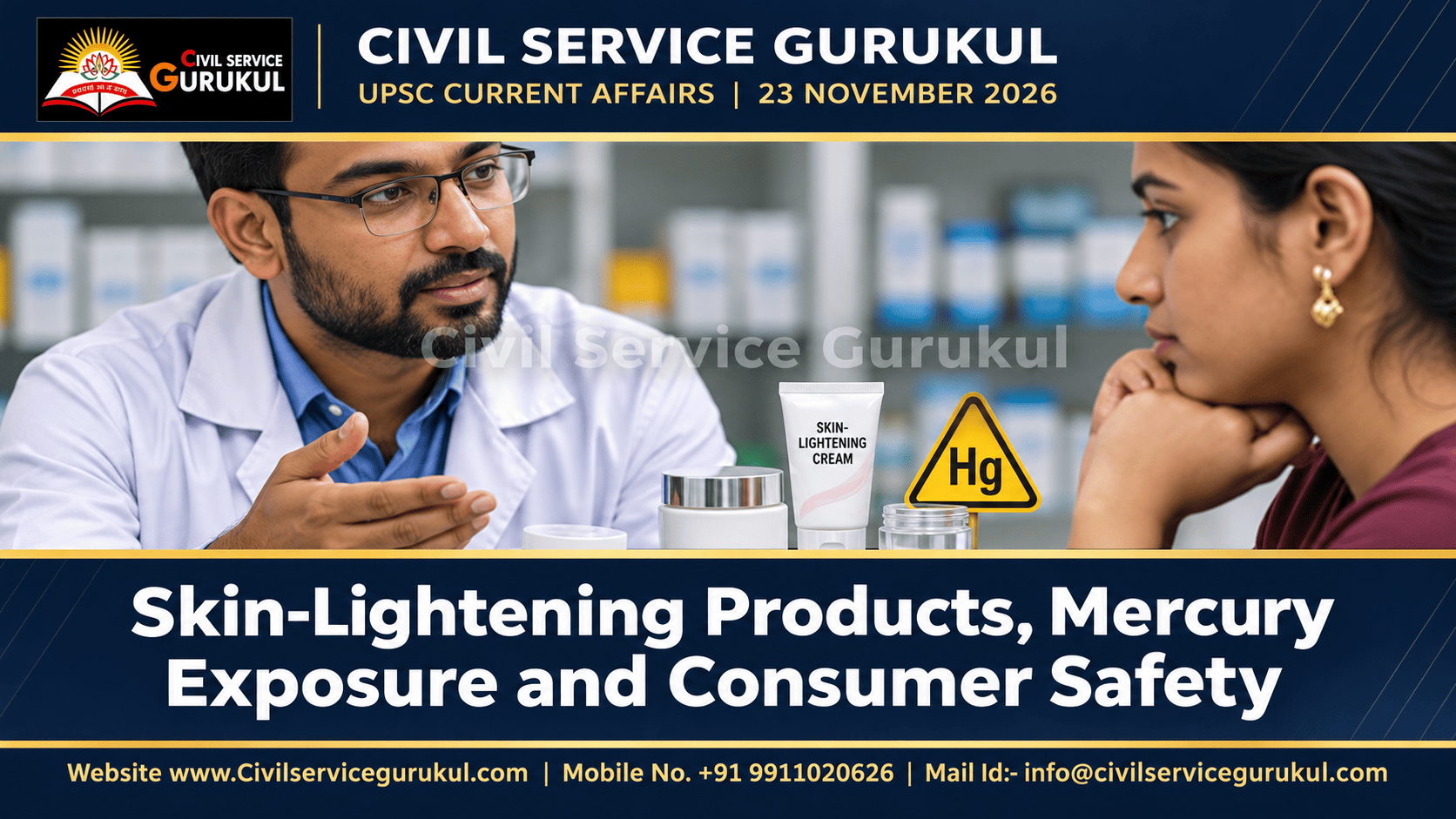
Mercury in Skin-Lightening Creams: Health Risks, India's Cosmetics Rules and the Minamata Convention
Why have mercury-contaminated skin-lightening products emerged as a major public-health concern? Explore the science of heavy-metal toxicity, India's cosmetic regulations, international mercury controls, consumer rights, social discrimination and the lessons for UPSC Civil Services Prelims and Mains.
The growing availability of skin-lightening creams through physical shops, online marketplaces and social media has raised important questions about consumer safety. While many cosmetic products are lawfully manufactured and marketed, some unregulated or contaminated products may expose consumers to hazardous substances such as mercury.
Mercury is a toxic metal capable of damaging the kidneys, nervous system and other organs, depending on the form of mercury and the nature of exposure.
This issue is especially relevant for India because the demand for skin-lightening products is also linked to social attitudes that attach unequal value to different skin tones.
For UPSC aspirants, the topic offers an important opportunity to connect scientific knowledge with public-health administration, consumer protection, environmental treaties and ethical governance.
- GS II: Public health, government policies, social justice and institutional accountability.
- GS III: Science and technology, environmental pollution and public-health risks.
- GS IV: Consumer welfare, honesty in advertising, responsibility and ethical governance.
- Essay: Social stereotypes, health literacy and the consequences of discrimination.
1. Why Is Mercury in Skin-Lightening Products in the News?
In November 2026, reports from Kerala highlighted suspected health damage associated with the use of mercury-contaminated skin-lightening cosmetics.
News reports described cases involving kidney disease and concerns about products marketed through online and informal distribution channels.
On 22 November 2026, Kerala authorities reportedly directed a wider inspection drive involving unapproved cosmetic products, their distribution networks and promotional activities.
Such developments bring attention to three interconnected public-policy issues:
- The health risks arising from unsafe consumer products.
- The ability of regulators to monitor imported, domestic and online cosmetic products.
- The impact of discriminatory beauty norms on consumer behaviour.
2. What Is Mercury? Basic Science for UPSC Prelims
Mercury is a naturally occurring chemical element with the symbol Hg and atomic number 80.
It is a heavy metal that is liquid at ordinary room temperature.
Forms of Mercury
| Form | General Characteristics | Relevance |
|---|---|---|
| Elemental Mercury | Metallic mercury, which may release toxic vapour. | Relevant to exposure through inhalation and industrial settings. |
| Inorganic Mercury Compounds | Mercury combined with other elements, forming inorganic compounds. | Some compounds have been illegally used in skin-lightening products. |
| Organic Mercury Compounds | Mercury-containing organic compounds, including methylmercury. | Methylmercury can accumulate in aquatic food chains. |
Why Is Mercury Dangerous?
Mercury can interfere with normal biological processes. Its toxic effects vary according to the chemical form, amount absorbed, exposure pathway and duration of exposure.
The World Health Organization recognises mercury as a chemical of major public-health concern.
3. Health Effects of Mercury Exposure
Mercury-containing skin products can create health risks through repeated exposure.
Not every cosmetic product contains mercury, and exposure does not produce identical symptoms in every person.
Major Health Concerns
Kidney Damage
Certain forms of mercury may injure kidney tissues and contribute to abnormal kidney function.
Nervous-System Effects
Mercury exposure may affect the nervous system, with possible effects on sensation, movement and cognitive functioning.
Skin Problems
Unsafe products may cause irritation, rashes, discolouration or other skin-related harm.
Risks to Vulnerable Groups
Developing children and pregnant individuals require particular attention in mercury exposure prevention.
What Is Membranous Nephropathy?
Recent reports have discussed a kidney condition called membranous nephropathy in connection with suspected mercury exposure.
Membranous nephropathy is a kidney disorder affecting the glomeruli, which are the small filtering structures inside the kidneys.
When these structures are damaged, protein may leak into the urine, sometimes resulting in swelling and other symptoms.
The condition has several possible causes. Determining whether a specific case is associated with mercury requires appropriate medical investigation.
4. How Do Skin-Lightening Products Affect Pigmentation?
The colour of human skin is influenced substantially by melanin, a pigment produced by specialised cells called melanocytes.
Melanin contributes to natural pigmentation and plays a protective role against ultraviolet radiation.
Why Is Mercury Used in Some Unsafe Products?
Certain mercury compounds can interfere with melanin production.
This effect has contributed to their illicit use in products marketed for skin lightening.
However, interference with pigment production does not make mercury a safe cosmetic ingredient.
5. Regulation of Cosmetics in India: Cosmetics Rules, 2020
India regulates cosmetics under the Drugs and Cosmetics Act, 1940 and the Cosmetics Rules, 2020, along with relevant standards and subsequent amendments.
The regulatory framework addresses manufacturing, import, labelling, product quality, testing and enforcement.
Mercury Limit Under Rule 39(5)
Rule 39(5) of the Cosmetics Rules, 2020 specifies mercury limits for imported and domestically manufactured cosmetic products.
| Product Category | Provision |
|---|---|
| Finished cosmetics other than specified eye-area products | Unintentional mercury must not exceed 1 part per million. |
| Cosmetics intended only for the eye area | A separate provision specifies a maximum of 70 ppm for mercury used as a preservative. |
Other Regulatory Requirements
- Applicable manufacturing and import authorisations.
- Compliance with prescribed quality and safety standards.
- Appropriate product labelling.
- Inspection and collection of samples.
- Testing through applicable laboratory procedures.
- Enforcement action for non-compliant products.
Product labels are an important consumer-information tool, but a printed label alone does not guarantee that the contents are safe.
6. Which Institutions Regulate Cosmetic Safety in India?
| Institution | Relevant Role |
|---|---|
| Central Drugs Standard Control Organisation | Central regulatory functions, including important responsibilities for imported cosmetics. |
| Drugs Controller General of India | Important central regulatory and oversight responsibilities within the drug and cosmetic regulatory system. |
| State Licensing Authorities | Domestic manufacturing licensing, inspections and relevant enforcement. |
| Bureau of Indian Standards | Development of relevant quality and technical standards. |
| Central Consumer Protection Authority | Action concerning unfair trade practices and misleading advertisements under the consumer protection framework. |
Why Regulatory Coordination Matters
Unsafe cosmetic products may pass through different channels: manufacturing units, importers, distributors, retail shops and online marketplaces.
Effective enforcement therefore requires coordination among different regulatory and administrative bodies.
A product removed from one marketplace may continue to circulate elsewhere unless supply-chain tracing and coordinated enforcement are undertaken.
7. Minamata Convention on Mercury: International Environmental Governance
The Minamata Convention on Mercury is an international environmental treaty addressing risks to human health and the environment associated with mercury pollution.
It covers various aspects of mercury management, including products, industrial processes, emissions and releases.
Important Convention Facts
- The Convention was adopted in 2013.
- It entered into force in 2017.
- India became a Party in 2018.
- Article 4 addresses mercury-added products.
- Annex A identifies product categories subject to phase-out requirements.
What About Mercury in Cosmetics?
The Convention's original Annex A approach included cosmetics containing more than 1 ppm mercury, including skin-lightening soaps and creams, subject to the specified product scope and exclusions.
At the fifth meeting of the Conference of the Parties in 2023, Parties adopted an amendment removing the 1 ppm threshold for mercury-added cosmetics.
The amendment clarifies the direction towards eliminating deliberately added mercury in cosmetics.
The COP-5 amendments entered into force on 25 April 2025 for applicable Parties, subject to the Convention's amendment acceptance rules.
Why Is the Convention Named Minamata?
The Convention is named after Minamata, Japan, where severe mercury pollution caused a major public-health and environmental disaster.
The episode became an important example of the consequences of industrial pollution and inadequate environmental safeguards.
8. Consumer Protection and Misleading Advertising
Consumer safety is not limited to whether a product is legally registered or labelled.
It also involves the quality of information available to consumers.
Consumer Protection Act, 2019
The Consumer Protection Act, 2019 establishes a framework for protecting consumers against unfair practices and other legally recognised violations.
The Central Consumer Protection Authority has powers relating to misleading advertisements and consumer interests.
Influencer and Advertising Responsibility
The Guidelines for Prevention of Misleading Advertisements and Endorsements for Misleading Advertisements, 2022 address the responsibilities of advertisers and endorsers.
Influencers and celebrities should exercise appropriate due diligence before promoting consumer products.
Claims about safety, medical effectiveness or rapid appearance changes should not be treated as trustworthy merely because they are made by popular public figures.
9. Colourism: The Social Justice and Ethics Dimension
The market for skin-lightening products cannot be understood only through consumer choice or cosmetic technology.
It must also be examined in the context of colourism.
What Is Colourism?
Colourism is discriminatory or preferential treatment based on skin shade.
It may reinforce the belief that lighter skin is more desirable or socially valuable.
Social Consequences
- Unrealistic beauty standards and reduced self-confidence.
- Discriminatory treatment in social and professional spaces.
- Marketing pressures that exploit personal insecurities.
- Increased vulnerability to exaggerated product claims.
- Unequal expectations affecting women and other social groups.
GS IV: Ethical Questions
The issue raises questions about honesty in advertising, respect for human dignity, informed consumer consent and corporate accountability.
A society committed to equality must challenge discriminatory standards while also protecting individuals from unsafe products.
10. Governance Challenges in Controlling Unsafe Cosmetics
Informal Supply Chains
Products sold through unverified distributors may be difficult to trace and inspect.
Online Marketplace Monitoring
Digital sales channels can allow products to reach consumers across administrative boundaries.
Testing and Laboratory Capacity
Effective market surveillance depends on reliable sampling and analytical facilities.
Consumer Awareness
Consumers may not recognise unsafe ingredients or misleading advertising.
Institutional Coordination
Regulators may need to coordinate across imports, manufacturing, retail and online sales.
Social Pressures
Discriminatory beauty standards can sustain demand for products promising rapid skin-lightening effects.
Regulation must therefore address both immediate product safety and the structural conditions that make consumers vulnerable to exploitation.
11. Way Forward: A Comprehensive Public-Health Response
- Risk-Based Market Surveillance: Prioritise suspicious and unregistered products for testing.
- Stronger Supply-Chain Traceability: Identify manufacturers, importers, distributors and responsible sellers.
- Digital Marketplace Accountability: Improve the response to unlawful listings and unsafe product promotion.
- Laboratory Strengthening: Expand dependable analytical capacity for detecting heavy metals.
- Consumer Education: Promote evidence-based awareness of mercury risks and safe product choices.
- Healthcare Awareness: Help professionals recognise and appropriately investigate suspected toxic exposures.
- Social Behaviour Change: Challenge colourism through education, responsible media and inclusive messaging.
- International Cooperation: Support implementation of applicable mercury-control commitments and information sharing.
- Accountability: Ensure enforcement decisions follow due process and are based on reliable evidence.
- Measurable Outcomes: Track inspections, violations identified, recalls, laboratory capacity and public awareness.
12. UPSC Prelims: Quick Revision Notes
| Concept | Exam-Ready Fact |
|---|---|
| Mercury | Hg; atomic number 80 |
| Nature | Toxic heavy metal |
| Major affected organs | Kidneys and nervous system, among others |
| Melanin | Pigment contributing to natural skin colour |
| Indian cosmetic legislation | Drugs and Cosmetics Act, 1940; Cosmetics Rules, 2020 |
| Mercury rule | Rule 39(5) of Cosmetics Rules, 2020 |
| General finished cosmetic threshold | 1 ppm for unintentional mercury, subject to the specified category distinction |
| Central cosmetic regulator | CDSCO |
| International agreement | Minamata Convention on Mercury |
| Convention adopted | 2013 |
| Entered into force | 2017 |
| India became a Party | 2018 |
| Relevant treaty provision | Article 4 and Annex A |
| Social concept | Colourism |
Five Common UPSC MCQ Traps
- Trap 1: Assuming all cosmetics contain mercury.
- Trap 2: Confusing the 1 ppm unintentional-mercury limit with permission to deliberately add mercury to skin creams.
- Trap 3: Treating a newspaper allegation as a final laboratory or regulatory finding.
- Trap 4: Confusing Minamata with the Stockholm, Basel or Rotterdam Conventions.
- Trap 5: Assuming product labelling alone guarantees safety.
13. Original UPSC Prelims MCQs with Answer Reveal
MCQ 1. Consider the following statements about mercury:
1. Mercury has the chemical symbol Hg.
2. Mercury has atomic number 80.
3. Mercury exposure can affect kidney function.
Reveal Answer and Explanation
Correct Answer: D
All three statements are correct. Mercury is Hg, has atomic number 80 and can cause kidney damage depending on the exposure.
MCQ 2. With reference to India's Cosmetics Rules, 2020, consider:
1. Rule 39(5) deals with mercury limits for cosmetic products.
2. The general limit for unintentional mercury in finished cosmetics other than specified eye-area products is 1 ppm.
3. The rule permits deliberate addition of mercury to all skin-lightening creams.
Reveal Answer and Explanation
Correct Answer: A
Statements 1 and 2 are correct. Statement 3 is incorrect because a limit for unintentional mercury does not constitute blanket permission to deliberately add mercury to skin-lightening products.
MCQ 3. The Minamata Convention primarily concerns:
Reveal Answer and Explanation
Correct Answer: C
The Minamata Convention is an international environmental agreement addressing mercury.
Stockholm concerns Persistent Organic Pollutants, Basel concerns hazardous wastes, and CITES concerns international trade in endangered species.
MCQ 4. Consider the following institutions:
1. CDSCO
2. State Licensing Authorities
3. Central Consumer Protection Authority
Which of the above may have relevant roles in addressing unsafe cosmetics or misleading cosmetic advertising?
Reveal Answer and Explanation
Correct Answer: D
All three institutions have relevant but distinct roles.
CDSCO performs central regulatory functions, state authorities address domestic licensing and enforcement, and CCPA addresses relevant misleading advertisements and consumer-protection issues.
MCQ 5. Which statement best describes colourism?
Reveal Answer and Explanation
Correct Answer: B
Colourism refers to unequal social treatment or preference based on skin tone.
It is relevant to discussions of discrimination, marketing practices and human dignity.
14. UPSC Mains Questions and Model Answer Approach
Question 1: "Unsafe skin-lightening products are not merely a consumer issue but a public-health and governance challenge." Critically examine.
Suggested Answer Framework
- Introduction: Link recent developments with mercury toxicity.
- Public health: Explain kidney, neurological and skin-related risks.
- Governance: Discuss quality control, testing, enforcement and online marketplaces.
- Social dimension: Explain colourism and misleading advertising.
- Way forward: Propose coordinated regulation, consumer literacy and public-health surveillance.
Illustrative Model Answer
The availability of unsafe skin-lightening products demonstrates how consumer markets can generate significant public-health and governance risks. Mercury-containing cosmetics are particularly concerning because exposure can damage the kidneys and nervous system.
Public-health dimension: Repeated exposure to unsafe products may cause serious harm. The problem also raises questions about consumer awareness, early diagnosis and the availability of reliable information.
Governance dimension: India regulates cosmetics through the Drugs and Cosmetics Act, 1940, and the Cosmetics Rules, 2020. However, effective protection requires product testing, inspection, import controls and coordination among regulatory authorities. Online marketplaces and informal distribution networks can complicate enforcement and traceability.
Social dimension: Colourism and misleading beauty claims can create unhealthy demand for rapid skin-lightening products. This connects cosmetic safety with gender sensitivity, human dignity and social equality.
Way forward: India should strengthen risk-based product surveillance, laboratory capacity, supply-chain monitoring and consumer grievance mechanisms. Responsible advertising, health literacy and inclusive beauty messaging are equally important.
Conclusion: A sustainable solution must combine scientific regulation, institutional accountability and social transformation, rather than relying solely on action against individual products.
Question 2: Examine the ethical responsibilities of manufacturers, advertisers and social media influencers in the marketing of skin-lightening products.
Answer-Writing Points
- Truthfulness in product claims.
- Transparency about commercial endorsements.
- Duty to avoid promoting unsafe products.
- Respect for consumer autonomy and informed choice.
- Protection of vulnerable consumers.
- Rejection of discriminatory beauty stereotypes.
- Accountability for misleading representations.
Suggested Conclusion
Ethical marketing should not exploit social insecurity or conceal health risks. Manufacturers, advertisers and influencers must place consumer well-being, transparency and human dignity above commercial gain.
15. Final Revision: Ten Key Takeaways
- Mercury is a toxic heavy metal with chemical symbol Hg.
- Mercury has atomic number 80.
- Certain mercury compounds can affect kidney and nervous-system function.
- Melanin contributes to natural skin pigmentation.
- India regulates cosmetics through the Drugs and Cosmetics Act and Cosmetics Rules.
- Rule 39(5) specifies mercury limits for cosmetic products.
- The general unintentional mercury limit for ordinary finished cosmetics is 1 ppm.
- The Minamata Convention addresses mercury pollution and related health and environmental risks.
- CDSCO, state regulators and consumer-protection authorities have distinct responsibilities.
- Colourism, misleading advertising and weak enforcement are important governance and ethical dimensions.
Frequently Asked Questions (FAQs)
1. Why is mercury in skin-lightening creams important for UPSC?
It connects health, science, consumer safety, environmental governance, social justice and ethics, making it relevant to Prelims and multiple Mains papers.
2. Why are mercury-containing creams dangerous?
Mercury exposure may damage the kidneys, nervous system and skin. The risk depends on the mercury compound, concentration and nature of exposure.
3. What is the Indian mercury limit for most finished cosmetics?
Rule 39(5) of the Cosmetics Rules, 2020 provides a 1 ppm limit for unintentional mercury in finished cosmetics other than specified eye-area products.
4. Which institution handles cosmetic import regulation in India?
CDSCO performs important central regulatory functions for imported cosmetics under the applicable framework.
5. What does the Minamata Convention address?
It is an international environmental treaty addressing risks associated with mercury and mercury compounds.
6. What is the connection between mercury and kidney disease?
Certain types of mercury exposure can damage kidney tissues. A specific clinical diagnosis requires qualified medical evaluation.
7. What is colourism?
Colourism refers to unequal treatment or preference based on skin tone, often contributing to discriminatory beauty standards.
8. Which GS Mains papers cover this issue?
GS II addresses public health and governance, GS III covers environment and science, and GS IV addresses ethical responsibility and social values.
9. Are all skin-lightening products unsafe?
No. Product safety depends on ingredients, quality, regulatory compliance and use. It is incorrect to assume that all cosmetics contain mercury.
10. What is the most important governance lesson?
Effective consumer protection requires scientific testing, traceable supply chains, reliable advertising and public-health awareness alongside appropriate enforcement.
UPSC Current Affairs Keywords and Related Topics
Prepare Current Affairs with a UPSC-Oriented Approach
Civil Service Gurukul helps aspirants connect important national and international developments with the UPSC syllabus.
Our learning approach emphasises conceptual clarity, verified facts, Prelims practice, Mains answer writing, analytical thinking and systematic revision.
Build your Civil Services preparation with subject-wise current affairs, examination-focused notes and structured test practice.
Explore Civil Service Gurukul Contact Our TeamMobile: +91 9911020626
Prepare with Mentors Who Cleared the Exam
Get personalized study plans, evaluated answer models, and test series access.