
IMO Net-Zero Framework 2026: UPSC Analysis
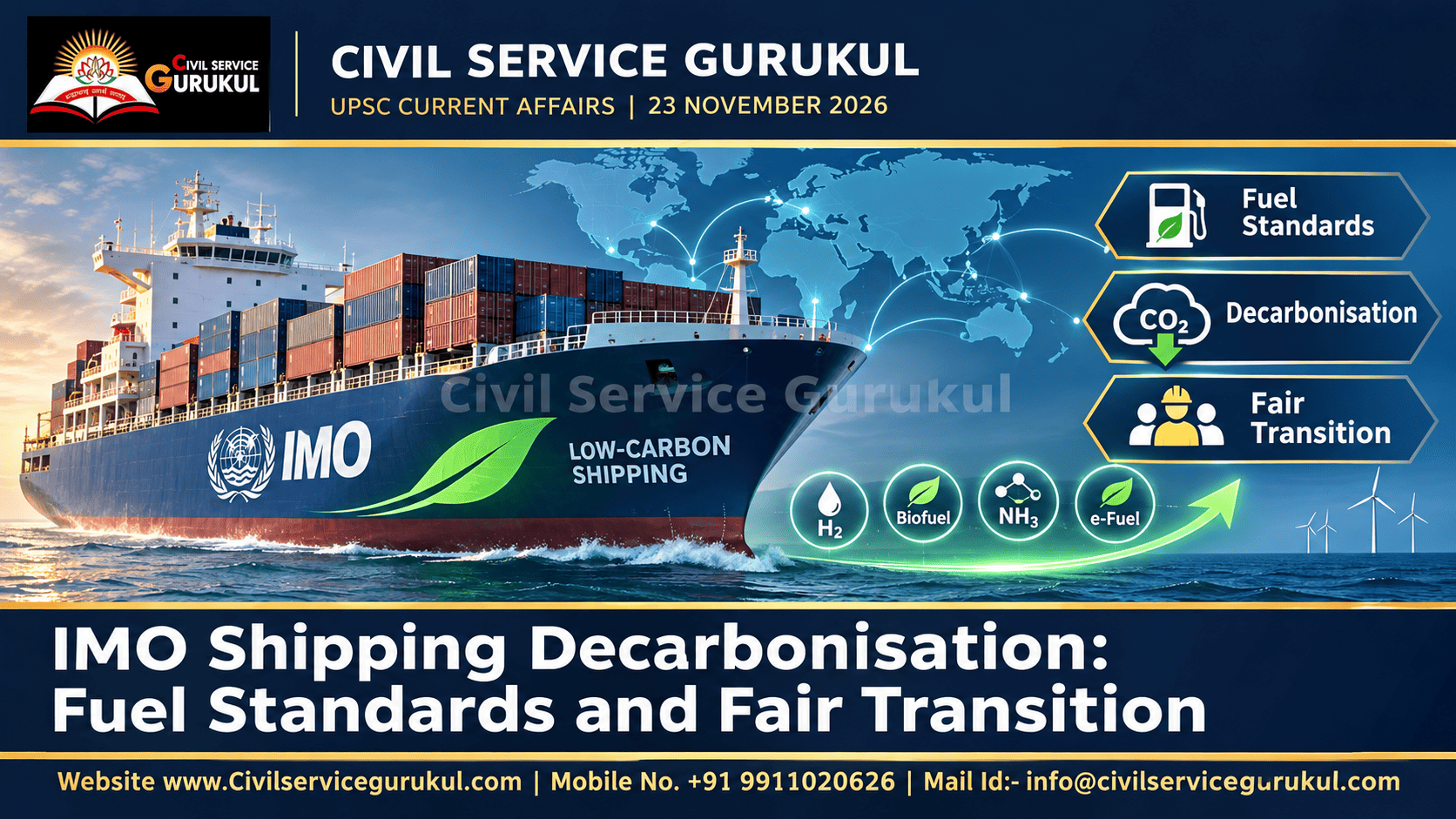
IMO Net-Zero Shipping Framework 2026: Global Fuel Standards, Carbon Pricing and India's Just Transition Challenge
Can global shipping move towards net-zero greenhouse-gas emissions without creating an unfair burden on developing economies? The International Maritime Organization is negotiating new regulations combining cleaner marine fuel requirements with emissions pricing. Understand the latest negotiations, India's interests, sustainable fuel technologies and the key issues for UPSC Civil Services Prelims and Mains.
International shipping is a vital part of global commerce, moving goods between producers, manufacturers and consumers across national boundaries. However, most large commercial vessels continue to depend on fossil-based marine fuels, creating greenhouse-gas emissions that contribute to climate change.
Reducing these emissions requires international cooperation because ships may be registered in one country, owned in another, fuelled elsewhere and operate between several ports.
The International Maritime Organization (IMO) is therefore working towards a global regulatory framework for shipping decarbonisation.
The proposed IMO Net-Zero Framework combines a marine fuel greenhouse-gas intensity standard with an emissions-pricing mechanism.
The important policy question is how these measures can accelerate the energy transition while protecting developing countries from disproportionate economic burdens.
- GS II: Important international institutions, agreements and their effect on India's interests.
- GS III: Environment, climate change, economic development, infrastructure and energy security.
- GS IV: Climate justice, intergenerational equity, public accountability and responsible governance.
- Essay: Sustainable development, international cooperation and a just energy transition.
- Prelims: IMO, MARPOL, MEPC, emissions intensity, alternative fuels and climate targets.
1. Why Is IMO Shipping Decarbonisation in the News?
The IMO's Marine Environment Protection Committee approved draft net-zero shipping regulations during its 83rd session, held from 7 to 11 April 2025.
These draft regulations were intended to be included in MARPOL Annex VI, creating international requirements for reducing greenhouse-gas emissions from applicable ships.
However, formal adoption was not completed during the extraordinary MEPC session in October 2025.
The committee agreed to adjourn the meeting for one year.
Throughout 2026, countries continued negotiating the unresolved regulatory, technical and economic issues.
Important November 2026 Meetings
| Meeting | Date | Purpose / Status |
|---|---|---|
| ISWG-GHG 22 | 1–4 September 2026 | Discussed outstanding concerns with the draft framework. |
| ISWG-GHG 23 | 23–27 November 2026 | Scheduled technical and policy negotiations on remaining issues. |
| MEPC 85 | 30 November–3 December 2026 | Scheduled committee review and consideration of negotiation outcomes. |
| Possible resumed extraordinary session | 4 December 2026 | Subject to confirmation by MEPC 85. |
Why Does This Matter for UPSC?
- It highlights international climate governance.
- It raises questions about global carbon pricing.
- It affects shipping, trade and logistics costs.
- It connects climate goals with developing-country interests.
- It requires new energy infrastructure and technologies.
- It demonstrates the difference between negotiations and binding rules.
2. What Is the International Maritime Organization?
The International Maritime Organization (IMO) is a specialised agency of the United Nations responsible for international shipping regulation.
Its work includes maritime safety, security, prevention of pollution from ships and the improvement of international maritime practices.
Important Facts
| Particular | Information |
|---|---|
| Full form | International Maritime Organization |
| Organisation type | United Nations specialised agency |
| Headquarters | London, United Kingdom |
| Founding convention adopted | 1948 |
| Convention entered into force | 1958 |
| First IMO assembly meeting | 1959 |
| Original name | Inter-Governmental Maritime Consultative Organization |
| Name changed to IMO | 1982 |
| Relevant environmental committee | Marine Environment Protection Committee |
Why Is International Coordination Necessary?
Ships operate across maritime jurisdictions and international trade routes.
Different national fuel rules could create inconsistent requirements and operational difficulties.
A global framework may encourage more consistent standards while reducing the risk of fragmented regulation.
3. MARPOL Annex VI and the Marine Environment Protection Committee
MARPOL is the International Convention for the Prevention of Pollution from Ships.
It is one of the main international conventions addressing pollution associated with shipping.
What Does Annex VI Cover?
MARPOL Annex VI primarily concerns air pollution from ships.
It includes requirements relating to emissions, fuel quality and energy efficiency.
The proposed IMO Net-Zero Framework was developed as draft amendments to Annex VI.
Important MARPOL Annexes
| Annex | Main Subject |
|---|---|
| Annex I | Prevention of pollution by oil |
| Annex II | Noxious liquid substances carried in bulk |
| Annex III | Harmful substances carried in packaged form |
| Annex IV | Sewage from ships |
| Annex V | Garbage from ships |
| Annex VI | Air pollution from ships |
What Is MEPC?
The Marine Environment Protection Committee is an IMO committee responsible for environmental issues connected with international maritime activity.
It considers matters such as ship pollution, energy efficiency, greenhouse-gas emissions and related regulatory measures.
4. IMO's 2023 Greenhouse Gas Strategy: Targets for 2030, 2040 and 2050
In July 2023, the IMO adopted its revised strategy for reducing greenhouse-gas emissions from international shipping.
The strategy introduced a strengthened ambition to achieve net-zero emissions by or around 2050, taking different national circumstances into account.
| Year / Indicator | IMO Strategy Ambition |
|---|---|
| 2030: Total GHG emissions | Reduce by at least 20%, striving for 30%, compared with 2008. |
| 2030: Carbon intensity | Reduce carbon intensity of international shipping by at least 40%, compared with 2008. |
| 2030: Cleaner energy uptake | Zero or near-zero GHG technologies, fuels and energy sources to account for at least 5%, striving for 10%, of international shipping energy use. |
| 2040: Total GHG emissions | Reduce by at least 70%, striving for 80%, compared with 2008. |
| 2050 | Reach net-zero GHG emissions by or around 2050. |
Total Emissions vs Carbon Intensity
These are different measures.
Total emissions represent the overall greenhouse gases produced.
Carbon intensity relates emissions to an appropriate measure of shipping activity or transport work.
A ship or fleet may become more efficient per unit of transport while total emissions change differently because of growth in shipping activity.
5. What Is the Proposed IMO Net-Zero Framework?
The IMO Net-Zero Framework is a proposed package of regulations intended to encourage lower greenhouse-gas emissions from ships.
Its central design contains two complementary policy elements.
Technical Element: Global Marine Fuel Standard
A goal-based standard would progressively reduce the greenhouse-gas intensity of marine energy used by applicable vessels.
Economic Element: GHG Emissions Pricing
A pricing mechanism would create financial incentives to reduce emissions and support the transition towards lower-emission fuels.
Which Ships Would Be Covered?
The draft framework was designed to apply to oceangoing ships above 5,000 gross tonnage, subject to the detailed scope of the proposed rules.
The IMO states that this ship category accounts for more than 85% of global shipping greenhouse-gas emissions.
However, this threshold should not be confused with a measure of the ship's cargo weight.
Gross Tonnage vs Deadweight Tonnage
| Term | Meaning |
|---|---|
| Gross Tonnage (GT) | A dimensionless measure derived from a ship's enclosed internal volume. |
| Deadweight Tonnage (DWT) | The carrying capacity of a ship by weight, including cargo, fuel and other loads. |
6. Global Marine Fuel Standard: How Would It Work?
The proposed fuel standard aims to reduce the greenhouse-gas intensity of marine fuels over time.
It encourages ships and fuel suppliers to move towards lower-emission energy sources and improved operational practices.
Illustrative Compliance Process
Record the marine energy consumed during the relevant period.
Determine the lifecycle GHG intensity of the energy used.
Compare performance against the applicable fuel-intensity requirements.
Apply the relevant compliance or economic mechanism under the final rules.
Why Might a Fuel Standard Matter?
- It can create demand for cleaner marine fuels.
- It encourages investment in alternative energy systems.
- It may influence ship-design and procurement decisions.
- It can create incentives for fuel innovation.
- It requires credible emissions accounting.
The final design, compliance pathways, thresholds and implementation dates depend on the outcome of international negotiations.
7. What Is the Proposed Global GHG Emissions-Pricing Mechanism?
A greenhouse-gas emissions-pricing mechanism creates a financial cost associated with emissions or emissions-intensity performance.
The proposed IMO approach would complement the fuel standard and provide incentives to reduce emissions from international shipping.
Why Combine Standards and Pricing?
A technical standard sets performance requirements.
An economic mechanism affects the financial incentives associated with different compliance choices.
Together, they may encourage shipping companies to invest in cleaner fuels, operational efficiency and new technologies.
Proposed IMO Net-Zero Fund
The draft framework also envisages an international IMO Net-Zero Fund.
Under the proposed arrangements, revenues could support eligible low-emission technologies, fuels and transition-related initiatives.
The possible use of funds and the treatment of developing countries remain important matters for negotiation.
8. Well-to-Wake Emissions: Why Lifecycle Accounting Matters
A critical technical question is how to measure the actual climate impact of different marine fuels.
A fuel may appear relatively clean when burned aboard a ship, yet produce substantial greenhouse-gas emissions during its production or transportation.
Three Important Concepts
| Concept | Meaning |
|---|---|
| Well-to-Tank | Emissions associated with fuel production, processing and supply before use aboard the ship. |
| Tank-to-Wake | Emissions associated with use of the fuel aboard the vessel. |
| Well-to-Wake | Combined lifecycle emissions covering the upstream supply chain and fuel use. |
Illustrative Example
Consider two ships using fuels with similar emissions during operation.
If one fuel requires emissions-intensive production while the other is produced using genuinely low-emission processes, their full lifecycle impacts may differ.
Well-to-wake accounting seeks to identify such differences.
What Is Methane Slip?
Methane slip occurs when unburned methane escapes during the operation of certain gas-fuelled engines or related systems.
It is important because methane is a powerful greenhouse gas.
Thus, evaluating LNG as a marine fuel requires consideration of upstream emissions and methane slip, rather than focusing only on carbon dioxide from combustion.
9. Alternative Marine Fuels: Opportunities and Limitations
No single alternative fuel is guaranteed to meet every shipping requirement.
The relative merits depend on how fuels are produced, transported, stored and used.
| Fuel / Technology | Potential Opportunity | Key Challenge |
|---|---|---|
| Green Ammonia | Potential low lifecycle GHG emissions when produced using low-emission pathways. | Toxicity, safe handling, fuel infrastructure and other environmental concerns. |
| Green Methanol | Potentially lower lifecycle emissions, depending on feedstock and production method. | Sustainable production, fuel availability and supply-chain verification. |
| Green Hydrogen | Potential low-emission energy carrier when produced using renewable electricity. | Storage, transport, energy density and infrastructure requirements. |
| Liquefied Natural Gas | Can reduce some air pollutants compared with conventional fuels in certain applications. | Fossil-carbon emissions, upstream methane leakage and methane slip. |
| Sustainable Biofuels | Potential reduction in lifecycle emissions under suitable production conditions. | Feedstock availability, land-use impacts and sustainability certification. |
| Wind-Assisted Propulsion | Can reduce energy demand in appropriate vessel and route conditions. | Vessel compatibility, weather variability and installation costs. |
| Energy Efficiency Technologies | Can reduce fuel use through improvements in ship operations and design. | Initial investment, operational constraints and varying savings. |
10. Why Is a Just Transition Important for Developing Economies?
Shipping decarbonisation can produce important long-term environmental benefits.
However, the costs of switching to cleaner fuels and new infrastructure may not be distributed equally among countries.
Who May Face Greater Challenges?
Small Island Developing States
Countries heavily dependent on maritime imports may be sensitive to higher shipping and fuel costs.
Least Developed Countries
Limited financial and infrastructure capacity can make transition investments difficult.
Trade-Dependent Economies
Higher freight costs may affect exports, imports and supply-chain competitiveness.
Smaller Maritime Operators
Access to finance and cleaner fuels may differ from that of larger operators.
What Does a Just Transition Require?
- Equitable finance: Support for countries with limited resources.
- Technology access: Training, knowledge-sharing and appropriate technology transfer.
- Infrastructure development: Investment in safer low-emission fuel supply chains.
- Impact assessment: Evaluation of changes in freight costs, food security and trade competitiveness.
- Fair participation: Meaningful involvement of developing countries in international rule-making.
- Transition support: Measures to assist workers, ports and affected communities.
11. India's Role in IMO Shipping Climate Negotiations
India is a major maritime trading nation, with significant interests in ports, shipping, shipbuilding, energy and logistics.
Developments in international shipping regulations can affect Indian importers, exporters, ship operators and port infrastructure.
India's Engagement in 2026
India participated in the IMO's 22nd Intersessional Working Group on Greenhouse Gas Emissions from Ships, held on 1–4 September 2026.
India's Directorate General of Shipping reaffirmed support for a practical, inclusive and equitable pathway towards maritime decarbonisation.
Important Interests for India
Trade Competitiveness
India must consider how changing shipping costs influence the competitiveness of international trade.
Energy Security
Cleaner marine fuels may create opportunities to diversify energy sources and supply chains.
Green Ports
Ports may need new storage, bunkering, safety and energy infrastructure.
Industrial Development
Alternative fuels, ship technologies and maritime services could support new industries.
India's Maritime Decarbonisation Opportunities
India has been exploring cleaner maritime fuel infrastructure and green shipping initiatives.
A recent IMO-supported study has considered how India could develop alternative marine fuel bunkering capabilities.
Its phased approach envisages developing initial competitive bunkering facilities, expanding fuel options and strengthening green maritime corridors over time.
These are planning and investment opportunities, not proof that every proposed facility is already operational.
12. What Are Green Shipping Corridors?
A green shipping corridor generally refers to a maritime route where relevant stakeholders cooperate to support lower-emission or zero-emission shipping operations.
These initiatives may involve ports, shipping operators, fuel producers, regulators and other stakeholders.
Potential Components
- Alternative fuel availability at participating ports.
- Appropriate fuel storage and handling facilities.
- Low-emission vessels and related technologies.
- Safety and technical standards.
- Reliable emissions measurement.
- Coordination between maritime stakeholders.
Why Are Corridors Useful?
Shipping companies may be reluctant to invest in cleaner-fuel vessels without dependable fuel availability.
Similarly, fuel suppliers may hesitate to build infrastructure before demand becomes visible.
Coordinated corridors can help address this investment coordination problem.
13. Major Challenges in Global Shipping Decarbonisation
Fuel Availability
Production capacity for alternative marine fuels must grow to meet shipping demand.
High Initial Investment
Vessels, engines, storage facilities and port infrastructure may require substantial capital.
Safety Standards
Some alternative fuels create important handling, toxicity and operational safety considerations.
Lifecycle Verification
Emissions accounting depends on reliable data and credible fuel certification.
International Disagreement
Countries differ in energy resources, trade structures, economic interests and regulatory preferences.
Equity and Affordability
The cost burden may be particularly significant for vulnerable and trade-dependent economies.
The Risk of Carbon Leakage
Carbon leakage can arise when emissions-intensive activity shifts rather than truly declines because of differences in regulatory requirements.
Coordinated maritime standards may help reduce inconsistent incentives across international routes, though the actual outcome depends on policy design.
14. Way Forward: Making Maritime Decarbonisation Effective and Equitable
- Complete Transparent Negotiations: Seek broad agreement on technically sound international measures.
- Use Credible Lifecycle Accounting: Measure upstream and operational GHG emissions consistently.
- Support Developing Countries: Design appropriate financial and technical assistance.
- Expand Alternative Fuel Infrastructure: Develop safe and commercially viable bunkering systems.
- Encourage Technology Innovation: Invest in cleaner vessels, engines and efficiency solutions.
- Protect Food Security and Trade Access: Evaluate effects on freight-dependent and vulnerable economies.
- Develop Green Corridors: Promote coordinated port-to-port decarbonisation initiatives.
- Strengthen Data Quality: Establish transparent monitoring, reporting and verification systems.
- Promote Capacity Building: Train seafarers, port operators and fuel-handling professionals.
- Measure Real Outcomes: Evaluate total GHG reductions, not only compliance paperwork or announced targets.
15. UPSC Prelims 2027: Quick Revision Table
| Concept | Exam-Ready Fact |
|---|---|
| IMO | International Maritime Organization |
| IMO headquarters | London, United Kingdom |
| IMO status | UN specialised agency |
| MEPC | Marine Environment Protection Committee |
| MARPOL | International Convention for the Prevention of Pollution from Ships |
| MARPOL Annex VI | Air pollution from ships |
| 2023 IMO Strategy | Net-zero GHG emissions by or around 2050 |
| 2030 total GHG checkpoint | At least 20%, striving for 30%, below 2008 |
| 2040 total GHG checkpoint | At least 70%, striving for 80%, below 2008 |
| 2030 carbon-intensity ambition | At least 40% below 2008 |
| 2030 cleaner-energy ambition | At least 5%, striving for 10%, of international shipping energy |
| Net-Zero Framework draft approved | MEPC 83, April 2025 |
| Adoption postponed | October 2025 |
| Status as of 23 November 2026 | Formal adoption remained pending |
| ISWG-GHG 23 | 23–27 November 2026 |
| MEPC 85 | 30 November–3 December 2026 |
| Well-to-Wake | Well-to-Tank plus Tank-to-Wake emissions |
| Draft framework elements | Marine fuel standard and GHG pricing mechanism |
| Draft applicability | Oceangoing ships over 5,000 GT, subject to detailed scope |
| Just transition | Equitable distribution of costs, opportunities and assistance |
Six Important UPSC MCQ Traps
- Trap 1: Draft framework approved means treaty amendments already entered into force. Incorrect.
- Trap 2: MARPOL Annex VI concerns only oil pollution. Incorrect.
- Trap 3: Gross tonnage is the weight of cargo carried. Incorrect.
- Trap 4: Tank-to-wake and well-to-wake emissions are identical. Incorrect.
- Trap 5: All alternative fuels automatically produce zero lifecycle emissions. Incorrect.
- Trap 6: The IMO's 2030 carbon-intensity target is the same as its total-emissions checkpoint. Incorrect.
16. Original UPSC Prelims MCQs with Answer Reveal
MCQ 1. The International Maritime Organization is principally concerned with:
Reveal Correct Answer and Explanation
Correct Answer: B
The IMO is a United Nations specialised agency responsible for international shipping regulation.
The other options describe subject areas associated with different institutions.
MCQ 2. Consider the following statements about the IMO Net-Zero Framework:
1. Its draft legal text was approved in April 2025.
2. It combines a proposed marine fuel standard and GHG emissions-pricing mechanism.
3. Its formal adoption had already been completed by 23 November 2026.
Reveal Correct Answer and Explanation
Correct Answer: A
Statements 1 and 2 are correct.
Statement 3 is incorrect because formal adoption had not been completed as of the stated date.
Negotiations continued in November 2026.
MCQ 3. MARPOL Annex VI is mainly associated with:
Reveal Correct Answer and Explanation
Correct Answer: C
MARPOL Annex VI addresses air pollution from ships.
Sewage is addressed under Annex IV, while garbage is addressed under Annex V.
MCQ 4. With reference to the 2023 IMO GHG Strategy, consider:
1. It aims for net-zero GHG emissions from international shipping by or around 2050.
2. It includes an indicative 2040 checkpoint of at least 70% GHG reduction, striving for 80%, compared with 2008.
3. It aims for at least 40% reduction in carbon intensity by 2030 compared with 2008.
Reveal Correct Answer and Explanation
Correct Answer: D
All three statements are correct.
Remember that the carbon-intensity ambition and the total GHG emission checkpoints measure different outcomes.
MCQ 5. What does well-to-wake accounting include?
Reveal Correct Answer and Explanation
Correct Answer: C
Well-to-wake accounting combines the upstream fuel lifecycle with emissions associated with its use aboard the ship.
It is broader than tank-to-wake accounting.
MCQ 6. Consider the following statements about alternative marine fuels:
1. Green ammonia may create safety challenges related to toxicity.
2. LNG can have lifecycle greenhouse-gas impacts associated with methane leakage.
3. All fuels labelled green necessarily have zero lifecycle emissions.
Reveal Correct Answer and Explanation
Correct Answer: A
Statements 1 and 2 are correct.
Statement 3 is incorrect. The environmental benefit of alternative fuels depends on production, transport, use and other lifecycle factors.
MCQ 7. Which of the following may be important considerations in a just transition for global shipping?
1. Financial support for vulnerable developing countries.
2. Access to low-emission marine technologies.
3. Potential effects of shipping costs on food security and trade.
4. Participation of affected countries in rule-making.
Reveal Correct Answer and Explanation
Correct Answer: D
All four considerations are relevant to a fair maritime energy transition.
Environmental policy must consider economic and social consequences alongside emissions reduction.
MCQ 8. With reference to gross tonnage and deadweight tonnage, which statement is correct?
Reveal Correct Answer and Explanation
Correct Answer: C
Gross tonnage is derived from the ship's enclosed volume and is dimensionless.
Deadweight tonnage relates to how much weight a ship can carry.
They must not be confused.
17. UPSC Mains Questions and Model Answers
Question 1: "Decarbonisation of international shipping cannot succeed without global cooperation and an equitable energy transition." Critically examine with reference to the IMO Net-Zero Framework.
Suggested Answer Structure
- Introduce shipping's international character.
- Explain the IMO Net-Zero Framework.
- Discuss fuel standards and pricing.
- Analyse technological and economic obstacles.
- Explain equity concerns for developing economies.
- Conclude with feasible policy reforms.
Illustrative Model Answer
International shipping supports global trade but also produces greenhouse-gas emissions that contribute to climate change. Its transnational character makes coordinated regulation essential.
The IMO's 2023 Greenhouse Gas Strategy aims for net-zero shipping emissions by or around 2050. The proposed Net-Zero Framework combines a global marine fuel-intensity standard with an emissions-pricing mechanism.
Benefits: These measures can encourage cleaner fuel adoption, technological innovation and investment in low-emission shipping. A common global framework may also reduce regulatory fragmentation.
Challenges: Clean-fuel production remains limited, new vessels and port infrastructure require significant investment, and lifecycle emissions must be measured reliably.
Equity concerns: Higher shipping costs may disproportionately affect developing countries, small island states and economies dependent on imported essentials. Limited financial capacity may also slow their transition.
Way forward: International rules should promote credible emissions measurement, technology cooperation, capacity building, transition finance and fair participation in decision-making.
Conclusion: Maritime decarbonisation must reconcile environmental ambition with economic equity. A just transition will strengthen both the legitimacy and effectiveness of global climate governance.
Question 2: Explain the importance of lifecycle greenhouse-gas accounting in evaluating alternative marine fuels.
Illustrative Model Answer
Lifecycle greenhouse-gas accounting measures emissions associated with a fuel across production, transport and final use.
In shipping, this is commonly described as well-to-wake accounting.
It combines well-to-tank emissions, arising before the fuel is used aboard a ship, with tank-to-wake emissions associated with its onboard use.
This approach is important because a fuel with relatively low shipboard emissions may still generate substantial emissions during production or transportation.
For example, LNG requires evaluation of methane leakage, while hydrogen, ammonia and methanol must be assessed according to their production pathways.
Credible lifecycle accounting supports fair fuel comparison, reduces misleading environmental claims and improves the effectiveness of shipping climate policy.
Therefore, international standards should be supported by reliable data, transparent methodologies and independent verification.
Question 3: "Climate justice requires that the costs of environmental transition should not fall disproportionately on vulnerable nations." Discuss in the context of global shipping.
Answer-Writing Points
- Equity and distributive justice.
- Intergenerational responsibility.
- Protection of vulnerable economies.
- Meaningful international participation.
- Transparency in climate finance.
- Technology access and capacity building.
- Shared responsibility and accountable governance.
Suggested Conclusion
Climate justice does not require abandoning environmental ambition.
It requires designing the transition so that vulnerable nations have a fair opportunity to participate and adapt.
Equitable financing, technology cooperation and transparent international institutions can help reconcile climate protection with human development.
18. Final Revision: Ten Key Takeaways
- IMO is a UN specialised agency headquartered in London.
- MARPOL Annex VI concerns air pollution from ships.
- The IMO's 2023 GHG Strategy aims for net-zero international shipping by or around 2050.
- The 2030 total-emissions checkpoint is at least 20% reduction, striving for 30%, compared with 2008.
- The 2040 checkpoint is at least 70% reduction, striving for 80%.
- The proposed framework combines a marine fuel standard with GHG pricing.
- Draft regulations were approved in April 2025.
- Formal adoption remained pending on 23 November 2026.
- Well-to-wake accounting covers upstream and onboard fuel emissions.
- A just transition requires consideration of developing-country costs and capabilities.
Frequently Asked Questions (FAQs)
1. What is the IMO Net-Zero Framework?
It is a proposed international regulatory framework combining a marine fuel GHG-intensity standard with an emissions-pricing mechanism.
2. Was the framework formally adopted by 23 November 2026?
No. The draft was approved in April 2025, but formal adoption was postponed and remained pending as of 23 November 2026.
3. What is the IMO's net-zero target?
The 2023 IMO GHG Strategy aims to achieve net-zero GHG emissions from international shipping by or around 2050.
4. What is MARPOL Annex VI?
It is the annex of MARPOL addressing air pollution from ships, including applicable energy-efficiency requirements.
5. What is the Marine Environment Protection Committee?
MEPC is an IMO committee responsible for environmental matters relating to international shipping.
6. What does well-to-wake mean?
It includes GHG emissions associated with the production and supply of fuel and its use onboard a ship.
7. Why is shipping carbon pricing controversial?
Countries differ over implementation costs, revenue distribution, fuel availability, trade effects and the needs of developing economies.
8. What is a green shipping corridor?
It is a coordinated maritime route initiative intended to support lower-emission shipping operations and relevant fuel infrastructure.
9. Why is the framework important for India?
It may affect India's shipping sector, ports, international trade, fuel infrastructure, energy security and climate diplomacy.
10. Which UPSC papers cover shipping decarbonisation?
The issue is relevant to GS II, GS III, GS IV, Essay and Prelims.
Related UPSC Environment and International Relations Topics
Master International Relations and Environment for UPSC 2027
Civil Service Gurukul helps aspirants connect important global environmental and economic developments with the UPSC Civil Services Examination syllabus.
Our learning approach emphasises factual accuracy, conceptual clarity, UPSC Prelims MCQs, Mains answer writing, analytical understanding and systematic revision.
Strengthen your UPSC preparation through current-affairs analysis, structured notes and subject-wise test practice.
Explore Civil Service Gurukul Contact Our TeamMobile: +91 9911020626
Prepare with Mentors Who Cleared the Exam
Get personalized study plans, evaluated answer models, and test series access.