
GEODE Autism Research 2026: UPSC Current Affairs
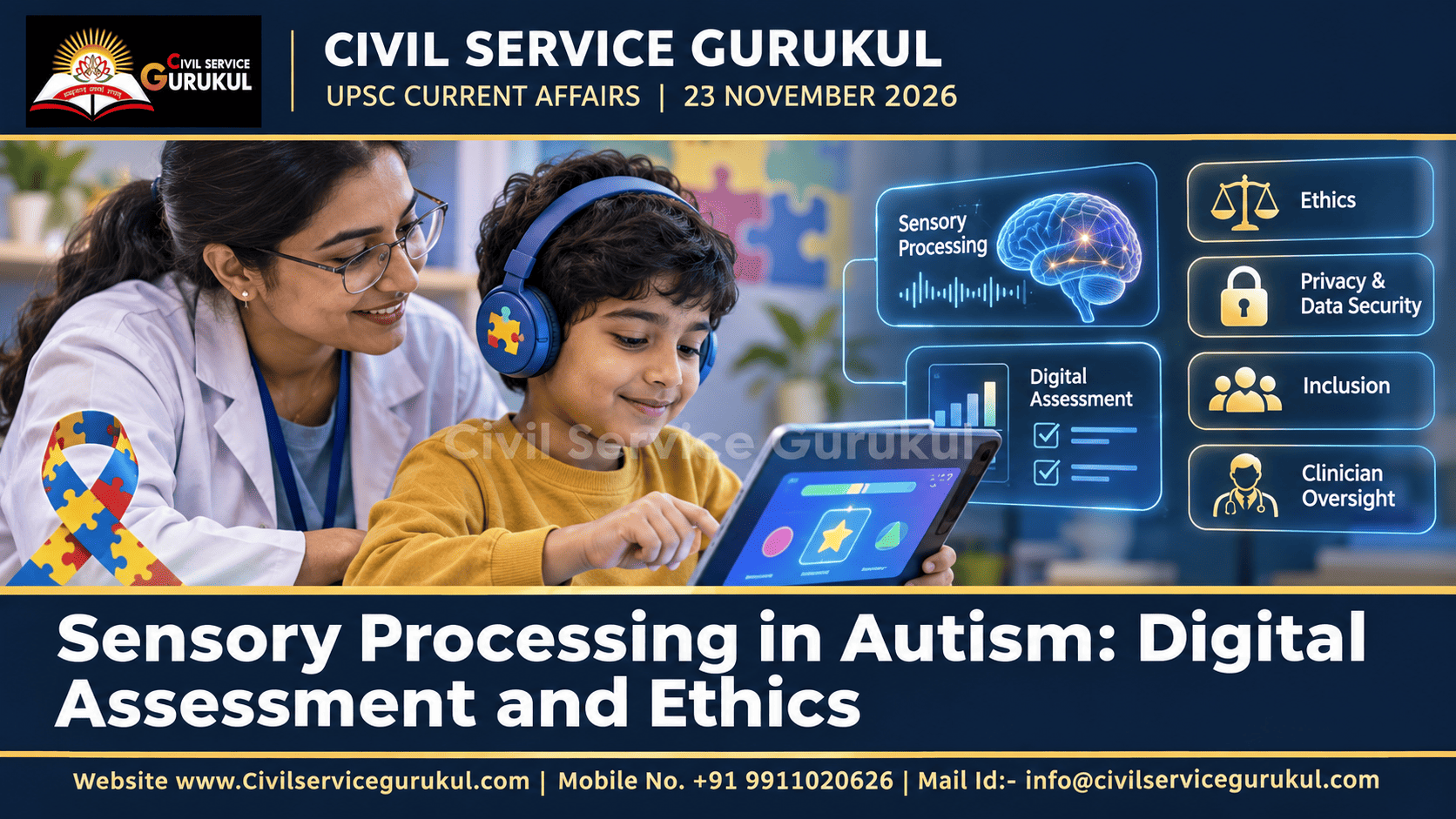
GEODE Game and Autism Research: How Digital Games Reveal Sensory Processing Differences
Can a simple online treasure-hunting game reveal how individuals process visual information? Boston University researchers have developed GEODE, an innovative instruction-free research game for investigating sensory evidence integration in autism. Explore the science, findings, limitations, disability rights and ethical questions through a comprehensive UPSC Prelims and Mains perspective.
Autism research has entered an important new phase as digital tools make it possible to study cognitive and sensory processes without relying exclusively on spoken instructions or conventional questionnaire-based assessments.
A new research game called GEODE, developed by researchers associated with Boston University, demonstrates how carefully designed digital tasks can improve participation in neuroscience research.
The study was published in the journal Science Advances on 11 September 2026. Its findings drew renewed attention in November 2026.
The central research question was: how do autistic individuals accumulate, combine and interpret visual information while making decisions?
For UPSC aspirants, the development connects neuroscience, disability inclusion, digital health, scientific methodology, data privacy and ethical governance.
- GS Paper II: Social justice, health, vulnerable sections, disability rights and inclusive public services.
- GS Paper III: Science and technology, digital innovation, neuroscience and emerging research tools.
- GS Paper IV: Informed consent, privacy, autonomy, dignity and research ethics.
- Essay: Technology and inclusion, human dignity, accessible innovation and responsible scientific progress.
- UPSC Prelims: Sensory processing, autism spectrum disorder, scientific research methods and disability-related laws.
1. Why Is Game-Based Autism Research in the News?
In November 2026, scientific reporting highlighted research using an online video game to investigate visual perception in autism.
The research team transformed a laboratory-style sensory evidence task into an engaging treasure-hunting game.
The game can be learned through feedback and practice rather than detailed spoken or written instructions.
This matters because traditional perception experiments may exclude individuals who have limited spoken language, intellectual disabilities or difficulty understanding complex test instructions.
Why Is the Research Significant?
- It explores a more inclusive research methodology.
- It reduces dependence on spoken instructions.
- It allows investigation of visual information processing.
- It uses computational models to analyse decisions.
- It may support future studies of individual differences.
- It raises important questions about digital access and research ethics.
2. What Is Autism Spectrum Disorder?
Autism spectrum disorder (ASD) is a neurodevelopmental condition associated with differences in social communication, patterns of behaviour, interests and sensory experiences.
The term spectrum reflects the diversity of autistic characteristics, abilities and support needs.
Some autistic people communicate fluently through speech, while others use alternative communication systems or have limited spoken language.
Sensory experiences also vary substantially between individuals.
Important Characteristics
- Differences in social communication and interaction.
- Restricted or repetitive patterns of behaviour or interests.
- Possible unusual responses to sensory stimuli.
- Diverse language and communication profiles.
- Different strengths, preferences and support needs.
What Does Neurodiversity Mean?
Neurodiversity recognises natural variations in human neurological development and functioning.
The concept encourages respect for individual differences and supports appropriate accommodations and equal participation.
Recognition of neurodiversity does not eliminate the need for healthcare, support services or individualised assistance where these are needed.
3. Sensory Processing in Autism: Core Scientific Concepts
Sensory processing refers to how the nervous system receives, interprets and responds to information from the body and surrounding environment.
Relevant information may involve sight, sound, touch, smell, taste, body position and movement.
Types of Sensory Differences
| Concept | Meaning | Illustration |
|---|---|---|
| Hyperreactivity | Stronger or more noticeable response to particular sensory input | Significant discomfort from certain loud sounds |
| Hyporeactivity | Reduced apparent response to particular sensory input | Limited response to some sensory changes |
| Sensory Seeking | Repeated interest in particular sensory experiences | Seeking specific movements or textures |
| Sensory Integration | Combining sensory information for perception and action | Using visual signals to make a decision |
Autistic individuals may experience different combinations of these patterns. They should not be assumed to have identical sensory profiles.
4. What Is GEODE? The New Digital Research Game
GEODE stands for Gathering Evidence to Optimize Decisions.
It is an online game developed for studying visual evidence accumulation and decision-making.
Its design draws inspiration from experimental tasks previously used in animal neuroscience research.
Instead of requiring participants to understand lengthy spoken instructions, the game teaches its rules through trial, feedback and progressive challenges.
Key Features of GEODE
Instruction-Free Learning
Participants learn the game through practice and feedback rather than complex verbal explanations.
Visual Decision Task
Players observe visual events and decide which side contains more information signals.
Online Accessibility
The game supports remote participation and can be used through compatible digital interfaces.
Computational Analysis
Researchers analyse patterns of learning and decision-making using mathematical models.
5. How Does the GEODE Game Work?
The player participates in a treasure-hunting experience involving visual signals.
Gem-shaped flashes appear on opposite sides of the screen.
The task requires the player to determine which side displayed more flashes.
Observe the visual signals presented during the game.
Accumulate information as flashes appear on both sides.
Select the side believed to have more flashes.
Receive feedback and continue learning through subsequent trials.
Why Is This an Evidence-Accumulation Task?
The participant must retain information about earlier visual events while additional signals are presented.
The final decision depends on combining evidence over time.
Researchers can then analyse whether errors arise in circumstances where evidence becomes more difficult to distinguish.
6. Key Findings of the 2026 GEODE Study
The research included 308 adolescents aged 11 to 17 years.
The study compared the performance of autistic adolescents with that of their non-autistic siblings.
Major Observations
- Participants across groups were able to engage with the game.
- Autistic participants generally performed comparably during easier practice trials.
- As the task became more demanding, the autistic group showed slower learning and somewhat lower accuracy on average.
- The mathematical analysis suggested greater imprecision in accumulating visual evidence among autistic participants.
- The measure was associated with adaptive functioning, or everyday abilities such as communication and self-care.
- In a smaller subset matched on adaptive functioning, some differences between autistic participants and siblings were no longer significant.
What Does the Study Establish?
The results support the usefulness of a game-based method for measuring visual evidence accumulation in a diverse research group.
They do not establish that the game can independently diagnose autism.
They also do not establish one universal sensory processing pattern for all autistic individuals.
7. What Is Integration Noise in the GEODE Research?
One important concept in the study is integration noise.
The term refers to a model-based estimate of imprecision while combining sensory evidence over time.
Simple Illustration
Imagine observing a sequence of lights flashing on the left and right sides of a screen.
You must remember the running count of flashes on each side.
If the mental representation of this count becomes less precise as additional flashes appear, the final decision may become less accurate.
The mathematical model uses integration noise to represent this kind of imprecision.
What Integration Noise Does Not Mean
- It is not a direct recording of neuronal activity.
- It is not necessarily a biological cause of autism.
- It is not an autism-specific diagnostic biomarker.
- It cannot independently establish a person's clinical diagnosis.
8. Assessment, Screening and Diagnosis: Important Differences
A major risk in reporting emerging health technologies is confusing research measurements with clinical diagnosis.
| Term | Meaning | Important Limitation |
|---|---|---|
| Research Assessment | Measurement of a defined characteristic for scientific investigation. | Not automatically validated for clinical decisions. |
| Screening | Identification of individuals who may need further evaluation. | A positive result does not itself establish diagnosis. |
| Clinical Diagnosis | Professional assessment using appropriate clinical criteria and relevant evidence. | Requires qualified evaluation and contextual interpretation. |
| Monitoring Tool | Measurement of changes over time in a particular outcome. | Needs reliability and validity for its intended use. |
Can GEODE Diagnose Autism?
No.
GEODE has been developed and studied as a research measure of visual evidence integration.
A clinical diagnosis of autism requires an appropriate professional evaluation based on developmental history, observed characteristics and accepted diagnostic criteria.
A single digital performance measure cannot substitute for the complete clinical process.
9. Sensitivity, Specificity and Scientific Validation
Before any new digital health tool is adopted for screening or diagnosis, its intended use must be clearly defined.
Researchers also need to evaluate its accuracy, reliability and performance across different populations.
Important Assessment Metrics
| Term | Exam-Ready Meaning |
|---|---|
| Sensitivity | Proportion of people with the condition correctly identified by the test. |
| Specificity | Proportion of people without the condition correctly identified. |
| False Positive | A person without the condition receives a positive result. |
| False Negative | A person with the condition receives a negative result. |
| Reliability | Consistency of measurement under appropriate conditions. |
| Validity | Extent to which a measure supports its intended interpretation and use. |
| Generalisability | Extent to which findings apply to other relevant populations and settings. |
These concepts are relevant to medical test evaluation generally.
The GEODE study should not be assigned a diagnostic sensitivity or specificity without an appropriate validated diagnostic testing framework.
10. Why Is GEODE Research Relevant for India?
India has substantial linguistic, geographical and socioeconomic diversity.
People seeking neurodevelopmental assessments may face barriers related to language, specialist availability, transport and digital access.
Potential Opportunities
Reduced Language Barriers
Tasks that do not require complex spoken instructions may support participation across different language groups.
Inclusive Research
Alternative interaction methods may enable participation by individuals who are excluded from conventional research tasks.
Remote Participation
Online tools may support research outside large specialist centres, subject to digital access.
Individualised Understanding
Research measurements may help scientists study differences in cognitive processing and support needs.
Important Limitations for India
- Unequal access to devices and internet connectivity.
- Differences in motor and visual abilities.
- Variation in familiarity with digital games.
- Potential cultural and socioeconomic bias.
- Need for validation among Indian participants.
- Need for privacy safeguards and accessible consent.
The 2026 GEODE research should not be presented as an Indian clinical validation study.
Local research would be needed before drawing broad conclusions about performance in Indian populations.
11. Rights of Persons with Disabilities Act, 2016
India's Rights of Persons with Disabilities Act, 2016 provides an important legal framework for disability rights, equal opportunity and inclusion.
The Act recognises autism spectrum disorder among its specified disabilities.
Important Policy Principles
- Equality and non-discrimination.
- Respect for dignity and individual autonomy.
- Accessibility and reasonable accommodation.
- Inclusive education.
- Appropriate support and participation.
- Protection against exclusion and stigma.
Why Is the Act Relevant to Digital Research?
Digital research tools should be designed so that persons with different communication or support needs can participate meaningfully.
This includes appropriate accessibility, communication support, voluntary participation and protection from discrimination.
12. Ethical Challenges in Digital Autism Assessment
Digital health research can improve inclusion, but it also creates new responsibilities for researchers, institutions and technology developers.
1. Informed Consent
Participants and appropriate guardians must receive understandable information about the study's purpose, procedures, risks and data practices.
Where appropriate, the participant's own assent and preferences should also be respected.
2. Privacy and Data Protection
Behavioural performance data may reveal sensitive information about individual participants.
Data collection should be limited to legitimate research needs, with appropriate security, retention and access controls.
3. Algorithmic Bias
A model trained on a narrow population may not perform equally well across different languages, cultures, ages or support profiles.
4. Accessibility
An instruction-free game may still be inaccessible to individuals with certain visual, motor or sensory needs.
Accessibility must be evaluated rather than assumed.
5. Human Oversight
Research outputs should be interpreted by suitably qualified professionals within the tool's validated scope of use.
Digital Personal Data Protection Framework
India's Digital Personal Data Protection Act, 2023, and Digital Personal Data Protection Rules, 2025, provide a framework for personal-data processing, including provisions relating to children.
Important principles include appropriate consent, purpose limitation, data minimisation and security.
Researchers and organisations must check the applicable commencement dates, phased implementation and relevant legal exceptions.
13. Scientific and Governance Challenges
Limited Generalisability
Research results may not apply equally across all ages, cultures and disability profiles.
Technology Access
A digital-first approach may exclude participants without suitable devices or internet access.
Clinical Misinterpretation
Experimental scores may be wrongly treated as diagnostic conclusions.
Measurement Bias
Game familiarity, motor ability, fatigue and attention can influence performance.
Privacy Risks
Inadequate safeguards may expose personal and behavioural data.
Over-Reliance on Algorithms
Automated outputs may be given more authority than the evidence supports.
14. Way Forward: Responsible and Inclusive Digital Assessment
- Validate Across Diverse Populations: Test research tools across relevant ages, languages, support needs and socioeconomic groups.
- Improve Accessibility: Provide alternative interfaces and reasonable accommodations.
- Ensure Meaningful Consent: Use accessible information and appropriate participant assent procedures.
- Protect Personal Data: Apply data minimisation, security and clear governance.
- Maintain Professional Oversight: Keep clinical decisions within appropriate professional assessment frameworks.
- Monitor Algorithmic Bias: Evaluate group-level and individual-level performance differences.
- Support Local Research: Conduct independent validation studies relevant to India's diverse population.
- Include Autistic Stakeholders: Involve autistic people, families and disability advocates in technology design.
- Develop Accessible Grievance Systems: Create channels for addressing privacy or research participation concerns.
- Maintain Scientific Transparency: Clearly distinguish research findings from validated clinical applications.
15. UPSC Prelims 2027: Quick Revision Table
| Topic | Important Fact |
|---|---|
| GEODE | Gathering Evidence to Optimize Decisions |
| Research institution | Boston University researchers and collaborators |
| Journal | Science Advances |
| Publication date | 11 September 2026 |
| Participants | 308 adolescents |
| Age range | 11–17 years |
| Autistic participants | 212 |
| Non-autistic siblings | 96 |
| Primary research concept | Visual sensory evidence integration |
| Integration noise | Model-based imprecision during evidence accumulation |
| Clinical status | Research measure, not established standalone diagnostic test |
| Autism | Neurodevelopmental condition |
| Sensitivity | TP / (TP + FN) |
| Specificity | TN / (TN + FP) |
| Indian disability law | Rights of Persons with Disabilities Act, 2016 |
| Personal data law | Digital Personal Data Protection Act, 2023 |
| Related rules | DPDP Rules, 2025, with phased commencement |
| GS IV themes | Dignity, consent, privacy and fairness |
Six Important MCQ Traps
- GEODE is a confirmed autism diagnostic test — incorrect.
- All autistic people have the same sensory profile — incorrect.
- Integration noise is a direct brain recording — incorrect.
- Screening and diagnosis are identical — incorrect.
- A language-free tool is automatically accessible to everyone — incorrect.
- Digital research removes the need for informed consent — incorrect.
16. Original UPSC Prelims MCQs with Answer Reveal
MCQ 1. What does GEODE stand for?
Reveal Correct Answer and Explanation
Correct Answer: B
GEODE stands for Gathering Evidence to Optimize Decisions.
It is a research game developed to study visual evidence accumulation and decision-making.
MCQ 2. Consider the following statements:
1. Autism is a neurodevelopmental condition.
2. Every autistic person has an identical sensory profile.
3. Sensory hyperreactivity involves increased responsiveness to certain stimuli.
Reveal Correct Answer and Explanation
Correct Answer: C
Statements 1 and 3 are correct.
Statement 2 is incorrect because autistic individuals have diverse sensory and communication profiles.
MCQ 3. Which statement most accurately describes GEODE?
Reveal Correct Answer and Explanation
Correct Answer: B
GEODE is a research game for investigating visual evidence integration.
It is not a genetic test, medicine or established standalone autism diagnostic tool.
MCQ 4. Consider the following statements about sensitivity and specificity:
1. Sensitivity measures the proportion of people with a condition correctly identified.
2. Specificity measures the proportion of people without a condition correctly identified.
3. High sensitivity necessarily means zero false positives.
Reveal Correct Answer and Explanation
Correct Answer: A
Statements 1 and 2 are correct.
Statement 3 is incorrect. Sensitivity and specificity measure different aspects of test performance.
High sensitivity does not automatically eliminate false positives.
MCQ 5. Under which Indian law is autism spectrum disorder recognised as a specified disability?
Reveal Correct Answer and Explanation
Correct Answer: B
The Rights of Persons with Disabilities Act, 2016 recognises autism spectrum disorder among the specified disabilities.
MCQ 6. Integration noise in GEODE refers to:
Reveal Correct Answer and Explanation
Correct Answer: B
Integration noise is a parameter estimated by a computational model.
It is not a direct EEG measure or a genetic diagnostic marker.
MCQ 7. Which of the following are important ethical safeguards in digital neurodevelopmental research?
1. Informed consent
2. Data privacy
3. Accessibility and non-discrimination
4. Independent scientific validation
Reveal Correct Answer and Explanation
Correct Answer: D
All four are important.
Ethical research must protect participant rights while ensuring that the tool's performance is scientifically supported.
MCQ 8. Consider the following findings of the 2026 GEODE study:
1. The study included autistic adolescents and non-autistic siblings.
2. The researchers examined visual evidence accumulation.
3. The study conclusively established integration noise as an autism-specific clinical biomarker.
Reveal Correct Answer and Explanation
Correct Answer: A
Statements 1 and 2 are correct.
Statement 3 is incorrect. The study did not establish integration noise as a uniquely autism-specific clinical marker.
17. UPSC Mains Questions and Model Answers
Question 1: "Digital and game-based assessment tools offer opportunities for inclusive neurodevelopmental research but also raise serious concerns regarding validity, accessibility and ethics." Critically examine.
Suggested Answer Structure
- Introduce digital assessment and the GEODE example.
- Explain accessibility and scientific opportunities.
- Discuss validity, bias, privacy and digital exclusion.
- Connect the issue with disability rights in India.
- Conclude with responsible innovation and professional oversight.
Illustrative Model Answer
Digital tools are creating new opportunities for neurodevelopmental research by enabling innovative methods of observation and data collection.
The GEODE study, developed by Boston University researchers, illustrates how a game-based approach can examine visual evidence integration without complex spoken instructions.
Opportunities: Such tools may reduce language barriers, support remote participation and include individuals traditionally excluded from conventional research tasks. They may also generate quantitative measures for studying learning and perception.
Challenges: Digital tools require scientific validation before clinical use. Performance may be influenced by device access, motor ability, attention and familiarity with technology. Algorithmic bias, privacy concerns and unequal connectivity may further limit inclusion.
Indian context: The Rights of Persons with Disabilities Act, 2016 supports dignity, accessibility and non-discrimination. Digital research should respect these principles through accessible design and meaningful participation.
Way forward: Independent validation, privacy safeguards, stakeholder participation, appropriate professional oversight and local research are essential.
Conclusion: Technology should complement human-centred healthcare and inclusive research, rather than replace scientific judgement or individual rights.
Question 2: Examine the ethical responsibilities of researchers and technology developers when collecting behavioural data from autistic children and adolescents.
Illustrative Model Answer
Research involving children and persons with disabilities requires heightened attention to autonomy, dignity and participant welfare.
Informed consent: Researchers must provide accessible information to participants and appropriate guardians.
Privacy: Personal and behavioural data should be collected for legitimate purposes and protected through suitable safeguards.
Fairness: Tools must not discriminate against participants based on language, disability or digital access.
Scientific integrity: Researchers must communicate limitations and avoid presenting experimental measurements as established clinical diagnoses.
Accountability: Participants should have accessible channels to raise concerns.
Conclusion: Responsible innovation must combine scientific progress with dignity, transparency, accessibility and respect for individual rights.
Question 3: How can India promote inclusive digital health research while protecting the rights of persons with disabilities?
Answer-Writing Points
- Accessibility by design.
- Community and stakeholder participation.
- Affordable digital infrastructure.
- Independent validation for Indian populations.
- Informed consent and data protection.
- Professional oversight and accountability.
- Alignment with the RPwD Act, 2016.
- Equitable access across regions and languages.
Suggested Conclusion
Inclusive digital health research should be guided by the principles of accessibility, equality and scientific reliability.
India can encourage innovation while protecting participant rights through responsible data practices, local validation and meaningful involvement of persons with disabilities.
18. Final Revision: Ten Key Takeaways
- GEODE stands for Gathering Evidence to Optimize Decisions.
- It is an online research game for studying visual evidence integration.
- The 2026 study involved 308 adolescents.
- The participants included 212 autistic adolescents and 96 non-autistic siblings.
- The findings were published in Science Advances.
- Autism is a neurodevelopmental condition with diverse characteristics and support needs.
- Integration noise is a mathematical model parameter, not direct brain recording.
- GEODE is not an established standalone diagnostic test for autism.
- India's RPwD Act, 2016 recognises autism spectrum disorder as a specified disability.
- Digital research must prioritise validity, accessibility, privacy, consent and human dignity.
Frequently Asked Questions (FAQs)
1. What is GEODE?
GEODE stands for Gathering Evidence to Optimize Decisions. It is an online research game designed to examine visual information processing.
2. Who developed GEODE?
It was developed by researchers associated with Boston University and their collaborators.
3. When was the GEODE research published?
The research was published in Science Advances on 11 September 2026.
4. How many participants were included?
The research included 308 adolescents aged 11–17 years, including 212 autistic participants and 96 non-autistic siblings.
5. Can GEODE diagnose autism?
No. GEODE has been studied as a visual perception research measure, not an established standalone clinical diagnostic tool.
6. What is integration noise?
It is a model-based estimate of imprecision while accumulating sensory information over time.
7. Why are instruction-free games important?
They may reduce some language and instruction-related barriers to research participation.
8. Which Indian law recognises autism as a specified disability?
The Rights of Persons with Disabilities Act, 2016.
9. What ethical issues arise in digital autism research?
Important issues include informed consent, data privacy, scientific validity, accessibility, algorithmic bias and participant dignity.
10. Which UPSC Mains papers cover this topic?
The issue is relevant to GS II, GS III, GS IV and Essay.
Related UPSC Current Affairs Topics
Prepare Science & Technology Current Affairs for UPSC 2027
Civil Service Gurukul helps aspirants connect important scientific and technological developments with the UPSC Civil Services Examination syllabus.
Our examination-focused approach emphasises conceptual clarity, verified current affairs, Prelims MCQ practice, Mains answer writing, ethical analysis and systematic revision.
Strengthen your UPSC preparation with structured notes, current-affairs analysis and subject-wise test practice.
Explore Civil Service Gurukul Contact Our TeamMobile: +91 9911020626
Prepare with Mentors Who Cleared the Exam
Get personalized study plans, evaluated answer models, and test series access.