India–Poland Relations 2026: Can Both Nations Double Bilateral Trade by 2030?
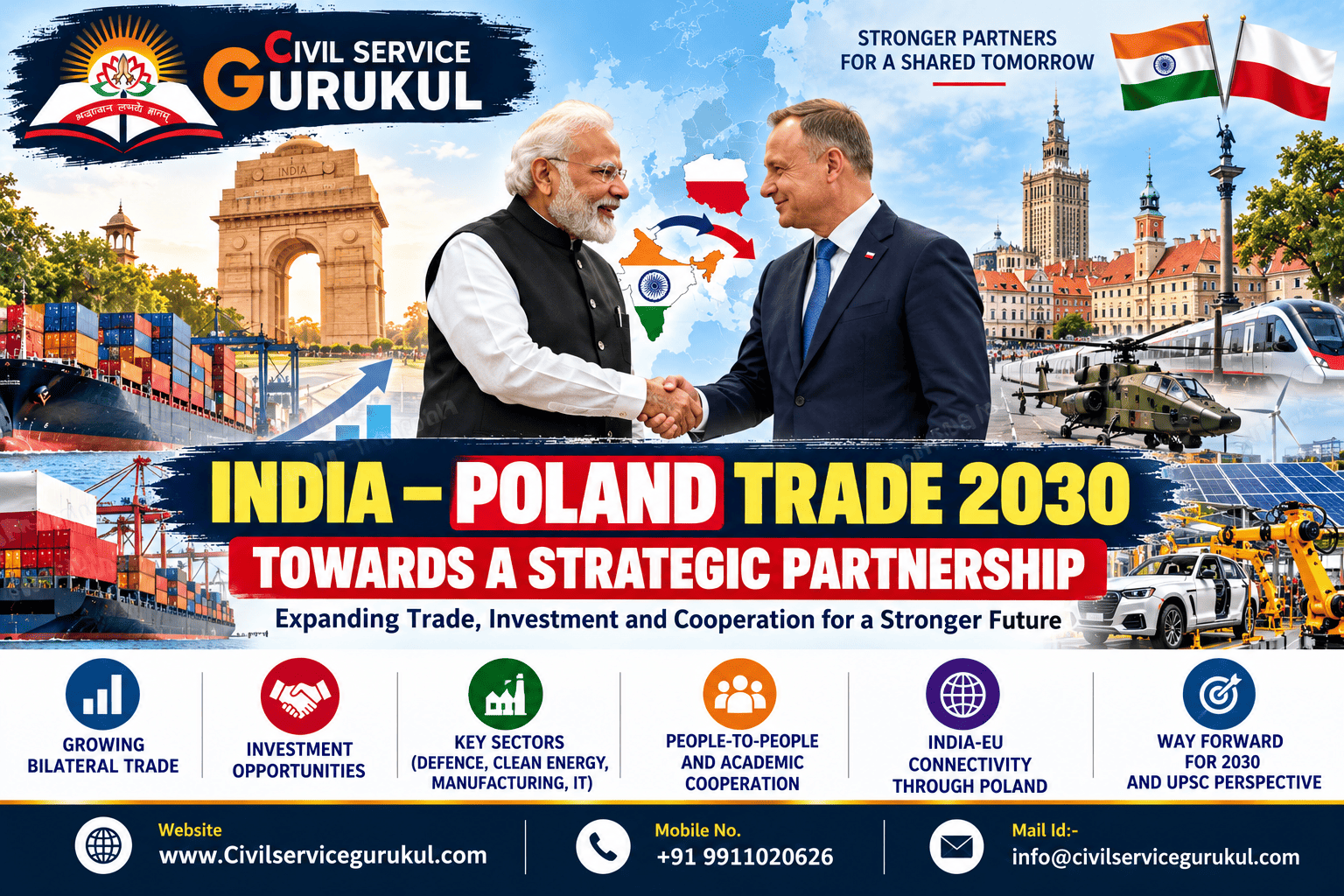
India–Poland Relations 2026: Can Both Nations Double Bilateral Trade by 2030?
Explore the India–Poland Strategic Partnership, the 2030 trade target, defence cooperation, India–EU relations, critical technologies and Global South diplomacy.
UPSC Current Affairs | 26 October 2026
India and Poland have agreed on a shared target of doubling bilateral trade by 2030.
The announcement followed the official visit of Polish Prime Minister Donald Tusk to India from 21–23 October 2026.
Prime Minister Narendra Modi and Prime Minister Tusk discussed trade, investment, defence, technology, connectivity and multilateral cooperation.
The visit built on the Strategic Partnership established in August 2024.
Important outcomes included Poland's entry into the Coalition for Disaster Resilient Infrastructure, a Defence Industry Dialogue and an agreed dialogue on counter-terrorism.
For UPSC, the developments are relevant to GS Paper II and GS Paper III.
1. Why Are India–Poland Relations in the News?
Polish Prime Minister Donald Tusk visited India from 21 to 23 October 2026.
He was accompanied by a high-level delegation that included around 100 business leaders and industry representatives.
During the visit, Prime Minister Narendra Modi and Prime Minister Tusk held bilateral discussions.
The two leaders reaffirmed their commitment to deepening the India–Poland Strategic Partnership.
The most important economic announcement was a shared target to double bilateral trade by 2030.
2. Background of India–Poland Relations
India and Poland have maintained diplomatic and economic relations for several decades.
Poland is an important European country with industrial, manufacturing and technological capabilities.
India is a large and growing economy with strengths in services, manufacturing, technology and human resources.
The two countries have opportunities to cooperate in sectors where their economic strengths complement each other.
3. Strategic Partnership: The 2024 Turning Point
Prime Minister Narendra Modi visited Poland in August 2024.
During that visit, India and Poland elevated their relationship to a Strategic Partnership.
The countries also adopted an Action Plan for 2024–2028.
The Action Plan provides a framework for advancing cooperation across different policy areas.
A mid-term review of the Action Plan was undertaken in September 2026 during ministerial engagement in Warsaw.
4. Key Outcomes of the October 2026 Visit
| Area | Announcement or Outcome |
|---|---|
| Trade | Target of doubling bilateral trade by 2030. |
| Disaster Management | Poland joins the Coalition for Disaster Resilient Infrastructure. |
| Defence | Establishment of a Defence Industry Dialogue announced. |
| Counter-Terrorism | Agreement to hold a dialogue on counter-terrorism. |
These outcomes demonstrate that the relationship is expanding beyond conventional trade and diplomatic engagement.
5. What Does Doubling Bilateral Trade by 2030 Mean?
Bilateral trade refers to the exchange of goods and services between two countries.
The India–Poland trade target seeks to increase economic exchange significantly by 2030.
At the India–Poland Business Forum, Union Minister Sarbananda Sonowal referred to bilateral trade of approximately USD 6.36 billion.
This reported figure provides context for the scale of the relationship, but the official doubling target should be understood according to the baseline and measurement method adopted by the two sides.
Trade expansion may involve greater exports, imports, business partnerships and investment-led supply-chain activity.
6. Why Is Poland Important for India?
Poland has an important geographical and economic position within Europe.
It can provide opportunities for Indian companies seeking access to Central and Eastern European markets.
Potential Advantages
- Access to European supply chains.
- Industrial and engineering partnerships.
- Technology collaboration.
- Logistics and transport connectivity.
- Investment opportunities.
- Research and academic cooperation.
Poland's membership of the European Union also makes the relationship relevant to India's broader European engagement.
7. India–Poland Trade and Investment Opportunities
The two countries identified several areas where business cooperation could expand.
| Sector | Potential Cooperation |
|---|---|
| Industrial Machinery | Manufacturing equipment and engineering partnerships. |
| Defence | Industrial dialogue, technology and possible joint production. |
| Pharmaceuticals | Business and market partnerships. |
| Infrastructure | Engineering, transport and project cooperation. |
| Energy | Energy technology and cleaner systems. |
| Critical Minerals | Mining, processing and supply-chain cooperation. |
| Information Technology | Digital services and emerging technologies. |
These areas represent opportunities and policy priorities. They should not all be interpreted as completed commercial agreements.
8. India–EU Relations: Why Is the Poland Partnership Important?
Poland is a member of the European Union.
Therefore, stronger India–Poland relations can support India's wider engagement with the EU.
The leaders highlighted the India–EU Summit held in January 2026 and the wider strategic agenda for cooperation.
They also supported the early signing, ratification and timely implementation of the India–EU Free Trade Agreement.
Trade agreements can create opportunities through improved market access, clearer rules and stronger investment relationships.
However, actual benefits depend on the legal terms, implementation and business competitiveness.
9. What Is a Free Trade Agreement?
A Free Trade Agreement, or FTA, is an arrangement between participating economies that reduces or removes specified barriers to trade.
FTAs may address tariffs, market access, services, rules of origin and other trade-related matters.
Potential Benefits
- Improved export opportunities.
- Greater access to imported inputs.
- More investment cooperation.
- Stronger international value chains.
- Expanded opportunities for businesses.
The benefits are not automatic. Some domestic industries may also face stronger competition.
10. Defence and Security Cooperation
India and Poland have identified defence cooperation as an important part of their Strategic Partnership.
The leaders welcomed the outcomes of the eighth Joint Working Group meeting on defence, held in Warsaw in September 2026.
The October visit also produced an announcement concerning a Defence Industry Dialogue.
Potential Areas
- Defence industry partnerships.
- Technology cooperation.
- Co-development opportunities.
- Possible co-production arrangements.
- Cybersecurity cooperation.
- Defence innovation.
Specific industrial projects would require separate commercial and governmental decisions.
11. Counter-Terrorism Dialogue
India and Poland agreed to strengthen dialogue on counter-terrorism.
Such cooperation can help countries exchange perspectives on security challenges and international responses.
The announcement concerns a dialogue mechanism, not the completion of a new joint security operation.
12. Critical Minerals and Emerging Technologies
Critical minerals are important for many modern industries, including clean energy, electronics and advanced manufacturing.
India and Poland discussed opportunities in mining, critical minerals, battery recycling and related technologies.
The leaders also identified potential cooperation in:
- Artificial intelligence.
- Semiconductors.
- Quantum technologies.
- Digital transformation.
- Startup partnerships.
- Space cooperation.
These fields are relevant to technological resilience and future economic competitiveness.
13. Connectivity and the IMEC Initiative
Connectivity involves transport, logistics and infrastructure links that facilitate movement of goods and people.
India and Poland discussed stronger aviation, shipping and maritime cooperation.
The leaders also recognised the importance of the India–Middle East–Europe Economic Corridor, known as IMEC.
Why Connectivity Matters
- Can reduce logistics inefficiencies.
- May improve supply-chain resilience.
- Supports access to international markets.
- Creates opportunities for infrastructure cooperation.
- Can strengthen trade diversification.
Proposed connectivity projects should not be treated as fully operational unless implementation is confirmed.
14. Poland Joins CDRI: Why Is This Important?
The Coalition for Disaster Resilient Infrastructure, or CDRI, is an international initiative focused on improving the resilience of infrastructure against disasters and climate-related risks.
India played a leading role in launching the initiative in 2019.
Poland's announced entry into CDRI strengthens the scope for international cooperation on resilient infrastructure.
Important Areas
- Disaster-resilient infrastructure.
- Climate adaptation.
- Infrastructure planning.
- Risk assessment.
- Knowledge and technology exchange.
15. Climate and Clean Energy Cooperation
India and Poland reaffirmed their support for international climate action.
The leaders recognised the importance of clean energy, sustainable technologies and climate-resilient development.
India also invited Poland to join the International Solar Alliance and the Global Biofuels Alliance.
An invitation to join an organisation should not be confused with confirmed membership.
16. Cultural and Educational Relations
Cultural and academic exchanges can strengthen relationships between countries.
India and Poland recognised opportunities for cooperation in education, research and cultural engagement.
Poland has a tradition of scholarship in Indian languages and Indology.
The joint statement welcomed the ICCR Chair of Indian Studies at Jagiellonian University in Krakow.
Student exchanges, research partnerships and cultural programmes can contribute to long-term people-to-people relations.
17. Challenges in Achieving the 2030 Trade Target
Market Access
Businesses must understand regulatory requirements, standards and commercial conditions in each market.
Logistics and Connectivity
Transport costs and delivery times can affect competitiveness.
Industrial Competition
Companies must offer competitive quality, technology and pricing.
Geopolitical Risks
Regional instability can disrupt supply chains and trade routes.
Implementation of Agreements
Diplomatic commitments must be followed by practical actions and institutional coordination.
18. The Way Forward
- Strengthen Business Partnerships: Encourage cooperation between companies and industry associations.
- Improve Market Access: Support businesses in understanding trade regulations and standards.
- Develop Resilient Supply Chains: Diversify sourcing and strengthen industrial partnerships.
- Expand Technology Cooperation: Promote joint research and innovation in emerging sectors.
- Advance Defence Dialogue: Identify feasible areas for industrial cooperation.
- Promote Educational Exchange: Strengthen academic and cultural connections.
- Review Progress: Track the implementation of the 2024–2028 Action Plan and the 2030 trade objective.
19. UPSC Prelims Quick Revision
- Polish Prime Minister Donald Tusk visited India from 21–23 October 2026.
- India and Poland set a target of doubling bilateral trade by 2030.
- The relationship was elevated to a Strategic Partnership in August 2024.
- The India–Poland Action Plan covers 2024–2028.
- Poland announced its entry into CDRI.
- A Defence Industry Dialogue was announced.
- Both countries agreed to a counter-terrorism dialogue.
- Poland is a member of the European Union.
- IMEC is relevant to India–Europe connectivity.
- India invited Poland to join ISA and the Global Biofuels Alliance.
20. UPSC Prelims Practice MCQs
Consider the following statements about India–Poland relations:
- The relationship was elevated to a Strategic Partnership in 2024.
- The countries adopted an Action Plan for 2024–2028.
- Bilateral trade had already doubled by October 2026.
Which statements are correct?
(A) 1 only
(B) 1 and 2 only
(C) 2 and 3 only
(D) 1, 2 and 3
Statements 1 and 2 are correct. Statement 3 is incorrect because doubling trade by 2030 is a target.
The Coalition for Disaster Resilient Infrastructure primarily focuses on:
(A) Military alliances
(B) Disaster-resilient infrastructure
(C) Currency integration
(D) Global electoral management
CDRI promotes cooperation on infrastructure resilience against disasters and climate-related risks.
Which of the following is correct regarding Poland?
(A) Poland is a member of the European Union.
(B) Poland is located in South America.
(C) Poland is a member of ASEAN.
(D) Poland is not part of Europe.
Poland is a European country and a member of the European Union.
Which of the following was announced during the October 2026 India–Poland engagement?
(A) Formation of a common currency
(B) Target of doubling bilateral trade by 2030
(C) Creation of a new military alliance
(D) Merger of both countries' parliaments
The two leaders set the target of doubling bilateral trade by 2030.
21. UPSC Mains Practice Question
"India's Strategic Partnership with Poland reflects its growing engagement with Central and Eastern Europe."
Discuss the significance of the India–Poland relationship in trade, defence, connectivity and India–EU cooperation.
Word Limit: 250 words
Suggested Answer Framework
- Introduce the 2024 Strategic Partnership.
- Mention the 2030 trade target.
- Discuss defence and emerging technology cooperation.
- Explain Poland's importance within the EU.
- Highlight connectivity and CDRI.
- Discuss implementation challenges.
- Conclude with a balanced assessment of strategic opportunities.
22. Frequently Asked Questions
What is the India–Poland trade target for 2030?
India and Poland have set a shared objective of doubling bilateral trade by 2030.
When did India and Poland become strategic partners?
The relationship was elevated to a Strategic Partnership in August 2024.
Who visited India in October 2026?
Polish Prime Minister Donald Tusk visited India from 21 to 23 October 2026.
What is the India–Poland Action Plan?
It is a framework adopted for 2024–2028 to guide bilateral cooperation.
What is CDRI?
The Coalition for Disaster Resilient Infrastructure promotes international cooperation on infrastructure resilience.
Why is Poland important for India's European strategy?
Poland is an EU member and can support India's engagement with Central and Eastern European markets.
23. Conclusion: A Partnership with Wider European Significance
India–Poland relations have evolved from conventional diplomatic engagement towards a broader Strategic Partnership.
The 2030 trade target demonstrates the ambition to deepen economic cooperation.
Defence dialogue, technology collaboration, connectivity and disaster resilience also provide opportunities for stronger bilateral relations.
For India, Poland is important not only as a bilateral partner but also as part of its wider engagement with Europe.
Final UPSC Takeaway: The significance of the India–Poland Strategic Partnership lies in linking trade, technology, security and connectivity with India's broader European foreign-policy objectives.
Prepare for UPSC with Civil Service Gurukul
Strengthen your preparation in International Relations, Indian Economy, Polity, Science and Technology, Geography and Current Affairs through structured UPSC learning resources.
Website: www.civilservicegurukul.com
Mobile: +91 9911020626
Email: info@civilservicegurukul.com
Editorial Disclaimer: This article is original educational analysis for UPSC preparation, based on publicly reported information available as of 26 October 2026. The trade-doubling objective is a future target. Proposed dialogue mechanisms, technology partnerships and connectivity opportunities should not be interpreted as completed commercial projects. The article does not reproduce newspaper reporting.
Prepare with Mentors Who Cleared the Exam
Get personalized study plans, evaluated answer models, and test series access.