SAMHiTA Project 2026: How India and Sri Lanka Are Saving 100 Ancient Manuscripts
SAMHiTA Project 2026: How India and Sri Lanka Are Saving 100 Ancient Manuscripts
Explore India's cultural heritage initiative in Sri Lanka, Buddhist manuscripts, digital preservation, civilisational diplomacy and its importance for UPSC.
UPSC Current Affairs | 26 October 2026
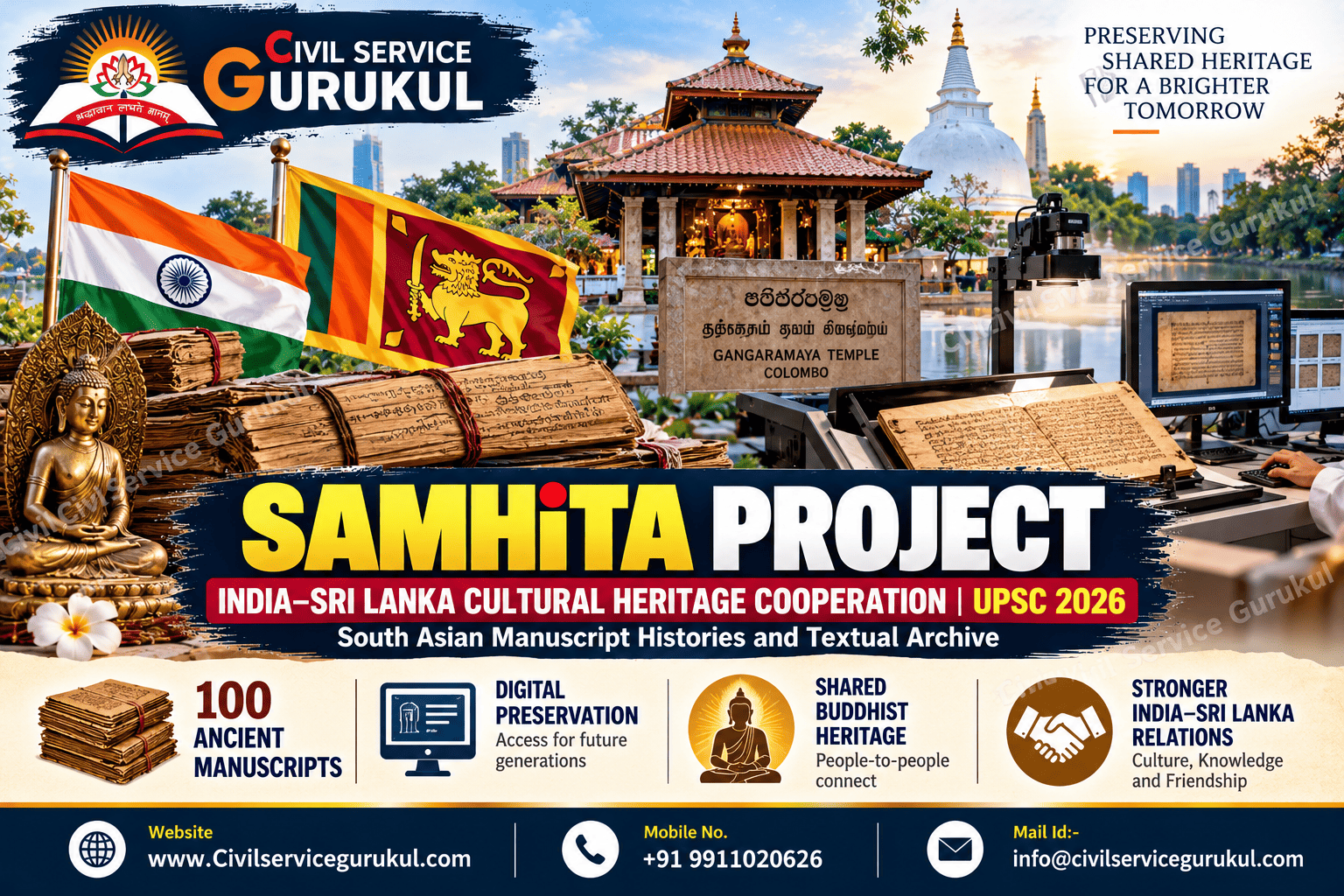
The SAMHiTA Project, or South Asian Manuscript Histories and Textual Archive, is an India-supported cultural heritage initiative.
Launched at Gangaramaya Temple in Colombo, the project aims to digitise 100 ancient manuscripts.
These manuscripts cover Buddhist traditions, philosophy, languages and cultural practices.
The initiative is being undertaken by the India International Centre, New Delhi, with grant assistance from the Government of India.
The digitisation target is November 2026.
For UPSC, the project is an example of cultural preservation, India–Sri Lanka cooperation and digital heritage management.
1. Why Is the SAMHiTA Project in the News?
India and Sri Lanka launched the SAMHiTA Project at Gangaramaya Temple, Colombo.
The initiative aims to preserve 100 ancient manuscripts through digitisation.
The manuscripts represent important aspects of South Asia's religious, linguistic and intellectual history.
The project also highlights the growing role of technology in protecting cultural heritage.
Its significance extends beyond preservation because it strengthens people-to-people and cultural ties between India and Sri Lanka.
2. What Is the Full Form of SAMHiTA?
SAMHiTA stands for South Asian Manuscript Histories and Textual Archive.
It is a cultural heritage initiative focused on the digitisation and preservation of ancient manuscripts from South Asia.
Its objective is to protect fragile historical documents and improve access to the knowledge they contain.
3. Key Facts About the SAMHiTA Project
| Particulars | Details |
|---|---|
| Full Form | South Asian Manuscript Histories and Textual Archive |
| Nature | India-supported cultural heritage initiative |
| Implementing Institution | India International Centre, New Delhi |
| Financial Support | Grant assistance from the Government of India |
| First Sri Lankan Partner | Gangaramaya Temple, Colombo |
| Partnership MoU | July 2026 |
| Manuscript Target | 100 ancient manuscripts |
| Target Completion | November 2026 |
| Core Purpose | Preservation and digital accessibility of cultural heritage |
4. What Are Ancient Manuscripts?
A manuscript is a document written or produced by hand, rather than created through modern mass printing.
Historically, manuscripts were used to record religious teachings, literature, medicine, philosophy, astronomy, law and other subjects.
South Asia has a rich tradition of manuscript production using materials such as palm leaves, birch bark and paper.
These materials can deteriorate because of humidity, insects, physical handling and environmental changes.
Why Manuscripts Matter
- They preserve historical knowledge.
- They provide evidence of linguistic development.
- They help researchers understand intellectual traditions.
- They preserve religious and philosophical teachings.
- They offer insights into social and cultural practices.
5. Why Is Manuscript Digitisation Important?
Digitisation means creating digital representations of physical documents.
For manuscripts, this generally involves capturing high-quality images and organising related information for preservation and access.
Major Benefits
- Reduced Handling: Researchers can consult digital copies without repeatedly handling fragile originals.
- Improved Accessibility: Digital records can support wider scholarly access, subject to permissions.
- Research Support: Scholars can compare texts, scripts and historical sources.
- Digital Preservation: Multiple managed copies can reduce the risk of losing recorded information.
- Educational Use: Digitised material can support teaching and cultural awareness.
However, digitisation does not replace the need to conserve the physical manuscript.
6. How Does Manuscript Digitisation Work?
A typical digitisation programme may involve several stages.
- Documentation: Record the manuscript's identity, condition and basic characteristics.
- Conservation Assessment: Determine whether the document can be handled and photographed safely.
- Digital Imaging: Capture high-resolution images using suitable equipment.
- Metadata Creation: Record information such as title, language, script and subject where known.
- Digital Storage: Preserve files using appropriate backup and data-management practices.
- Access Management: Determine how digital copies may be used by researchers and the public.
These are general practices in heritage digitisation. They should not be interpreted as a confirmed technical workflow for every SAMHiTA manuscript.
7. Why Is Gangaramaya Temple Important?
Gangaramaya Temple is a well-known Buddhist temple in Colombo, Sri Lanka.
It has cultural and religious importance in Sri Lankan Buddhist society.
The temple became the first participating Sri Lankan institution under SAMHiTA, following an MoU signed in July 2026.
Its participation illustrates how religious and cultural institutions can contribute to heritage preservation.
8. India–Sri Lanka Buddhist Heritage
India and Sri Lanka share longstanding Buddhist cultural connections.
Buddhism originated in the Indian subcontinent and spread to different regions of Asia.
Sri Lanka became an important centre for the preservation and development of Buddhist learning and traditions.
Historical interactions helped create connections in religious thought, literature, art and monastic education.
Major Cultural Connections
- Buddhist teachings and philosophical traditions.
- Monastic institutions and scholarship.
- Pali and related textual traditions.
- Religious pilgrimage and cultural exchange.
- Historical literary and intellectual connections.
The SAMHiTA Project builds on this broader civilisational relationship.
9. Cultural Diplomacy and Soft Power
Cultural diplomacy refers to using cultural exchange and cooperation to strengthen relationships between countries.
Soft power is the ability to influence others through attraction, values and cultural appeal, rather than coercion.
Projects such as SAMHiTA can contribute to cultural diplomacy by supporting shared heritage preservation.
Potential Benefits
- Stronger people-to-people relationships.
- Greater academic collaboration.
- Preservation of shared historical knowledge.
- Improved cultural understanding.
- Opportunities for research and education.
10. India–Sri Lanka Relations: A Wider Perspective
India and Sri Lanka maintain relations across multiple areas, including trade, development cooperation, maritime security and cultural exchange.
Their geographical proximity makes bilateral cooperation important in the Indian Ocean region.
Cultural projects form one part of this broader relationship.
SAMHiTA demonstrates how heritage cooperation can support bilateral engagement without being a conventional trade or security initiative.
11. Digital Heritage and Emerging Technologies
Digital technology is becoming increasingly important for the protection and study of cultural resources.
Advanced imaging, digital archives and searchable catalogues can help researchers study historical materials.
Optical Character Recognition, or OCR, may assist in recognising text in some scripts.
However, ancient handwriting, damaged documents and complex scripts can make automated recognition difficult.
Human scholarly review remains important for accurate interpretation.
12. Challenges in Preserving Ancient Manuscripts
| Challenge | Why It Matters |
|---|---|
| Physical Deterioration | Age, moisture and handling can damage manuscripts. |
| Specialist Skills | Conservation and interpretation require trained experts. |
| Language Barriers | Historical scripts and languages may be difficult to read. |
| Digital Storage | Digital files require long-term maintenance and backup. |
| Access Rights | Institutions must consider ownership, permissions and cultural sensitivities. |
| Funding | Long-term conservation needs sustained resources. |
13. What Is the Way Forward?
- Strengthen Conservation: Protect physical manuscripts alongside digital copies.
- Develop Skilled Teams: Train archivists, conservators and language specialists.
- Improve Digital Standards: Use reliable metadata, storage and backup practices.
- Promote Academic Collaboration: Encourage cooperation between scholars and heritage institutions.
- Respect Cultural Ownership: Develop access arrangements with participating institutions.
- Expand Participation: Encourage other eligible cultural institutions to explore cooperation.
14. UPSC Prelims Quick Revision
- SAMHiTA stands for South Asian Manuscript Histories and Textual Archive.
- It is an India-supported cultural heritage initiative.
- The project was launched at Gangaramaya Temple, Colombo.
- The target is to digitise 100 ancient manuscripts.
- The India International Centre, New Delhi, is the implementing institution.
- The Government of India provides grant assistance.
- The first Sri Lankan partnership MoU was signed in July 2026.
- The target completion is November 2026.
- The manuscripts cover Buddhism, philosophy, languages and cultural practices.
- The initiative is relevant to cultural diplomacy and digital heritage preservation.
15. UPSC Prelims Practice MCQs
The SAMHiTA Project is primarily associated with:
(A) Satellite-based agriculture
(B) Digitisation of ancient manuscripts
(C) Maritime defence exercises
(D) Financial inclusion
SAMHiTA focuses on the preservation and digitisation of ancient South Asian manuscripts.
Which institution is undertaking the SAMHiTA Project?
(A) Reserve Bank of India
(B) India International Centre, New Delhi
(C) National Disaster Management Authority
(D) Election Commission of India
The India International Centre, New Delhi, is undertaking the project with Government of India grant assistance.
Gangaramaya Temple, associated with the SAMHiTA Project, is located in:
(A) Kathmandu
(B) Colombo
(C) Thimphu
(D) Bangkok
Gangaramaya Temple is located in Colombo, Sri Lanka.
Consider the following statements about manuscript digitisation:
- It can reduce repeated handling of fragile originals.
- It completely eliminates the need for physical conservation.
- It can support wider scholarly access.
Which statements are correct?
(A) 1 only
(B) 1 and 3 only
(C) 2 and 3 only
(D) 1, 2 and 3
Digitisation can improve access and reduce handling, but physical conservation remains essential.
16. UPSC Mains Practice Questions
"Digitisation of ancient manuscripts is essential for preserving India's shared civilisational heritage with South Asian countries."
Discuss with reference to the SAMHiTA Project.
Word Limit: 150 words
"Cultural diplomacy can strengthen bilateral relations beyond conventional economic and security cooperation."
Examine the statement in the context of India–Sri Lanka relations.
Word Limit: 250 words
Suggested Answer Structure
- Define cultural diplomacy.
- Introduce the shared Buddhist heritage.
- Explain the SAMHiTA initiative.
- Discuss academic and people-to-people cooperation.
- Identify conservation and implementation challenges.
- Conclude with the importance of sustained cultural partnerships.
17. Frequently Asked Questions
What is the SAMHiTA Project?
It is an India-supported initiative to digitise and preserve ancient South Asian manuscripts.
What is the full form of SAMHiTA?
South Asian Manuscript Histories and Textual Archive.
How many manuscripts will be digitised?
The reported project target is 100 ancient manuscripts.
Where was the SAMHiTA Project launched?
At Gangaramaya Temple in Colombo, Sri Lanka.
What is the target completion date?
November 2026, according to the 26 October 2026 current-affairs report.
Why is the project important for UPSC?
It connects Art and Culture, Buddhist heritage, India–Sri Lanka relations, cultural diplomacy and digital preservation.
18. Conclusion: Preserving the Past Through Technology
The SAMHiTA Project demonstrates how cultural heritage and modern technology can work together.
By targeting the digitisation of 100 ancient manuscripts, the initiative seeks to protect valuable records of South Asia's religious and intellectual traditions.
It also creates an opportunity to strengthen India–Sri Lanka relations through shared cultural heritage.
Long-term success will depend on careful conservation, reliable digital management and continued institutional cooperation.
Final UPSC Takeaway: The SAMHiTA Project is an example of how digital preservation can support cultural diplomacy, historical research and international cooperation.
Prepare for UPSC with Civil Service Gurukul
Strengthen your preparation in Indian History, Art and Culture, International Relations, Science and Technology and Current Affairs through structured UPSC learning resources.
Website: www.civilservicegurukul.com
Mobile: +91 9911020626
Email: info@civilservicegurukul.com
Editorial Disclaimer: This article is original educational analysis for UPSC preparation. Project facts reflect information reported on 26 October 2026. The November 2026 completion date is a target and does not establish that digitisation has been completed. General discussion of conservation methods and policy implications is explanatory rather than a description of confirmed project procedures.
Prepare with Mentors Who Cleared the Exam
Get personalized study plans, evaluated answer models, and test series access.