BRICS Parliamentary Forum 2026: Why AI Governance and Global South Cooperation Matter for India
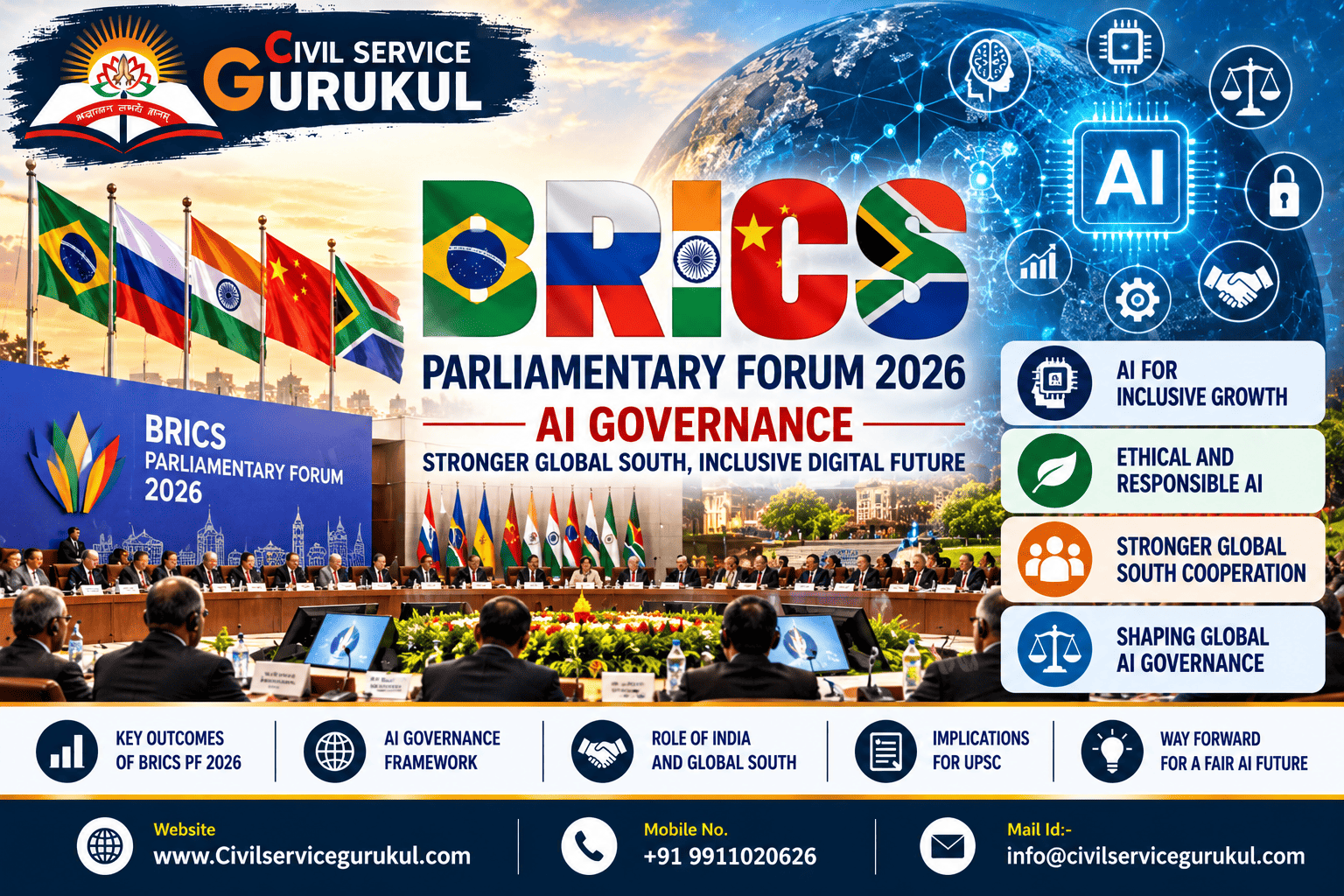
BRICS Parliamentary Forum 2026: Why AI Governance and Global South Cooperation Matter for India
India hosts the 12th BRICS Parliamentary Forum in New Delhi, bringing parliamentary diplomacy, ethical artificial intelligence and people-centric development into the global spotlight.
UPSC Current Affairs | 26 October 2026
India is hosting the 12th BRICS Parliamentary Forum on 26–27 October 2026 at Samvidhan Sadan, New Delhi.
Lok Sabha Speaker Om Birla inaugurated the forum on 26 October 2026.
The conference focuses on strengthening parliamentary cooperation for people-centric development.
Its four major pillars are Resilience, Innovation, Cooperation and Sustainability.
Important discussions include ethical AI, digital transformation, global governance reforms, institutional resilience and sustainable development.
For UPSC aspirants, the forum connects India's foreign policy, multilateral institutions, technology governance and parliamentary diplomacy.
1. Why Is the BRICS Parliamentary Forum in the News?
The Parliament of India is hosting the 12th BRICS Parliamentary Forum in New Delhi on 26 and 27 October 2026.
The meeting brings together parliamentary representatives from BRICS member and partner countries.
Lok Sabha Speaker Om Birla inaugurated the conference on 26 October.
Prime Minister Narendra Modi also interacted with parliamentary delegations.
The forum provides an opportunity for lawmakers to discuss common challenges and explore international cooperation.
2. Key Facts About the 2026 Forum
| Particulars | Details |
|---|---|
| Event | 12th BRICS Parliamentary Forum |
| Dates | 26–27 October 2026 |
| Host Country | India |
| Venue | Samvidhan Sadan, New Delhi |
| Parliamentary Leadership | Lok Sabha Speaker Om Birla |
| Central Theme | Strengthening Parliaments for People-Centric Development |
| Major Pillars | Resilience, Innovation, Cooperation and Sustainability |
| Key Discussion Areas | AI governance, institutional resilience, global governance reforms and sustainable development |
The forum is a parliamentary cooperation platform. It should not be confused with the BRICS Summit of heads of state and government.
3. What Is BRICS?
BRICS is a grouping of major emerging economies that cooperate on international economic, political and development issues.
The original BRIC grouping included Brazil, Russia, India and China.
South Africa subsequently joined, creating the BRICS acronym.
The grouping has since expanded to include additional members.
BRICS cooperation covers areas such as development finance, international governance, technology, trade and sustainable development.
4. What Is the BRICS Parliamentary Forum?
The BRICS Parliamentary Forum provides a platform for parliamentary leaders and legislators to exchange ideas and strengthen cooperation.
Unlike executive-level summits, parliamentary forums focus on the role of legislatures.
Major Functions
- Exchange parliamentary experiences.
- Discuss shared legislative challenges.
- Strengthen parliamentary diplomacy.
- Promote institutional cooperation.
- Encourage dialogue on global governance.
- Support knowledge sharing and capacity building.
The forum itself does not directly make laws that automatically apply to all participating countries.
5. Understanding Parliamentary Diplomacy
Parliamentary diplomacy means engagement between legislators and parliamentary institutions of different countries.
Traditional diplomacy is generally led by governments through foreign ministries and diplomatic missions.
Parliamentary diplomacy adds another channel of international dialogue.
| Traditional Diplomacy | Parliamentary Diplomacy |
|---|---|
| Primarily conducted by the executive. | Conducted through parliamentary representatives. |
| Focuses on official foreign-policy negotiations. | Focuses on legislative dialogue and cooperation. |
| May produce treaties and executive agreements. | May produce parliamentary understandings and recommendations. |
| Operates through diplomatic institutions. | Operates through parliamentary forums and exchanges. |
6. Four Pillars of the 2026 Forum
A. Resilience
Resilience refers to the ability of institutions to respond effectively to uncertainty and major challenges.
Parliaments can strengthen resilience through legislation, oversight and institutional accountability.
B. Innovation
Innovation focuses on the responsible use of new technologies, including artificial intelligence and digital systems.
The forum discusses how parliamentary institutions can support human-centred technology governance.
C. Cooperation
Cooperation involves improving dialogue among countries and supporting more representative global governance.
D. Sustainability
Sustainability focuses on development that addresses present needs without undermining the well-being of future generations.
7. Why Is Artificial Intelligence Governance Important?
Artificial intelligence is increasingly used in public services, education, healthcare, industry and digital platforms.
However, AI also raises questions about fairness, privacy, accountability and public safety.
Governments and parliaments must consider how to encourage innovation while protecting citizens.
Major AI Governance Challenges
- Protection of personal data.
- Algorithmic discrimination.
- Transparency of automated decisions.
- Accountability for harmful outcomes.
- Misuse of deepfakes and misinformation.
- Cybersecurity risks.
- Unequal access to technology.
These challenges often cross national borders, making international dialogue important.
8. What Is Ethical AI?
Ethical AI refers to developing and using artificial intelligence in ways consistent with human rights, fairness and public welfare.
Important Principles
- Fairness: Avoid unjust discrimination.
- Transparency: Explain relevant system decisions.
- Accountability: Establish responsibility for outcomes.
- Privacy: Protect personal information.
- Safety: Reduce foreseeable harms.
- Human Oversight: Maintain meaningful human responsibility.
The BRICS Parliamentary Forum provides an opportunity to exchange perspectives on these principles.
However, discussions about ethical AI should not be mistaken for the adoption of a single binding BRICS AI law.
9. Role of Parliaments in AI Governance
Parliaments can shape technology governance through several important functions.
- Debating and enacting relevant laws.
- Reviewing executive policies.
- Examining public expenditure.
- Protecting fundamental rights.
- Conducting committee inquiries.
- Promoting transparency and accountability.
International parliamentary dialogue can help legislators learn from different national approaches.
10. BRICS and the Global South
The term Global South generally refers to developing and emerging economies with shared concerns about development and representation.
It is not simply a geographical term.
Many countries associated with the Global South seek greater participation in international decision-making.
Important Concerns
- Access to development finance.
- Technology transfer.
- Climate finance.
- Reform of global institutions.
- Digital inclusion.
- Fairer international economic opportunities.
BRICS provides one platform through which participating countries can discuss these concerns.
11. Why Does Global Governance Reform Matter?
Global governance refers to international rules, institutions and cooperation mechanisms used to address shared problems.
Countries often disagree about whether existing institutions adequately represent the contemporary world.
Emerging economies frequently advocate greater representation and participation in global decision-making.
Possible Areas of Reform
- Representation in international institutions.
- Development financing arrangements.
- Cooperation on climate change.
- International technology governance.
- Responses to cross-border crises.
Parliamentary dialogue can contribute ideas and political understanding, although formal institutional reforms require separate decision-making processes.
12. India's Strategic Importance
Hosting the BRICS Parliamentary Forum gives India an opportunity to strengthen engagement with participating countries.
India can highlight its perspectives on inclusive development, digital transformation, institutional cooperation and international governance.
Potential Benefits
- Stronger parliamentary relationships.
- Greater dialogue on emerging technologies.
- Cooperation on sustainable development.
- Exchange of legislative practices.
- More opportunities for Global South engagement.
These are potential benefits, not guaranteed outcomes of the conference.
13. Parliamentary Diplomacy and India's Constitution
India's Parliament performs important legislative, financial and oversight functions.
These functions provide a foundation for discussing institutional accountability with other parliaments.
Relevant Constitutional Provisions
| Provision | Relevance |
|---|---|
| Article 79 | Constitution of Parliament. |
| Article 105 | Powers, privileges and immunities of Parliament and its members. |
| Article 110 | Definition of Money Bills. |
| Article 253 | Parliament's legislative power for implementing international agreements. |
International parliamentary discussions do not themselves change Indian law.
Any domestic legislative action must follow applicable constitutional procedures.
14. Sustainable Development and BRICS Cooperation
Sustainable development requires balancing economic growth, social inclusion and environmental protection.
BRICS countries face different development challenges, but many share concerns about energy security, infrastructure, poverty and climate resilience.
Parliaments can contribute through budgetary oversight, policy debate and legislation.
Cooperation may also help countries exchange experiences in public service delivery and environmental governance.
15. Major Challenges Facing BRICS Cooperation
Different National Priorities
Member countries have different economic structures and foreign-policy interests.
Geopolitical Differences
Strategic disagreements can make consensus difficult on sensitive issues.
Implementation Gaps
International declarations require follow-up actions to produce practical results.
Technology Inequality
Countries differ in access to digital infrastructure, AI expertise and investment.
Institutional Diversity
Participating countries have different political and parliamentary systems.
16. The Way Forward
- Promote Responsible AI: Encourage cooperation on fairness, transparency and human oversight.
- Strengthen Parliamentary Dialogue: Support regular engagement among legislative institutions.
- Improve Global South Representation: Create more opportunities for developing countries to influence global discussions.
- Focus on Implementation: Translate shared priorities into practical national and international initiatives.
- Support Digital Inclusion: Address gaps in infrastructure, skills and technology access.
- Advance Sustainable Development: Encourage cooperation on climate resilience, social inclusion and development.
17. UPSC Prelims Quick Revision
- The 12th BRICS Parliamentary Forum is being held on 26–27 October 2026.
- India is the host country.
- The venue is Samvidhan Sadan, New Delhi.
- Lok Sabha Speaker Om Birla inaugurated the forum on 26 October.
- The central theme concerns people-centric development through stronger parliaments.
- The four pillars are Resilience, Innovation, Cooperation and Sustainability.
- Ethical AI and digital transformation are important agenda areas.
- The forum is different from the BRICS heads-of-government summit.
- Parliamentary diplomacy involves cooperation between legislative institutions.
18. UPSC Prelims Practice MCQs
Consider the following statements regarding the 12th BRICS Parliamentary Forum:
- India is hosting the forum in 2026.
- The forum focuses on parliamentary cooperation.
- The forum directly enacts binding laws for every BRICS member country.
Which statements are correct?
(A) 1 only
(B) 1 and 2 only
(C) 2 and 3 only
(D) 1, 2 and 3
Statements 1 and 2 are correct. Statement 3 is incorrect because the forum does not directly enact laws for participating countries.
Which of the following is not one of the four pillars of the 2026 forum?
(A) Resilience
(B) Innovation
(C) Cooperation
(D) Privatisation
The four pillars are Resilience, Innovation, Cooperation and Sustainability.
Parliamentary diplomacy primarily refers to:
(A) Negotiations conducted only by central banks
(B) International dialogue among legislative representatives
(C) Judicial review of foreign constitutions
(D) Military alliances among parliamentary states
Parliamentary diplomacy involves dialogue and cooperation among parliaments and legislators.
Which of the following is most closely associated with ethical AI governance?
(A) Removing all human oversight
(B) Eliminating accountability for automated decisions
(C) Promoting fairness, transparency and responsibility
(D) Preventing all technological innovation
Ethical AI governance emphasises fairness, transparency, accountability and human welfare.
19. UPSC Mains Practice Question
"Parliamentary diplomacy can strengthen multilateral cooperation by connecting global commitments with domestic accountability."
Discuss this statement with reference to the BRICS Parliamentary Forum 2026.
Word Limit: 250 words
Suggested Answer Framework
- Define parliamentary diplomacy.
- Explain the purpose of the BRICS Parliamentary Forum.
- Discuss AI governance and global governance reforms.
- Analyse India's Global South role.
- Identify implementation challenges.
- Conclude with people-centric multilateral cooperation.
20. Frequently Asked Questions
What is the BRICS Parliamentary Forum?
It is a platform for parliamentary representatives of BRICS countries to discuss common priorities and strengthen legislative cooperation.
When is the 12th BRICS Parliamentary Forum being held?
The forum is being held on 26–27 October 2026 in New Delhi.
Who inaugurated the 2026 forum?
Lok Sabha Speaker Om Birla inaugurated the forum on 26 October 2026.
What are the four pillars of the forum?
Resilience, Innovation, Cooperation and Sustainability.
Why is AI governance on the agenda?
Artificial intelligence creates opportunities but also raises questions about privacy, fairness, transparency, safety and accountability.
Why is the forum important for UPSC?
It connects International Relations, parliamentary diplomacy, Global South cooperation, AI governance, sustainable development and ethics.
21. Conclusion: From Parliamentary Dialogue to Action
The 12th BRICS Parliamentary Forum highlights the growing importance of legislative cooperation in international relations.
Issues such as artificial intelligence, climate change and global governance cannot be addressed effectively through isolated national action alone.
Parliamentary institutions can contribute through legislation, public accountability and exchange of experience.
For India, hosting the forum creates an opportunity to strengthen its engagement with BRICS and the Global South.
Final UPSC Takeaway: The value of international parliamentary cooperation lies in translating shared global priorities into responsible policies and meaningful benefits for citizens.
Prepare for UPSC with Civil Service Gurukul
Build conceptual clarity in International Relations, Indian Polity, Economy, Science and Technology, Ethics and Current Affairs through structured UPSC learning resources.
Website: www.civilservicegurukul.com
Mobile: +91 9911020626
Email: info@civilservicegurukul.com
Editorial Disclaimer: This article provides original educational analysis for UPSC preparation based on publicly reported information available on 26 October 2026. The forum is scheduled to continue through 27 October. No final conference declaration or post-event outcome is claimed here. Analytical observations about possible benefits and policy reforms are not official conference decisions.
Prepare with Mentors Who Cleared the Exam
Get personalized study plans, evaluated answer models, and test series access.