
Climate Finance 2026: India's UN Summit Stand | UPSC 2027
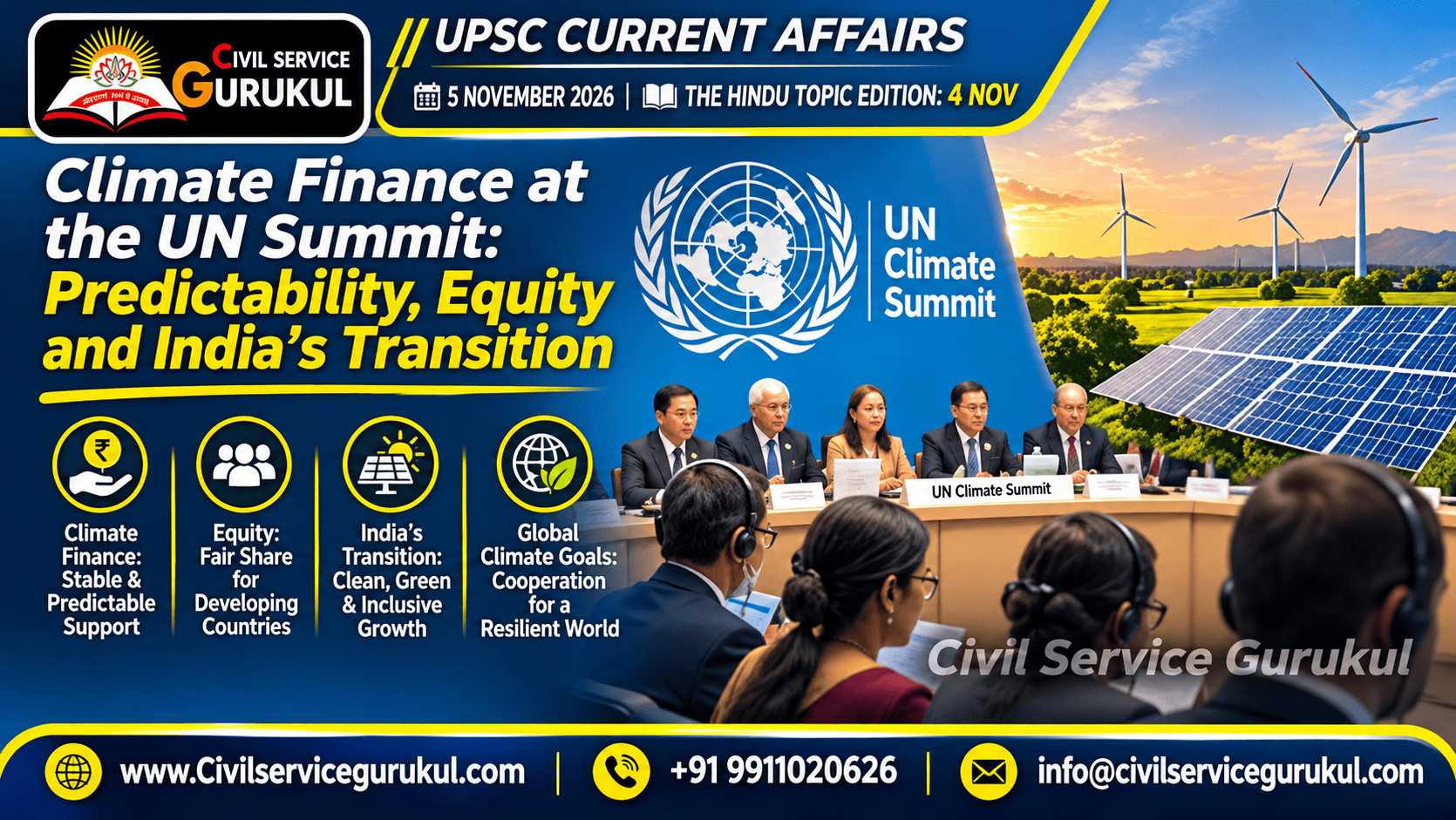
UPSC CURRENT AFFAIRS | INTERNATIONAL RELATIONS | ENVIRONMENT
India's Climate Finance Diplomacy 2026: UN Climate Summit, $300 Billion Goal, Climate Justice and Equitable Energy Transition
Complete UPSC Prelims and Mains analysis of international climate finance, India's negotiating priorities, global climate governance and sustainable development.
Published: 5 November 2026
1. Why Is Climate Finance in News?
A current-affairs topic index dated 4 November 2026 highlighted India's intention to push for predictable climate finance and an equitable transition at a key United Nations climate summit.
The issue reflects a longstanding debate between developed and developing countries over climate responsibility, financial support and development needs.
For India, climate finance is closely connected with energy security, economic development, adaptation, industrial transition and climate justice.
The dated headline indicates a negotiating priority. It should not be interpreted as confirmation of a new summit agreement.
2. What Is Climate Finance?
Climate finance refers broadly to financial resources used to support activities addressing climate change.
These resources may come from public, private, domestic or international sources.
Climate finance supports several major objectives.
Mitigation
Reducing greenhouse gas emissions or enhancing carbon sinks.
Adaptation
Reducing vulnerability to climate change impacts.
Loss and Damage
Addressing harms associated with climate impacts that cannot be fully avoided through mitigation or adaptation.
Resilience
Strengthening the capacity of communities, economies and infrastructure to withstand climate-related shocks.
3. Why Is Climate Finance Important for Developing Countries?
Developing countries often face the combined challenge of economic development and climate action.
They must expand energy access, infrastructure and employment while responding to climate risks.
Many developing economies also face high borrowing costs and limited fiscal space.
Predictable international finance can help countries plan long-term climate investments.
- Renewable energy expansion.
- Electricity grid modernization.
- Climate-resilient agriculture.
- Flood and drought preparedness.
- Low-carbon transport.
- Industrial decarbonisation.
- Coastal protection.
4. UNFCCC: Foundation of Global Climate Governance
The United Nations Framework Convention on Climate Change was adopted in 1992.
Its objective is to stabilize greenhouse gas concentrations at a level that prevents dangerous human interference with the climate system.
The UNFCCC recognizes that countries have different historical responsibilities and capabilities.
This principle forms an important basis for international climate negotiations.
5. Common but Differentiated Responsibilities and Respective Capabilities
CBDR-RC stands for Common but Differentiated Responsibilities and Respective Capabilities.
It recognizes that climate change is a common global challenge, but countries differ in their contributions to the problem and their capacity to respond.
Core Principles
- All countries have responsibilities for climate action.
- Responsibilities and capacities are not identical.
- Developed countries have important leadership obligations.
- Development circumstances must be considered.
- International cooperation should reflect equity.
6. Paris Agreement and Climate Finance
The Paris Agreement was adopted in 2015 under the UNFCCC.
Its provisions are important for understanding climate finance and national climate action.
| Article | Key Focus |
|---|---|
| Article 2 | Temperature goals, adaptation and aligning finance flows with climate-resilient, low-emission development |
| Article 4 | Mitigation commitments and nationally determined contributions |
| Article 9 | Climate finance, including developed-country obligations to provide financial resources |
Article 9 is particularly important for UPSC questions on international climate finance.
7. COP29 and the New Collective Quantified Goal
At COP29 in Baku, Azerbaijan, in 2024, countries agreed on a new collective quantified goal on climate finance.
The goal calls for at least USD 300 billion annually by 2035 for developing countries, with developed countries taking the lead.
The broader decision also calls for scaling climate finance from all public and private sources toward USD 1.3 trillion per year by 2035.
8. Why Does India Demand Predictable Climate Finance?
Predictability means that countries can reasonably anticipate the availability, timing and conditions of financial support.
Uncertain funding can complicate multi-year infrastructure and adaptation planning.
Major Concerns
- Difference between announced pledges and actual disbursements.
- Uncertainty regarding future funding availability.
- High borrowing costs.
- Complex approval procedures.
- Inadequate grant-based support.
- Limited resources for adaptation.
- Potential debt burdens.
Predictable finance requires transparent reporting and credible delivery mechanisms.
9. Grants, Loans and Concessional Climate Finance
Climate finance can be provided through different financial instruments.
| Instrument | Characteristics | Major Concern |
|---|---|---|
| Grants | Generally do not require repayment | Limited availability |
| Concessional Loans | Loans offered on more favourable terms than market borrowing | Repayment obligations remain |
| Commercial Loans | Market-based financing | Potentially high borrowing costs |
| Guarantees | Risk-sharing instruments supporting investment | Complex valuation and accounting |
| Equity Investment | Capital invested in exchange for ownership interests | Commercial return expectations |
Climate finance quality should not be judged only by the headline amount.
Grant equivalence, repayment terms and actual accessibility also matter.
10. Climate Justice and Historical Responsibility
Climate justice examines the fair distribution of climate-related responsibilities, risks and resources.
Countries and communities that have contributed less to historical emissions may nevertheless face severe climate impacts.
Climate justice therefore connects environmental protection with equity, development and international cooperation.
Key Dimensions
- Historical responsibility.
- Development needs.
- Vulnerability to climate impacts.
- Access to finance and technology.
- Intergenerational equity.
- Fair distribution of transition costs.
11. What Is an Equitable or Just Energy Transition?
A just transition seeks to make the shift toward a lower-carbon economy fair for workers, communities and affected regions.
The transition may create new opportunities in clean energy, manufacturing and technology.
However, it may also create economic challenges for regions dependent on fossil-fuel industries.
Important Elements
- Worker reskilling.
- Employment diversification.
- Social protection.
- Affordable energy access.
- Regional development support.
- Community participation.
- Inclusive industrial policies.
12. India's Energy Transition and Development Priorities
India's climate transition must balance energy security, economic growth, employment and environmental sustainability.
Potential investment priorities include:
- Renewable energy generation.
- Electricity transmission and distribution.
- Energy storage.
- Energy efficiency.
- Cleaner industrial technologies.
- Low-emission transport.
- Climate-resilient infrastructure.
The availability and cost of finance influence the feasibility of these investments.
13. Adaptation Finance: Why It Matters
Adaptation finance supports measures that reduce exposure and vulnerability to climate change impacts.
For India, adaptation needs may include:
- Drought-resilient agriculture.
- Flood management.
- Heat action plans.
- Water conservation.
- Coastal protection.
- Resilient public infrastructure.
- Early warning systems.
Many adaptation projects generate public benefits without producing direct commercial revenue.
This can strengthen the case for grants and highly concessional finance.
14. Loss and Damage Finance
Loss and damage concerns climate-related harms that cannot be fully avoided through mitigation and adaptation.
Examples may include:
- Damage from extreme weather events.
- Loss of livelihoods.
- Destruction of infrastructure.
- Coastal land loss.
- Non-economic losses affecting communities and ecosystems.
International arrangements for responding to loss and damage are distinct from ordinary mitigation project finance.
15. Important International Climate Finance Mechanisms
| Mechanism | Major Purpose |
|---|---|
| Green Climate Fund | Supports mitigation and adaptation in developing countries |
| Global Environment Facility | Finances eligible global environmental projects and programmes |
| Adaptation Fund | Supports concrete adaptation projects and programmes |
| Fund for Responding to Loss and Damage | Supports responses to climate-related loss and damage in vulnerable developing countries |
| Multilateral Development Banks | Provide loans, guarantees and other development finance instruments |
16. Challenges in Global Climate Finance
Insufficient Funding
Climate investment needs may exceed available international financial support.
Debt Sustainability
Loan-heavy finance can create repayment pressures.
Transparency
Different reporting methods can make comparisons difficult.
Adaptation Gap
Adaptation needs may receive less financing than required.
Access Barriers
Complex procedures can disadvantage countries and institutions with limited administrative capacity.
Delivery Delays
Funding announcements do not necessarily translate into immediate disbursements.
17. Way Forward: Making Climate Finance Effective
- Improve predictability of financial commitments.
- Publish transparent and comparable finance data.
- Distinguish grants from loans and other instruments.
- Use grant-equivalent measures where appropriate.
- Expand affordable finance for adaptation.
- Reduce unnecessary access barriers.
- Support technology cooperation and capacity building.
- Protect livelihoods in transitioning regions.
- Strengthen monitoring of project outcomes.
- Ensure local communities participate in climate planning.
18. UPSC Prelims Quick Revision
- UNFCCC was adopted in 1992.
- Paris Agreement was adopted in 2015.
- CBDR-RC recognizes differentiated responsibilities and capabilities.
- Article 2 of the Paris Agreement includes alignment of finance flows with climate goals.
- Article 4 addresses mitigation and nationally determined contributions.
- Article 9 addresses climate finance.
- COP29 was held in Baku, Azerbaijan, in 2024.
- COP29 established an NCQG of at least USD 300 billion annually by 2035 for developing countries, with developed countries taking the lead.
- The broader COP29 finance decision calls for scaling finance toward USD 1.3 trillion annually by 2035.
- Adaptation finance differs from mitigation finance.
- Loss and damage is a distinct area of international climate cooperation.
19. UPSC Prelims Practice MCQs
Question 1
Which article of the Paris Agreement deals specifically with climate finance?
- Article 2
- Article 4
- Article 9
- Article 21
Article 9 contains key provisions concerning climate finance.
Question 2
CBDR-RC is associated with:
- International monetary exchange rates
- Common but Differentiated Responsibilities and Respective Capabilities
- Global maritime navigation rules
- International intellectual property registration
CBDR-RC is an important principle of international climate governance.
Question 3
COP29 in 2024 was held in:
- Paris
- Dubai
- Baku
- Glasgow
COP29 was held in Baku, Azerbaijan.
Question 4
The COP29 New Collective Quantified Goal includes a finance target of at least:
- USD 30 billion annually by 2030
- USD 100 billion annually by 2025
- USD 300 billion annually by 2035
- USD 3 trillion annually by 2030
The COP29 goal specifies at least USD 300 billion annually by 2035 for developing countries, with developed countries taking the lead.
Question 5
Which of the following best describes adaptation finance?
- Finance used only for increasing fossil-fuel extraction
- Finance supporting measures that reduce vulnerability to climate impacts
- Finance exclusively for international trade
- Finance that must always generate commercial profits
Adaptation finance supports actions that reduce vulnerability and exposure to climate change impacts.
20. UPSC Mains Practice Questions
GS Paper II — International Relations
Question: Examine India's demand for predictable and equitable climate finance in the context of global climate negotiations. (250 words)
GS Paper III — Environment
Question: Discuss the major challenges in financing climate mitigation and adaptation in developing countries. (250 words)
GS Paper IV — Ethics
Question: Climate justice requires balancing historical responsibility, development needs and intergenerational equity. Discuss. (150 words)
21. Model UPSC Mains Answer
Question: Evaluate the need for predictable and equitable international climate finance for India.
Introduction:
Climate finance is essential for enabling developing countries to pursue mitigation, adaptation and climate-resilient development.
Body:
- Equity: CBDR-RC recognizes differences in responsibility and capability.
- Development: India must balance economic growth, energy access and emissions reduction.
- Predictability: Reliable funding supports long-term infrastructure planning.
- Affordability: Grants and concessional finance can reduce debt pressures.
- Adaptation: Vulnerable communities require support for climate resilience.
- Just transition: Workers and regions affected by economic restructuring need protection.
- Accountability: Transparent reporting is necessary to distinguish pledges from actual delivery.
Conclusion:
A credible climate finance framework must combine adequate resources, predictable delivery, fair financial terms and measurable outcomes.
22. Key Takeaways for UPSC Aspirants
- Understand the UNFCCC and Paris Agreement framework.
- Remember CBDR-RC and climate justice.
- Differentiate the COP29 USD 300 billion goal from the broader USD 1.3 trillion scaling ambition.
- Distinguish grants, loans and concessional finance.
- Explain mitigation, adaptation and loss and damage separately.
- Connect India's climate diplomacy with energy security and development.
- Include just transition and livelihood protection in Mains answers.
- Use transparent finance accounting and accountability as practical reforms.
Frequently Asked Questions
What is climate finance?
Climate finance refers broadly to financial resources supporting climate mitigation, adaptation and related climate-response activities.
Why is India demanding predictable climate finance?
Predictable finance helps countries plan long-term climate investments and reduces uncertainty over funding availability and timing.
What is the COP29 climate finance goal?
COP29 established a new goal of at least USD 300 billion annually by 2035 for developing countries, with developed countries taking the lead.
What is CBDR-RC?
It means Common but Differentiated Responsibilities and Respective Capabilities, a principle recognizing different national responsibilities and capacities.
Which Paris Agreement article deals with climate finance?
Article 9 contains important provisions on climate finance.
What is a just energy transition?
It is an approach to decarbonisation that also considers workers, communities, energy affordability and development needs.
Is this topic important for UPSC 2027?
Yes. It connects international relations, climate governance, environmental policy, economic development and ethics.
Prepare for UPSC with Civil Service Gurukul
Strengthen your UPSC preparation with current affairs, international relations, environment notes, Prelims MCQs and structured Mains answer writing.
Visit Civil Service GurukulWebsite: www.civilservicegurukul.com
Mobile: +91 9911020626
Email: info@civilservicegurukul.com
Prepare with Mentors Who Cleared the Exam
Get personalized study plans, evaluated answer models, and test series access.