Ghana's BRICS Membership Bid 2026: Strategic Importance, India–Africa Relations & World Geography for UPSC
Ghana's BRICS Membership Bid 2026: Strategic Importance, India-Africa Relations & World Geography for UPSC
Why is Ghana seeking closer cooperation with BRICS? Explore this West African country's geography, natural resources, economic significance and strategic relationship with India.
Why Is Ghana in the News?
Ghana's Cabinet has approved the country's plan to formally seek membership in BRICS, the grouping of major emerging economies.
The decision was announced in Accra on 6 October 2026 by Ghana's Foreign Affairs Minister Samuel Okudzeto Ablakwa during a visit by India's External Affairs Minister, Dr S. Jaishankar.
Ghana views closer engagement with BRICS as an opportunity to diversify its economic partnerships, attract investment and strengthen its participation in South-South cooperation.
This development is important for UPSC because it connects African geography, emerging global institutions, resource diplomacy and India's engagement with the Global South.
1. Ghana: Country Profile and Key Facts
Ghana is a country situated in West Africa, along the Atlantic coast of the Gulf of Guinea. It has a historically important role in African decolonisation and occupies a significant position in regional economic and political cooperation.
| Parameter | Important Information |
|---|---|
| Official Name | Republic of Ghana |
| Capital | Accra |
| Continent | Africa |
| Region | West Africa |
| Official Language | English |
| Currency | Ghanaian Cedi |
| Independence | 6 March 1957 |
| Former Colonial Name | Gold Coast |
| Independence Leader | Kwame Nkrumah |
| Political System | Unitary Presidential Republic |
| Coastline | Gulf of Guinea, Atlantic Ocean |
2. Ghana on the World Map: Geographical Location
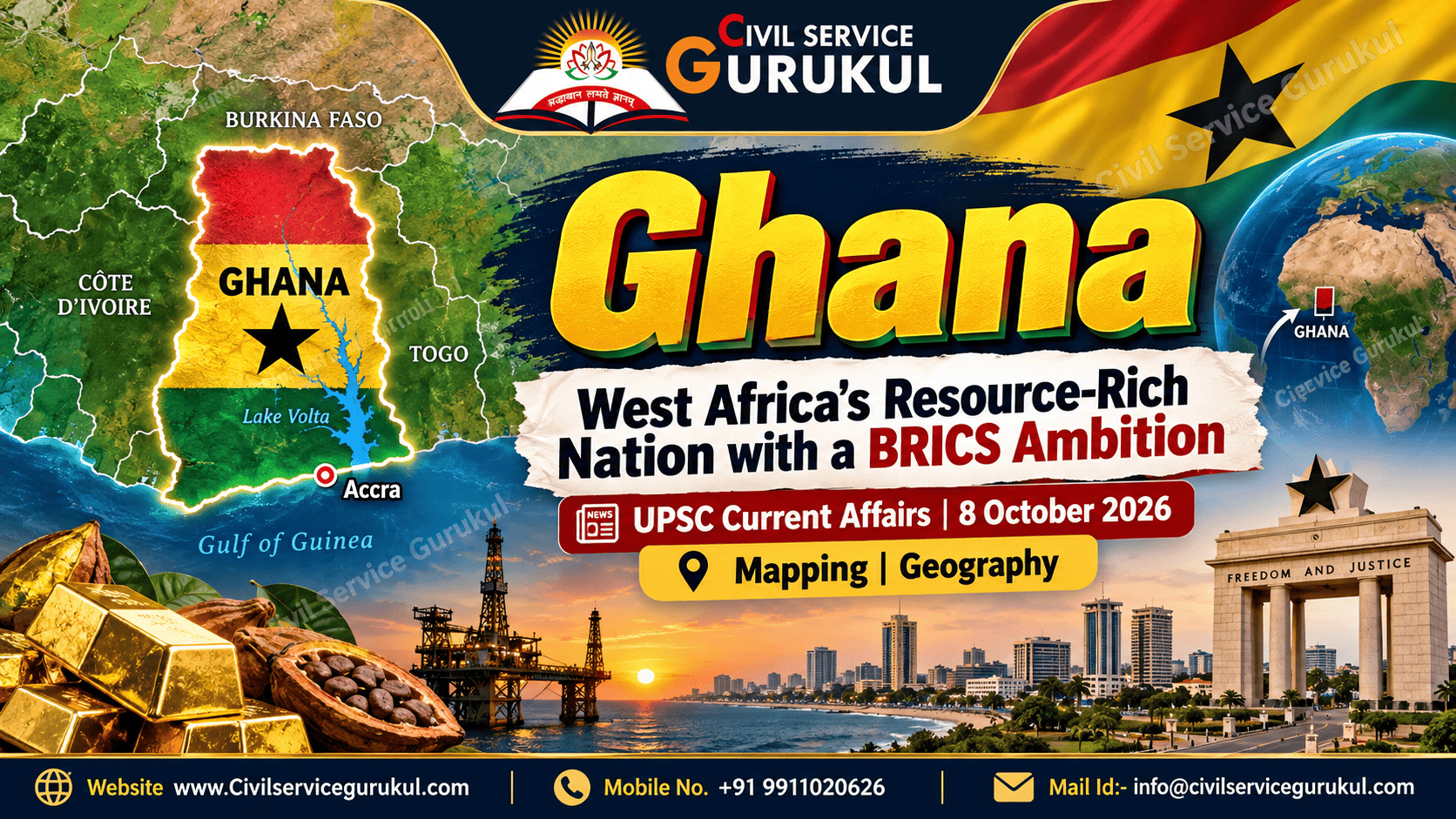
Ghana lies on the southern coast of West Africa. It is located slightly north of the Equator, and the Prime Meridian passes through the country.
Neighbouring Countries of Ghana
- North: Burkina Faso
- West: Côte d'Ivoire (Ivory Coast)
- East: Togo
- South: Gulf of Guinea, part of the Atlantic Ocean
Remember Ghana's three land neighbours through the sequence:
Ivory Coast – Ghana – Togo from west to east, with Burkina Faso to the north.
The Gulf of Guinea lies to the south.
Why Is the Gulf of Guinea Important?
The Gulf of Guinea is a major maritime region along the western African coastline. Its importance arises from:
- International commercial shipping routes.
- Offshore oil and gas production.
- Fishing resources and maritime livelihoods.
- Coastal ports and trade infrastructure.
- Regional maritime security concerns.
The location of Ghana provides access to Atlantic trade routes and strengthens its potential role in regional logistics and commercial cooperation.
3. Ghana's Physical Geography
A. Volta River Basin
The Volta River system is among the most significant drainage systems of West Africa.
It includes the Black Volta, White Volta and Oti River, which contribute to the larger Volta drainage network.
B. Lake Volta
Lake Volta is a vast artificial reservoir created following the construction of the Akosombo Dam.
- Located in eastern Ghana.
- Important for hydroelectric power generation.
- Supports fisheries and water transport.
- Among the largest man-made reservoirs in the world by surface area.
C. Relief and Landscapes
Ghana contains coastal plains, forest-covered areas, plateaus, river valleys and savanna landscapes.
Its upland features include the Akwapim-Togo Ranges and Mount Afadjato, commonly cited as Ghana's highest mountain.
D. Climate
Ghana experiences a tropical climate influenced by the seasonal movement of the Intertropical Convergence Zone (ITCZ).
- Southern Ghana generally has humid tropical conditions.
- Northern Ghana experiences a pronounced wet and dry seasonal cycle.
- Southwesterly winds from the Atlantic bring moisture and seasonal rainfall.
- The Harmattan is a dry, dust-bearing northeasterly wind associated with the Sahara.
4. Why Is Ghana Economically Important?
Ghana possesses significant natural resources and plays an important role in the West African economy.
Major Natural Resources
| Resource | Economic Significance |
|---|---|
| Gold | Major mineral export and source of foreign exchange. |
| Cocoa | Important agricultural export and rural livelihood source. |
| Crude Oil | Supports energy production and export revenue. |
| Bauxite | Potential input for aluminium and mineral-based industries. |
| Manganese | Industrial mineral used, among other applications, in steel production. |
| Diamonds | Part of Ghana's historical mineral resource base. |
The Historical Gold Coast
Before independence, the territory was widely known as the Gold Coast. The name reflected its long history of gold production and commercial interactions along the West African coast.
Cocoa Economy
Ghana is an important cocoa-producing country. Cocoa contributes to rural employment, agricultural exports and agro-processing opportunities.
For developing economies, moving from raw commodity exports to domestic value addition can create jobs and support industrialisation.
5. What Is BRICS?
BRICS is a forum of emerging economies that promotes dialogue and cooperation on development, finance, political coordination and global governance reform.
The original BRIC grouping involved Brazil, Russia, India and China. South Africa subsequently joined, resulting in the name BRICS.
Key Areas of Cooperation
- Trade and investment cooperation.
- Development finance.
- Reform of multilateral institutions.
- Greater representation for emerging economies.
- Technology and infrastructure collaboration.
- South-South development partnerships.
6. Why Does Ghana Want to Join BRICS?
1. Diversification of Economic Partnerships
Ghana seeks to broaden its international economic relationships beyond traditional development and trade partners.
2. Greater Investment Opportunities
Closer engagement with emerging economies could increase opportunities in infrastructure, industrial development, energy and manufacturing.
3. Stronger Global South Cooperation
Ghana's proposed membership reflects growing interest among developing countries in institutions that can amplify their collective negotiating voice.
4. Industrialisation and Value Addition
Ghana could seek deeper technology, manufacturing and processing partnerships, particularly in cocoa, minerals, agriculture and energy.
5. Global Governance Reforms
An expanded BRICS grouping could provide additional opportunities for dialogue on international financial institutions and developing-country representation.
7. Strategic Significance of Ghana's BRICS Bid
Ghana's interest illustrates broader changes in international economic diplomacy.
Multipolarity
Countries increasingly engage with multiple centres of economic and political influence rather than depending exclusively on a single bloc.
Africa's Growing Role
African economies seek greater participation in global investment, development financing and international rule-making processes.
Resource Sovereignty
Resource-rich countries can use diversified partnerships to improve their ability to negotiate investment, processing and technology arrangements.
Institutional Limitations
However, wider cooperation does not automatically guarantee improved economic outcomes.
Actual benefits depend on implementation, creditworthiness, domestic reforms, infrastructure, financial stability and mutually beneficial agreements.
8. India-Ghana Relations: Why They Matter
India and Ghana share longstanding diplomatic engagement rooted in post-colonial cooperation, South-South solidarity and development partnerships.
A. Historical Cooperation
India's independence movement and Ghana's anti-colonial struggle form part of the broader history of Asian and African decolonisation.
Jawaharlal Nehru and Kwame Nkrumah were prominent figures in the emergence of post-colonial diplomacy and the Non-Aligned Movement.
B. Economic Partnership
- Trade in goods and industrial products.
- Pharmaceutical and healthcare cooperation.
- Technical and educational exchanges.
- Investment in manufacturing and other productive sectors.
- Capacity-building and development assistance.
C. Development Diplomacy
India's engagement with African countries includes training, skills development, technology cooperation and development-oriented partnerships.
D. Diplomatic Importance
Ghana's interest in BRICS provides another opportunity for dialogue between India and African countries on economic diversification, institutional reform and development.
9. Ghana's Role in African Regional Institutions
A. African Union (AU)
The African Union seeks to promote continental integration, cooperation, peace and development among African states.
B. ECOWAS
Ghana has a significant role in West African regional cooperation.
The Economic Community of West African States (ECOWAS) is associated with economic integration and regional collaboration.
C. African Continental Free Trade Area
The Secretariat of the African Continental Free Trade Area (AfCFTA) is located in Accra, Ghana.
AfCFTA aims to advance intra-African trade by progressively reducing barriers and supporting continental market integration.
10. Ghana's Independence and Historical Importance
Ghana achieved independence from British colonial rule on 6 March 1957.
Kwame Nkrumah played a central role in the independence movement and became one of the most influential advocates of Pan-Africanism.
Ghana's independence was historically significant because it became the first sub-Saharan African colony to gain independence from European colonial administration in the post-war wave of African decolonisation.
What Is Pan-Africanism?
Pan-Africanism is an intellectual and political movement emphasising solidarity, cooperation and self-determination among people of African descent and African societies.
It influenced continental integration, anti-colonial movements and African political thought.
11. Important Places in Ghana for UPSC Mapping
| Location | Why Important? |
|---|---|
| Accra | National capital and AfCFTA Secretariat. |
| Kumasi | Major urban centre associated with Ashanti history and culture. |
| Tema | Important maritime port and industrial centre near Accra. |
| Lake Volta | Large artificial reservoir and hydroelectric resource. |
| Akosombo Dam | Major hydroelectric project on the Volta River. |
| Lake Bosumtwi | Natural lake associated with a meteorite impact crater. |
| Cape Coast | Historical coastal centre connected with colonial-era trade. |
12. Ghana's BRICS Bid: Opportunities and Challenges
| Potential Opportunities | Possible Challenges |
|---|---|
| New trade relationships | Trade and regulatory barriers |
| Development finance opportunities | Debt sustainability risks |
| Technology partnerships | Limited industrial capacity |
| Stronger diplomatic engagement | Different interests among partners |
| Global South representation | Uncertain membership outcome |
| Resource-processing investment | Environmental and governance concerns |
13. UPSC Prelims: Quick Revision Facts
- Ghana is located in West Africa.
- Capital: Accra.
- Official language: English.
- Currency: Ghanaian Cedi.
- Former name: Gold Coast.
- Independence: 6 March 1957.
- Major independence leader: Kwame Nkrumah.
- Northern neighbour: Burkina Faso.
- Western neighbour: Côte d'Ivoire.
- Eastern neighbour: Togo.
- Southern maritime boundary: Gulf of Guinea.
- Important reservoir: Lake Volta.
- Major dam: Akosombo Dam.
- AfCFTA Secretariat: Accra.
- Current affairs: Ghana's proposed BRICS membership.
14. UPSC Prelims Practice MCQs
Consider the following statements about Ghana:
- Ghana is located in West Africa.
- The Prime Meridian passes through Ghana.
- Ghana is a landlocked country.
Which of the statements are correct?
(A) 1 only
(B) 1 and 2 only
(C) 2 and 3 only
(D) 1, 2 and 3
Ghana is situated in West Africa, the Prime Meridian passes through it, and it has a coastline along the Gulf of Guinea.
Which of the following countries does NOT share a land border with Ghana?
(A) Burkina Faso
(B) Togo
(C) Nigeria
(D) Côte d'Ivoire
Nigeria does not directly border Ghana. Togo lies between Ghana and Benin, with Nigeria farther to the east.
Lake Volta is primarily associated with which of the following?
(A) Ethiopia
(B) Ghana
(C) Kenya
(D) Morocco
Lake Volta is a large artificial reservoir in Ghana associated with the Akosombo Dam.
The Secretariat of the African Continental Free Trade Area is located in:
(A) Nairobi
(B) Addis Ababa
(C) Accra
(D) Johannesburg
The AfCFTA Secretariat is headquartered in Accra, Ghana.
With reference to Ghana's BRICS announcement in October 2026, which statement is correct?
(A) Ghana has automatically become a member.
(B) Ghana's Cabinet approved plans to seek membership.
(C) Ghana is one of the original BRIC members.
(D) Ghana has withdrawn from African regional cooperation.
Cabinet approval represents a step towards an application. It does not confer immediate BRICS membership.
15. UPSC Mains Answer-Writing Practice
"The growing interest of African countries in emerging multilateral groupings reflects a transformation in Global South diplomacy." Discuss with special reference to Ghana's proposed BRICS membership and India's engagement with Africa.
Suggested Answer Structure
Introduction: Explain Ghana's BRICS membership aspirations and the changing international economic environment.
Body:
- Explain the strategic importance of Africa in global governance.
- Examine economic diversification and investment opportunities.
- Discuss the role of South-South cooperation.
- Analyse India-Africa diplomatic and development relations.
- Assess membership uncertainty, financial risks and policy challenges.
Conclusion: Emphasise inclusive multilateralism, sustainable economic cooperation and African agency in global institutions.
16. UPSC GS Paper I: Geography Practice
Explain how the geographical location, climate, river systems and natural resources of Ghana influence its economic development and strategic importance in West Africa.
Answer-Writing Keywords
- Atlantic Ocean access.
- Gulf of Guinea maritime trade.
- Volta River Basin.
- Hydroelectricity and Akosombo Dam.
- Gold and cocoa exports.
- ITCZ and tropical climate.
- AfCFTA and regional connectivity.
17. Analytical Perspective: Ghana and the Global South
Ghana's proposed BRICS application reflects the interest of developing economies in expanding their diplomatic and financial options.
Such diversification may create new opportunities for investment, technology transfer and industrial development.
However, developing economies also need strong institutions, sustainable public finances, transparent infrastructure projects and productive domestic industries.
The long-term importance of Ghana's international economic partnerships will depend less on the number of institutions it joins and more on the quality of development outcomes it achieves.
18. Conclusion
Ghana occupies an important position in West Africa because of its Atlantic coastline, rich natural resources, historical leadership in African independence and regional economic institutions.
Its decision to seek BRICS membership highlights the growing significance of South-South cooperation and the diversification of international economic partnerships.
For India, stronger engagement with Ghana can complement broader Africa-focused diplomacy, trade relationships, technology cooperation and development partnerships.
For UPSC aspirants, Ghana represents an excellent example of the connection between physical geography, economic resources, regional organisations and contemporary international relations.
Final UPSC Revision Takeaways
- Ghana lies in West Africa along the Gulf of Guinea.
- Accra is the capital and hosts the AfCFTA Secretariat.
- Its land neighbours are Côte d'Ivoire, Burkina Faso and Togo.
- Lake Volta and Akosombo Dam are important geographical features.
- Ghana achieved independence in 1957.
- Gold, cocoa and petroleum are significant economic resources.
- Ghana has approved plans to apply for BRICS membership, not completed accession.
- The development is relevant to India-Africa relations and the evolving role of the Global South.
UPSC Preparation Formula: Map Location + Physical Geography + Economic Resources + Current Affairs + International Relations.
Prepare with Mentors Who Cleared the Exam
Get personalized study plans, evaluated answer models, and test series access.