
E100 Ethanol Fuel Rules 2026: UPSC Analysis
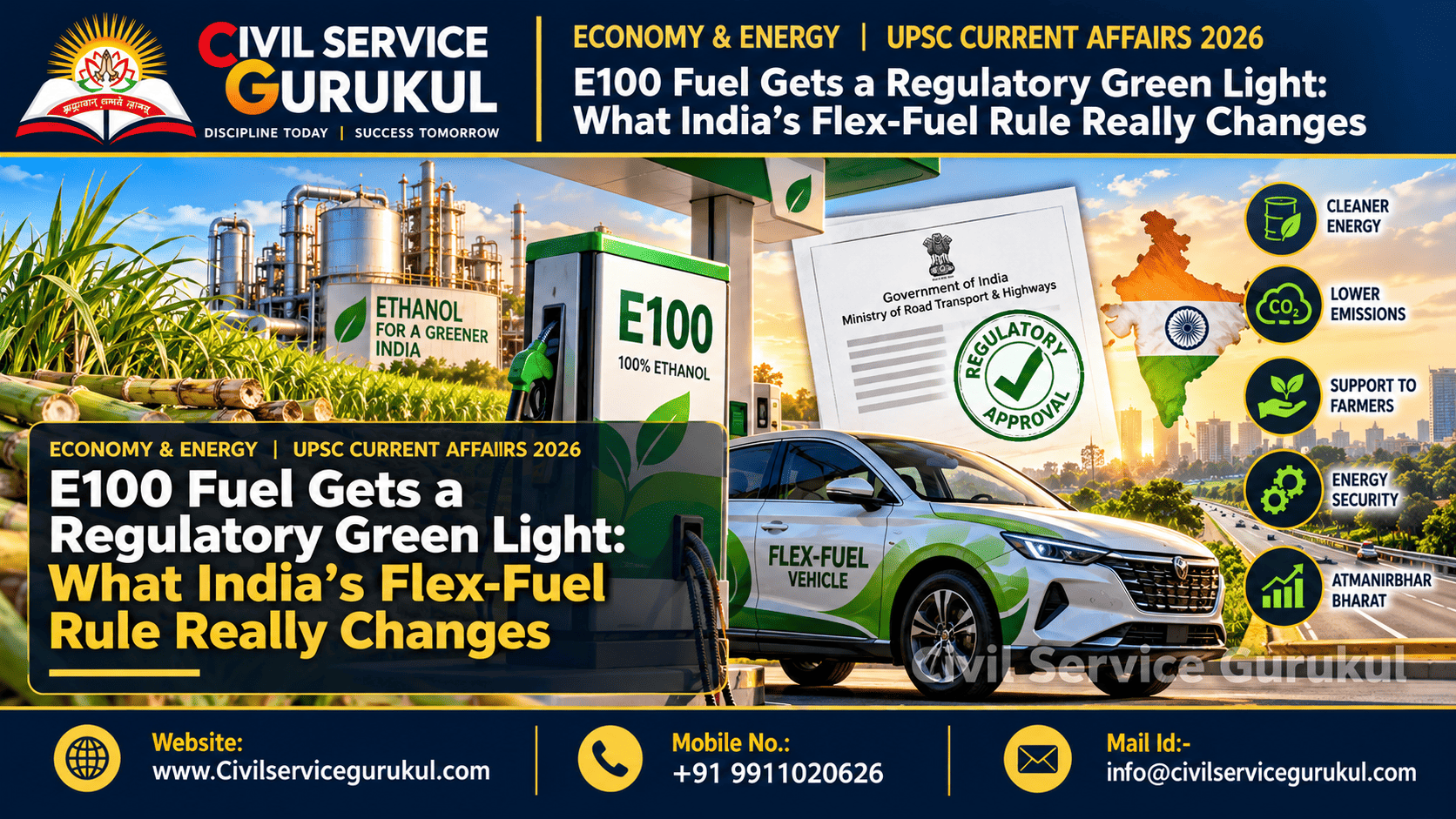
E100 Ethanol Fuel Rules 2026: India's Flex-Fuel Vehicle Policy, Energy Security and UPSC Analysis
Understanding India's reported October 2026 E100 regulatory amendment, fuel compatibility, energy diversification and sustainable transport challenges.
India's ethanol policy has often been discussed in terms of E20 petrol, which contains 20% ethanol by volume.
According to the supplied October 2026 report, the Ministry of Road Transport and Highways issued notification G.S.R. 911(E), dated 23 October 2026, recognising E100 alongside E85 in specified vehicle emission and testing provisions.
The amendment concerns vehicles specifically designed by original equipment manufacturers as flex-fuel vehicles.
It does not mean that conventional petrol vehicles or vehicles certified only for E20 can automatically use E100.
The development is relevant to energy security, agriculture, fuel standards, consumer protection and lifecycle environmental sustainability.
Prelims: Biofuels, ethanol blends, alternative energy and environmental science.
GS Paper II: Regulation, governance and consumer protection.
GS Paper III: Energy security, agriculture, environmental sustainability and economic development.
1. Why Is E100 Ethanol Fuel in the News?
India has been pursuing ethanol blending as part of its efforts to diversify transport fuels and reduce dependence on petroleum.
The policy discussion has primarily focused on E20 petrol, containing 20% ethanol and 80% petrol by volume.
The supplied October 2026 report describes a regulatory amendment that recognises higher ethanol concentrations for specially designed vehicles.
The important distinction is between creating a regulatory pathway for compatible vehicles and requiring all vehicles to use the new fuel.
2. What Is E100 Ethanol Fuel?
Ethanol is an alcohol that can be used as a transport fuel.
The letter E followed by a number commonly indicates the approximate ethanol percentage in a fuel blend.
E100 refers to essentially pure ethanol fuel.
Because ethanol has different combustion and material properties from petrol, high-ethanol operation requires appropriate engine and fuel-system design.
3. E20 vs E85 vs E100: Important Differences
| Fuel | Approximate Ethanol Content | Vehicle Compatibility |
|---|---|---|
| E20 | 20% ethanol by volume | Vehicles approved for E20 operation |
| E85 | 85% ethanol by volume | Appropriately designed and certified flex-fuel vehicles |
| E100 | Essentially pure ethanol | Vehicles specifically designed and certified for high-ethanol operation |
An E20-compatible vehicle should not be assumed to be compatible with E100.
Vehicle owners must follow the fuel specifications and compatibility instructions issued by the manufacturer.
4. What Changed Under the Reported October 2026 Rules?
The supplied report identifies notification G.S.R. 911(E), dated 23 October 2026, issued by the Ministry of Road Transport and Highways.
It describes amendments to provisions associated with Rule 115 of the Central Motor Vehicles Rules, 1989.
The reported amendment adds E100 alongside E85 in specified vehicle emission and testing provisions.
The change applies to vehicles designed by original equipment manufacturers for flex-fuel operation under the relevant requirements.
What the amendment does not establish
- It does not require every petrol vehicle to use E100.
- It does not make E100 suitable for ordinary E20 vehicles.
- It does not establish nationwide retail availability.
- It does not eliminate emission testing requirements.
- It does not prove that all manufacturers have begun commercial E100 production.
The distinction between regulatory permission and commercial implementation is central to understanding the development.
5. How Do Flex-Fuel Vehicles Work?
Flex-fuel vehicles are designed to operate on varying ethanol-petrol blends within the range approved by the manufacturer.
They require appropriate engine calibration and fuel-system components.
Important technical requirements
- Suitable fuel-system materials.
- Appropriate engine calibration.
- Fuel composition detection or suitable control strategies.
- Compatible injection and combustion systems.
- Emission control performance across approved blends.
Compatibility depends on the actual vehicle design and certification, not merely the presence of an electronic fuel-injection system.
6. How Can Ethanol Support India's Energy Security?
Domestic ethanol production can potentially substitute for part of the petrol consumed in road transport.
This may contribute to diversification of energy sources and reduced exposure to imported petroleum.
Potential benefits
- Greater diversification of transport fuels.
- Potential reduction in petrol import dependence.
- Development of domestic fuel-processing industries.
- Opportunities in distribution infrastructure.
- Additional markets for eligible agricultural feedstocks.
However, the scale of these benefits depends on actual ethanol production, fuel demand, vehicle adoption and distribution infrastructure.
7. Agricultural and Rural Economic Implications
Ethanol production can create demand for agricultural feedstocks and support related processing industries.
This may generate economic opportunities for farmers and rural value chains.
However, agricultural resources are limited, and fuel production must be balanced with food security and water sustainability.
The food-fuel-water nexus
The food-fuel-water nexus refers to the interdependence of food production, energy generation and water resources.
Expanding fuel-crop production may increase competition for agricultural land and irrigation water.
Policy decisions must therefore consider crop availability, groundwater conditions, food requirements and regional agricultural sustainability.
8. Is Ethanol Always Environmentally Sustainable?
Ethanol is often discussed as a renewable transport fuel.
However, its environmental performance depends on how it is produced.
Important factors affecting lifecycle emissions
- Feedstock cultivation.
- Fertiliser use.
- Irrigation requirements.
- Land-use change.
- Energy used in ethanol processing.
- Transport and distribution.
Therefore, tailpipe emissions alone cannot determine the overall environmental impact of ethanol.
Lifecycle assessment examines environmental impacts across production, processing, distribution and use.
A renewable fuel should not automatically be described as carbon-neutral without evaluating its full lifecycle.
9. Major Challenges in Implementing E100 Fuel
Introducing high-ethanol transport fuels requires coordination between vehicle manufacturers, fuel suppliers, regulators and consumers.
Key challenges
- Availability of compatible vehicles.
- Fuel quality assurance.
- Appropriate storage and distribution infrastructure.
- Clear fuel dispenser labelling.
- Consumer awareness.
- Protection against misfuelling.
- Lifecycle emissions monitoring.
- Water and agricultural resource management.
- Coordination of technical standards.
A regulatory certification pathway is an important step, but practical deployment requires additional infrastructure and market readiness.
10. Policy Priorities and the Way Forward
India's ethanol strategy should balance energy security with environmental sustainability and consumer protection.
Recommended policy measures
- Ensure clear fuel-pump labelling.
- Provide accurate manufacturer compatibility information.
- Coordinate vehicle testing and fuel-quality standards.
- Evaluate lifecycle greenhouse gas emissions.
- Monitor water footprints across feedstocks.
- Protect food security through transparent procurement rules.
- Promote water-efficient agricultural practices.
- Strengthen consumer grievance mechanisms.
- Assess commercial feasibility before large-scale deployment.
- Integrate ethanol policy with broader low-carbon mobility strategies.
11. UPSC Prelims Quick Revision Notes
- E20: Petrol blend containing 20% ethanol by volume.
- E85: Fuel containing approximately 85% ethanol.
- E100: Essentially pure ethanol fuel.
- Flex-fuel vehicle: Vehicle designed for approved varying ethanol-petrol blends.
- Regulatory framework: Central Motor Vehicles Rules, 1989.
- Relevant provision: Rule 115, concerning emission standards.
- Reported notification: G.S.R. 911(E), dated 23 October 2026.
- Key distinction: Vehicle certification does not guarantee fuel retail availability.
- Environmental concept: Lifecycle greenhouse gas assessment.
- Economic concept: Food-fuel-water nexus.
12. UPSC Prelims Practice MCQs
With reference to E100 ethanol fuel, consider the following statements:
- E100 refers to essentially pure ethanol fuel.
- All E20-compatible vehicles can automatically operate on E100.
- High-ethanol operation requires appropriate vehicle design.
Which statements are correct?
(a) 1 and 2 only
(b) 1 and 3 only
(c) 2 and 3 only
(d) 1, 2 and 3
E100 is essentially pure ethanol. Compatibility with E20 does not establish compatibility with E100, which requires appropriate vehicle design.
Which of the following best describes a flex-fuel vehicle?
(a) A vehicle that operates only on electricity.
(b) A vehicle designed to use approved varying ethanol-petrol blends.
(c) A vehicle that can use any liquid fuel without modification.
(d) A vehicle exempt from emission standards.
Flex-fuel vehicles are designed to operate on varying ethanol-petrol blends within the approved range.
Which of the following factors are relevant to the lifecycle environmental impact of ethanol?
- Fertiliser use.
- Land-use change.
- Energy used in processing.
Select the correct answer:
(a) 1 only
(b) 1 and 2 only
(c) 2 and 3 only
(d) 1, 2 and 3
Lifecycle assessment considers cultivation, processing, distribution and related environmental impacts.
A regulatory provision permitting certification of E100-compatible vehicles necessarily implies:
(a) E100 is available at every filling station.
(b) Every petrol vehicle can use E100.
(c) A certification pathway exists for vehicles meeting the applicable requirements.
(d) Ethanol has no environmental externalities.
Regulatory certification and commercial fuel availability are separate matters.
13. UPSC Mains Practice Questions
Question 1 — GS Paper III
Evaluate ethanol-based transport fuels as an instrument of India's energy security, with reference to lifecycle sustainability and consumer safeguards. (250 words)
Suggested Answer Framework
Ethanol-based transport fuels can diversify India's energy sources and potentially reduce dependence on imported petroleum.
The reported October 2026 amendment concerning E100 reflects a regulatory pathway for high-ethanol operation in compatible flex-fuel vehicles.
Potential benefits include import substitution, domestic processing opportunities and additional demand for eligible agricultural feedstocks.
However, lifecycle emissions, water use, land requirements, food security and vehicle compatibility create important challenges.
Effective implementation requires fuel-quality standards, consumer labelling, manufacturer certification, transparent agricultural procurement and environmental assessment.
Thus, ethanol should be evaluated as one component of a diversified and sustainable transport-energy strategy.
Question 2 — GS Paper III
Discuss the food-fuel-water nexus in India's biofuel policy. How can energy diversification be achieved without undermining agricultural sustainability? (150 words)
Answer Approach
- Define the food-fuel-water nexus.
- Explain the energy-security benefits of ethanol.
- Discuss competition for land and water.
- Highlight food-security concerns.
- Recommend efficient feedstocks and transparent procurement.
- Conclude with integrated sustainability assessment.
14. Frequently Asked Questions
What is E100 ethanol fuel?
E100 refers to essentially pure ethanol used as a transport fuel in appropriately designed vehicles.
What is the difference between E20 and E100?
E20 contains 20% ethanol by volume, while E100 refers to essentially pure ethanol fuel.
Can an E20-compatible car use E100?
Not merely because it accepts E20. E100 requires suitable manufacturer-designed and certified fuel-system compatibility.
Does the reported 2026 rule require E100 at all fuel pumps?
No. Vehicle certification and commercial fuel availability are separate matters.
What is a flex-fuel vehicle?
A flex-fuel vehicle is designed to operate on varying ethanol-petrol blends within its approved operating range.
Is ethanol always carbon-neutral?
No. Its lifecycle environmental impact depends on feedstock cultivation, processing energy, water use and land-use effects.
Why is E100 relevant for UPSC?
It connects energy security, agriculture, environmental sustainability, regulation and consumer protection.
15. Conclusion: E100 Is a Regulatory Opportunity, Not a Universal Fuel Mandate
The reported October 2026 E100 amendment represents an enabling regulatory development for compatible flex-fuel vehicles.
It should not be interpreted as a requirement for every petrol vehicle to use pure ethanol.
Ethanol can potentially contribute to energy diversification and domestic agricultural value chains.
However, the long-term success of high-ethanol fuels will depend on vehicle compatibility, fuel availability, consumer safeguards and lifecycle sustainability.
For UPSC aspirants, the central lesson is to distinguish regulatory permission from commercial implementation and to evaluate biofuels through economic, environmental and social dimensions.
Prepare for UPSC with Civil Service Gurukul
Strengthen your preparation for UPSC Prelims and Mains with concept-based current affairs, Indian Economy, Environment, Science and Technology, and answer-writing practice.
Website: www.civilservicegurukul.com
Mobile: +91 9911020626
Email: info@civilservicegurukul.com
Disclaimer: This article is intended for UPSC educational preparation. The October 2026 regulatory details follow the supplied source material and should be checked against the official Gazette before legal or operational reliance. Vehicle owners must follow manufacturer-approved fuel specifications.
Prepare with Mentors Who Cleared the Exam
Get personalized study plans, evaluated answer models, and test series access.