Internet Access as Fundamental Right: UPSC Notes 2026
Children's Right to Internet Access: Supreme Court's 2026 Judgment, Constitutional Rights and Online Safety Explained
Complete UPSC notes covering Articles 19 and 21, the proportionality doctrine, child-centred digital governance, judicial precedents, cyber safety, Prelims MCQs and a model Mains answer.
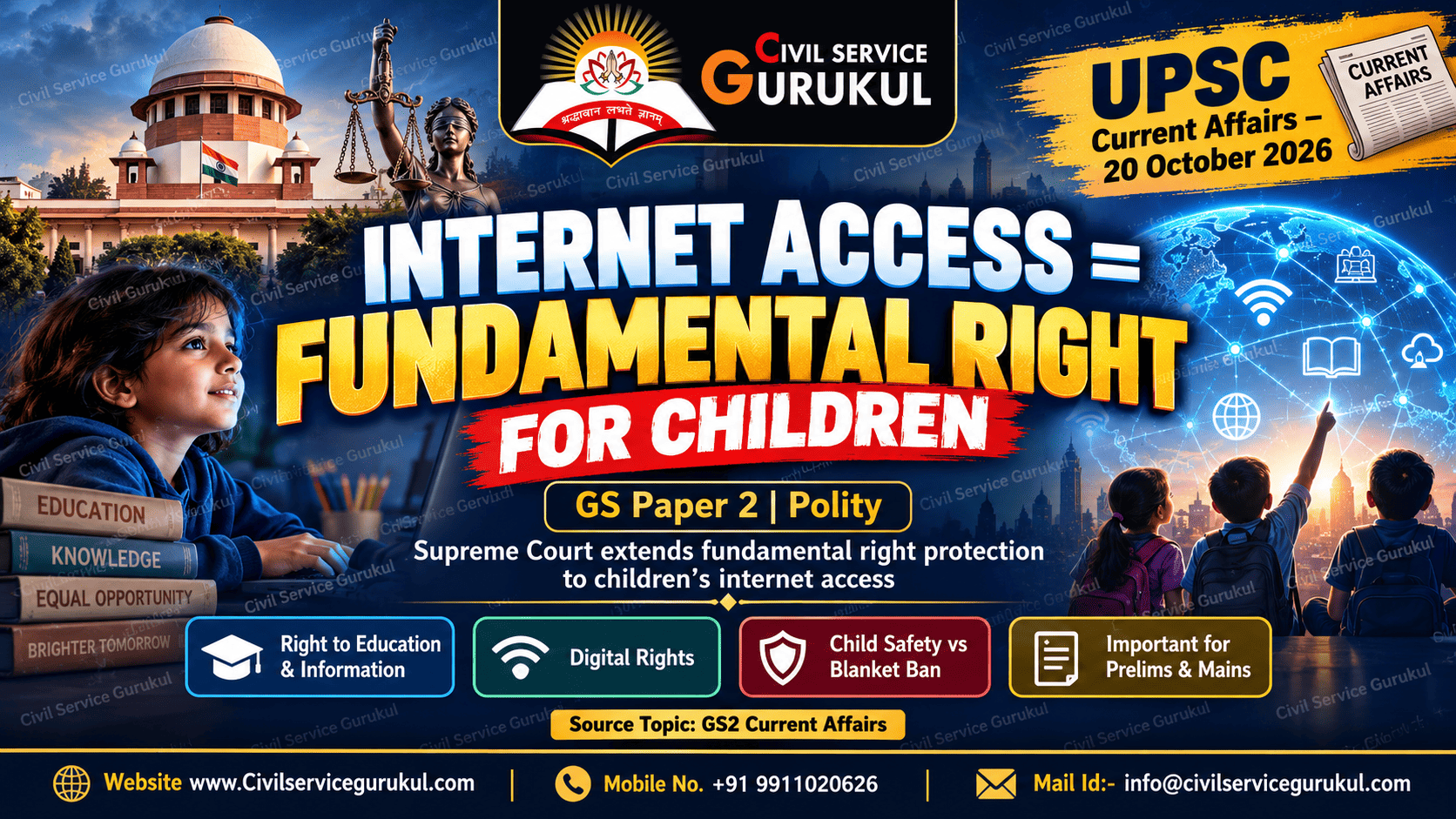
Why in News? In its October 2026 ruling concerning online child protection, the Supreme Court of India recognised the right to access and use the internet as a fundamental right under Article 21 read with Article 19(1)(a) of the Constitution. The Court clarified that this protection extends to children, while emphasising that digital safety requires proportionate safeguards rather than blanket exclusion.
UPSC Syllabus Relevance
GS Paper II: Indian Constitution, fundamental rights, judiciary, government policies, vulnerable sections and governance.
GS Paper III: Cybersecurity, information technology and emerging digital risks.
GS Paper IV: Ethical issues involving child autonomy, privacy, safety and platform responsibility.
Prelims: Constitutional articles, landmark judgments, POCSO Act and digital governance terminology.
1. Background: Why Did the Supreme Court Consider Children's Internet Rights?
Access to digital networks has become important for education, communication, access to information, creativity and participation in public life.
At the same time, children may encounter cyberbullying, exploitation, inappropriate content and privacy violations.
The Supreme Court considered these concerns in proceedings involving measures against child sexual exploitation and abuse material, commonly abbreviated as CSEAM.
The central constitutional question was whether children could be comprehensively denied online access in the name of safety.
The Court emphasised that preventing harm should not automatically mean excluding children from a medium central to contemporary life.
2. Constitutional Basis of the Right to Internet Access
| Article | Constitutional Protection | Relevance |
|---|---|---|
| 19(1)(a) | Freedom of speech and expression | Digital communication, access to ideas and expression |
| 19(2) | Permissible reasonable restrictions | Lawful and justified regulation of expression |
| 21 | Life and personal liberty | Dignity, autonomy and meaningful digital participation |
| 21A | Right to education for children aged 6–14 | Relevant to digital educational access |
| 14 | Equality before law | Non-arbitrary and inclusive digital governance |
| 15(3) | Special provisions for women and children | Constitutional basis for protective measures |
Article 19(1)(a): Digital Expression
The internet serves as a means for receiving information, expressing opinions and participating in public discussion.
Any restrictions on constitutionally protected expression must be evaluated under the relevant constitutional framework.
Article 21: Dignity and Autonomy
Modern digital access can affect an individual's education, independence, access to public services and social participation.
The Court's recognition links internet use with meaningful exercise of rights and personal dignity.
3. Important Supreme Court Judgments
| Case | Year | Significance |
|---|---|---|
| Secretary, Ministry of I&B v. Cricket Association of Bengal | 1995 | Right to impart and receive information under freedom of expression |
| Justice K.S. Puttaswamy v. Union of India | 2017 | Privacy recognised as a fundamental right |
| Anuradha Bhasin v. Union of India | 2020 | Constitutional protection for speech and trade carried on through the internet |
| Pragya Prasun v. Union of India | 2025 | Digital access and inclusion in relation to constitutional rights |
| Just Rights for Children Alliance proceedings | 2026 | Explicit recognition of internet access as a fundamental right, including for children |
Important Distinction for UPSC
Anuradha Bhasin did not declare that the State must provide free internet access to every individual.
Its focus included constitutional protection for speech and trade through the internet and scrutiny of restrictive measures.
The October 2026 judgment made an express statement regarding the right to access and use the internet itself.
4. Key Elements of the October 2026 Supreme Court Ruling
Fundamental Right Recognition
Internet access and use are constitutionally protected, including for children.
Opposition to Blanket Bans
Indiscriminate age-based exclusion is inconsistent with the Court's approach to children's rights.
Proportionate Safeguards
Protective measures should address actual harms without unnecessary interference with rights.
Platform Accountability
Digital intermediaries must contribute to detecting, reporting and removing unlawful exploitation material.
The Proportionality Principle
Constitutional review of rights restrictions typically examines whether a measure has a legitimate purpose, legal basis and rational connection to that purpose.
It also asks whether less restrictive alternatives exist and whether the overall interference with rights is justified.
For example, protecting children from harmful content may justify age-appropriate safeguards, but not necessarily the complete denial of digital access.
5. Child Mode and Online Safety Safeguards
The Supreme Court discussed the possibility of dedicated child modes for social-media accounts.
Such modes could incorporate safeguards suited to children's age and vulnerability.
- Accounts set to private by default.
- Controls over contact from unknown adults.
- Age-appropriate content moderation.
- Limitations on unsuitable advertising.
- Reasonable parental consent and oversight.
- Digital literacy and safer online behaviour.
Why Privacy Matters
Some age-verification systems collect sensitive personal information.
A child protection framework should avoid unnecessary surveillance or excessive collection of identifying data.
6. National Hash and URL List Database
The Court directed the creation of a national mechanism to support detection and removal of child sexual exploitation and abuse material.
The system is envisaged as a repository of verified digital identifiers and URLs, not a public collection of the harmful material itself.
How Would It Work?
- Potential harmful content is identified or reported through the appropriate channels.
- Specialised tools may assist preliminary screening.
- Trained human analysts independently verify suspected material.
- Verified hashes or URLs are entered into a secured database.
- Platforms check for matching material and take required action.
- Audit, correction and grievance mechanisms protect against errors.
Why Human Verification Is Important
Incorrect identification can lead to the removal of lawful information.
Verification, recordkeeping, independent auditing and appeals are therefore essential.
Prelims Concept: Hash
A digital hash is an identifier generated from data through a defined computational process.
Perceptual hashing can help identify visually similar content even where certain technical changes have been made.
Hash identifiers can support detection without storing the prohibited material itself in the shared list.
7. Why the Judgment Matters for India
Digital Education
Online learning can support access to educational resources, particularly where physical facilities are limited.
Equality and Inclusion
Protecting digital access is relevant for children in rural communities, economically disadvantaged households and marginalised groups.
Child Agency
Children require opportunities to learn, communicate and develop informed decision-making skills.
Constitutional Governance
The decision reinforces the principle that public-interest regulation must remain consistent with fundamental rights.
Technology Accountability
Digital platforms are expected to contribute to protecting users against serious online harms.
8. Challenges in Implementing Children's Digital Rights
Digital Divide
Unequal access to devices, affordable connectivity and digital literacy.
Online Exploitation
Risks associated with grooming, cyberbullying, harmful content and data misuse.
Privacy and Surveillance
Excessive age verification may increase sensitive data collection.
Implementation Costs
Smaller digital platforms may face substantial costs in building moderation and compliance systems.
The Governance Dilemma
A policy framework that is too permissive could leave children exposed to serious harm.
A framework that is too restrictive could undermine education, autonomy and freedom of expression.
The challenge is to build evidence-based protections without denying legitimate digital participation.
9. Way Forward: A Rights-Based Digital Childhood Framework
- Safety by Design: Encourage child-appropriate privacy settings and risk-aware default configurations.
- Digital Literacy: Strengthen online safety education for children, teachers and parents.
- Targeted Enforcement: Prioritise unlawful content and exploitative conduct rather than general exclusion.
- Privacy-Protective Verification: Minimise collection of unnecessary personal information.
- Institutional Coordination: Improve cooperation between government, law enforcement and digital platforms.
- Accessible Connectivity: Address affordability, digital accessibility and regional disparities.
- Independent Oversight: Provide transparent redressal and auditing of content-moderation decisions.
10. UPSC Prelims 2027: Quick Revision Notes
| Topic | Remember |
|---|---|
| Judgment | 15 October 2026 |
| Principal constitutional provisions | Articles 21 and 19(1)(a) |
| Bench | Justices J.B. Pardiwala and K. Vinod Chandran |
| Child protection approach | Proportionate safeguards rather than blanket internet bans |
| Child mode | Proposed age-appropriate account safeguards |
| CSEAM | Child Sexual Exploitation and Abuse Material |
| National database | Verified hash and URL identifiers |
| Important 2020 case | Anuradha Bhasin v. Union of India |
| Privacy case | Justice K.S. Puttaswamy v. Union of India |
| UPSC GS Paper | GS-II: Constitution, Polity and Governance |
11. UPSC Prelims Practice MCQs
Question 1
With reference to the Supreme Court's October 2026 ruling on internet access, consider the following statements:
- Internet access and use were recognised under Article 21 read with Article 19(1)(a).
- The protection applies only to adults.
- The Court opposed blanket bans on children's internet access.
(a) 1 only
(b) 1 and 3 only
(c) 2 and 3 only
(d) 1, 2 and 3
View correct answer
Answer: (b) 1 and 3 only.The Court expressly included children within the constitutional protection.
Question 2
The Supreme Court judgment in Anuradha Bhasin v. Union of India is most closely associated with:
(a) Freedom of speech and trade through the internet
(b) Abolition of judicial review
(c) Constitutional amendment of Article 21
(d) Uniform civil code
View correct answer
Answer: (a).The judgment examined restrictions affecting constitutional freedoms exercised through the internet.
Question 3
Which safeguards were discussed in relation to a dedicated child mode?
- Private-by-default accounts
- Restrictions on unsolicited messages from unknown adults
- Unrestricted behavioural advertising directed at children
(a) 1 and 2 only
(b) 2 and 3 only
(c) 1 and 3 only
(d) All three
View correct answer
Answer: (a) 1 and 2 only.Child mode was discussed as a protection-oriented design approach.
Question 4
The proposed National Hash and URL List Database is principally intended to:
(a) Store citizens' online passwords
(b) Support coordinated detection and removal of verified CSEAM
(c) Replace all internet service providers
(d) Maintain a national register of every social-media user
View correct answer
Answer: (b).The mechanism concerns verified digital identifiers and URLs of prohibited material.
Question 5
Which of the following best describes the proportionality principle in digital governance?
(a) Every restriction is valid if it concerns the internet
(b) Public authorities may impose restrictions without legal authority
(c) Restrictions must pursue legitimate aims while appropriately respecting rights
(d) Children have no fundamental rights online
View correct answer
Answer: (c).Proportionality examines legitimate purposes and the extent of rights interference.
12. UPSC Mains 2027: Model Answer
GS-II Practice Question — 15 Marks
"The recognition of internet access as a fundamental right places corresponding obligations on the State to ensure meaningful and equitable digital participation." Discuss with special reference to children's rights and online safety.
Suggested length: 250 words
Model Answer
Introduction: In October 2026, the Supreme Court recognised the right to access and use the internet under Article 21 read with Article 19(1)(a), including for children. The ruling acknowledges digital participation as increasingly important for dignity, education and expression.
Constitutional obligations: The State must respect freedom of expression, avoid arbitrary restrictions and adopt proportionate measures to secure legitimate safety objectives. Article 14 reinforces non-arbitrariness, while Article 21A highlights the importance of educational opportunity.
Barriers: Unequal connectivity, device affordability, digital illiteracy, language barriers and accessibility constraints limit meaningful participation. At the same time, online exploitation, harmful content and intrusive surveillance create additional risks.
Way forward: A rights-based framework should combine affordable digital infrastructure, school-level digital literacy, privacy-preserving design and strong enforcement against online exploitation. Child-appropriate account settings, independent oversight and effective grievance mechanisms can provide protection without blanket exclusion.
Conclusion: India must move beyond the false choice between digital access and child safety. Constitutional governance requires both meaningful inclusion and effective, proportionate protection.
Additional Mains Practice Questions
- Examine the constitutional limits on blanket restrictions on digital platforms for minors. (10 marks)
- Discuss the role of proportionality and privacy-by-design in child-centred digital governance. (15 marks)
- Digital exclusion can reinforce existing social inequality. Analyse with reference to Article 21 and educational access. (15 marks)
13. Frequently Asked Questions
Q1. Is the right to internet access explicitly written in the Constitution?
No separate article expressly bears that title. The Supreme Court has recognised the right through interpretation of existing fundamental rights.
Q2. Which articles were central to the 2026 ruling?
Article 21 read with Article 19(1)(a).
Q3. Does the ruling prevent all internet regulation for children?
No. Proportionate, lawful measures to protect children remain relevant.
Q4. What does child mode mean?
Age-appropriate platform settings designed to reduce exposure to online harms.
Q5. What is CSEAM?
Child Sexual Exploitation and Abuse Material.
Q6. Why is the topic important for UPSC?
It connects constitutional law, governance, digital inclusion, children's welfare and technology regulation.
14. Conclusion: Digital Access With Constitutional Safeguards
The October 2026 Supreme Court ruling provides an important framework for viewing internet access through the lens of fundamental rights.
For children, the objective is not unrestricted exposure to digital risks but meaningful participation supported by age-appropriate protections.
The way forward lies in combining constitutional freedoms with online safety, privacy, digital literacy and equitable access.
For UPSC aspirants, the central takeaway is that digital rights and child protection must be reconciled through proportionate and accountable governance.
Prepare for UPSC 2027 With Civil Service Gurukul
Join our Integrated Guidance Program for UPSC Prelims and Mains, including Indian Polity, Current Affairs, answer-writing practice, revision notes and conceptual preparation.
Enquire About Courses Visit Our WebsitePrepare with Mentors Who Cleared the Exam
Get personalized study plans, evaluated answer models, and test series access.