ELV Circular Economy Report 2026: UPSC Notes
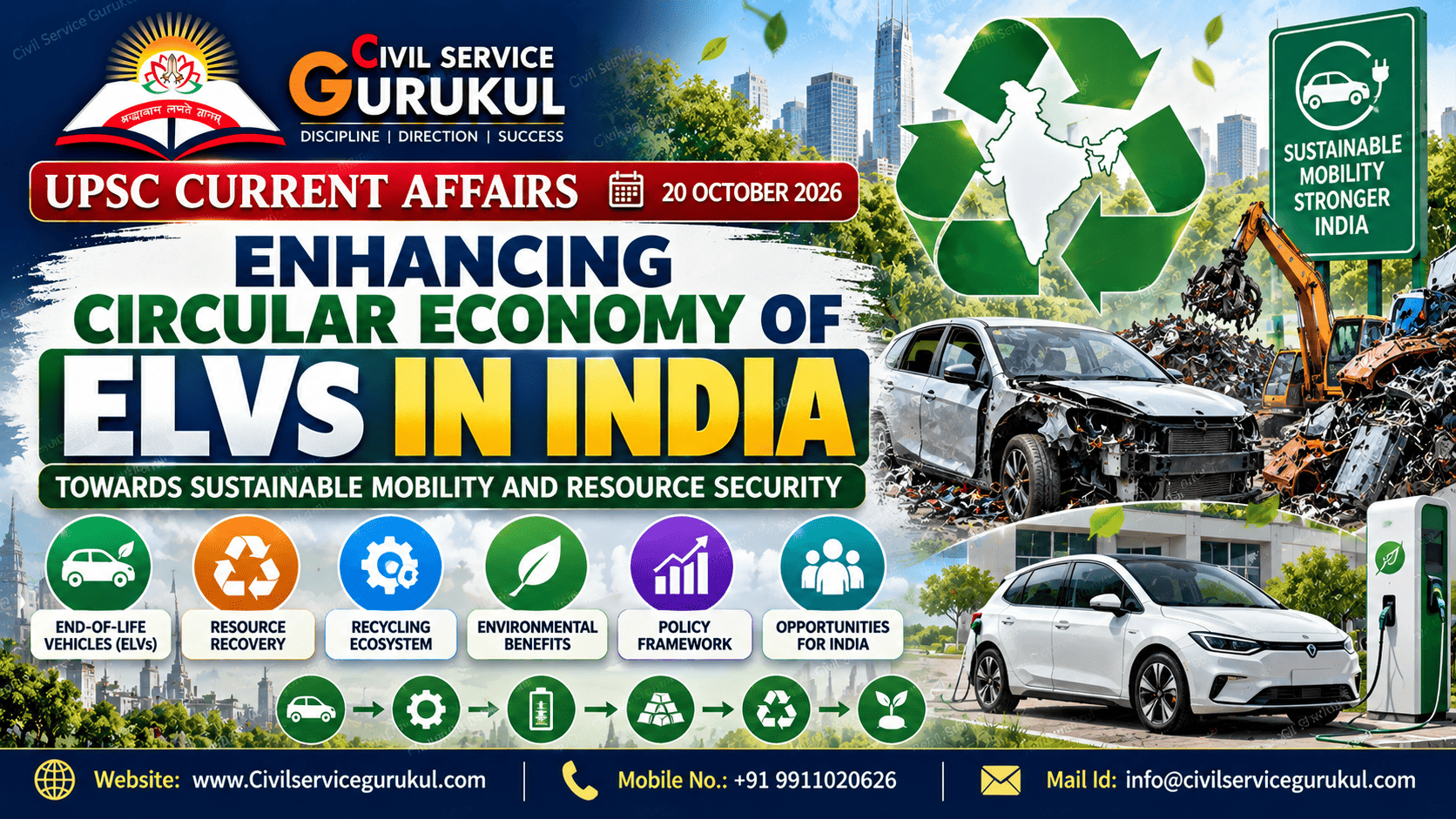
Enhancing Circular Economy of End-of-Life Vehicles in India: NITI Aayog Report 2026 Explained
India's projected 50 million end-of-life vehicles by 2030, recycling infrastructure, vehicle scrappage policy, Extended Producer Responsibility and complete UPSC Prelims–Mains notes.
Why in News? NITI Aayog's January 2026 report, prepared with research support from TERI, warns that the cumulative number of End-of-Life Vehicles (ELVs) in India could increase from approximately 23 million in 2025 to nearly 50 million by 2030. The report highlights the need for formal recycling, environmental protection, resource recovery, better infrastructure and effective implementation of vehicle scrapping reforms.
UPSC GS Section / Paper
GS Paper III: Environment, pollution, waste management, industrial development, resource efficiency and sustainable growth.
GS Paper II: Government policy, regulation and institutional coordination.
GS Paper I: Urbanisation and its environmental consequences.
Prelims: NITI Aayog, ELVs, EPR, RVSF, ATS, CoD and the VAHAN portal.
1. What Are End-of-Life Vehicles?
End-of-Life Vehicles are vehicles that are no longer roadworthy, are legally ineligible for use under applicable provisions, or are voluntarily surrendered for environmentally sound scrapping.
The precise legal treatment depends on registration, fitness, vehicle category and applicable rules. A vehicle's age alone should not be treated as universal proof that it must be scrapped.
Materials That Can Be Recovered
Ferrous Metals
Steel and iron from vehicle bodies and components.
Non-Ferrous Metals
Aluminium, copper and other recoverable metals.
Polymers and Glass
Recoverable plastic, rubber and glazing materials.
Hazardous Components
Batteries, fluids and contaminated parts needing special handling.
2. NITI Aayog's January 2026 Report
NITI Aayog released the report as part of a broader effort to strengthen circularity across material-intensive waste streams.
It was launched alongside separate reports concerning waste tyres and electronic waste and lithium-ion batteries.
The study examines environmental, regulatory, financial and infrastructure barriers in the vehicle-scrapping ecosystem.
| Particular | Details |
|---|---|
| Report title | Enhancing Circular Economy of End-of-Life Vehicles (ELVs) in India |
| Publisher | NITI Aayog |
| Knowledge partner | TERI |
| Publication | January 2026 |
| Launch | 22 January 2026, Jaipur |
| 2025 estimated cumulative stock | Nearly 23 million ELVs |
| 2030 projected cumulative stock | Nearly 50 million ELVs |
3. What Is a Circular Economy?
A circular economy seeks to keep materials and products in productive use for longer, reduce avoidable waste and recover value when products reach the end of their life.
For vehicles, it includes repair, reuse, responsible dismantling, materials recycling and safe disposal of hazardous residues.
Circular Vehicle Management
The priority is not simply to crush old vehicles. It is to recover useful resources while preventing environmental harm.
4. Why Are ELVs an Environmental and Economic Concern?
Air Pollution
Older and poorly maintained vehicles can generate substantial air pollution. Replacing high-emitting vehicles may improve air quality where supported by appropriate policies.
Soil and Water Pollution
Unscientific dismantling may release oil, coolants, fuel, battery chemicals and other hazardous substances.
Resource Loss
Failure to recover usable metals increases dependence on virgin raw materials.
Worker Safety
Unregulated dismantling can expose workers to physical injuries, toxic substances and unsafe working conditions.
Resource Security
Recovering steel, aluminium and copper supports domestic material availability and efficient manufacturing.
5. India's Vehicle Scrappage Policy Framework
India's scrappage ecosystem is governed through motor vehicle and environmental regulations, including requirements for vehicle fitness, scrapping facilities and relevant waste-management responsibilities.
Important Components
| Component | Purpose |
|---|---|
| Motor Vehicles Scrapping Facility Rules, 2021 | Regulate recognition and operation of vehicle scrapping facilities. |
| Automated Testing Station Rules | Provide framework for vehicle fitness testing. |
| VAHAN | Digital vehicle-registration information system. |
| V-Scrap | Digital functions relating to authorised vehicle scrapping. |
| Certificate of Deposit | Documents vehicle handover for authorised scrapping and supports eligible incentives. |
| Environment Protection Framework | Addresses relevant pollution-control and waste-management obligations. |
6. RVSFs and ATS: Important Differences
| Aspect | ATS | RVSF |
|---|---|---|
| Full Form | Automated Testing Station | Registered Vehicle Scrapping Facility |
| Main Role | Assesses vehicle fitness. | Receives and processes ELVs for scrapping. |
| Core Activity | Vehicle testing and inspection. | Depollution, dismantling and materials recovery. |
| Important Output | Fitness-related test result or certificate. | Relevant authorised scrapping documents. |
What Is a Certificate of Deposit?
The Certificate of Deposit is issued by an RVSF to recognise the transfer of the vehicle from the registered owner to the authorised scrapper.
It is important for eligible benefits associated with purchasing a new vehicle, subject to applicable rules.
7. Extended Producer Responsibility in ELV Management
Extended Producer Responsibility, or EPR, assigns specified end-of-life waste-management responsibilities to producers under the applicable regulatory framework.
In the vehicle sector, EPR can encourage formal recovery of materials and improve the accountability of producers and recyclers.
Report's Recommendations
The report suggests reviewing EPR targets in view of increasing formal scrapping capacity and projected ELV supply.
It also recommends reconsidering the treatment of automobile production scrap for EPR compliance.
These recommendations should be understood as proposed improvements to the framework, not automatically as changes already notified.
8. Why Has Formal Vehicle Scrapping Been Difficult?
Informal Competition
Informal dealers may offer higher prices because they avoid some formal compliance and infrastructure costs.
Limited Infrastructure
Some regions lack sufficient testing and registered scrapping facilities.
Complex Procedures
Vehicle owners can face difficulties with documents, ownership records and deregistration.
Inconsistent Incentives
Scrappage-related financial benefits and their implementation can vary across jurisdictions.
Why Do Informal Operators Attract Owners?
The report describes differences in prices, convenience and processing time between formal and informal channels.
Formalisation will require addressing these commercial realities, not merely imposing additional obligations.
9. Major Recommendations of the NITI Aayog Report
| Reform Area | Suggested Action |
|---|---|
| Scrapping Infrastructure | Expand RVSF coverage, including public or PPP-supported models where private investment is insufficient. |
| Fitness Testing | Improve ATS availability based on district vehicle density and demand. |
| Informal Sector | Support phased transition toward registered and environmentally compliant operations. |
| Financial Incentives | Promote more consistent Certificate of Deposit concessions. |
| Digital Reform | Improve VAHAN, V-Scrap, ownership-transfer and scrap-price discovery systems. |
| Deregistration | Link deregistration more closely to valid formal scrapping documentation, with specified exceptions. |
| Extended Producer Responsibility | Revisit targets and improve formal recovery incentives. |
| Tax and Finance | Examine sector-specific GST issues and financing mechanisms. |
| Carbon Markets | Develop an appropriate methodology for eligible recycling-related carbon credits. |
| Awareness | Explain legal, financial and environmental benefits of authorised scrapping. |
10. How Could a Stronger ELV Circular Economy Help India?
Material Recovery
Recycled metals can reduce part of the demand for primary raw materials.
Green Employment
Formal dismantling, repair, sorting and recycling can create skilled economic opportunities.
Pollution Prevention
Controlled depollution reduces the risk of hazardous materials entering soil and water.
Industrial Competitiveness
Reliable secondary materials can support manufacturing and resource efficiency.
Viksit Bharat 2047
Circularity aligns with India's ambition for a more sustainable, resource-efficient and competitive economy.
11. UPSC Prelims 2027: Quick Revision Table
| Term | Important Fact |
|---|---|
| ELV | End-of-Life Vehicle |
| Report Publisher | NITI Aayog |
| Knowledge Partner | TERI |
| Publication | January 2026 |
| Report Launch | 22 January 2026, Jaipur |
| 2025 Estimated ELVs | Nearly 23 million |
| 2030 Projected ELVs | Nearly 50 million |
| RVSF | Registered Vehicle Scrapping Facility |
| ATS | Automated Testing Station |
| EPR | Extended Producer Responsibility |
| CoD | Certificate of Deposit |
| MoRTH | Ministry of Road Transport and Highways |
| VAHAN | Vehicle-registration digital system |
| V-Scrap | Digital vehicle scrapping functions |
| Primary GS Paper | GS-III |
12. UPSC Prelims Practice MCQs
Question 1
The report "Enhancing Circular Economy of End-of-Life Vehicles in India" was published by:
(a) Reserve Bank of India
(b) NITI Aayog
(c) Election Commission
(d) Finance Commission
View answer
Answer: (b) NITI Aayog.
Question 2
Which of the following are correctly matched?
1. ATS — Automated Testing Station
2. RVSF — Registered Vehicle Scrapping Facility
3. EPR — Extended Producer Responsibility
(a) 1 only
(b) 1 and 2 only
(c) 2 and 3 only
(d) 1, 2 and 3
View answer
Answer: (d). All three are correctly matched.
Question 3
The principal function of an Automated Testing Station is:
(a) Issuing passports
(b) Assessing vehicle fitness
(c) Regulating the stock market
(d) Manufacturing new vehicles
View answer
Answer: (b).
Question 4
Which statement best explains a circular economy?
(a) Immediate disposal after product use
(b) Keeping materials in productive use and recovering value
(c) Complete elimination of manufacturing
(d) Exclusive reliance on virgin raw materials
View answer
Answer: (b).
Question 5
Consider the following statements:
1. The report projects nearly 50 million cumulative ELVs by 2030.
2. RVSFs are associated with formal vehicle scrapping.
3. Every vehicle older than 15 years must be scrapped regardless of fitness and category.
(a) 1 only
(b) 1 and 2 only
(c) 2 and 3 only
(d) All three
View answer
Answer: (b). Statement 3 makes an incorrect universal claim. Applicable rules depend on vehicle category, registration, fitness and other conditions.
13. UPSC Mains GS-III: Model Answer
Practice Question — 15 Marks
"Scientific management of end-of-life vehicles can transform an environmental liability into an economic resource." Discuss with reference to NITI Aayog's 2026 circular economy report.
Word limit: 250 words
Model Answer
Introduction: India's expanding vehicle fleet has increased the importance of managing end-of-life vehicles. NITI Aayog's 2026 report projects nearly 50 million cumulative ELVs by 2030, requiring an organised recycling ecosystem.
Opportunities: Scientific dismantling enables recovery of steel, aluminium, copper and other materials, reducing waste and dependence on virgin resources. Formal facilities can prevent hazardous releases and create green employment.
Challenges: Limited testing and scrapping infrastructure, informal sector competition, complex deregistration procedures and inconsistent financial incentives constrain formal participation.
Policy measures: The report recommends expanding Registered Vehicle Scrapping Facilities and Automated Testing Stations, improving Extended Producer Responsibility, strengthening VAHAN and V-Scrap platforms, simplifying documentation and providing more consistent Certificate of Deposit benefits.
Way forward: India should combine regulatory enforcement with incentives, finance, public awareness and inclusive formalisation of informal recyclers. Technology-enabled tracking and reliable material recovery standards can improve accountability.
Conclusion: A circular ELV ecosystem can advance resource efficiency, environmental protection and industrial competitiveness, supporting sustainable development and Viksit Bharat 2047.
14. Frequently Asked Questions
Q1. What does ELV stand for?
End-of-Life Vehicle.
Q2. Who published the ELV circular economy report?
NITI Aayog in January 2026.
Q3. What is the 2030 ELV projection?
Nearly 50 million cumulative end-of-life vehicles.
Q4. What is RVSF?
Registered Vehicle Scrapping Facility.
Q5. What is a Certificate of Deposit?
A document recognising transfer of a vehicle to an authorised scrapping facility and supporting eligible scrappage-linked benefits.
Q6. Which GS paper covers the topic?
Primarily GS-III, covering environment, economy, pollution and sustainable development.
15. Conclusion: Building a Circular Automotive Economy
India's projected growth in end-of-life vehicles makes vehicle recycling an increasingly important national policy issue.
Formal scrapping offers potential benefits through materials recovery, pollution prevention, industrial competitiveness and greener employment.
However, success depends on ensuring that authorised scrapping is convenient, financially attractive and available across regions.
For UPSC aspirants, the essential link is between circular economy principles, vehicle scrappage regulation, Extended Producer Responsibility and sustainable industrial development.
Prepare for UPSC 2027 with Civil Service Gurukul
Join the Integrated Guidance Program covering Indian Economy, Environment, Governance, Current Affairs, Prelims preparation and GS-III Mains answer writing.
For our Indian Economy study materials authored by CA Dhananjay Ojha, or to enrol in our courses, contact Civil Service Gurukul.
Contact for Books & Courses Visit Our WebsitePrepare with Mentors Who Cleared the Exam
Get personalized study plans, evaluated answer models, and test series access.