Educated Unemployment in India: UPSC Notes 2027
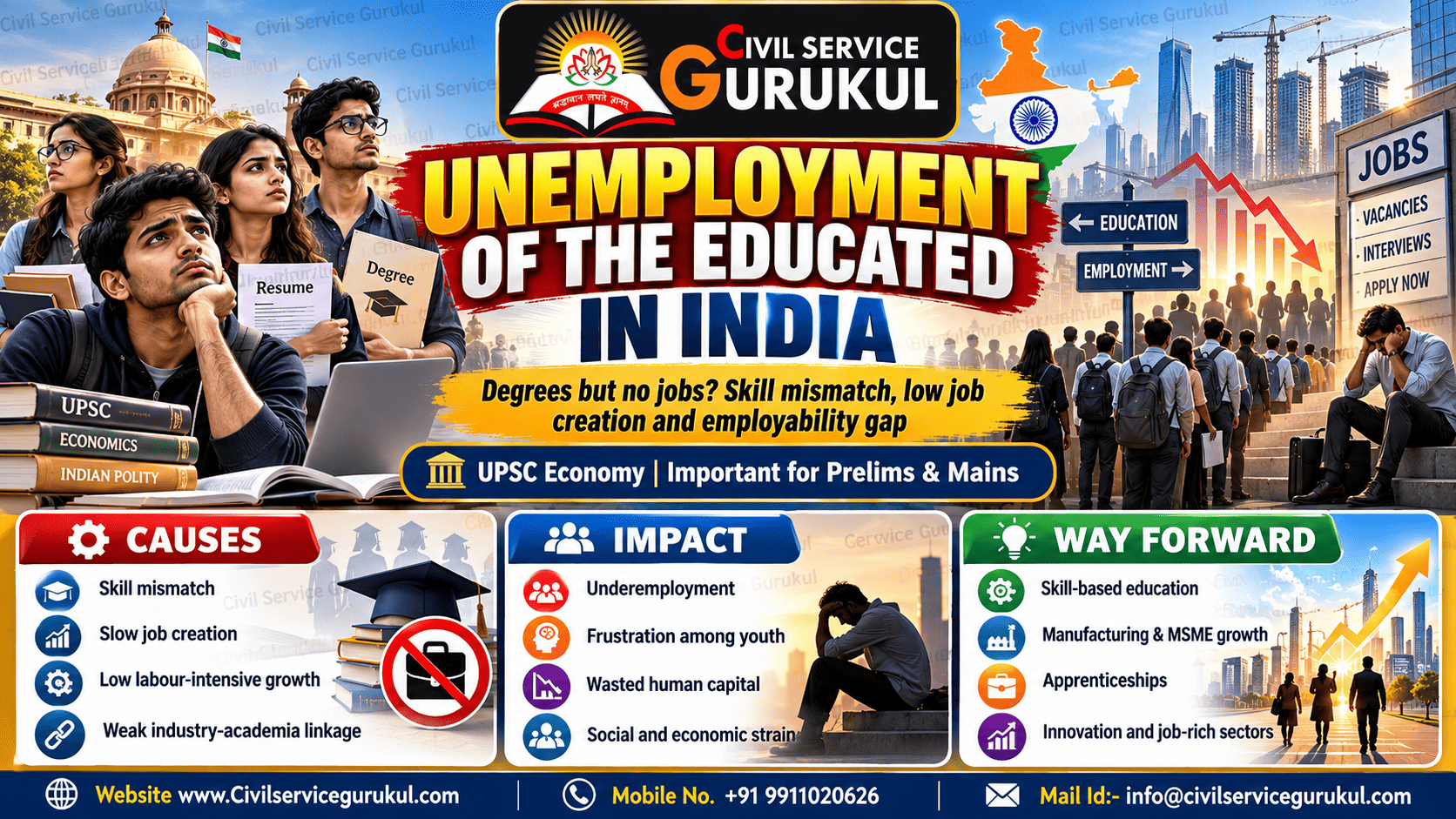
Educated Unemployment in India: Why Degrees Are Not Translating into Quality Jobs
Complete UPSC notes on educated youth unemployment, PLFS data, the ILO–IHD India Employment Report, structural unemployment, skill mismatches, demographic dividend, and policy reforms.
Why in News? Educated unemployment remains an important economic and developmental challenge in India. The PLFS Annual Report 2025 estimated unemployment among educated persons aged 15 years and above at 6.5%, compared with 7.0% in 2024. Although this indicates improvement, difficulties in matching education with suitable employment remain a structural concern.
UPSC GS Section / Paper
GS Paper III: Indian economy, employment, development, inclusive growth and human capital.
GS Paper II: Education, skill development, government policies and human-resource development.
GS Paper I: Population, youth, urbanisation and demographic dividend.
Prelims: PLFS, ILO, unemployment types, employment indicators and government skilling initiatives.
1. What Is Educated Unemployment?
Educated unemployment refers to a situation in which people who possess educational qualifications are unable to obtain employment despite seeking or being available for work.
It may involve school leavers, graduates, postgraduates or professionally qualified individuals.
However, in the PLFS Annual Report 2025, the specific category "educated persons" refers to individuals with secondary education or above.
Educated Unemployment vs Underemployment
Educated Unemployment
A qualified person does not have work but is seeking or available for it under the survey definition.
Educated Underemployment
A qualified person is working but may not be using their skills fully or may lack sufficient hours or remunerative opportunities.
This distinction matters because official unemployment rates do not fully capture the quality of employment.
2. India's Educated Unemployment: Latest Official Data
According to the PLFS Annual Report 2025, published in March 2026, unemployment among persons aged 15 years and above with secondary education or higher declined from 7.0% in 2024 to 6.5% in 2025.
The unemployment rate for people aged 15–29 was estimated at 9.9% in 2025 under the usual-status measure.
The September 2026 PLFS monthly bulletin reported an overall unemployment rate of 5.0% for persons aged 15 and above under Current Weekly Status.
| Labour Market Indicator | Figure | Reference |
|---|---|---|
| Educated unemployment | 7.0% | PLFS 2024, age 15+, secondary and above, usual status |
| Educated unemployment | 6.5% | PLFS 2025, age 15+, secondary and above, usual status |
| Youth unemployment | 9.9% | PLFS 2025, age 15–29, usual status |
| Overall monthly unemployment | 5.0% | September 2026, age 15+, Current Weekly Status |
| Regular wage/salaried share | 23.6% | PLFS 2025, employed workers, usual status |
What Can Be Concluded?
Educated unemployment has decreased in the recent annual PLFS comparison.
Nevertheless, the gap between aggregate employment indicators, graduate expectations and access to well-paying jobs warrants policy attention.
3. Findings of the ILO–IHD India Employment Report 2024
The India Employment Report 2024, prepared by the Institute for Human Development with the International Labour Organization, examined youth employment, education and skills.
It identified a significant concentration of unemployment among educated young people.
Selected Historical Findings
| Finding | Value | Reference |
|---|---|---|
| Share of unemployed who were youth | 82.9% | 2022 |
| Share of unemployed who were educated youth | 65.7% | 2022 |
| Graduate youth unemployment | 29.1% | Historical estimate discussed in the 2024 report |
| Graduate young women unemployment | 34.5% | Same historical reference |
| Graduate young men unemployment | 26.4% | Same historical reference |
These figures show how unemployment has historically been concentrated among educated youth.
They are not estimates for October 2026 and should not be presented as the latest unemployment rates for graduates.
4. Major Causes of Educated Unemployment in India
Skill Mismatch
Educational qualifications do not always correspond to employers' practical skill requirements.
Insufficient Quality Jobs
The supply of graduates can exceed openings in desirable formal and well-paying occupations.
Limited Practical Training
Some programmes provide insufficient internships, apprenticeships or industry exposure.
Regional Disparities
High-productivity jobs are concentrated in selected cities and industrial centres.
Recruitment Frictions
Information gaps, selection delays and mismatched job expectations can increase search time.
Changing Technology
Digitalisation and AI can change demand for existing and emerging skills.
Can Aspirations Contribute?
Some educated jobseekers may prefer employment that provides stable earnings, social protection, career progression or geographic suitability.
These preferences are economically relevant, but they must not be used to dismiss the shortage of productive opportunities.
5. Education–Employment Mismatch
India's education system has expanded access to degrees and professional qualifications.
But the transition from academic learning to productive employment can remain difficult.
The Mismatch Cycle
Important Policy Response
Strengthening employer-linked curricula, competency-based assessment, internships and local labour-market information can improve education-to-employment transitions.
6. Educated Young Women and Employment Barriers
Educated young women may face additional obstacles to accessing suitable employment.
Such barriers can include care responsibilities, limited safe transport, workplace discrimination, mobility constraints and restricted local employment opportunities.
The ILO–IHD report highlighted substantial historical unemployment among young women with graduate qualifications.
Suggested Measures
- Affordable childcare services.
- Safe and accessible transport.
- Equal opportunities in recruitment.
- Skill programmes linked to market demand.
- Suitable and secure workplace arrangements.
- Stronger participation in science and technology careers.
7. Jobless Growth and Structural Transformation
An economy can experience high output growth without creating proportionate employment.
Technological progress, capital-intensive production and productivity improvements may allow firms to produce more with limited additional labour.
However, technological progress can also create new occupations and support income growth. The overall effect depends on how enterprises, skills and demand evolve.
Structural Transformation
Structural transformation involves shifting economic activity and labour towards higher-productivity sectors.
For India, this requires expansion of remunerative work in manufacturing, modern services, construction and productive enterprises.
Core GS-III Argument
Educational expansion creates human-capital potential. That potential generates a demographic dividend only when supported by enough productive employment opportunities.
8. Economic and Social Impacts
Human Capital Underutilisation
Skills and education may not translate into their full productive potential.
Household Financial Stress
Long job searches can increase financial pressure on families.
Migration Pressures
Jobseekers may move toward major cities or international employment markets.
Unequal Opportunity
Employment access can vary by region, gender, household resources and skills.
Persistent educated unemployment can also reduce the returns to educational investment and weaken inclusive growth.
9. Important Labour-Market Concepts for UPSC
| Concept | Explanation |
|---|---|
| LFPR | Labour Force Participation Rate: labour force as a proportion of the relevant population. |
| WPR | Worker Population Ratio: employed persons as a proportion of the relevant population. |
| Unemployment Rate | Unemployed persons as a proportion of the labour force. |
| Usual Status | Employment assessment based on a longer reference period, broadly the previous 365 days. |
| Current Weekly Status | Employment assessment based on the preceding seven days. |
| Structural Unemployment | Mismatch between job requirements and available workers or their location. |
| Underemployment | Insufficient or inadequate utilisation of labour. |
| NEET | Not in Employment, Education or Training. |
10. Government Initiatives Relevant to Educated Employment
| Initiative | Objective |
|---|---|
| National Education Policy 2020 | Improve education quality, flexibility and vocational integration. |
| Skill India Mission | Strengthen workforce capabilities and employability. |
| PMKVY | Promote vocational training and recognised skills. |
| National Apprenticeship Promotion Scheme | Encourage work-based learning. |
| PM Internship Scheme | Facilitate practical industry exposure for eligible candidates. |
| National Career Service | Improve employment information and career services. |
| Startup India | Support entrepreneurship and innovation. |
| Make in India | Promote manufacturing investment and industrial development. |
| MUDRA | Expand access to credit for eligible microenterprises. |
Policy evaluation should consider actual job placement, employment quality, real earnings, career progression and enterprise productivity.
11. Way Forward: Creating Quality Jobs for Educated Youth
- Industry-Aligned Education: Regularly update curricula based on labour-market demand.
- Expand Apprenticeships: Integrate structured work experience with higher and vocational education.
- Labour-Intensive Industries: Support sectors capable of generating substantial remunerative employment.
- MSME Development: Strengthen credit, technology, market access and productivity.
- Digital and AI Skills: Promote adaptable skills for changing workplace needs.
- Female Employment: Improve childcare, transport, safety and access to suitable work.
- District-Level Employment Planning: Align skilling programmes with regional industries and job vacancies.
- Entrepreneurship: Support viable businesses rather than viewing self-employment as an automatic substitute for quality jobs.
- Better Employment Data: Track graduate transitions, underemployment and real earnings alongside unemployment.
12. UPSC Prelims 2027: Quick Revision Table
| Topic | Important Fact |
|---|---|
| Official Employment Survey | Periodic Labour Force Survey |
| Conducted By | National Statistics Office under MoSPI |
| PLFS Annual Report | 2025, released March 2026 |
| Educated Unemployment, 2025 | 6.5%, age 15+, secondary education and above, usual status |
| Educated Unemployment, 2024 | 7.0%, comparable usual-status definition |
| Youth Unemployment, 2025 | 9.9%, age 15–29, usual status |
| September 2026 Overall Unemployment | 5.0%, age 15+, CWS |
| ILO–IHD Employment Report | India Employment Report 2024 |
| Educated Youth Share of Unemployed | 65.7%, historical 2022 figure |
| NEET | Not in Employment, Education or Training |
| Primary GS Paper | GS-III |
13. UPSC Prelims Practice MCQs
Question 1
According to PLFS Annual Report 2025, the unemployment rate among educated persons aged 15 and above was:
(a) 3.1%
(b) 5.0%
(c) 6.5%
(d) 9.9%
View Answer
Correct Answer: (c). The figure applies to persons with secondary education or above under usual status.
Question 2
The Periodic Labour Force Survey is conducted under which ministry?
(a) Ministry of Labour and Employment only
(b) Ministry of Statistics and Programme Implementation
(c) Ministry of Education
(d) Ministry of Finance
View Answer
Correct Answer: (b).
Question 3
With reference to the ILO–IHD India Employment Report 2024, the historical 65.7% figure represents:
(a) Educated youth unemployment rate in 2026
(b) Employment rate of graduates
(c) Share of educated youth among all unemployed persons in 2022
(d) Percentage of graduates working abroad
View Answer
Correct Answer: (c). It is a share of unemployed persons, not an unemployment rate.
Question 4
Which situation best describes structural unemployment?
(a) Temporary job search after leaving a job
(b) Skills and locations of workers do not match available vacancies
(c) All workers receive equal wages
(d) No employment opportunities change over time
View Answer
Correct Answer: (b).
Question 5
Consider the following:
- The unemployment rate is calculated using the labour force as denominator.
- Underemployment and unemployment are identical.
- Job creation and skilling are both relevant for addressing educated unemployment.
(a) 1 only
(b) 1 and 3 only
(c) 2 and 3 only
(d) All three
View Answer
Correct Answer: (b). Statement 2 is incorrect.
Question 6
A demographic dividend is most likely to benefit India when:
(a) Working-age population increases without jobs
(b) Productive employment, education and health improve together
(c) Skill training is disconnected from industry
(d) Unemployment data are ignored
View Answer
Correct Answer: (b).
14. UPSC Mains GS-III: Model Answer
Practice Question — 15 Marks
"Educated unemployment in India reflects not merely a shortage of jobs but a deeper mismatch between educational outcomes and the structure of labour demand." Critically examine and suggest suitable policy measures.
Suggested word limit: 250 words
Model Answer
Introduction: Educated unemployment refers to unemployment among people with formal educational qualifications. The PLFS Annual Report 2025 recorded unemployment of 6.5% among persons aged 15 and above with secondary education or higher, down from 7.0% in 2024.
Structural Causes: The expansion of educational attainment has not been uniformly matched by remunerative jobs. Skills mismatches, limited practical training, uneven industrial development and recruitment frictions constrain graduate employment. Technology also changes employer skill requirements.
Social Dimensions: Educated women face additional mobility, care and workplace barriers. Regional inequality can intensify competition for suitable jobs. Underemployment further reduces the return on education.
Policy Solutions: India requires industry-linked curricula, apprenticeships, district-level skills planning and greater MSME productivity. Labour-intensive manufacturing and modern services must expand quality employment. Women need safe transport, childcare and equitable workplace opportunities. Career counselling and better employment data can improve job matching.
Conclusion: India can realise its demographic dividend only when expanding education is accompanied by productive employment, higher labour earnings and inclusive structural transformation.
Additional Mains Questions
- Discuss the relationship between higher education, employability and structural unemployment in India. (10 marks)
- Examine the challenges faced by educated young women in accessing productive employment. (15 marks)
- How can apprenticeships and MSME-led growth help address the education-to-employment gap? (15 marks)
15. Frequently Asked Questions
Q1. What is educated unemployment?
Unemployment among people who possess formal educational qualifications.
Q2. What was India's educated unemployment rate in 2025?
6.5% among persons aged 15 and above with secondary education or higher, under PLFS usual status.
Q3. What is the main cause of graduate unemployment?
There is no single cause. Insufficient suitable jobs, skills mismatch, regional disparities and other labour-market barriers contribute.
Q4. What does the 65.7% figure mean?
Educated young people accounted for 65.7% of all unemployed persons in 2022, as reported by ILO–IHD.
Q5. What does PLFS stand for?
Periodic Labour Force Survey.
Q6. Which GS paper covers educated unemployment?
Primarily GS Paper III, with relevance to GS-II and GS-I.
16. Conclusion: From Educational Expansion to Productive Employment
India has made substantial progress in improving access to education. Recent PLFS evidence also shows a reduction in educated unemployment under its annual usual-status measure.
However, employment quality, graduate job matching, women's participation and regional inequality remain important challenges.
A comprehensive response must combine relevant education, practical skills, productive investment, stronger enterprises and inclusive labour-market institutions.
For UPSC 2027, the central argument is that India's demographic dividend depends not simply on producing graduates, but on creating enough productive opportunities for their capabilities.
Prepare for UPSC 2027 With Civil Service Gurukul
Join the Integrated Guidance Program covering Indian Economy, employment issues, government policies, Prelims practice, current affairs and GS-III Mains answer writing.
Explore Indian Economy study material authored by CA Dhananjay Ojha, or contact us for books and courses.
Enquire About Books & Courses Visit Our WebsitePrepare with Mentors Who Cleared the Exam
Get personalized study plans, evaluated answer models, and test series access.