Daily Current Affairs & News Analysis
Our daily news analysis consists of two integral parts — Daily News Analysis and Important Editorials curated rigorously from The Hindu, The Indian Express, LiveMint, PIB, and Sansad TV debates. Content is mapped directly to UPSC CSE and State PCS syllabi.
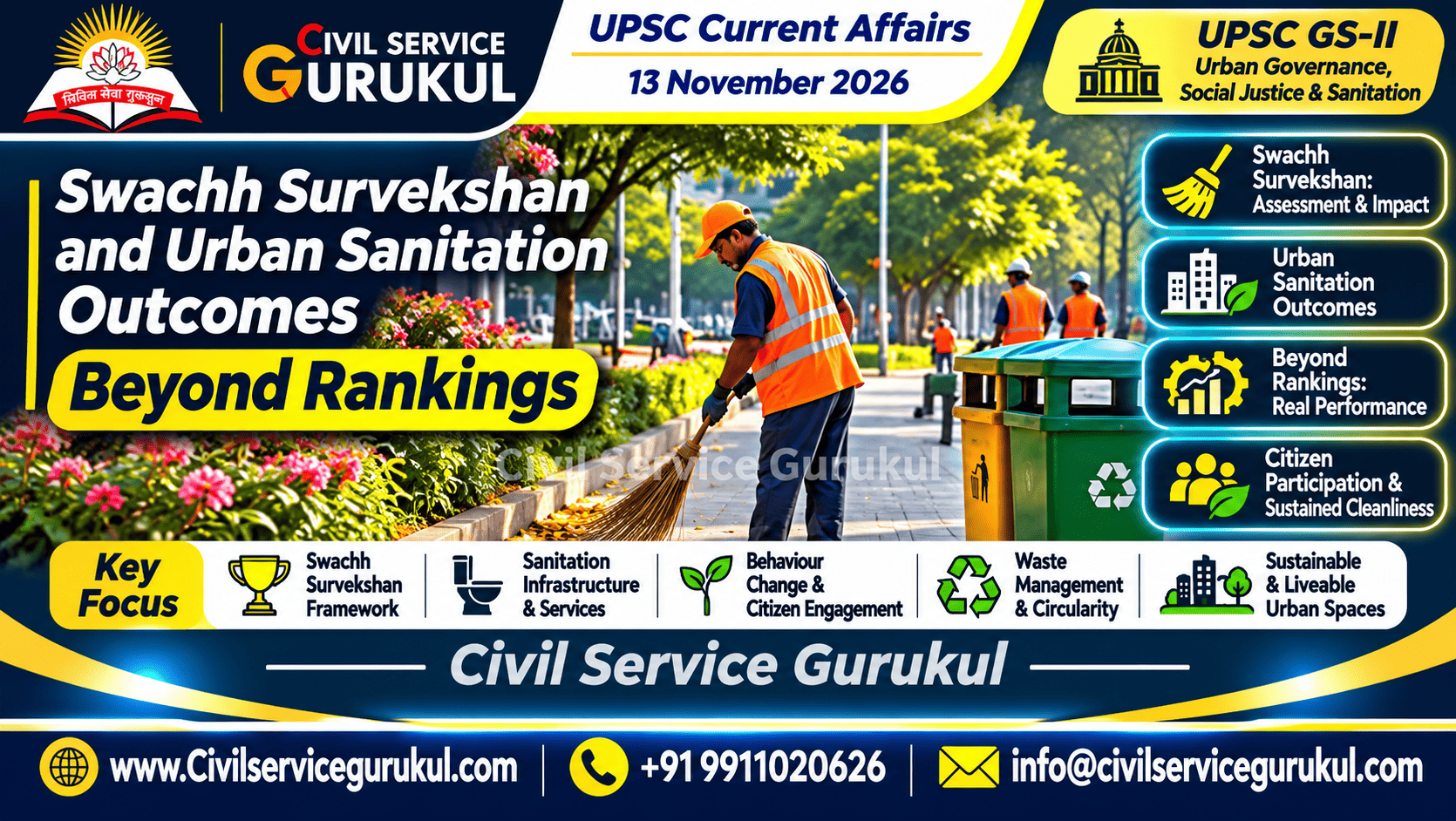
Swachh Survekshan 2026: India's Cleanest Cities, Urban Sanitation & Beyond Rankings | UPSC
Swachh Survekshan has become a prominent mechanism for assessing cleanliness and sanitation performance in Indian cities. Yet a high rank alone cannot establish whether waste is scientifically processed, sanitation workers are protected or underserved neighbourhoods receive equitable services. This Civil Service Gurukul UPSC 2027 analysis explores the Swachh Bharat Mission–Urban, urban local bodies, source segregation, material recovery facilities, decentralised waste processing, wastewater management and the limitations of competitive city rankings. It also examines the importance of independent audits, transparent waste-flow data, citizen feedback, inclusion and long-term environmental outcomes, with original Prelims MCQs, a GS-II Mains model answer and rapid revision notes.
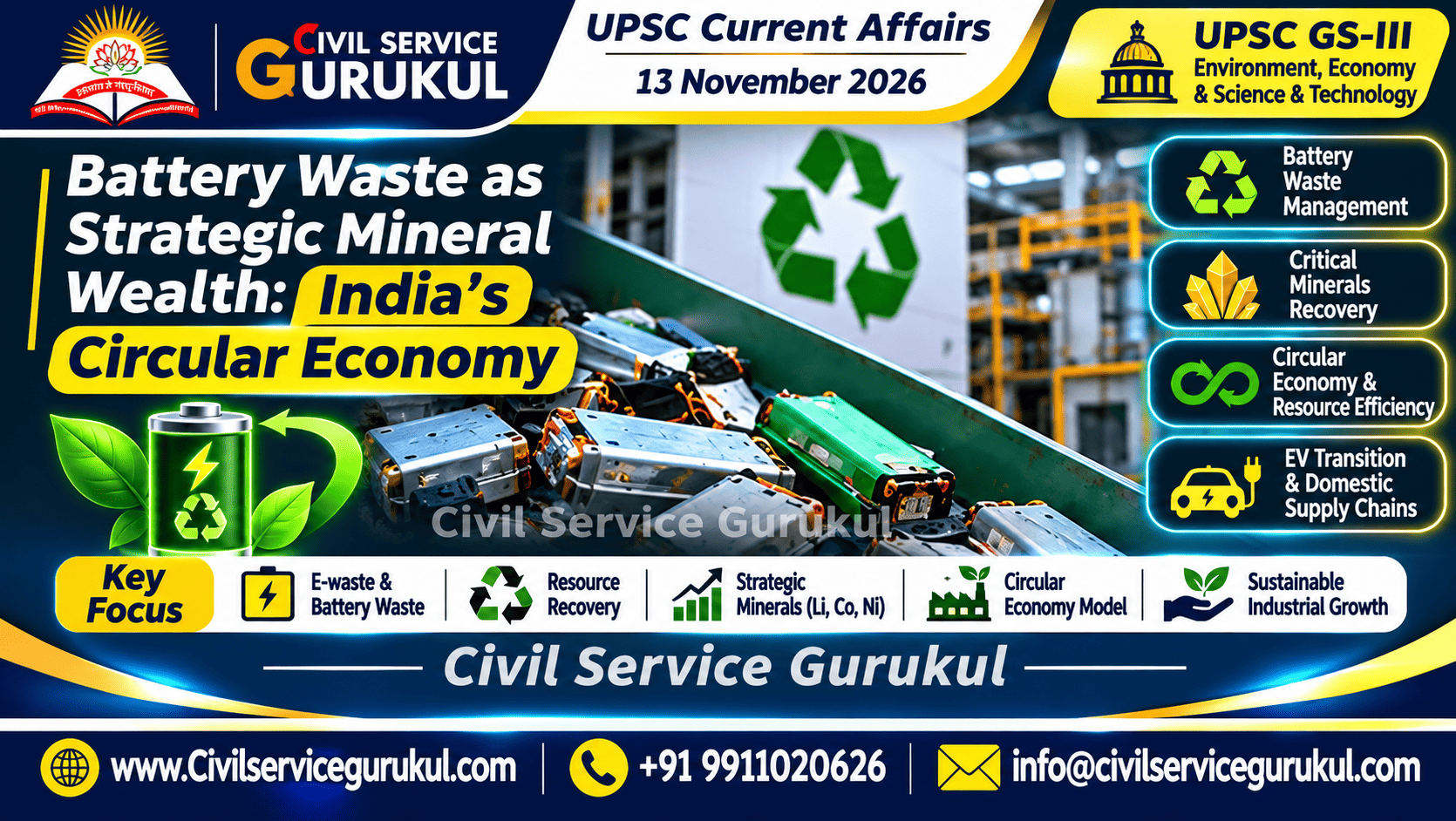
India Battery Recycling 2026: Black Mass Export Ban, Critical Minerals & Circular Economy | UPSC
India's battery waste is emerging as a strategic source of critical minerals essential for electric vehicles, renewable energy storage, electronics and advanced manufacturing. In November 2026, the government prohibited exports of specified lithium-ion battery black mass to strengthen domestic recycling and mineral recovery. The move complements the ₹1,500 crore critical mineral recycling incentive scheme under the National Critical Mineral Mission and the Battery Waste Management Rules, 2022. This Civil Service Gurukul UPSC 2027 article examines lithium-ion battery chemistry, urban mining, Extended Producer Responsibility, black mass, recycling technologies, environmental risks, India's mineral security and circular-economy policies. It includes original Prelims MCQs, a GS-III Mains model answer and an exam-oriented revision card.
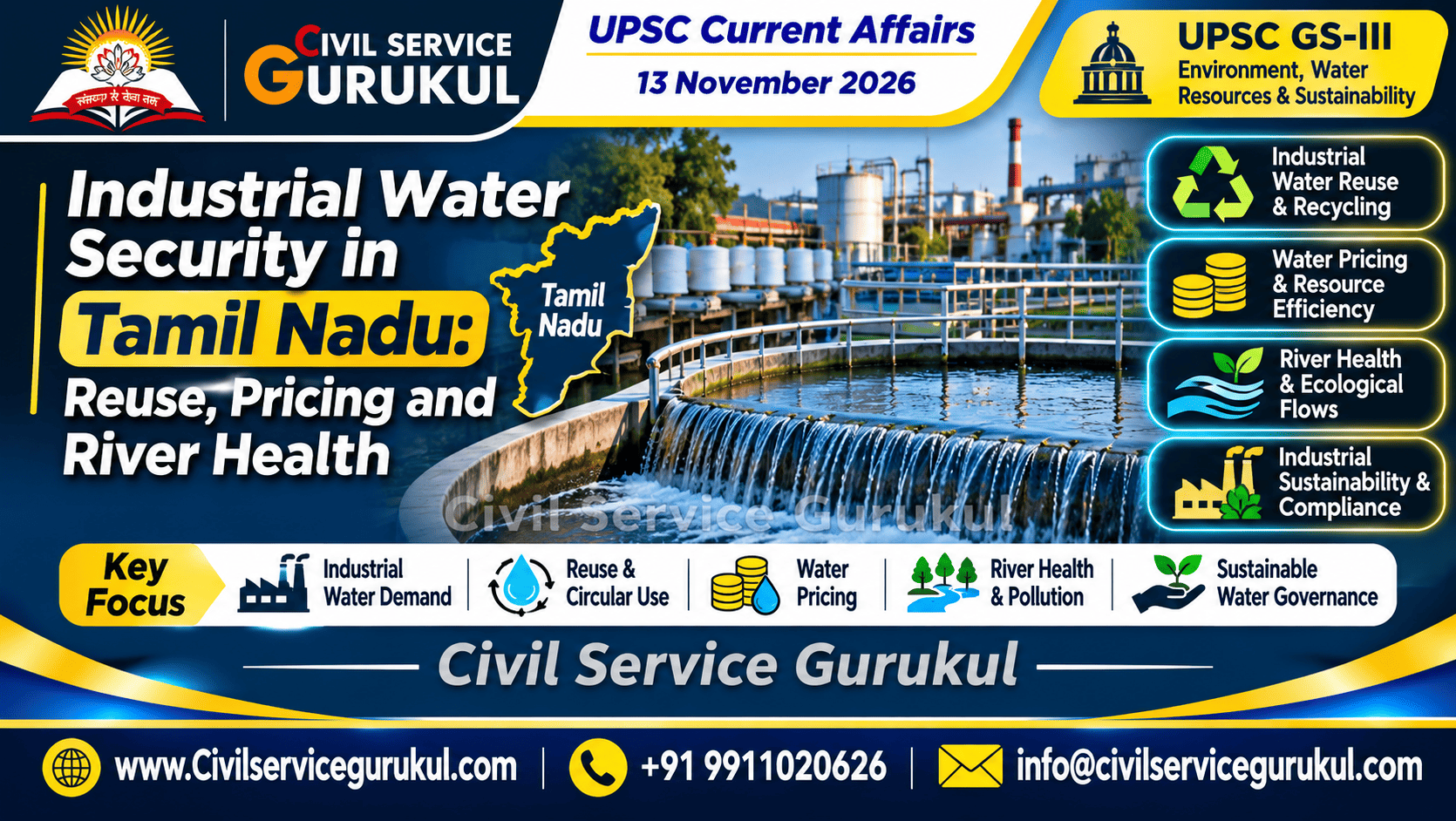
Tamil Nadu Industrial Water Crisis 2026: Wastewater Reuse, Water Pricing & River Health | UPSC
Tamil Nadu's industrial growth creates an urgent need to balance manufacturing competitiveness with freshwater availability, groundwater sustainability and healthy river ecosystems. Seasonal rainfall, urban demand, agricultural irrigation and industrial withdrawals place competing pressures on limited water resources. This Civil Service Gurukul analysis examines the role of treated wastewater reuse, closed-loop industrial recycling, realistic water pricing, effluent regulation, basin-level governance and transparent water accounting. It explains key concepts such as water withdrawal versus consumption, Zero Liquid Discharge, Common Effluent Treatment Plants, environmental flows and the polluter-pays principle, with UPSC Prelims MCQs, a GS-III Mains model answer and a rapid revision framework.
OBC Creamy Layer 2026: Supreme Court Principles, ₹8 Lakh Rule & Substantive Equality | UPSC
The creamy-layer principle is a central feature of India's OBC reservation framework, designed to ensure that affirmative-action benefits reach socially and educationally disadvantaged sections rather than becoming concentrated among relatively advanced families. Rooted in the Supreme Court's landmark Indra Sawhney judgment of 1992, the principle raises important questions about substantive equality, the relationship between economic advancement and social disadvantage, and the fairness of administrative eligibility tests. This Civil Service Gurukul article examines Articles 14, 15 and 16, the central OBC creamy-layer framework, the ₹8 lakh income ceiling and its limitations, judicial scrutiny, distinctions involving SC/ST reservation, and policy reforms. It includes original UPSC Prelims questions, a GS-II Mains model answer and a rapid revision card.
India–France Relations 2026: Economic Security, Critical Technology & Strategic Autonomy | UPSC
India–France strategic cooperation is expanding beyond traditional defence engagement into economic security, critical and emerging technologies, supply-chain resilience, clean energy, space and advanced manufacturing. Against the backdrop of November 2026 reporting on bilateral economic-security and technology discussions, this Civil Service Gurukul article explains the historical foundations of the partnership, the Horizon 2047 roadmap, strategic autonomy, defence industrial cooperation, semiconductor and AI ecosystems, civil nuclear energy, Indo-Pacific interests, technology-transfer challenges and policy priorities. Designed for UPSC Prelims and Mains 2027, it includes factual distinctions, original statement-based MCQs, a GS-II/GS-III model answer, revision notes and analytical frameworks.
India Visa Reform 2026: 9 Categories, 70% Shorter Forms, e-Visa & UPSC GS-II Analysis
India has undertaken a major rationalisation of its visa regime, reducing the number of main categories from 13 to nine and sub-categories from 49 to 23, while cutting application-form fields by 65–70%. The reform includes renaming the Tourist Visa as the Visitor Visa, introducing differentiated provisions for business, medical treatment, AYUSH, education and research, and updating digital immigration systems. With e-Visa facilities available to nationals of 172 countries, the policy aims to improve tourism, investment, medical-value travel, international education and administrative efficiency. Civil Service Gurukul examines the Ministry of Home Affairs' November 2026 announcement, the nine-category structure, V-1 and V-2 visas, e-Visa versus regular visa, immigration governance, security and privacy concerns, implementation challenges, UPSC Prelims MCQs and a GS-II Mains model answer.
Birsa Munda & Janjatiya Gaurav Divas 2026: Ulgulan, PESA, FRA and Tribal Rights | UPSC 2027
Janjatiya Gaurav Divas is observed across India on 15 November to commemorate the birth anniversary of Birsa Munda, the tribal freedom fighter who led the Ulgulan movement against colonial authority and exploitative agrarian relations in Chotanagpur. The 2026 Janjatiya Gaurav Pakhwada runs from 1 to 15 November, with government-announced initiatives related to tribal education, culture, healthcare, forest rights and rural development. This Civil Service Gurukul UPSC 2027 article examines Birsa Munda's historical contributions, the Munda land system, colonial exploitation, the Ulgulan movement, the Chota Nagpur Tenancy Act, Fifth and Sixth Schedules, PESA 1996, Forest Rights Act 2006 and contemporary questions of community self-governance. It also provides original UPSC Prelims MCQs, GS-I and GS-II Mains analysis and a concise revision framework.
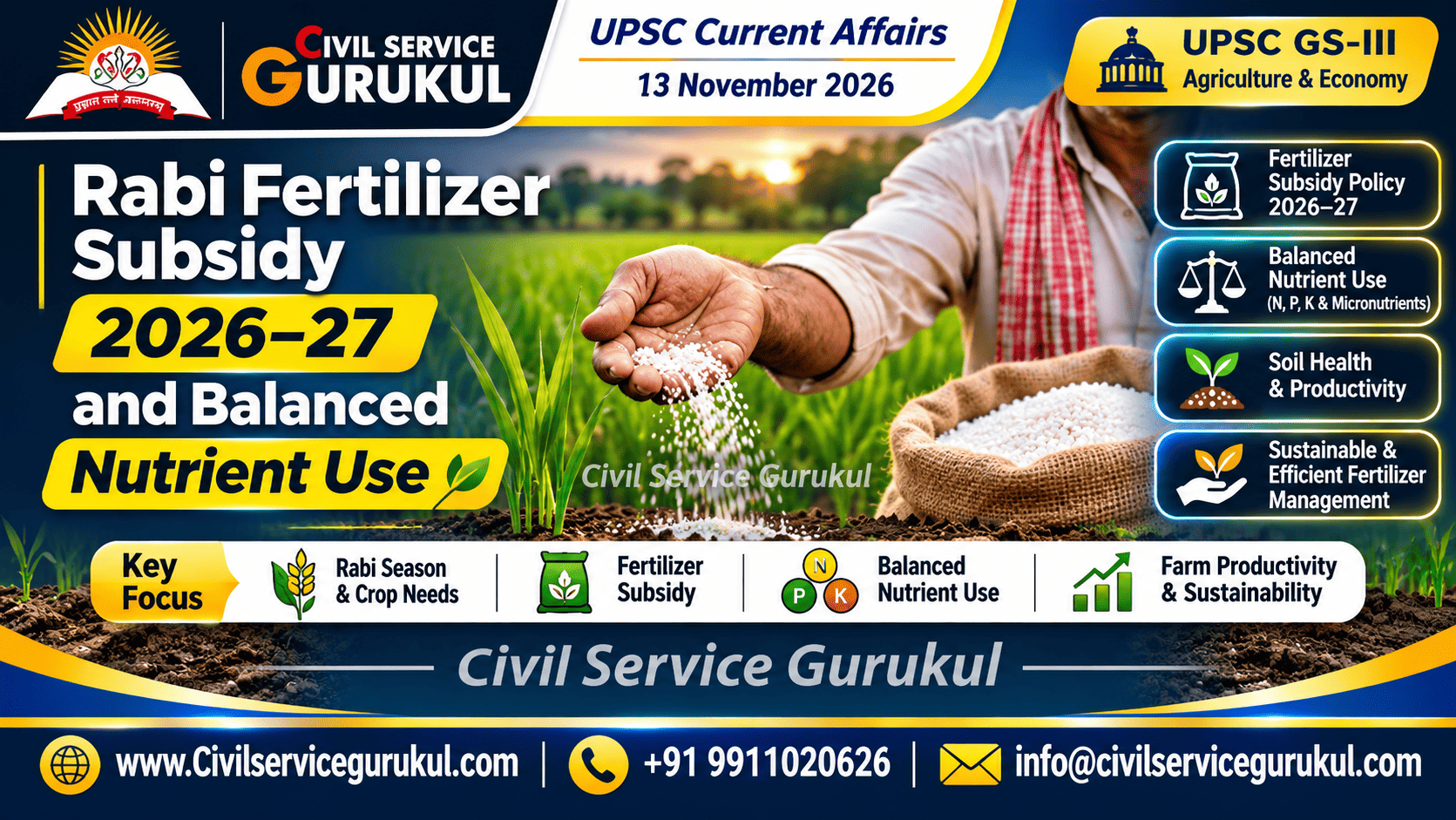
Rabi Fertiliser Subsidy 2026–27: 64% Increase, NBS Rates, Budget Impact & UPSC Analysis
India's Union Cabinet approved a tentative ₹62,370.02 crore subsidy requirement for phosphatic and potassic fertilisers during Rabi 2026–27, representing an approximately 64% increase over the previous Rabi season. The revised Nutrient Based Subsidy rates apply from 1 October 2026 to 31 March 2027 and cover nitrogen, phosphorus, potassium and sulphur content in 28 grades of P&K fertilisers. Along with the Kharif 2026 provision, the combined seasonal P&K requirement reaches approximately ₹1.04 lakh crore against the FY 2026–27 Budget Estimate of ₹54,000 crore. Civil Service Gurukul examines the NBS framework, DAP price protection, differences between urea and P&K subsidies, global price pressures, fiscal implications, soil nutrient imbalance, sustainable agriculture reforms, UPSC Prelims MCQs and a GS-III Mains model answer.
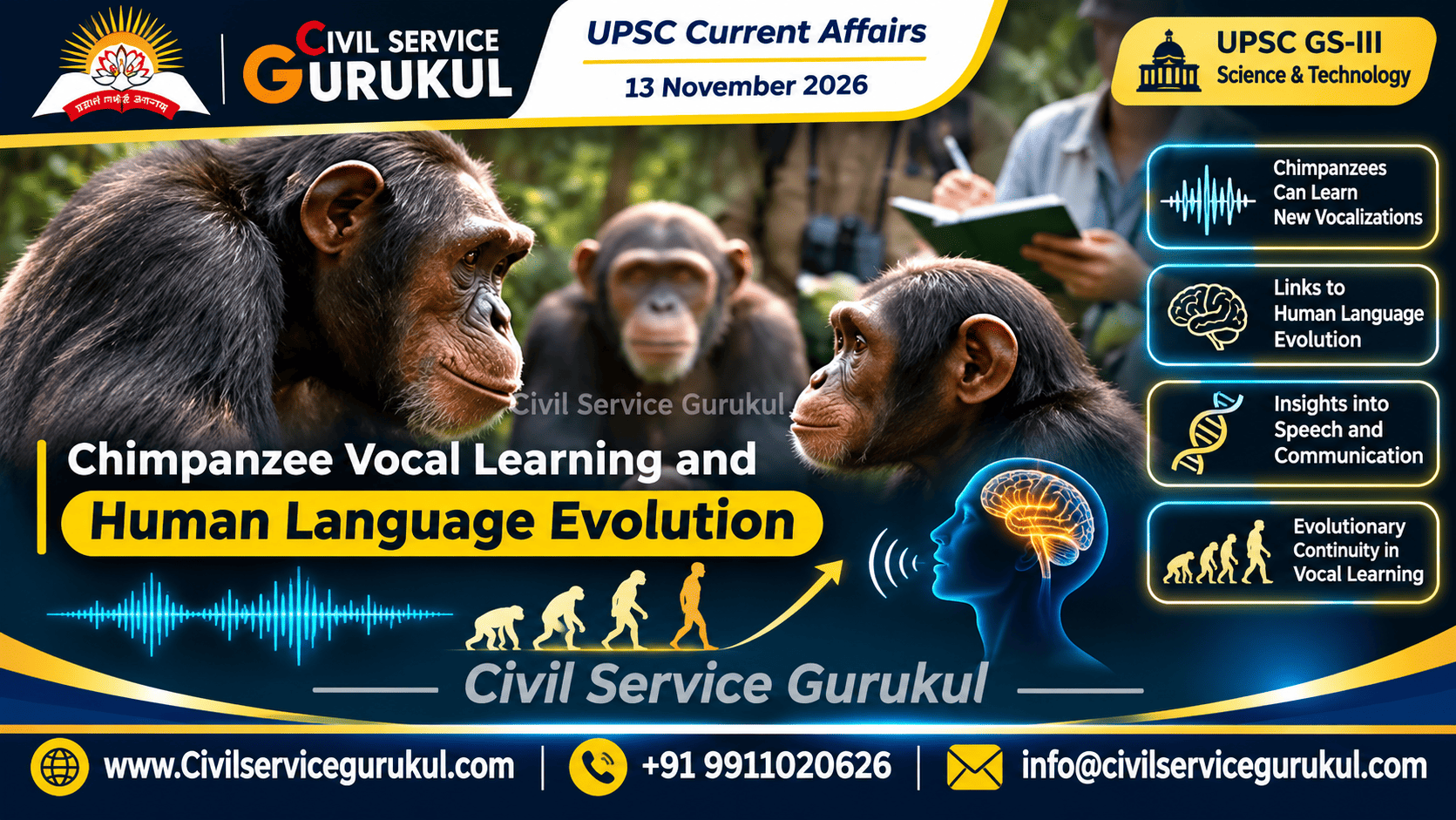
Chimpanzees Learn Vocal Calls from Adults: PNAS 2026 Study, Human Language Evolution and UPSC Analysis
A November 2026 PNAS study has found evidence that chimpanzees learn the social use of certain calls from adult role models, offering new insights into the evolutionary origins of human language. Researchers studied 91 chimpanzees across four wild communities in Taï National Park, Côte d’Ivoire, and four sanctuary groups at Tacugama in Sierra Leone. Wild chimpanzees used a raspberry-like sound predominantly during grooming, while orphaned groups without adult models used the call across varied social contexts. After an adult joined one sanctuary group, the juveniles' call use became more consistent. Civil Service Gurukul explains vocal usage learning, production learning, arbitrary conventions, social transmission, human language evolution, research limitations, species facts, UPSC Prelims MCQs and GS Mains analytical perspectives.
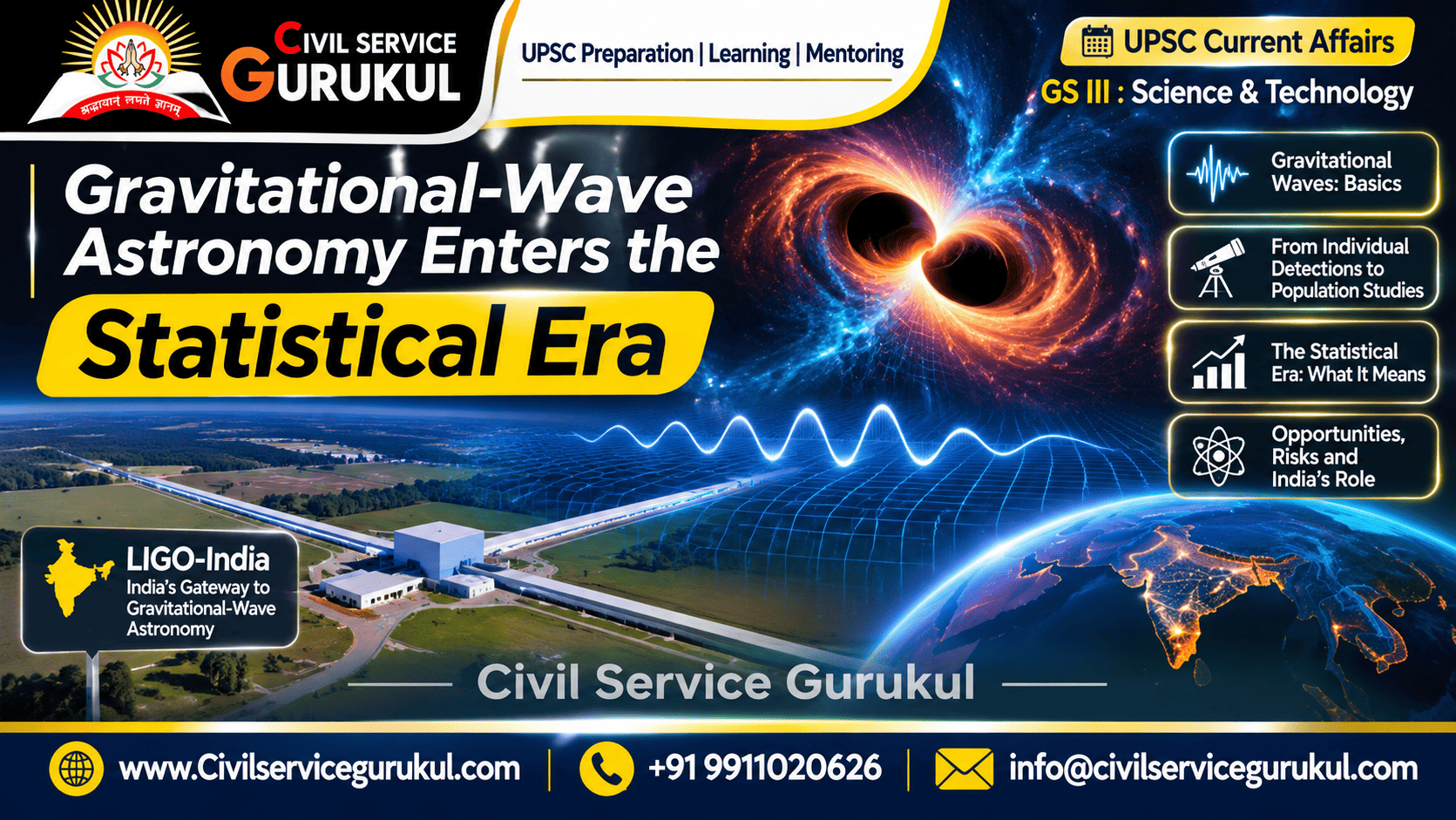
Gravitational-Wave Astronomy Enters Statistical Era: GWTC-5.0, 390 Detections and LIGO-India | UPSC 2027
Gravitational-wave astronomy has entered a statistical era as the international LIGO–Virgo–KAGRA collaboration expands its catalogue of cosmic events. The GWTC-5.0 release of May 2026 includes 390 cumulative significant detections, including 161 newly identified signals from the O4b observing period. Larger datasets allow researchers to examine black-hole populations, merger rates, cosmic evolution and general relativity with greater statistical confidence. For India, the development is especially important because of LIGO-India, the gravitational-wave observatory project being developed in Maharashtra. This Civil Service Gurukul UPSC 2027 analysis explains the science, key discoveries, detector network, statistical inference, India's contribution, limitations, Prelims concepts, original practice MCQs and Mains answer-writing strategy.