
UPSC Mains Micro-Notes: 30-Day Revision Strategy
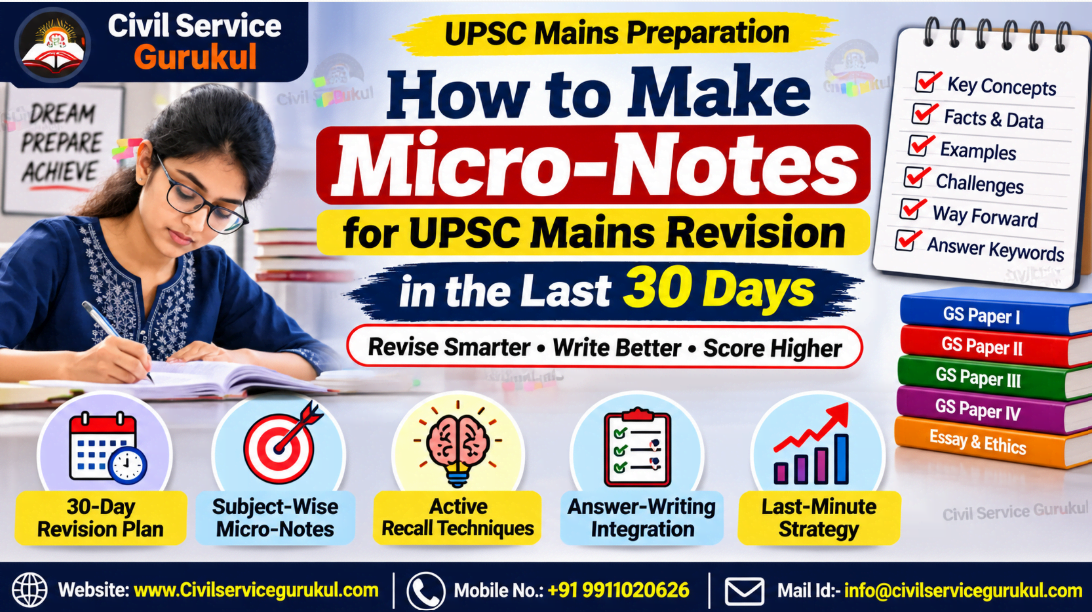
UPSC MAINS STRATEGY 30-DAY REVISION GS PAPERS I–IV
UPSC Mains in 30 Days: The Micro-Notes Method to Revise Faster and Write Better Answers
Subject-wise micro-notes, realistic examples, active recall, revision timetable, and answer-writing strategies.
1. Why the Last 30 Days Matter
The final month before UPSC Mains is not the ideal time to begin collecting large quantities of new study material.
For aspirants who have already covered most of the syllabus, the priority should shift towards consolidation, active recall, answer-writing practice and revision.
Aspirants often possess hundreds of pages of notes but struggle to retrieve important facts, examples and arguments during the examination.
These are suggested planning targets rather than official UPSC preparation requirements.
2. What Are Micro-Notes?
Micro-notes are highly compressed revision notes containing only the most useful information needed to recall and write an answer.
They are not miniature textbooks or copies of coaching handouts.
Essential Components
- Definition or core concept.
- Three to five major dimensions.
- Relevant constitutional or policy reference.
- One useful example or case study.
- Challenges or limitations.
- Way forward or conclusion.
- Keywords for answer writing.
↓
ONE PAGE
↓
KEYWORDS + EXAMPLES + ANALYSIS
↓
FASTER RECALL
3. Before and After: How to Convert Bulky Notes into Micro-Notes
Example: Urban Flooding
BEFORE: Ineffective Notes
Urban flooding is a serious problem in India. It happens because of heavy rainfall, poor drainage, construction, population growth and other factors.
It causes many problems and the government should take steps to prevent flooding.
Problems:
- Vague language.
- No clear structure.
- No useful examples.
- No specific solutions.
- Difficult to convert into an answer.
AFTER: Exam-Ready Micro-Note
Topic: Urban Flooding
Causes:
- Wetland loss.
- Floodplain encroachment.
- Impervious surfaces.
- Inadequate stormwater drains.
- Extreme rainfall.
Impacts:
- Loss of lives and assets.
- Disruption of urban services.
- Public health risks.
Solutions:
- Restore wetlands.
- Improve drainage.
- Protect floodplains.
- Strengthen early-warning systems.
Conclusion Keyword: Climate-resilient urban planning.
4. The Seven-Step Method for Creating Micro-Notes
Step 1: Begin with the UPSC Syllabus
Select topics directly linked to the General Studies syllabus and previous-year question themes.
Step 2: Use One Reliable Base Source
Use your already-prepared standard notes, textbooks or consolidated class material.
Avoid collecting several new sources during the final revision phase.
Step 3: Extract High-Value Keywords
Identify concepts, constitutional provisions, committees, schemes, case studies and analytical dimensions.
Step 4: Convert Sentences into Points
Replace long paragraphs with short, meaningful keywords.
Step 5: Add One Strong Example
A suitable example can strengthen the credibility of a Mains answer.
Step 6: Include a Way Forward
Where relevant, record two or three practical solutions or a concise concluding idea.
Step 7: Test Recall
Close the notes and attempt to reproduce the main arguments from memory.
↓
ORGANISE → RECALL → WRITE
↓
REVISE
5. The Ideal Micro-Notes Template
Topic: __________________
GS Paper: __________________
Core Definition: __________________
Key Dimensions:
- __________________
- __________________
- __________________
- __________________
- __________________
Example / Data: __________________
Challenges: __________________
Way Forward: __________________
Conclusion Keyword: __________________
Related PYQ Theme: __________________
6. Subject-Wise Micro-Notes for GS Papers I–IV
GS Paper I: Society
Topic: Urbanisation
Key Dimensions:
- Migration and employment.
- Housing and informal settlements.
- Urban infrastructure.
- Social inequality.
- Environmental stress.
Example: Urban flooding and pressure on public services in rapidly growing cities.
Way Forward: Inclusive urban planning, affordable housing and resilient infrastructure.
GS Paper II: Governance
Topic: E-Governance
Key Dimensions:
- Transparency.
- Efficiency.
- Citizen participation.
- Service delivery.
- Digital inclusion.
Example: Direct Benefit Transfer and online grievance portals.
Challenges: Digital divide, privacy and cybersecurity.
Way Forward: Inclusive access, accountable institutions and strong data safeguards.
GS Paper III: Economy
Topic: MSME Development
Key Dimensions:
- Employment generation.
- Credit access.
- Technology adoption.
- Market linkages.
- Export competitiveness.
Challenges: Limited finance, low productivity and delayed payments.
Way Forward: Formalisation, skill development, digitalisation and stronger market access.
GS Paper IV: Ethics
Topic: Integrity
Definition: Consistency between ethical principles, decisions and actions.
Key Dimensions:
- Honesty.
- Accountability.
- Transparency.
- Public trust.
- Resistance to undue influence.
Example: A public servant refusing an improper benefit despite personal pressure.
Conclusion Keyword: Ethical public service.
7. Micro-Notes for Essay Preparation
Essay micro-notes should focus on themes rather than memorised essays.
Prepare compact idea banks covering:
- Philosophical perspectives.
- Historical examples.
- Social dimensions.
- Economic dimensions.
- Ethical perspectives.
- Environmental concerns.
- Relevant illustrations.
Example: Technology and Humanity
Theme: Technology and Humanity
Positive Dimensions:
- Healthcare innovation.
- Educational access.
- Scientific progress.
- Productivity improvement.
Concerns:
- Digital inequality.
- Privacy risks.
- Algorithmic bias.
- Job displacement.
Core Argument: Technology should remain human-centred and ethically governed.
8. The 1–3–5 Revision Technique
The 1–3–5 technique is a suggested spaced-revision schedule.
| Revision | Suggested Timing | Activity |
|---|---|---|
| First | Day 1 | Create micro-notes and recall immediately |
| Second | Day 3 | Revise without looking first |
| Third | Day 5 | Recall and practise an answer |
For important or difficult topics, additional revisions may be necessary.
9. Complete 30-Day UPSC Mains Micro-Notes Revision Plan
| Days | Main Focus | Revision Output |
|---|---|---|
| 1–5 | GS I: History, Society, Geography | Compact notes and answer practice |
| 6–10 | GS II: Constitution, Governance, IR | Articles, examples and analytical frameworks |
| 11–15 | GS III: Economy, Environment, Security | Concepts, diagrams and solutions |
| 16–20 | GS IV: Ethics and Case Studies | Definitions, examples and decision frameworks |
| 21–24 | Essay and cross-cutting themes | Essay idea banks and revision sheets |
| 25–27 | Integrated GS revision | Active recall and timed answers |
| 28–30 | Final consolidation | Weak-area revision and confidence building |
10. Suggested Daily Revision Routine
| Session | Activity | Suggested Duration |
|---|---|---|
| Session 1 | Micro-notes revision | 90 minutes |
| Session 2 | Active recall and self-testing | 60 minutes |
| Session 3 | Timed answer writing | 90 minutes |
| Session 4 | Optional / Essay / Ethics | 90 minutes |
| Session 5 | Error review and next-day planning | 30 minutes |
The schedule represents a flexible study framework. Include adequate breaks, sleep and recovery.
11. How to Use Micro-Notes in UPSC Mains Answers
Micro-notes should support answer writing rather than remain isolated revision material.
Example Question
"Discuss the major challenges of urbanisation in India and suggest measures for sustainable urban development."
Using the Micro-Note
- Introduction: Define urbanisation briefly.
- Challenges: Housing, infrastructure, inequality and environment.
- Examples: Urban flooding and pressure on civic services.
- Solutions: Integrated planning, affordable housing and resilient infrastructure.
- Conclusion: Inclusive and sustainable urban development.
↓
RECALL KEYWORDS
↓
MATCH QUESTION DEMANDS
↓
WRITE STRUCTURED ANSWER
12. Common Micro-Notes Mistakes to Avoid
| Mistake | Why It Hurts | Better Approach |
|---|---|---|
| Copying entire chapters | Notes remain too long | Extract only high-value information |
| Using too many sources | Creates confusion | Use a consolidated base source |
| Memorising without recall | Weak retrieval under pressure | Practise closed-book recall |
| Ignoring examples | Answers become generic | Add one relevant illustration |
| Overdecorating notes | Consumes revision time | Prioritise clarity and speed |
| Never updating weak areas | Errors repeat | Maintain a correction list |
13. Micro-Notes Self-Evaluation Checklist
- ☐ Is the topic linked to the UPSC syllabus?
- ☐ Can I revise it within a few minutes?
- ☐ Are the key concepts clearly identified?
- ☐ Have I included analytical dimensions?
- ☐ Is there at least one relevant example?
- ☐ Have I included challenges and solutions?
- ☐ Can I recall the note without reading it?
- ☐ Can I convert the note into a Mains answer?
- ☐ Have I corrected earlier mistakes?
- ☐ Is the material concise and accurate?
14. What to Do in the Final Seven Days
- Revise familiar high-yield micro-notes.
- Review mistakes from previous mock tests.
- Practise selective timed answers.
- Revise Ethics definitions and examples.
- Review Essay theme banks.
- Keep optional-subject revision active.
- Avoid unnecessary new study resources.
- Maintain adequate sleep and routine.
15. Conclusion
Micro-notes are a practical method for transforming large volumes of preparation material into accessible, exam-ready revision tools.
Their effectiveness depends on thoughtful compression, regular active recall and application through answer writing.
In the last 30 days, the aim should be to strengthen retrieval, clarity and confidence rather than accumulate more information.
Strengthen Your UPSC Mains Preparation
Civil Service Gurukul
UPSC | State PCS |
Mains Answer Writing |
Mentorship |
Current Affairs
Prepare with Mentors Who Cleared the Exam
Get personalized study plans, evaluated answer models, and test series access.