
Published: 15 October 2026 | Category: Daily News Analysis | Prepared by: Civil Service Gurukul Editorial Team
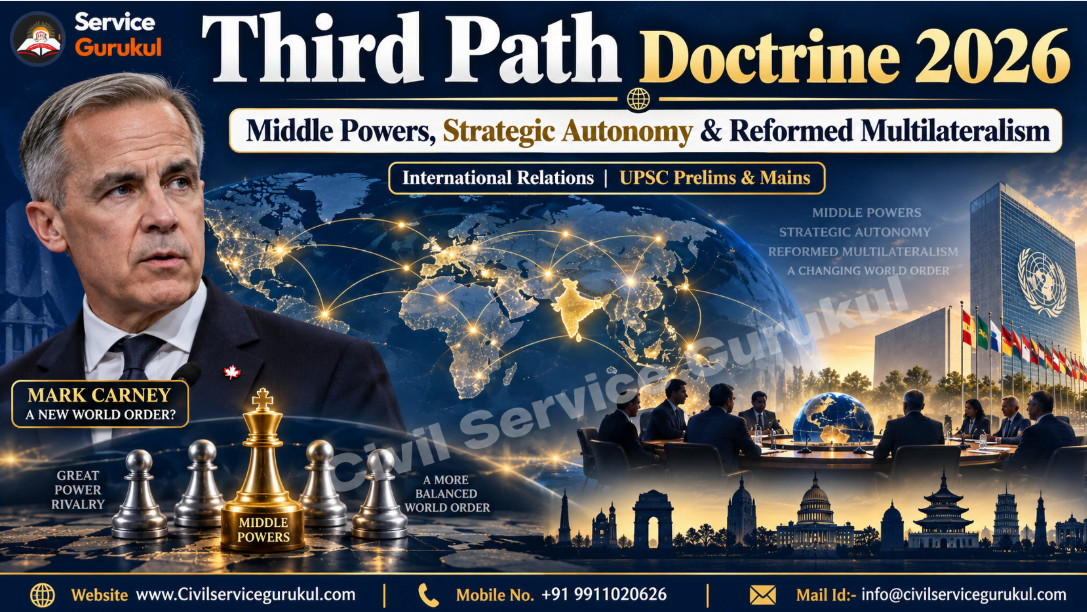
Canadian Prime Minister Mark Carney's Third Path Doctrine, articulated at the World Economic Forum in Davos on 20 January 2026, calls upon middle powers to cooperate amid growing great-power rivalry. The approach emphasises value-based realism, collective resilience, diversified partnerships and issue-specific coalitions. For UPSC preparation, the framework connects to India's strategic autonomy, Global South diplomacy, institutional reform and the evolving world order. This analysis includes six relevant UPSC PYQs, solutions, trend analysis and priority-wise revision topics.
1. Why Is the Third Path Doctrine in the News?
During his address at the World Economic Forum, Davos, on 20 January 2026, Canadian Prime Minister Mark Carney discussed the changing international order. He argued that economic interdependence, once considered a source of shared prosperity, can also be used as a mechanism of coercion.
Amid intensifying competition among major powers, countries with comparatively limited geopolitical influence face difficult choices. Rather than aligning automatically with a dominant power, Carney proposed that middle powers should work collectively to preserve their influence, sovereignty and prosperity.
- Speaker: Mark Carney, Prime Minister of Canada.
- Date: 20 January 2026.
- Venue: World Economic Forum, Davos, Switzerland.
- Central theme: Middle-power cooperation and a third path amid major-power competition.
- Key concept: Value-based realism.
The Third Path should be understood as a proposed diplomatic approach rather than a newly established international organisation or a legally binding treaty.
2. What Is the Third Path Doctrine?
The Third Path is an approach to international relations that encourages middle powers to strengthen their collective influence through pragmatic partnerships, common principles and economic resilience.
It challenges the assumption that countries must choose between competing centres of geopolitical power.
Three Strategic Choices
| Approach | Characteristics | Principal Limitation |
|---|---|---|
| Alignment with a major power | Close strategic, security and economic dependence on a dominant partner. | Potential erosion of independent policy choices. |
| Isolation or unilateralism | Reliance principally on national capabilities and limited external cooperation. | High costs and reduced international bargaining power. |
| Third Path | Collective action among middle powers through flexible partnerships and shared principles. | Success depends on trust, institutional capacity and converging interests. |
3. What Are the Core Principles of the Third Path?
A. Value-Based Realism
Value-based realism combines commitment to fundamental principles with a pragmatic assessment of geopolitical interests and constraints.
Mark Carney referred to the concept associated with Finnish President Alexander Stubb.
- Values: Sovereignty, territorial integrity, international law and respect for human rights.
- Realism: Recognition that states have different interests and cooperation often requires compromise.
- Pragmatism: Working with partners on areas of agreement without demanding identical positions on every issue.
B. Cooperation Among Middle Powers
Middle powers may lack the military or financial resources of superpowers but can exert influence through cooperation, markets, technology, diplomacy and international institutions.
C. Economic Sovereignty and Resilience
The framework encourages countries to reduce excessive dependence on individual partners by strengthening diversified trade, technology, energy and supply chains.
D. Flexible and Issue-Based Coalitions
Rather than relying exclusively on large universal forums, governments may develop smaller partnerships focused on specific challenges such as clean energy, trade, technological standards and critical minerals.
E. Defending International Rules
Collective diplomacy can help countries oppose coercion and support peaceful dispute settlement and the international legal order.
4. What Is Reformed, Inclusive and Networked Multilateralism?
Multilateralism refers to cooperation among three or more countries based on agreed rules, institutions or common objectives.
Networked multilateralism describes a model in which universal institutions, regional organisations and issue-specific coalitions operate through overlapping partnerships.
| Dimension | Conventional Multilateralism | Networked Approach |
|---|---|---|
| Structure | Relatively formal institutions with broad membership. | Overlapping institutions and flexible partnerships. |
| Decision-making | Formal negotiation and established procedures. | Issue-based and potentially faster coordination. |
| Participation | Often universal or region-wide. | May involve selected partners for specific purposes. |
| Examples | UN, WTO and other treaty-based institutions. | Issue-specific coalitions and minilateral arrangements. |
| Risk | Deadlock and slow institutional reform. | Fragmentation and exclusion of weaker countries. |
Why Does Global Governance Need Reform?
- Unequal representation within major institutions.
- Increasing geopolitical competition and institutional deadlock.
- New challenges involving artificial intelligence, cyber security and critical technologies.
- Debt distress, climate finance and development inequalities.
- Growing use of sanctions, tariffs and other economic tools in strategic rivalry.
What Would an Inclusive Framework Require?
Effective reform requires meaningful participation of developing countries, transparent decision-making, equitable development finance and institutional accountability.
5. How Is the Third Path Relevant to India's Foreign Policy?
India's foreign policy has long emphasised independent decision-making, strategic autonomy and cooperation with multiple countries. This creates points of convergence with middle-power diplomacy.
However, India's multi-alignment strategy is not identical to Carney's framework. India has its own security concerns, developmental priorities and diplomatic relationships.
India's Strategic Opportunities
Strategic Autonomy
Maintain independent policy choices without automatic alignment with any geopolitical bloc.
Global South Leadership
Advocate development finance, equitable representation, technology access and fairer global governance.
Economic Resilience
Diversify supply chains, strengthen domestic capacity and reduce strategic vulnerabilities.
Flexible Partnerships
Use different international arrangements for different strategic and economic objectives.
Relevant International Platforms
| Platform | Relevance for India | UPSC Focus |
|---|---|---|
| G20 | Global economic governance and development priorities. | Members, presidency, initiatives. |
| BRICS | Emerging-economy cooperation and governance reform. | Membership and institutional objectives. |
| Quad | Indo-Pacific cooperation and regional public goods. | Members, purpose and activities. |
| I2U2 | Cooperation involving India, Israel, UAE and USA. | Food security, technology and investment. |
| BIMSTEC | Bay of Bengal regional cooperation. | Member states, connectivity and security. |
| SCO | Eurasian security and regional dialogue. | Membership, mandates and Indian interests. |
6. What Are the Opportunities and Challenges of the Third Path?
| Potential Advantages | Major Challenges |
|---|---|
| Greater collective bargaining power. | Different national interests among participating states. |
| Diversification of economic dependencies. | Costly adjustments in trade and supply chains. |
| Faster issue-specific cooperation. | Overlapping mandates and institutional fragmentation. |
| Stronger diplomatic influence for middle powers. | Possibility of excluding smaller and vulnerable states. |
| Support for international rules. | Inconsistent application of principles and standards. |
Critical Assessment
A sustainable Third Path cannot merely create another selective geopolitical grouping. It must combine practical cooperation with inclusive participation, international accountability and reforms of existing institutions.
For India, its value would depend on whether such partnerships increase national autonomy and contribute to more representative global governance.
7. Six UPSC Previous Year Questions with Answers and Explanations
Editorial clarification: The following are historical UPSC questions on relevant international organisations and foreign policy themes. They were not questions about the Third Path Doctrine itself. Prelims questions have answer options; Mains questions require analytical written answers.
PYQ 1. G20 Membership
Question: In which one of the following groups are all the four countries members of G20?
- Argentina, Mexico, South Africa and Turkey
- Australia, Canada, Malaysia and New Zealand
- Brazil, Iran, Saudi Arabia and Vietnam
- Indonesia, Japan, Singapore and South Korea
Argentina, Mexico, South Africa and Türkiye are all G20 members. The remaining choices include countries such as Malaysia, New Zealand, Iran, Vietnam or Singapore, which are not individual G20 members.
UPSC Learning: Distinguish permanent members from guest participants. The African Union subsequently became a permanent G20 member in 2023.
PYQ 2. G20 Common Framework
Question: With reference to the "G20 Common Framework", consider the following statements:
- It is an initiative endorsed by the G20 together with the Paris Club.
- It is an initiative to support low-income countries with unsustainable debt.
Which of the statements given above is/are correct?
- 1 only
- 2 only
- Both 1 and 2
- Neither 1 nor 2
The Common Framework for Debt Treatments beyond the Debt Service Suspension Initiative is supported by the G20 and Paris Club. It aims to coordinate debt treatment for eligible low-income countries facing debt sustainability problems.
UPSC Learning: Focus on development finance, sovereign debt and cooperation among creditor countries.
PYQ 3. G20's Origin and India's Priorities
Question: Consider the following statements about G20:
- The G20 was originally established as a platform for Finance Ministers and Central Bank Governors to discuss international economic and financial issues.
- Digital public infrastructure is one of India's G20 priorities.
Which of the statements given above is/are correct?
- 1 only
- 2 only
- Both 1 and 2
- Neither 1 nor 2
The G20 was established in 1999 as a forum for Finance Ministers and Central Bank Governors. It evolved into a leaders' summit process in 2008.
Digital public infrastructure was an important priority during India's 2023 G20 Presidency.
UPSC Learning: Combine static institutional history with current international policy initiatives.
PYQ 4. BIMSTEC and SAARC
Question: Do you think that BIMSTEC is a parallel organisation like SAARC? What are the similarities and dissimilarities between the two? How are Indian foreign policy objectives realised by forming this new organisation? (10 Marks)
- Both organisations seek regional cooperation.
- SAARC focuses on South Asia, whereas BIMSTEC connects South and Southeast Asia around the Bay of Bengal.
- BIMSTEC supports regional connectivity, security cooperation and sectoral development.
- For India, it complements Act East and neighbourhood engagement and offers a platform that does not include Pakistan.
- Challenges include limited institutional capacity and uneven implementation.
PYQ 5. I2U2 and India's Position in Global Politics
Question: How will the I2U2 (India, Israel, UAE and USA) grouping transform India's position in global politics? (15 Marks)
- Introduce the four participating countries.
- Highlight cooperation in technology, investment, food security and clean energy.
- Explain India's ability to connect partners from different geopolitical regions.
- Discuss limitations involving geopolitical tensions and implementation capacity.
- Conclude with strategic autonomy and issue-based cooperation.
PYQ 6. NATO Expansion and India's Interests
Question: "The expansion and strengthening of NATO and a stronger US-Europe strategic partnership works well in India." What is your opinion about this statement? Give reasons and examples to support your answer. (15 Marks)
- Examine India's cooperation with the United States and European countries.
- Discuss security, technology and economic opportunities.
- Evaluate Russia-West tensions and their implications for India's defence, energy and diplomatic interests.
- Explain why NATO-related developments need not benefit India equally in every circumstance.
- Conclude with the importance of strategic autonomy.
8. UPSC PYQ Trend Analysis: What Should Aspirants Focus On?
| Year | Exam | Theme | Preparation Lesson |
|---|---|---|---|
| 2020 | Prelims | G20 membership | Revise exact members and guest status. |
| 2022 | Prelims | Debt framework | Understand objectives and participating institutions. |
| 2023 | Prelims | G20 priorities | Link institutional history with current affairs. |
| 2022 | Mains | BIMSTEC vs SAARC | Compare institutions and evaluate Indian interests. |
| 2022 | Mains | I2U2 grouping | Study flexible geopolitical partnerships. |
| 2023 | Mains | NATO and India | Apply strategic autonomy to complex diplomacy. |
How to Prepare for Prelims
- Memorise membership and objectives of major organisations.
- Understand their founding purposes and institutional structures.
- Revise economic governance initiatives and multilateral agreements.
- Practice statement-based elimination questions.
How to Prepare for Mains
- Practice comparison between multilateral and minilateral institutions.
- Evaluate the strategic implications for India.
- Include opportunities, limitations and a balanced way forward.
- Use contemporary illustrations rather than unsupported generalisations.
9. Most Important Topics to Revise for UPSC 2027
| Priority | Topic | Specific Revision Focus |
|---|---|---|
| Very High | Third Path Doctrine | Meaning, 2026 Davos context and middle-power cooperation. |
| Very High | Value-Based Realism | Principles, pragmatism and Alexander Stubb's concept. |
| Very High | India's Strategic Autonomy | Non-alignment, multi-alignment and independent decision-making. |
| Very High | International Organisations | UN, WTO, G20, BRICS, SCO: membership, roles and reform. |
| Very High | Minilateralism | Quad, I2U2 and BIMSTEC, with India's interests. |
| High | US-China Competition | Trade, technology, Indo-Pacific strategy and economic coercion. |
| High | Global South | Development finance, debt, representation and climate justice. |
| High | Global Economic Security | Critical minerals, sanctions, tariffs and supply-chain resilience. |
| High | International Law | UN Charter, sovereignty, non-use of force and territorial integrity. |
| Supporting | Essay and Ethics | National interest, legitimacy, justice and international cooperation. |
Five Questions Aspirants Must Be Able to Answer
- Why do middle powers seek collective influence?
- How does the Third Path differ from automatic bloc alignment?
- Can minilateralism strengthen universal multilateral institutions?
- How does the framework compare with India's strategic autonomy?
- Can a networked international order remain genuinely inclusive?
10. UPSC Prelims Practice MCQs: Third Path Doctrine
The following are original practice questions prepared for revision. They are not previous-year UPSC questions.
Practice Q1. The Third Path Doctrine was articulated at Davos in 2026 by:
- António Guterres
- Mark Carney
- Alexander Stubb
- Emmanuel Macron
View Answer and Explanation
Practice Q2. Value-based realism primarily combines:
- Isolationism and protectionism
- Principles and pragmatic diplomacy
- Military expansion and economic sanctions
- Exclusive alliances and unilateralism
View Answer and Explanation
Practice Q3. Which of the following best describes minilateralism?
- Cooperation among a limited number of countries on selected issues
- Complete withdrawal from international institutions
- Governance exclusively through the United Nations General Assembly
- A prohibition on bilateral diplomacy
View Answer and Explanation
Practice Q4. Which of the following is most consistent with India's strategic autonomy?
- Following one major power on every diplomatic issue
- Ending cooperation with international organisations
- Maintaining independent decisions while engaging multiple partners
- Relying solely on military alliances
View Answer and Explanation
Practice Q5. Which challenge is associated with networked multilateralism?
- All states must have identical economic policies
- All institutions become legally unnecessary
- Universal participation is automatically guaranteed
- Institutional fragmentation and unequal representation
View Answer and Explanation
Practice Q6. Which of the following is NOT a treaty-based international organisation?
- United Nations
- World Trade Organization
- Third Path Doctrine
- World Health Organization
View Answer and Explanation
11. UPSC Mains Answer-Writing Framework
"The Third Path offers middle powers an opportunity to influence a changing world order, but genuine multilateralism requires inclusiveness and institutional reform." Critically analyse with reference to India's foreign policy.
15 Marks | 250 Words
Model Answer
Introduction: The Third Path, articulated by Canadian Prime Minister Mark Carney in January 2026, advocates collective agency among middle powers in response to rising geopolitical competition and weakening international rules.
Opportunities:
- Collective bargaining can reduce vulnerability to economic coercion.
- Issue-specific coalitions can encourage cooperation on technology, climate and economic resilience.
- Diversified partnerships can support independent foreign-policy choices.
- Middle-power coordination can increase pressure for institutional reform.
Limitations:
- Different interests may prevent common positions.
- Selective partnerships can marginalise smaller countries.
- Fragmented arrangements may weaken accountability.
- Middle powers may remain economically dependent on major powers.
India's Approach: India should preserve strategic autonomy while working with diverse partners, advocating Global South representation, strengthening domestic economic resilience and supporting reform of international institutions.
Conclusion: The Third Path can complement a fairer international order, provided that flexible partnerships promote inclusive governance rather than create new forms of exclusion or bloc rivalry.
Additional Mains Practice Questions
GS II | 10 Marks
Differentiate traditional multilateralism from networked multilateralism with examples.
GS II | 15 Marks
Can middle-power cooperation reduce the impact of US-China geopolitical competition?
GS III | 10 Marks
Examine the economic security implications of weaponised interdependence for India.
Essay / GS II
"Strategic autonomy is strengthened by cooperation, not necessarily by isolation." Discuss.
12. Last-Minute Revision: 10 Facts to Remember
- Third Path: Cooperation among middle powers.
- Speaker: Canadian PM Mark Carney.
- Date: 20 January 2026.
- Venue: World Economic Forum, Davos.
- Value-based realism: Principles plus pragmatism.
- Alexander Stubb: Finnish President associated with value-based realism.
- Key challenge: Economic coercion and great-power rivalry.
- Networked multilateralism: Overlapping, issue-based cooperative arrangements.
- India's relevance: Strategic autonomy, Global South and institutional reform.
- UPSC focus: GS II International Relations, organisations and geopolitics.
13. Frequently Asked Questions
What is the Third Path Doctrine 2026?
It is an approach encouraging middle powers to cooperate, preserve sovereignty and build collective influence amid great-power competition.
Who proposed the Third Path at Davos?
Canadian Prime Minister Mark Carney articulated the approach on 20 January 2026.
Is the Third Path an international organisation?
No. It is a proposed diplomatic framework, not a treaty-based international body.
How is the Third Path different from non-alignment?
Non-alignment historically emphasised independence from competing Cold War blocs. The Third Path places particular emphasis on active collective cooperation among middle powers. Both can support independent foreign-policy decisions.
Why is the Third Path important for UPSC?
It connects current affairs with international organisations, India's strategic autonomy, multipolarity, economic security and global governance reform.
Which UPSC papers cover this subject?
GS II International Relations is the primary Mains area. It is also relevant to Prelims international organisations, GS III economic security, Essay and PSIR Optional.
Conclusion: The Way Forward
The Third Path reflects the search for greater diplomatic agency in a world increasingly characterised by major-power competition.
Its emphasis on cooperation, sovereignty and collective resilience offers useful insights for countries seeking greater autonomy.
For India, the central priority remains the protection of independent foreign-policy choices while building diversified partnerships and promoting inclusive reform of global institutions.