Spain Joins IPOI 2026: India's Maritime Strategy | UPSC
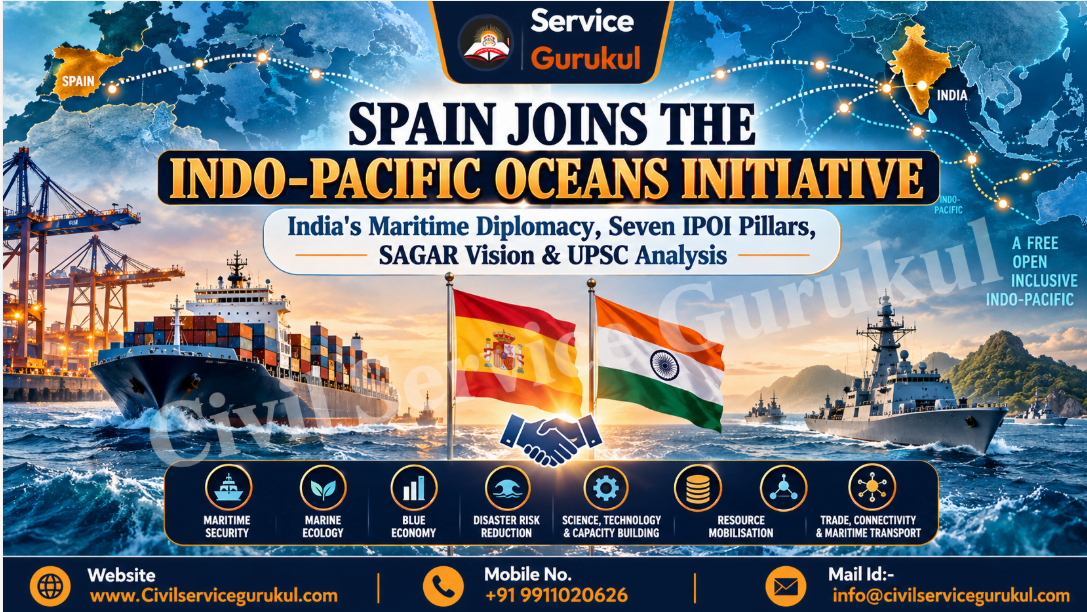

Spain Joins Indo-Pacific Oceans Initiative 2026: India's Maritime Diplomacy, Seven IPOI Pillars, SAGAR Vision & UPSC Analysis
Understanding Spain's participation in India's Indo-Pacific maritime initiative, maritime security, blue economy, regional connectivity and the future of India-Europe cooperation.
Current Affairs 2026 GS Paper II GS Paper III UPSC Prelims 2027Spain joined the India-led Indo-Pacific Oceans Initiative (IPOI) in January 2026, expanding international cooperation under India's Indo-Pacific vision.
Spanish Foreign Minister José Manuel Albares announced Spain's participation during his visit to India on 21 January 2026.
The IPOI, announced by Prime Minister Narendra Modi at the 14th East Asia Summit in Bangkok in November 2019, promotes cooperation through seven thematic pillars covering maritime security, ecology, resources, capacity building, disaster management, technology and connectivity.
This Civil Service Gurukul analysis examines the IPOI framework, Spain's participation, India's SAGAR vision, the strategic importance of the Indo-Pacific, blue economy opportunities, UPSC Prelims practice MCQs, Mains answer writing and high-priority revision topics.
1. Why Is Spain Joining IPOI in the News?
Spain announced its participation in the Indo-Pacific Oceans Initiative during the official visit of its Foreign Minister, José Manuel Albares, to India on 21 January 2026.
The announcement marked an important development in India-Spain diplomatic engagement and demonstrated growing European interest in cooperation across the Indo-Pacific region.
Spain highlighted opportunities for cooperation in science, connectivity, maritime transport and disaster risk reduction.
The development also complements Spain's broader Asia-Pacific diplomatic priorities and its engagement with India.
- Country: Spain.
- Initiative: Indo-Pacific Oceans Initiative (IPOI).
- Announcement: 21 January 2026.
- Spanish Foreign Minister: José Manuel Albares.
- Indian External Affairs Minister: S. Jaishankar.
- IPOI launched by: India.
- Launch year: 2019.
- Launch venue: 14th East Asia Summit, Bangkok.
- Number of pillars: Seven.
2. What Is the Indo-Pacific Oceans Initiative?
The Indo-Pacific Oceans Initiative is an India-led, voluntary and non-treaty-based framework for cooperation in the maritime domain.
It was announced by Prime Minister Narendra Modi on 4 November 2019 at the 14th East Asia Summit in Bangkok, Thailand.
The initiative seeks to develop practical cooperation among countries interested in a peaceful, stable, prosperous and sustainable Indo-Pacific.
Key Features of IPOI
- Voluntary participation by interested countries.
- Non-treaty-based cooperation.
- Seven thematic pillars.
- Focus on practical maritime projects.
- Cooperation with existing regional institutions.
- Emphasis on shared maritime challenges.
- Participation by countries from within and beyond the region.
Is IPOI a Military Alliance?
No. The IPOI is not a NATO-style collective defence alliance or a legally binding military organisation.
It is primarily a cooperative framework for maritime security, sustainable development, scientific collaboration and connectivity.
3. What Are the Seven Pillars of IPOI?
The IPOI operates through seven thematic areas designed to address interconnected challenges in the Indo-Pacific maritime region.
| No. | IPOI Pillar | Key Focus |
|---|---|---|
| 1 | Maritime Security | Maritime safety, cooperation, piracy and other security challenges. |
| 2 | Maritime Ecology | Marine pollution, ecosystems, biodiversity and environmental protection. |
| 3 | Maritime Resources | Sustainable use and management of marine resources. |
| 4 | Capacity Building and Resource Sharing | Training, institutional cooperation and shared expertise. |
| 5 | Disaster Risk Reduction and Management | Disaster preparedness, early warning and humanitarian cooperation. |
| 6 | Science, Technology and Academic Cooperation | Marine research, innovation and knowledge exchange. |
| 7 | Trade, Connectivity and Maritime Transport | Ports, shipping routes, logistics and maritime trade. |
Pillar 1: Maritime Security
Promotes cooperation to address piracy, maritime crime, illegal fishing and threats to the safety of shipping and coastal areas.
Pillar 2: Maritime Ecology
Focuses on protecting marine biodiversity, reducing ocean pollution and strengthening ecological sustainability.
Pillar 3: Maritime Resources
Promotes sustainable management of fisheries and other marine resources, while addressing risks from overexploitation.
Pillar 4: Capacity Building and Resource Sharing
Supports training, research capabilities, technical cooperation and institutional development among participating partners.
Pillar 5: Disaster Risk Reduction and Management
Encourages early-warning systems, preparedness and cooperation in responding to cyclones, tsunamis and other disasters.
Pillar 6: Science, Technology and Academic Cooperation
Promotes ocean observation, marine science, technological innovation and academic collaboration.
Pillar 7: Trade, Connectivity and Maritime Transport
Seeks to improve maritime transport systems, port infrastructure, connectivity and trade-related cooperation.
4. Why Did Spain Join the Indo-Pacific Oceans Initiative?
Spain's decision reflects its expanding engagement with India and the wider Asia-Pacific and Indo-Pacific regions.
A. Stronger India-Spain Relations
Joining IPOI provides another framework through which the two countries can expand cooperation on common interests.
B. Maritime Transport and Connectivity
Spain has important shipping and port capabilities. Cooperation may support exchange of expertise in maritime transport, logistics and connectivity.
C. Marine Science and Research
Spain's participation creates opportunities for collaborative ocean research, technology and academic partnerships.
D. Disaster Risk Reduction
Maritime disaster preparedness and resilience offer possible areas for joint initiatives, technical exchange and capacity building.
E. Broader European Engagement
Spain's involvement contributes to the wider European interest in Indo-Pacific cooperation and maritime stability.
F. Shared Interest in Multilateralism
The IPOI offers a flexible, cooperative framework in which partners can work on practical issues without forming an exclusive military bloc.
5. How Is IPOI Connected to India's SAGAR Vision?
SAGAR stands for Security and Growth for All in the Region.
Prime Minister Narendra Modi articulated the SAGAR vision in Mauritius in March 2015. It emphasises maritime security, economic cooperation, capacity building and regional development.
The IPOI, announced in 2019, provides a practical thematic framework for maritime cooperation consistent with India's broader Indo-Pacific vision.
IPOI vs SAGAR
| Feature | SAGAR | IPOI |
|---|---|---|
| Year | 2015 | 2019 |
| Nature | India's broader regional maritime vision. | Voluntary and thematic cooperation initiative. |
| Geographical Emphasis | Indian Ocean region. | Wider Indo-Pacific. |
| Primary Focus | Security, growth and regional cooperation. | Seven thematic maritime pillars. |
| Implementation | Multiple diplomatic and maritime partnerships. | Cooperative activities under identified pillars. |
6. What Is the Strategic Importance of the Indo-Pacific?
The Indo-Pacific connects the Indian and Pacific Ocean regions, including important shipping routes, economic centres and maritime chokepoints.
It is strategically important because international trade, energy supplies and maritime connectivity depend on secure sea lanes.
Important Maritime Chokepoints
| Chokepoint | Location | Importance |
|---|---|---|
| Strait of Malacca | Between the Malay Peninsula and Sumatra. | Major route connecting the Indian Ocean and Pacific-linked trade networks. |
| Strait of Hormuz | Between Iran and Oman. | Important route for international energy shipments. |
| Bab el-Mandeb | Between Yemen and the Horn of Africa. | Connects the Red Sea and Gulf of Aden. |
| Sunda Strait | Between Sumatra and Java. | Alternative maritime passage in Indonesia. |
| Lombok Strait | Between Bali and Lombok. | Important alternative deep-water maritime route. |
Why Does Maritime Security Matter to India?
- Protection of international shipping routes.
- Energy import security.
- Maritime trade and port development.
- Safety of coastal communities.
- Regional stability and security.
- Prevention of maritime crimes.
- Cooperation on climate and marine ecology.
7. How Is IPOI Relevant to the Blue Economy?
The blue economy broadly refers to the sustainable use of ocean resources for economic development, livelihoods and environmental sustainability.
IPOI supports objectives relevant to the blue economy through cooperation on maritime ecology, resources, transport and science.
Sustainable Fisheries
Support responsible fishing practices and protect the livelihoods of coastal communities.
Marine Biodiversity
Protect coastal and ocean ecosystems against pollution and degradation.
Maritime Transport
Improve maritime connectivity, port operations and logistics efficiency.
Ocean Research
Strengthen scientific understanding of marine systems and resources.
Disaster Resilience
Improve preparedness against cyclones, coastal flooding and tsunamis.
Coastal Development
Encourage sustainable livelihoods, infrastructure and economic opportunities.
Environmental Sustainability
Marine pollution, biodiversity loss, ocean warming and coastal degradation require cooperation beyond national borders.
The IPOI's ecology and resources pillars provide opportunities for partners to address these challenges collaboratively.
8. IPOI and Other Indo-Pacific Cooperation Frameworks
| Framework | Nature | Primary Focus |
|---|---|---|
| IPOI | India-led, voluntary, non-treaty-based initiative. | Seven pillars of maritime cooperation. |
| SAGAR | India's regional maritime vision. | Security and growth for all in the region. |
| IORA | Intergovernmental regional organisation. | Indian Ocean cooperation and sustainable development. |
| Quad | Diplomatic partnership of India, Australia, Japan and USA. | Indo-Pacific cooperation across strategic and practical fields. |
| ASEAN Outlook on the Indo-Pacific | ASEAN's cooperative regional outlook. | Inclusivity, cooperation and ASEAN centrality. |
| UNCLOS | International maritime treaty framework. | Rights and duties of states in maritime zones. |
9. Opportunities and Challenges Following Spain's Participation
| Opportunities | Challenges |
|---|---|
| Stronger India-Spain maritime cooperation. | Ensuring implementation beyond diplomatic declarations. |
| Greater engagement by European partners. | Different national priorities and institutional capacities. |
| Research and technology collaboration. | Funding and coordination requirements. |
| Enhanced maritime connectivity. | Infrastructure and logistical constraints. |
| Disaster preparedness and resilience. | Unequal technical capacity across participating countries. |
| Support for marine sustainability. | Environmental degradation and resource pressures. |
Critical Assessment
The expansion of IPOI can strengthen cooperation among countries with shared maritime and economic interests.
However, a voluntary framework depends on sustained political engagement, available resources and effective implementation.
For India, successful cooperation will require measurable projects, institutional coordination and inclusive regional engagement.
10. What Should Be the Way Forward for India and Spain?
1. Develop Practical Maritime Projects
Identify specific initiatives involving maritime transport, environmental protection, disaster resilience and scientific cooperation.
2. Strengthen Marine Science Partnerships
Promote cooperation between research institutions, universities and ocean technology organisations.
3. Improve Maritime Connectivity
Encourage sharing of expertise in port systems, maritime logistics and trade facilitation.
4. Promote Sustainable Blue Economy
Support marine resource conservation, sustainable fisheries and environmentally responsible development.
5. Enhance Disaster Preparedness
Promote early-warning capabilities, technical exchanges and joint disaster-risk management projects.
6. Strengthen Multilateral Coordination
Avoid unnecessary duplication by coordinating IPOI activities with relevant regional institutions.
7. Preserve an Inclusive Indo-Pacific
Cooperation should support international law, regional stability and practical engagement without creating unnecessary exclusion.
11. Why Is Spain Joining IPOI Important for UPSC?
| UPSC Paper | Syllabus Relevance |
|---|---|
| Prelims GS I | IPOI origin, seven pillars, East Asia Summit, chokepoints and international organisations. |
| Mains GS II | India-Spain relations, Indo-Pacific policy, maritime diplomacy and international cooperation. |
| Mains GS III | Blue economy, disaster management, marine environment and maritime security. |
| Essay | Global cooperation, ocean sustainability and regional development. |
| PSIR Optional | Indo-Pacific geopolitics, regional cooperation and international institutions. |
12. Most Important Topics to Revise for UPSC 2027
| Priority | Topic | Revision Focus |
|---|---|---|
| Very High | Seven IPOI Pillars | Exact thematic areas and objectives. |
| Very High | IPOI Launch | 2019, PM Narendra Modi, 14th East Asia Summit, Bangkok. |
| Very High | Spain's Participation | January 2026, José Manuel Albares and bilateral significance. |
| Very High | SAGAR | 2015, Mauritius, maritime security and regional growth. |
| High | Indo-Pacific Geography | Important seas, straits and maritime chokepoints. |
| High | Blue Economy | Marine resources, livelihoods and sustainability. |
| High | UNCLOS | Territorial sea, EEZ, continental shelf and navigation rights. |
| High | IORA and Quad | Origin, nature, members and differences from IPOI. |
| High | India-EU Relations | Connectivity and maritime cooperation. |
| High | Disaster Risk Management | Early warning, preparedness and coastal resilience. |
13. UPSC Prelims Practice MCQs with Answers
These are original UPSC-style practice questions. They are not actual previous-year examination questions.
Who announced the Indo-Pacific Oceans Initiative?
- Prime Minister of Japan
- Prime Minister Narendra Modi
- President of the United States
- Secretary-General of ASEAN
India announced IPOI at the 14th East Asia Summit in Bangkok on 4 November 2019.
How many thematic pillars does IPOI have?
- Five
- Six
- Seven
- Eight
IPOI has seven pillars covering maritime security, ecology, resources, capacity building, disaster management, science and technology, and trade and connectivity.
Consider the following statements about IPOI:
- IPOI was announced in 2019.
- It is a legally binding collective defence treaty.
- It promotes voluntary maritime cooperation.
Which statements are correct?
- 1 only
- 1 and 3 only
- 2 and 3 only
- 1, 2 and 3
IPOI is a voluntary, non-treaty-based maritime cooperation initiative, not a collective military defence treaty.
Which of the following are IPOI pillars?
- Maritime Ecology.
- Disaster Risk Reduction and Management.
- Science, Technology and Academic Cooperation.
- Trade, Connectivity and Maritime Transport.
- 1 and 2 only
- 2 and 3 only
- 1, 2 and 3 only
- 1, 2, 3 and 4
All four listed areas form part of the seven thematic pillars of IPOI.
Which Spanish Foreign Minister announced Spain's participation in IPOI in January 2026?
- José Manuel Albares
- Josep Borrell
- Pedro Sánchez
- Felipe VI
Spain's Foreign Minister announced the decision during his visit to India on 21 January 2026.
The SAGAR vision was announced by India in:
- 2012 at Bangkok
- 2015 at Mauritius
- 2019 at Singapore
- 2021 at New Delhi
SAGAR stands for Security and Growth for All in the Region and was articulated by Prime Minister Narendra Modi in Mauritius.
Which of the following best describes IPOI?
- A maritime military alliance.
- An international currency framework.
- A voluntary maritime cooperation initiative.
- A specialised agency of the United Nations.
IPOI is an open and voluntary initiative promoting practical maritime cooperation.
Which strait is located between the Malay Peninsula and Sumatra?
- Strait of Hormuz
- Strait of Malacca
- Bab el-Mandeb
- Strait of Gibraltar
The Strait of Malacca is a major maritime route connecting the Indian Ocean with Southeast Asian and Pacific trade networks.
14. UPSC Mains Answer-Writing Framework
"Spain's participation in the Indo-Pacific Oceans Initiative reflects the growing importance of India's maritime diplomacy." Examine the objectives of IPOI and evaluate the significance of European participation in the framework.
15 Marks | 250 WordsModel Answer
Introduction:
The Indo-Pacific Oceans Initiative, announced by India at the East Asia Summit in 2019, is a voluntary framework to promote practical cooperation in the maritime domain. Spain announced its participation in January 2026.
Major Objectives of IPOI:
- Promote maritime safety and security.
- Strengthen marine ecological protection.
- Encourage sustainable use of maritime resources.
- Build technical and institutional capabilities.
- Improve disaster preparedness and management.
- Support marine research and academic collaboration.
- Enhance maritime trade and connectivity.
Significance of Spain's Participation:
- Broadens international engagement with India's Indo-Pacific vision.
- Strengthens India-Spain bilateral relations.
- Creates scope for scientific and maritime technology cooperation.
- Encourages collaboration on connectivity and shipping.
- Supports disaster risk reduction and sustainable development.
- Connects Indian and European maritime cooperation priorities.
Challenges:
- Ensuring effective implementation of voluntary commitments.
- Mobilising sufficient financial and technical resources.
- Coordinating with existing regional institutions.
- Addressing divergent national interests.
Way Forward:
- Identify measurable joint maritime projects.
- Promote marine research and disaster resilience.
- Improve maritime transport and connectivity.
- Strengthen coordination among participating partners.
- Maintain an inclusive and rules-based approach.
Conclusion:
Spain's participation increases the scope for India-Europe maritime cooperation. Its long-term value will depend on translating diplomatic commitments into practical and sustainable projects.
Additional Mains Practice Questions
GS II | 10 Marks
Distinguish the Indo-Pacific Oceans Initiative from India's SAGAR vision.
GS II | 15 Marks
Assess the role of inclusive maritime cooperation frameworks in promoting Indo-Pacific stability.
GS III | 10 Marks
Explain the importance of marine ecology and sustainable resource management for India's blue economy.
Essay
"The oceans are not barriers between nations but bridges for cooperation and prosperity." Discuss.
15. Last-Minute Revision: 10 Facts
- Initiative: Indo-Pacific Oceans Initiative (IPOI).
- Proposed by: India.
- Announced: 4 November 2019.
- Venue: 14th East Asia Summit, Bangkok.
- Number of pillars: Seven.
- Nature: Open, voluntary and non-treaty-based.
- Spain's announcement: 21 January 2026.
- Spanish Foreign Minister: José Manuel Albares.
- SAGAR: Security and Growth for All in the Region, articulated in 2015.
- UPSC relevance: GS II International Relations and GS III Blue Economy and Disaster Management.
16. Frequently Asked Questions
When did Spain join the Indo-Pacific Oceans Initiative?
Spain announced its participation during Foreign Minister José Manuel Albares's visit to India on 21 January 2026.
Who launched the Indo-Pacific Oceans Initiative?
Prime Minister Narendra Modi announced IPOI at the 14th East Asia Summit in Bangkok on 4 November 2019.
How many pillars does IPOI have?
IPOI has seven thematic pillars covering maritime security, ecology, resources, capacity building, disaster management, science and technology, and maritime connectivity.
Is IPOI a military alliance?
No. It is a voluntary, non-treaty-based framework for practical maritime cooperation.
What is the relationship between SAGAR and IPOI?
SAGAR is India's broader maritime vision, while IPOI offers a thematic cooperative framework consistent with India's Indo-Pacific priorities.
Why is Spain's participation significant?
It offers opportunities to expand India-Spain maritime cooperation, particularly in science, connectivity, maritime transport and disaster risk reduction.
Which UPSC papers cover IPOI?
IPOI is relevant to Prelims GS I, Mains GS II International Relations, Mains GS III maritime security and disaster management, Essay and PSIR Optional.
Conclusion: India's Maritime Diplomacy and the Future of the Indo-Pacific
Spain's participation in the Indo-Pacific Oceans Initiative demonstrates increasing international interest in collaborative maritime governance.
For India, it provides another opportunity to deepen international partnerships while advancing the principles of security, sustainable development and inclusive regional cooperation.
The seven pillars of IPOI provide a framework for addressing shared maritime challenges through practical action.
Effective implementation, scientific cooperation, resource sharing and sustainable maritime development will determine the initiative's long-term contribution to the Indo-Pacific.
Prepare with Mentors Who Cleared the Exam
Get personalized study plans, evaluated answer models, and test series access.