Satellite Radiation: Blocking the View | UPSC Guide
Satellite Radiation: Blocking the View of the Universe
Civil Service Gurukul | Science & Technology
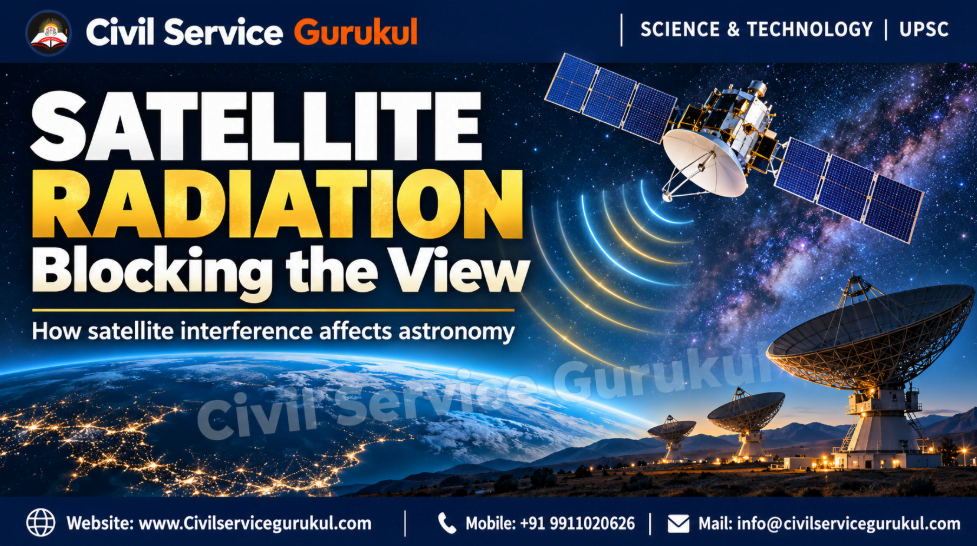
Satellites connect remote communities, support navigation and strengthen disaster response. However, their growing presence also creates a challenge for astronomy: artificial signals and reflected sunlight can overwhelm the faint information arriving from the universe.
UPSC syllabus connection: GS Paper III — Science and Technology, space technology and environmental implications; GS Paper II — international institutions and global governance.
Central distinction: “Blocking the view” mainly means contaminating observations. It does not mean satellites form a solid barrier across the sky.
1. Why Is Satellite Radiation a Concern?
Large satellite constellations consist of many spacecraft operating as coordinated networks. Communication networks in low Earth orbit can provide broad coverage and lower communication delays than more distant satellite systems. Their expansion also increases the number of artificial objects passing through telescope fields of view.
Astronomy depends on detecting extremely weak signals. A signal useful for communication, or unwanted electrical noise from spacecraft equipment, may be much stronger at a telescope than the celestial source being studied. Consequently, a technically functioning satellite can still create a scientific externality.
2. What Does “Satellite Radiation” Mean?
In this context, radiation means electromagnetic energy. The main radio-astronomy concern involves radio-frequency interference, while optical astronomy faces a separate problem from sunlight reflected by satellite surfaces.
Intentional radio transmissions
Satellites deliberately transmit radio signals to exchange information. These transmissions require spectrum coordination. Astronomical interference can arise from emissions outside an assigned channel, unwanted emissions or the combined effects of many satellites.
Unintended electromagnetic radiation
Spacecraft electronics can emit radio noise as a by-product of their operation. This is called unintended electromagnetic radiation, or UEMR. It is distinct from the satellite’s intended communication signal and may occur at frequencies used for scientific observations.
Reflected sunlight
Satellite bodies and solar panels reflect sunlight. Moving satellites can therefore appear as bright trails in optical telescope images. Reducing visible brightness does not automatically reduce radio emissions, so the two problems require different technical measures.
| Mechanism | Source | Main concern |
|---|---|---|
| Intentional radio transmission | Communication equipment | Interference with sensitive radio observations |
| Unintended radio emission | Onboard electronics | Noise beyond intended communication frequencies |
| Optical interference | Reflected sunlight | Bright trails and contaminated telescope images |
3. What Have Researchers Found?
LOFAR observations reported in 2023
Researchers using the Low Frequency Array, or LOFAR, observed 68 Starlink satellites and reported unintended emissions between 110 and 188 MHz. The observations included emissions within a band allocated to radio astronomy. The finding showed why examining communication transmissions alone is insufficient.
Second-generation satellites studied in 2024
A subsequent study found that some second-generation Starlink satellites produced unintended emissions up to 32 times stronger than those from earlier generations, after correcting for observed satellite distances. This was a result for the emissions and satellites studied; it should not be generalised to every frequency or spacecraft.
Further research in 2025
A study using the Engineering Development Array 2, a prototype station at the SKA-Low site, analysed approximately 76 million sky images collected over about 29 days. It investigated intended and unintended Starlink emissions across the SKA-Low frequency range, extending the evidence beyond the earlier LOFAR observations.
Exam caution: Stronger radio interference is not evidence that a satellite physically blocks more of the sky. It describes contamination of a measurement at particular frequencies.
4. How Does This Affect Astronomy?
Loss of faint cosmic signals
Radio astronomers study natural emissions from objects and processes such as pulsars, galaxies and interstellar gas. Artificial signals can conceal these emissions or make reliable measurements harder.
Reduced usable observing time
Researchers may need to exclude contaminated data or avoid affected observations. Repeated interference can reduce the scientific return from expensive facilities.
Challenges for optical sky surveys
Satellite trails affect images used to survey large areas of the sky. This matters for studies of changing celestial objects and searches for moving objects. Image processing can help, but removing a trail does not necessarily recover the astronomical information beneath it.
Limits of remote observatory locations
Radio-quiet zones reduce interference from nearby terrestrial equipment. However, satellites can pass above these protected locations. Geographic isolation therefore provides incomplete protection against space-based emitters.
5. Why Does the Issue Matter for India?
India has interests on both sides of this issue: expanding access to space-based services and maintaining strong astronomical research capabilities. Institutions operating facilities such as the Giant Metrewave Radio Telescope near Pune have a stake in preserving suitable observing conditions.
- Scientific capability: Sensitive observations support research, advanced instrumentation and training.
- Digital inclusion: Satellite connectivity can benefit underserved regions and strengthen communication resilience.
- Space industry: Early attention to emission control can improve spacecraft design and responsible operations.
- International cooperation: Interference crosses borders, requiring coordination between operators, scientists and public authorities.
A useful policy approach for India would assess astronomical impacts alongside the public benefits of satellite services, with consultation before constellation designs become difficult to change.
6. Governance Challenges and the Way Forward
Relevant international institutions
- International Telecommunication Union: Provides the international framework for radio-spectrum coordination. ITU-R Recommendation RA.769 sets out protection criteria for radio-astronomical measurements; it should not be described as a standalone global ban on satellite emissions.
- International Astronomical Union: Supports protection of astronomy through its Centre for the Protection of the Dark and Quiet Sky from Satellite Constellation Interference.
- UN COPUOS: Provides a forum for international discussion of peaceful space activities, including dark and quiet skies and large constellations.
Why regulation is difficult
Spectrum allocation, national licensing, technical standards and operational coordination address different aspects of interference. Compliance with an assigned communication band does not by itself demonstrate that every astronomical observation is protected.
An ITU discussion published in September 2026 highlighted growing concerns about out-of-band and spurious emissions and the importance of the World Radiocommunication Conference process for future protection.
Practical measures
- Improve spacecraft design: Test electronics for unintended emissions and use appropriate shielding, filtering and equipment design.
- Reduce optical brightness: Evaluate surface treatments and spacecraft orientation while accounting for thermal and operational requirements.
- Coordinate operations: Share accurate orbital information and investigate feasible observing and transmission arrangements.
- Measure cumulative effects: Assess the combined impact of constellations rather than examining each spacecraft in isolation.
- Strengthen monitoring: Compare pre-launch tests with independent observations after deployment.
- Support international standards: Develop clear, measurable expectations through cooperation among regulators, industry and astronomers.
7. UPSC Prelims: Essential Distinctions
- Radio telescopes receive natural radio emissions; ordinary radio astronomy does not require transmitting signals towards the objects being observed.
- UEMR originates from equipment operation and is distinct from intended communication transmissions.
- Optical satellite trails arise mainly from reflected sunlight.
- Radio-quiet zones cannot completely exclude interference from satellites passing overhead.
- Space debris concerns physical objects and collision risks; electromagnetic interference concerns signals. They are related governance issues but different hazards.
Practice Question
Consider the following statements:
- Satellite electronics can produce unintended radio emissions independently of intended communication signals.
- Radio-quiet zones completely prevent interference from orbiting satellites.
- Reflected sunlight from satellites can affect optical astronomical observations.
Which of the statements given above are correct?
- A. 1 and 2 only
- B. 1 and 3 only
- C. 2 and 3 only
- D. 1, 2 and 3
View answer and explanation
Correct answer: B. 1 and 3 only. Onboard electronics can generate unintended radio noise, while reflected sunlight can contaminate optical images. Radio-quiet zones mainly control terrestrial interference and cannot completely prevent emissions from satellites passing above them.
8. UPSC Mains: Answer-Writing Framework
Practice question: “The expansion of satellite constellations creates a conflict between digital connectivity and the protection of astronomical research.” Discuss and suggest measures for balanced governance. (250 words)
- Introduction: Explain the growth of satellite services and astronomy’s dependence on faint natural signals.
- Benefits: Discuss connectivity, disaster communication and technological development.
- Challenges: Distinguish intended transmissions, unintended emissions and reflected sunlight.
- Governance: Explain cross-border effects, cumulative impacts and the roles of relevant international institutions.
- Solutions: Recommend design improvements, monitoring, transparent data sharing and coordinated standards.
9. Frequently Asked Questions
Do satellites physically block the entire sky?
No. The concern is primarily interference with observations. Bright trails and artificial radio emissions can obscure information without forming a continuous physical barrier.
Does making satellites darker solve radio interference?
No. Optical brightness and radio emissions have different causes. A spacecraft can be less reflective while still emitting unwanted radio noise.
Can software remove all satellite interference?
No. Processing can identify and reduce some contamination, but it cannot guarantee recovery of information that was overwhelmed or never recorded reliably.
Conclusion
Satellite services and astronomical research both offer substantial public value. Protecting access to the universe requires incorporating observational impacts into spacecraft design, licensing discussions and international cooperation. For UPSC aspirants, the issue illustrates how technological progress creates shared-resource challenges that demand evidence-based governance.
Prepare with Mentors Who Cleared the Exam
Get personalized study plans, evaluated answer models, and test series access.