PM-KISAN Scheme 2026: DBT, Benefits & Challenges
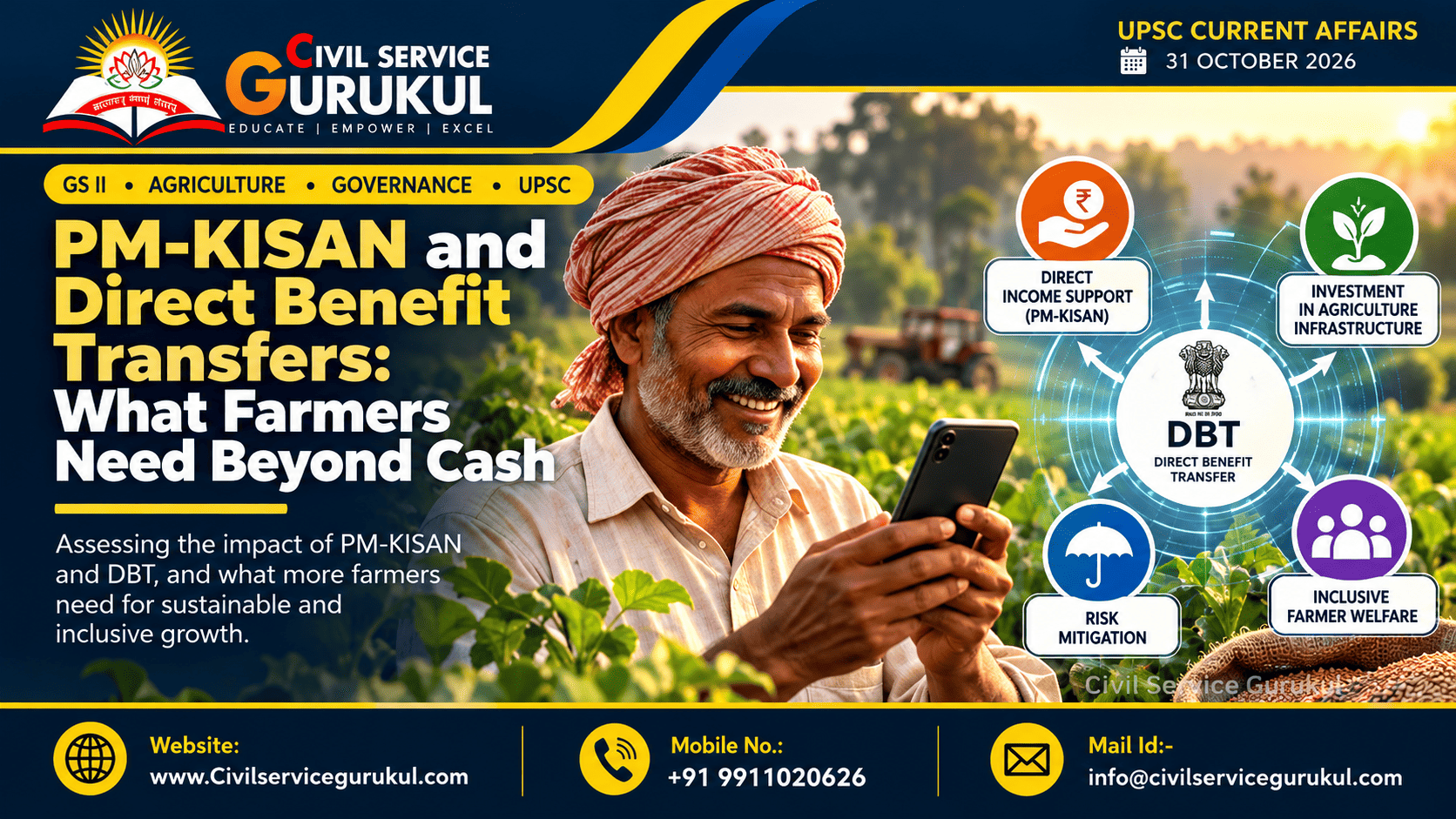
PM-KISAN Scheme 2026: Why ₹6,000 Direct Benefit Transfer Alone Cannot Solve Farmers' Challenges
A comprehensive UPSC analysis of PM-KISAN, Direct Benefit Transfers, farmer income security, eligibility challenges, financial inclusion and agricultural reforms.
The PM-KISAN scheme provides eligible landholding farmer families ₹6,000 per year in three instalments through Direct Benefit Transfer.
The scheme is designed to provide income support and improve access to predictable cash assistance.
However, Indian agriculture faces structural challenges such as weather shocks, rising input costs, market uncertainty and seasonal cash-flow gaps.
Income transfers can complement, but cannot replace, irrigation, agricultural extension services, crop insurance and better market access.
GS Paper II: Government welfare schemes, implementation mechanisms, social justice, governance and public service delivery.
GS Paper III: Indian agriculture, farm income, agricultural economics, subsidies, rural development and inclusive growth.
Prelims: PM-KISAN, Direct Benefit Transfer, Central Sector Schemes, eligibility requirements and government welfare programmes.
Why Is PM-KISAN in the News?
A current-affairs entry dated 30 October 2026 flagged a forthcoming PM-KISAN instalment.
The development draws attention to the design, delivery and effectiveness of direct income support for cultivators.
It also raises important questions about beneficiary identification, timely transfers and the broader needs of rural households.
An announcement of a PM-KISAN instalment does not establish that every registered applicant has received payment.
Actual payment status depends on eligibility, verification and successful transfer.
What Is PM-KISAN?
Pradhan Mantri Kisan Samman Nidhi, commonly known as PM-KISAN, is a Central Sector income-support scheme for eligible landholding farmer families.
Under the scheme, eligible families receive ₹6,000 annually in three instalments of ₹2,000 each.
Nature of the Scheme
- Central Sector Scheme.
- Income support for eligible landholding farmer families.
- Direct transfer to beneficiary bank accounts.
- Subject to prescribed eligibility and verification requirements.
Important Distinction
PM-KISAN is an income-support scheme.
It is not a crop insurance programme and does not automatically compensate farmers for crop losses.
How Does Direct Benefit Transfer Work?
Direct Benefit Transfer, or DBT, is a mechanism through which eligible beneficiaries receive government benefits through direct payment channels.
Potential Advantages
- Reduced dependence on intermediaries.
- Greater payment traceability.
- More predictable transfer mechanisms.
- Improved administrative monitoring.
Limitations
Digital payment systems still depend on accurate beneficiary records, identity verification, bank linkage and effective grievance redressal.
PM-KISAN is a Central Sector Scheme providing annual income support of ₹6,000 to eligible landholding farmer families.
Potential Benefits of PM-KISAN
Seasonal Liquidity
Predictable cash support can help eligible households manage some seasonal expenses.
Household Flexibility
Cash transfers allow beneficiaries to allocate funds according to their immediate needs.
Financial Inclusion
Bank-based payments can support formal financial access where accounts and payment systems function effectively.
Administrative Traceability
Digital transfers can make payment records easier to monitor.
Major Implementation Challenges
1. Land Record Errors
Inaccurate or outdated land records may create difficulties in identifying eligible beneficiaries.
2. Identity Verification
Incomplete verification may delay benefit processing.
3. e-KYC Requirements
Beneficiaries may face difficulties completing required verification procedures.
4. Bank Linkage
Incorrect or incomplete bank-related information may interrupt transfers.
5. Grievance Redressal
Inaccessible help desks or slow correction mechanisms may prolong payment difficulties.
6. Uniform Transfer Size
A fixed annual amount does not automatically adjust for severe crop losses, regional cost differences or varying household circumstances.
Tenant Farmers and Landless Agricultural Labourers
An important limitation of landholding-based income support is its relationship with recorded land ownership.
Tenant Farmers
Some cultivators farm land without owning it.
Where eligibility depends on recorded landholding, such cultivators may not qualify independently.
Landless Agricultural Labourers
Landless agricultural workers contribute to agricultural production but do not automatically qualify under a landholding-based income-support scheme.
Gender Dimension
Land ownership and record accuracy can affect the identification of eligible women farmers.
How can agricultural welfare policies protect vulnerable cultivators and workers without creating excessive administrative complexity?
Why Do Farmers Need More Than Cash Transfers?
Irrigation
Reliable irrigation can reduce dependence on uncertain rainfall.
Agricultural Extension
Access to reliable agronomic advice can support better farming decisions.
Crop Insurance
Appropriate insurance can help manage specified agricultural risks, subject to scheme conditions.
Market Access
Better access to markets, storage and price information can support farm income opportunities.
Affordable Credit
Suitable credit access can reduce short-term financial stress where responsibly designed.
Climate Resilience
Climate-adaptive farming practices can help manage weather-related agricultural risks.
| Policy Instrument | Primary Purpose | Key Limitation |
|---|---|---|
| PM-KISAN | Predictable income support | Limited annual amount and eligibility restrictions |
| Irrigation | Improved water availability | Infrastructure and resource constraints |
| Crop Insurance | Risk protection under scheme terms | Coverage and claims-related challenges |
| Extension Services | Technical farming advice | Uneven service access |
| Market Reforms | Better marketing opportunities | Infrastructure and institutional challenges |
Governance Implications of Agricultural DBT
Efficiency vs Inclusion
Digital transfers may improve efficiency, but strict verification can also create exclusion risks if correction systems are inadequate.
Transparency
Clear eligibility rules and accessible payment information can improve public accountability.
Grievance Redressal
Beneficiaries need practical mechanisms to correct errors and seek assistance.
Outcome-Based Evaluation
The effectiveness of a welfare programme should be assessed through household and agricultural outcomes, not merely the number of transfers.
Way Forward: Strengthening PM-KISAN and Agricultural Welfare
- Improve land-record accuracy and transparent correction.
- Strengthen accessible beneficiary help desks.
- Ensure timely and reliable transfers.
- Simplify verification without compromising necessary safeguards.
- Improve gender-sensitive land record systems.
- Address welfare gaps affecting tenant farmers and landless workers.
- Coordinate income support with irrigation and extension services.
- Strengthen access to suitable agricultural insurance.
- Improve market access and agricultural infrastructure.
- Integrate climate-resilient agriculture services.
- Conduct independent programme evaluations.
- Measure welfare outcomes rather than transfer counts alone.
UPSC Prelims Practice Questions
Question 1
The annual PM-KISAN benefit for an eligible farmer family is:
(a) ₹2,000
(b) ₹6,000
(c) ₹12,000
(d) ₹20,000
Eligible farmer families receive ₹6,000 annually in three instalments of ₹2,000 each.
Question 2
Consider the following statements:
- PM-KISAN is a Central Sector Scheme.
- PM-KISAN is primarily a crop insurance scheme.
Which of the statements given above is/are correct?
(a) 1 only
(b) 2 only
(c) Both 1 and 2
(d) Neither 1 nor 2
Statement 1 is correct. PM-KISAN is a Central Sector Scheme.
Statement 2 is incorrect. It provides income support, not crop-loss indemnity.
Question 3
Which of the following may create implementation challenges for DBT schemes?
- Inaccurate beneficiary records
- Bank linkage problems
- Inadequate grievance redressal
Select the correct answer:
(a) 1 only
(b) 1 and 2 only
(c) 2 and 3 only
(d) 1, 2 and 3
All three can affect effective delivery of DBT benefits.
Question 4
Which statement best explains the limitations of direct income support in agriculture?
(a) Cash transfers automatically eliminate all agricultural risks
(b) Income support can help liquidity but cannot replace irrigation, insurance and market access
(c) Direct transfers always cover all agricultural workers
(d) Cash transfers remove the need for agricultural policy
Income support can complement structural agricultural reforms, but cannot replace them.
UPSC Mains Practice Question
Question: "Direct income support can improve agricultural household liquidity, but it cannot substitute for structural reforms in Indian agriculture." Critically examine this statement with reference to PM-KISAN. (250 words)
Suggested Answer Framework
Introduction: Define PM-KISAN and direct income support.
Benefits: Discuss liquidity, predictability and transfer traceability.
Challenges: Explain land-record errors, verification issues and exclusion risks.
Structural Issues: Discuss irrigation, crop insurance, credit, markets and climate resilience.
Way Forward: Recommend transparent beneficiary correction, inclusive welfare and outcome-based evaluation.
Conclusion: Income support should complement a broader strategy for resilient and inclusive agriculture.
Frequently Asked Questions
What is PM-KISAN?
PM-KISAN is a Central Sector income-support scheme for eligible landholding farmer families.
How much financial assistance is provided under PM-KISAN?
Eligible families receive ₹6,000 annually in three instalments of ₹2,000 each.
Is PM-KISAN a crop insurance scheme?
No. It is an income-support scheme, not crop insurance.
Does PM-KISAN automatically cover all agricultural workers?
No. Eligibility is linked to prescribed landholding and other conditions.
Why can PM-KISAN payments be delayed?
Potential reasons include record discrepancies, verification issues and bank-linkage problems.
Which UPSC papers cover PM-KISAN?
GS Paper II covers welfare schemes and governance. GS Paper III covers agriculture and the Indian economy.
Key Takeaway for UPSC Aspirants
PM-KISAN demonstrates the potential of direct income support to improve household liquidity.
However, its effectiveness depends on accurate beneficiary identification, reliable transfers, accessible grievance redressal and inclusive policy design.
Sustainable agricultural welfare requires a broader combination of income support, irrigation, insurance, market access and climate resilience.
SEO Keywords and Tags
Prepare for UPSC with Civil Service Gurukul
Strengthen your understanding of Indian agriculture, government welfare schemes, economic development, financial inclusion and current affairs through examination-focused UPSC preparation.
Website: www.civilservicegurukul.com
Mobile: +91 9911020626
Email: info@civilservicegurukul.com
Prepare with Mentors Who Cleared the Exam
Get personalized study plans, evaluated answer models, and test series access.