
India–ASEAN Counterterrorism Cooperation 2026 | UPSC
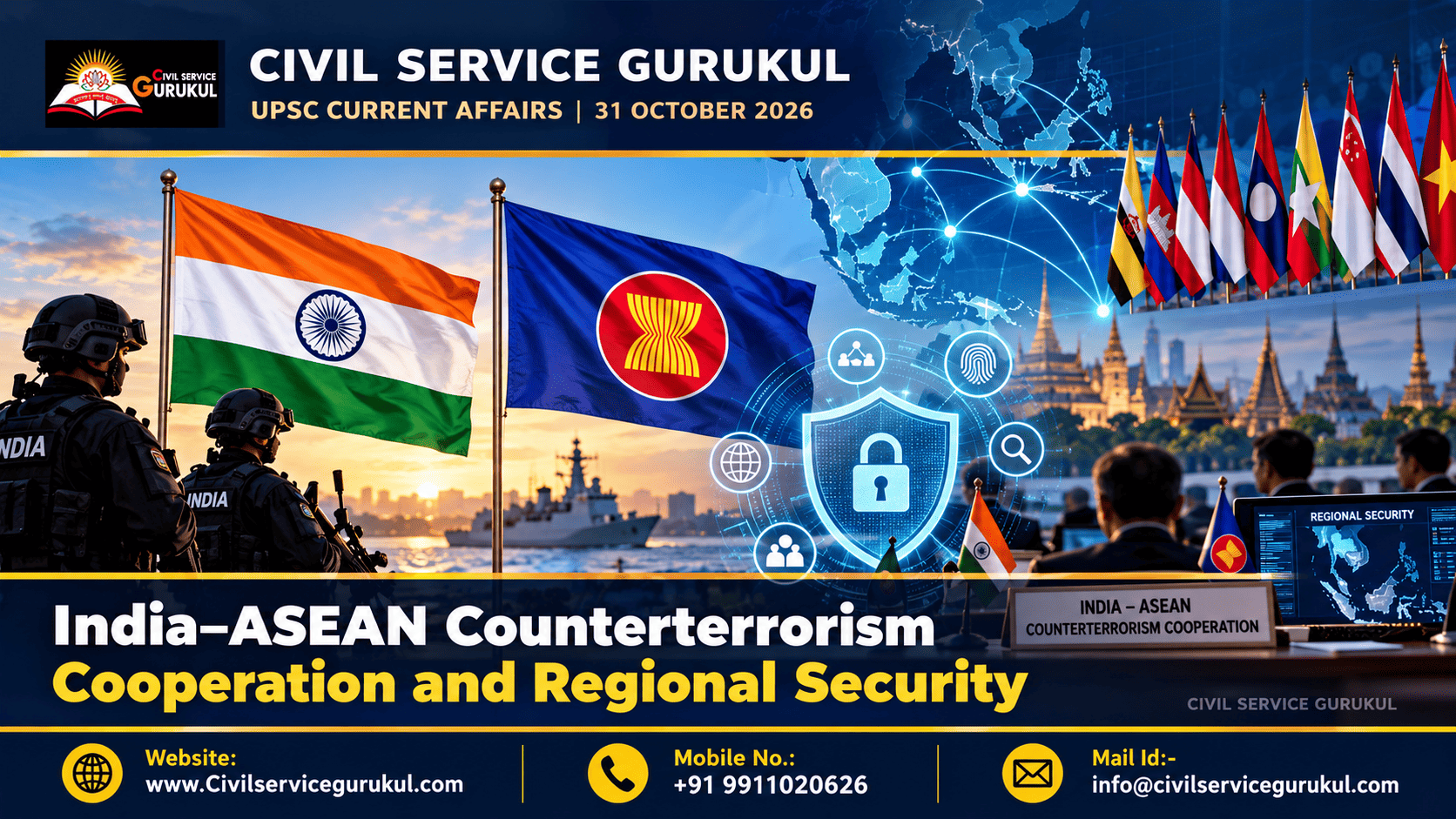
India–ASEAN Counterterrorism Cooperation 2026: Strengthening Regional Security and India's Act East Policy
A comprehensive UPSC analysis of counterterrorism cooperation, ASEAN centrality, regional security, terrorist financing, maritime threats, cybersecurity and India's Indo-Pacific engagement.
India and the Association of Southeast Asian Nations, or ASEAN, share important interests in maintaining regional stability and addressing transnational security threats.
Terrorism, illicit financing, organised crime and technology-enabled threats can cross national borders and require coordinated responses.
India–ASEAN security cooperation is therefore relevant to diplomatic engagement, information exchange, capacity building and regional resilience.
For India, this cooperation also supports broader engagement with Southeast Asia under the Act East Policy.
GS Paper II: Bilateral, regional and global groupings, international relations, India's neighbourhood and foreign policy.
GS Paper III: Internal security, terrorism, organised crime, cybersecurity, money laundering and security challenges.
Prelims: ASEAN, Act East Policy, ASEAN Regional Forum, East Asia Summit, ADMM-Plus and regional cooperation.
Why Is India–ASEAN Counterterrorism Cooperation Important?
The current-affairs theme dated 31 October 2026 highlights India–ASEAN counterterrorism cooperation and regional security.
The topic is significant because security threats often operate across national boundaries.
Effective responses may require cooperation between governments, law-enforcement agencies and relevant regional institutions.
The accompanying featured image identifies the subject but does not establish a specific new agreement, joint operation or meeting outcome.
Accordingly, this article examines the broader policy framework without asserting unverified developments.
What Is ASEAN?
The Association of Southeast Asian Nations was established in 1967 to promote regional cooperation.
ASEAN plays an important role in Southeast Asian diplomatic, economic and security dialogue.
ASEAN Centrality
ASEAN centrality refers to ASEAN's role as a central convening platform in regional cooperation and dialogue.
Consensus-Based Engagement
ASEAN commonly relies on consultation and consensus in collective decision-making.
Evolution of India–ASEAN Relations
India's engagement with ASEAN has developed across diplomatic, economic, cultural and strategic dimensions.
Early Partnership
India became an ASEAN sectoral dialogue partner in 1992.
Strategic Engagement
The relationship has expanded to include regional security, connectivity and Indo-Pacific cooperation.
Act East Policy
India's Act East Policy places emphasis on strengthening engagement with Southeast Asian countries.
Major Security Threats in the Region
1. Terrorism
Terrorist networks may exploit cross-border movement, financial channels and digital platforms.
2. Terrorist Financing
Illicit financial activity can support violent organisations and complicate law-enforcement efforts.
3. Transnational Organised Crime
Criminal networks may operate across multiple jurisdictions.
4. Online Radicalisation
Digital platforms can be misused to spread violent extremist propaganda.
5. Maritime Security Risks
Illegal activities at sea can create security and economic concerns.
Key Areas of India–ASEAN Counterterrorism Cooperation
Information Exchange
Relevant authorities can benefit from timely, lawful exchange of security information.
Capacity Building
Training and institutional cooperation can improve preparedness and investigative capabilities.
Financial Intelligence
Cooperation against terrorist financing requires appropriate financial monitoring and legal safeguards.
Legal Cooperation
Cross-border investigations may require mutual legal assistance and coordination between competent authorities.
Cybersecurity Dialogue
Digital threats create opportunities for cooperation in technical expertise and incident response.
Counterterrorism cooperation is not limited to military action.
It also involves diplomacy, law enforcement, financial intelligence, capacity building and international law.
Important Regional Security Institutions
| Institution | Principal Function | UPSC Relevance |
|---|---|---|
| ASEAN Regional Forum | Regional political and security dialogue | Security cooperation |
| East Asia Summit | Leaders-led strategic dialogue and cooperation | Indo-Pacific diplomacy |
| ADMM-Plus | Defence cooperation between ASEAN and dialogue partners | Regional defence engagement |
| ASEAN-India Dialogue | Bilateral and regional partnership engagement | India's foreign policy |
Maritime Security and Emerging Digital Threats
Maritime Security
The Indian Ocean and adjoining Southeast Asian waters are important for trade, connectivity and regional stability.
Maritime security cooperation can address shared concerns through dialogue, capacity building and lawful coordination.
Cybersecurity
Technology-enabled threats can cross borders rapidly and may require technical cooperation and appropriate legal mechanisms.
Balancing Security and Rights
Counterterrorism measures should be consistent with applicable law, due process and fundamental rights.
Challenges to Effective Regional Security Cooperation
- Different Legal Systems: Countries may have different definitions, procedures and legal requirements.
- Information Sensitivity: Security information requires appropriate confidentiality and safeguards.
- Capacity Differences: Institutional and technical capabilities vary across countries.
- Consensus Requirements: Multilateral coordination can be time-consuming.
- Technology Risks: Rapid digital change can outpace institutional responses.
- Geopolitical Competition: Regional tensions may complicate cooperation.
- Rights Protection: Security measures must avoid unlawful or disproportionate action.
India's Act East Policy and Regional Security
India's Act East Policy supports closer engagement with Southeast Asia across multiple sectors.
Strategic Connectivity
Regional connectivity can strengthen economic and people-to-people ties.
Diplomatic Engagement
Regular dialogue can help build trust and understanding.
Security Cooperation
Shared security concerns create opportunities for institutional and technical cooperation.
Indo-Pacific Stability
India's engagement with ASEAN is relevant to a stable and cooperative Indo-Pacific region.
Way Forward: Strengthening India–ASEAN Security Cooperation
- Expand regular counterterrorism dialogue.
- Improve lawful information-sharing mechanisms.
- Strengthen financial intelligence cooperation.
- Promote training and capacity building.
- Develop cooperation against technology-enabled security threats.
- Support maritime security coordination.
- Improve legal and institutional interoperability.
- Respect national sovereignty and applicable legal safeguards.
- Promote preventive and community-based approaches.
- Strengthen engagement through ASEAN-led institutions.
- Evaluate cooperation through practical, measurable outcomes.
UPSC Prelims Practice Questions
Question 1
ASEAN was established in:
(a) 1945
(b) 1967
(c) 1985
(d) 2001
ASEAN was established in 1967.
Question 2
India became an ASEAN sectoral dialogue partner in:
(a) 1975
(b) 1982
(c) 1992
(d) 2014
India became an ASEAN sectoral dialogue partner in 1992.
Question 3
Which of the following are relevant to regional counterterrorism cooperation?
- Financial intelligence
- Information exchange
- Capacity building
Select the correct answer:
(a) 1 only
(b) 1 and 2 only
(c) 2 and 3 only
(d) 1, 2 and 3
All three are relevant instruments of counterterrorism cooperation.
Question 4
Consider the following statements:
- The East Asia Summit is a forum for strategic dialogue.
- ADMM-Plus is associated with regional defence cooperation.
Which of the statements given above is/are correct?
(a) 1 only
(b) 2 only
(c) Both 1 and 2
(d) Neither 1 nor 2
Both statements are correct.
The East Asia Summit supports strategic dialogue, while ADMM-Plus facilitates defence cooperation.
UPSC Mains Practice Question
Question: "India–ASEAN counterterrorism cooperation is essential for strengthening regional stability in an increasingly interconnected security environment." Discuss the opportunities and challenges of this partnership with reference to India's Act East Policy. (250 words)
Suggested Answer Framework
Introduction: Explain the importance of India–ASEAN relations and transnational security challenges.
Opportunities: Discuss information exchange, financial intelligence, capacity building and cybersecurity cooperation.
Institutional Framework: Refer to ASEAN-led regional dialogue and defence mechanisms.
Challenges: Explain legal differences, capacity gaps, geopolitical tensions and rights safeguards.
Way Forward: Recommend regular dialogue, lawful cooperation, technical training and measurable outcomes.
Conclusion: Effective India–ASEAN security cooperation can support regional stability while respecting sovereignty and international law.
Frequently Asked Questions
What is ASEAN?
ASEAN is the Association of Southeast Asian Nations, established in 1967.
Why is India–ASEAN counterterrorism cooperation important?
It supports coordinated responses to cross-border security threats.
What is ASEAN centrality?
It refers to ASEAN's central convening role in regional dialogue and cooperation.
What is ADMM-Plus?
It is a defence cooperation framework involving ASEAN and its dialogue partners.
How is the Act East Policy relevant?
It promotes India's engagement with Southeast Asia across strategic, economic and other sectors.
Which UPSC papers cover this topic?
GS Paper II covers international relations, while GS Paper III covers internal security.
Key Takeaway for UPSC Aspirants
India–ASEAN counterterrorism cooperation reflects the growing importance of regional responses to transnational security challenges.
Information exchange, capacity building, financial intelligence and institutional dialogue can contribute to regional stability.
A sustainable partnership requires effective cooperation, respect for sovereignty, legal safeguards and continued diplomatic engagement.
SEO Keywords and Tags
Prepare for UPSC with Civil Service Gurukul
Strengthen your understanding of international relations, internal security, India's foreign policy, regional cooperation and current affairs through examination-focused UPSC preparation.
Website: www.civilservicegurukul.com
Mobile: +91 9911020626
Email: info@civilservicegurukul.com
Prepare with Mentors Who Cleared the Exam
Get personalized study plans, evaluated answer models, and test series access.