
India's Payment Revolution 2026: Complete UPSC Notes
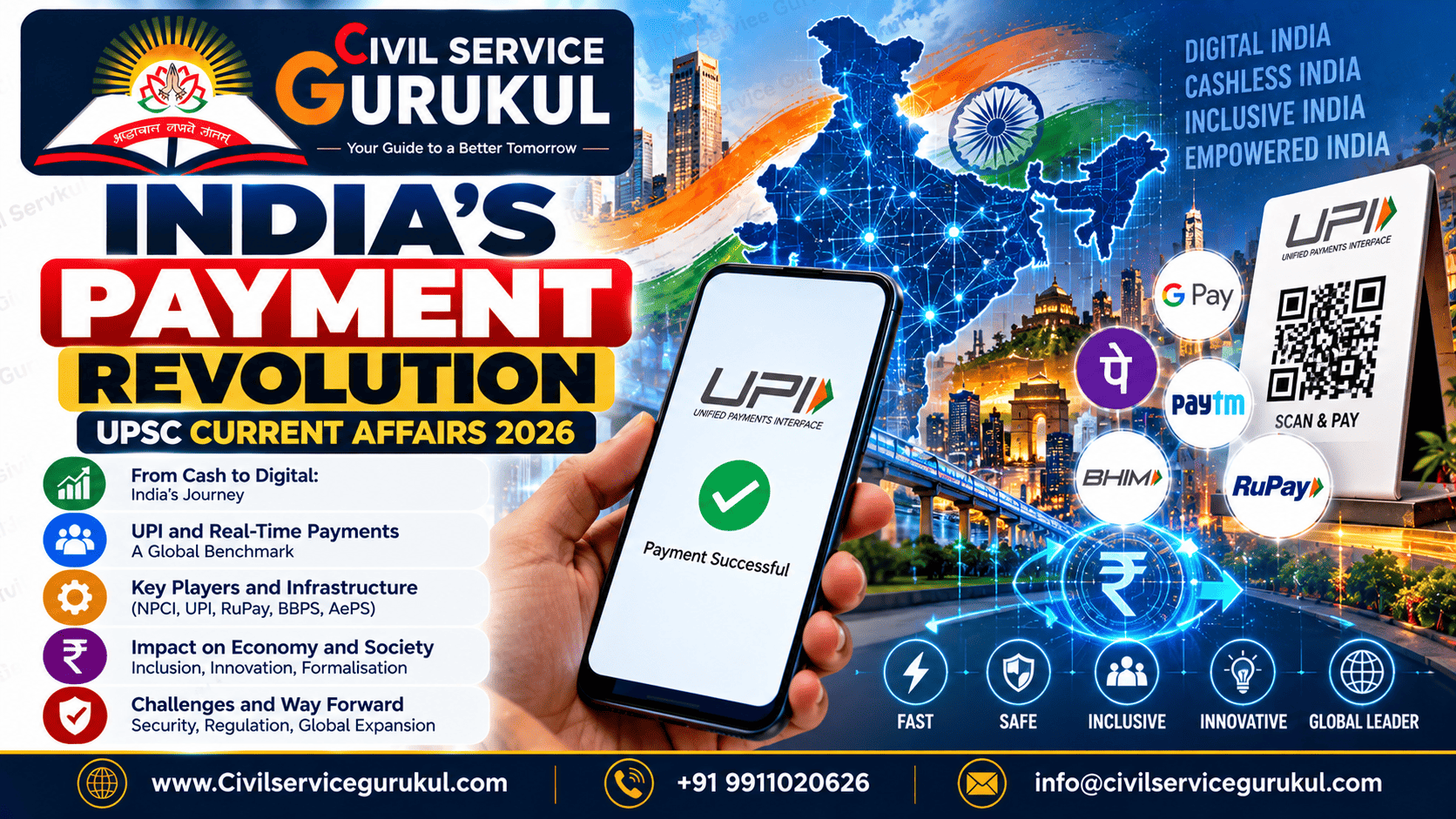
India's Payment Revolution: How UPI, Digital Public Infrastructure and Financial Inclusion Are Transforming the Economy
Complete UPSC notes on UPI, NPCI, the JAM Trinity, digital banking, financial inclusion, cross-border payments, cybersecurity and India's emerging fintech economy.
India's digital payment transformation represents one of the most significant developments in modern financial infrastructure. From cash-dominated transactions to instant QR-code payments, the country has developed a large-scale interoperable payment ecosystem. At its centre is the Unified Payments Interface (UPI), supported by the National Payments Corporation of India, the Reserve Bank of India and India's expanding digital public infrastructure. The revolution demonstrates how technology, institutional design and public policy can jointly support financial inclusion and economic efficiency.
1. Why Is India's Payment Revolution in the News?
The year 2026 marks a decade since the public rollout of the Unified Payments Interface in August 2016.
Over this period, UPI has evolved from a relatively small digital payment platform into the dominant mode of retail digital transactions in India.
Its growth has brought renewed attention to payment system economics, financial inclusion, cybersecurity, merchant charges and international expansion.
2. What Is UPI?
Unified Payments Interface (UPI) is an interoperable, real-time payment system developed and operated by the National Payments Corporation of India.
It enables eligible users to transfer money between participating bank accounts using mobile applications, virtual payment addresses, QR codes and other supported methods.
Important Features
- Instant bank-to-bank payments.
- Round-the-clock availability.
- Interoperability across participating banks and apps.
- Person-to-person and person-to-merchant transactions.
- Support for QR-code payments.
- Authentication and security safeguards.
3. Evolution of Digital Payments in India
| Year | Important Development |
|---|---|
| 2007 | Payment and Settlement Systems Act established a major legal framework for payment system regulation. |
| 2008 | NPCI was incorporated to develop and operate retail payment infrastructure. |
| 2010 | Immediate Payment Service (IMPS) was launched. |
| 2014 | Pradhan Mantri Jan-Dhan Yojana was launched to expand access to banking. |
| 2016 | UPI pilot launched in April; public rollout followed in August; BHIM was launched in December. |
| 2022 | RBI began pilots of the digital rupee. |
| 2026 | UPI completed a decade of public operations and continued expanding domestically and internationally. |
4. Role of NPCI
The National Payments Corporation of India is an umbrella organisation for operating retail payment and settlement systems in India.
It was established as an initiative of the RBI and the Indian Banks' Association and is incorporated as a not-for-profit company under the applicable company law framework.
Important NPCI Products
UPI
Instant interoperable payments between participating bank accounts.
RuPay
India's domestic card payment network.
IMPS
Immediate interbank electronic funds transfer service.
BBPS
Interoperable bill payment ecosystem, now branded Bharat Connect.
AePS
Aadhaar Enabled Payment System for supported banking transactions.
NACH
National Automated Clearing House for bulk and recurring payment processing.
5. What Is the JAM Trinity?
The JAM Trinity refers to Jan Dhan, Aadhaar and Mobile.
Together, these components help connect individuals with formal banking services, digital identification and mobile-based financial access.
JAM supports initiatives such as Direct Benefit Transfer and digital financial access, although not every UPI payment requires Aadhaar authentication or a Jan Dhan account.
6. How Does a UPI Payment Work?
- The payer initiates a payment using a participating UPI application.
- The payment request identifies the intended beneficiary through a supported payment identifier.
- The payer authorises the transaction using the applicable authentication method.
- Participating institutions process the payment through the UPI ecosystem.
- The payer and beneficiary receive transaction confirmation or failure information.
7. Why Has UPI Become So Popular?
A. Interoperability
Customers can transact across participating banks and apps without being restricted to a single provider's closed network.
B. Convenience
Payments can be initiated quickly through mobile applications and QR codes.
C. Low Entry Barriers
Small merchants can accept digital payments without necessarily requiring traditional card terminals.
D. Public Digital Infrastructure
Common infrastructure allows private companies to innovate in applications and services without rebuilding the entire underlying payment network.
E. Policy and Institutional Support
Regulatory oversight, banking participation and public initiatives have supported widespread adoption.
8. India's Digital Payment Growth: Key Statistics
| Indicator | Reported Figure |
|---|---|
| UPI Transaction Volume, FY 2025–26 | Approximately 24,161.69 crore |
| UPI Transaction Value, FY 2025–26 | Approximately ₹314.23 lakh crore |
| UPI Users Onboarded, June 2026 | Approximately 55.49 crore |
| UPI Transaction Volume, September 2026 | Approximately 2,406.84 crore |
| UPI Transaction Value, September 2026 | Approximately ₹29.37 lakh crore |
| Banks Live on UPI, September 2026 | 756 |
These figures demonstrate the growing scale of UPI, but transaction volume should not be confused with the number of unique users or with new economic output.
9. Financial Inclusion and UPI
Financial inclusion means ensuring access to appropriate and affordable financial products and services for individuals and businesses.
UPI can support inclusion by making electronic payments more accessible to small businesses, informal workers and households.
Potential Benefits
- Reduced dependence on physical cash for daily transactions.
- Greater convenience for small-value payments.
- Improved digital transaction records.
- Lower payment acceptance barriers for merchants.
- Greater opportunities for fintech innovation.
However, a bank account, mobile device, connectivity, digital literacy and trust remain important conditions for effective access.
10. Impact on MSMEs and Street Vendors
Merchant Convenience
QR-based payment acceptance can reduce dependence on cash handling and change.
Transaction Records
Digital records can assist bookkeeping and business financial management.
Customer Choice
Offering digital payments can make transactions easier for customers who prefer them.
Financial Access
Transaction histories may support some data-based financial services, subject to consent and lender assessment.
11. UPI Lite and UPI 123PAY
UPI Lite
UPI Lite is designed to make eligible small-value transactions more convenient by reducing friction in routine payments.
UPI 123PAY
UPI 123PAY expands access to UPI-related payment services for feature-phone users through supported non-smartphone interaction methods.
These products address different barriers in India's digital payments ecosystem.
12. UPI and India's Digital Public Infrastructure
Digital Public Infrastructure, or DPI, refers to foundational digital systems that enable interoperable services at scale.
India's DPI ecosystem includes important identity, payment and data-sharing components.
| Component | Principal Function |
|---|---|
| Aadhaar | Digital identity and authentication infrastructure. |
| UPI | Interoperable real-time digital payments. |
| DigiLocker | Digital document access and verification. |
| Account Aggregator Framework | Consent-based financial data sharing through regulated participants. |
Such systems can enable innovation by both public and private entities while raising important questions about privacy, competition, accessibility and governance.
13. India's UPI International Expansion
India has pursued international UPI acceptance and cross-border payment connectivity through partnerships involving NPCI International Payments Limited.
By August 2026, official communications reported UPI acceptance and/or cross-border connectivity in 11 foreign countries.
These included Singapore, the United Arab Emirates, France, Nepal, Bhutan, Sri Lanka, Mauritius, Qatar, Cambodia, Greece and the Maldives.
14. Economic Benefits of Digital Payments
- Transaction efficiency: Faster movement of money between participants.
- Lower cash-handling costs: Potential savings in cash management.
- Business formalisation: Better payment records may improve financial visibility.
- Innovation: Opportunities for fintech products and services.
- Consumer convenience: Easier everyday payments.
- Cross-border connectivity: Potentially more efficient international payments.
Digital payment growth can support economic efficiency, but it does not automatically eliminate informality, tax evasion or financial exclusion.
15. Merchant Discount Rate: The UPI Sustainability Debate
Merchant Discount Rate (MDR) generally refers to a fee associated with a merchant's acceptance of digital payments.
India's low-cost UPI model has supported rapid adoption. However, operating payment infrastructure involves costs for banks, payment service providers and technology firms.
The 2026 policy debate has included the question of whether some merchant transactions should bear charges to support the long-term sustainability of the payment ecosystem.
Arguments for Low or Zero Merchant Charges
- Encourages small merchants to adopt digital payments.
- Reduces barriers for low-value transactions.
- Supports wider financial inclusion.
Arguments for a Sustainable Fee Structure
- Helps finance payment infrastructure and cybersecurity.
- Supports investment in reliability and innovation.
- Reduces excessive dependence on subsidies.
Any fee policy should balance financial sustainability, consumer protection, merchant affordability and continued inclusion.
16. UPI vs NEFT vs RTGS vs IMPS
| System | Principal Use | Key Feature |
|---|---|---|
| UPI | Retail digital payments | Interoperable real-time payments through participating applications. |
| IMPS | Instant interbank transfers | Real-time electronic fund transfers. |
| NEFT | Electronic bank transfers | Continuous processing in half-hourly settlement batches. |
| RTGS | Large-value transfers | Real-time gross settlement, generally for transfers of ₹2 lakh or more. |
17. Is UPI the Same as the Digital Rupee?
No. UPI is a payment interface, whereas the digital rupee (e₹) is a Central Bank Digital Currency (CBDC) issued by the RBI.
| Feature | UPI | Digital Rupee |
|---|---|---|
| Nature | Payment infrastructure | Digital form of central bank money |
| Underlying Value | Generally transfers commercial bank deposit balances | Represents a liability of the RBI |
| Primary Role | Enables digital transactions | Provides a digital form of sovereign currency |
| Institution | NPCI operates UPI under RBI oversight | RBI issues the digital rupee |
18. Cybersecurity and Consumer Protection Challenges
The growing scale of digital payments creates significant opportunities but also increases exposure to fraud, technology failures and operational risks.
Major Challenges
- Phishing and impersonation fraud.
- Fraudulent QR codes and payment requests.
- Social engineering and remote-access scams.
- Digital literacy gaps.
- Network outages and transaction failures.
- Privacy and data protection concerns.
- Concentration risks involving major payment providers.
Essential Safety Practices
- Never share UPI PINs, OTPs or passwords.
- Verify the recipient before authorising payment.
- Do not approve unknown collect requests.
- Use trusted applications and keep them updated.
- Report suspicious transactions promptly through official banking and cybercrime channels.
- Remember that scanning a QR code and entering a PIN generally authorises a payment, not receipt of money.
19. Challenges to Universal Digital Inclusion
Digital Divide
Unequal access to devices, internet connectivity and digital literacy.
Infrastructure Reliability
Network outages and technical failures can interrupt payments.
Financial Sustainability
Payment providers require sustainable resources for technology and security.
Trust and Consumer Protection
Effective fraud prevention and grievance redressal are essential for adoption.
20. Way Forward: The Next Phase of India's Payment Revolution
1. Strengthen Cybersecurity
Improve fraud detection, authentication, consumer awareness and coordinated incident response.
2. Expand Inclusive Access
Promote accessible interfaces, regional languages, feature-phone solutions and suitable low-connectivity payment options.
3. Ensure Infrastructure Resilience
Invest in reliable networks, redundancy, capacity planning and operational risk management.
4. Balance Merchant Affordability and Sustainability
Develop transparent policies that preserve inclusion while supporting the financial viability of payment infrastructure.
5. Promote Competition
Encourage innovation and fair participation while managing concentration risks.
6. Strengthen International Connectivity
Develop secure, interoperable cross-border payment corridors with appropriate regulatory safeguards.
7. Improve Grievance Redressal
Provide clear complaint mechanisms and timely resolution of failed or disputed transactions.
21. UPSC Prelims Quick Revision
- UPI stands for Unified Payments Interface.
- UPI was launched on a pilot basis in April 2016.
- UPI became publicly available in August 2016.
- NPCI operates UPI under RBI regulatory oversight.
- NPCI was established as an RBI and Indian Banks' Association initiative.
- The Payment and Settlement Systems Act was enacted in 2007.
- JAM stands for Jan Dhan, Aadhaar and Mobile.
- BHIM is a UPI-based payment application.
- UPI supports P2P and P2M payments.
- UPI 123PAY helps extend digital payments to feature-phone users.
- UPI and the digital rupee are not the same.
- Digital payment expansion does not automatically ensure universal financial inclusion.
22. Original UPSC Prelims Practice MCQs
- It enables interoperable payments across participating banks.
- It is operated by the National Payments Corporation of India.
- Every UPI transaction requires an Aadhaar number.
(a) 1 and 2 only
(b) 2 and 3 only
(c) 1 and 3 only
(d) 1, 2 and 3
UPI is an interoperable payment system operated by NPCI. An Aadhaar number is not required for every UPI transaction.
(a) Jan Dhan, Aadhaar and Mobile
(b) Jan Dhan, Agriculture and Manufacturing
(c) Justice, Administration and Monetary Policy
(d) Jobs, Aadhaar and Markets
JAM stands for Jan Dhan, Aadhaar and Mobile, three important elements supporting digital financial access.
- UPI is a payment interface.
- The digital rupee is a liability of the RBI.
- UPI and CBDC are identical forms of money.
(a) 1 only
(b) 1 and 2 only
(c) 2 and 3 only
(d) 1, 2 and 3
UPI enables payments, whereas the digital rupee is a digital form of central bank money. They are not identical.
(a) International securities trading
(b) Digital payments for feature-phone users
(c) Cryptocurrency mining
(d) Government bond auctions
UPI 123PAY is intended to expand access to UPI-related payment services among feature-phone users.
23. UPSC Mains Practice Question
"India's digital payment revolution demonstrates the transformative potential of Digital Public Infrastructure, but its long-term success depends on inclusion, security and institutional sustainability." Discuss.
Model Answer Framework
India's digital payment ecosystem, particularly UPI, has transformed retail payments through interoperable, real-time financial infrastructure.
Major Achievements- Large-scale adoption of digital payments.
- Greater convenience for households and merchants.
- Support for financial inclusion and MSMEs.
- Opportunities for fintech innovation.
- International recognition of India's DPI model.
- Cyber fraud and data protection risks.
- Digital and financial literacy gaps.
- Connectivity and infrastructure constraints.
- Payment system concentration risks.
- Merchant fee and financial sustainability concerns.
India should strengthen cybersecurity, consumer protection, inclusive access, infrastructure resilience and transparent payment system governance.
ConclusionThe next stage of India's payment revolution should prioritise not merely transaction volume but secure, equitable and sustainable financial participation.
24. Frequently Asked Questions
What is India's payment revolution?
It refers to the rapid transformation of India's payment ecosystem through UPI, interoperable banking, QR codes and digital financial infrastructure.
Who developed UPI?
The National Payments Corporation of India developed UPI under RBI regulatory oversight.
What is the JAM Trinity?
Jan Dhan, Aadhaar and Mobile.
Is UPI available internationally?
Yes. UPI acceptance and cross-border payment connectivity are available through supported arrangements in several countries.
What is the difference between UPI and CBDC?
UPI is payment infrastructure, whereas CBDC is digital central bank money.
Why is UPI important for UPSC?
It connects financial inclusion, Indian economy, digital public infrastructure, banking regulation, fintech and cybersecurity.
25. Conclusion
India's payment revolution illustrates how public digital infrastructure, banking institutions and technological innovation can transform everyday economic activity.
UPI has become a cornerstone of India's digital economy, supporting convenient payments for millions of individuals and businesses.
However, long-term success requires stronger cybersecurity, financial inclusion, reliable infrastructure, consumer protection and sustainable payment economics.
For UPSC aspirants, India's payment revolution is a valuable case study of inclusive growth, digital governance and technology-led economic transformation.
Prepare for UPSC with Civil Service Gurukul
UPSC Prelims | Mains | Current Affairs | Answer Writing
Strengthen your preparation with original notes, concept-based explanations, practice MCQs and structured Mains answers.
Explore UPSC Resources Contact Civil Service Gurukul
Website: www.civilservicegurukul.com
Mobile: +91 9911020626
Email: info@civilservicegurukul.com
Prepare with Mentors Who Cleared the Exam
Get personalized study plans, evaluated answer models, and test series access.