India–Canada Defence Cooperation 2026 | UPSC GS-II
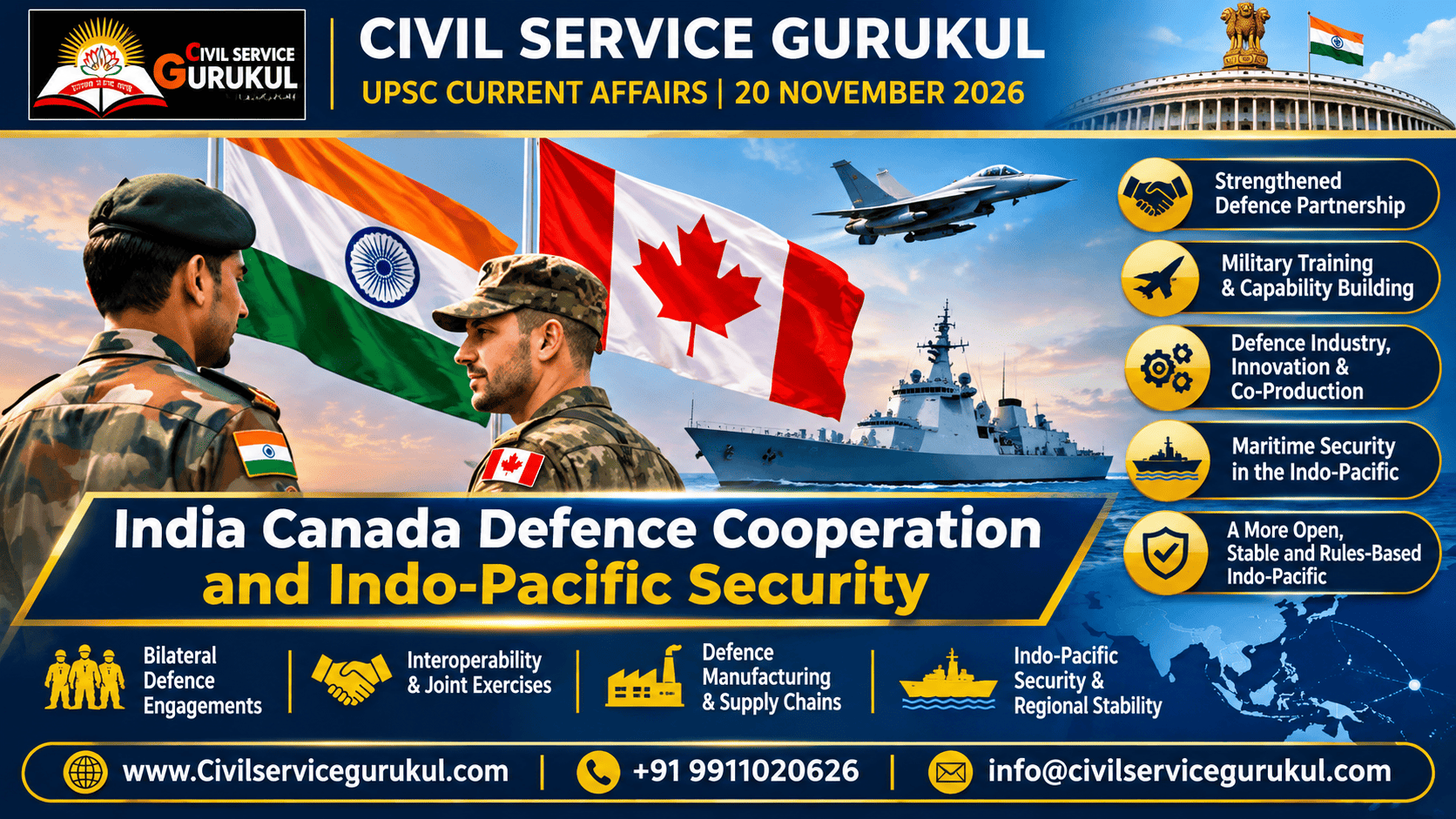
India–Canada Defence Cooperation 2026: First Defence Dialogue, Maritime Security and Indo-Pacific Strategy Explained
An in-depth UPSC analysis of the first India–Canada Defence Dialogue, the Modi–Carney Joint Statement, defence industrial cooperation, maritime security, Canada's NATO membership, Indo-Pacific geopolitics and India's strategic autonomy.
1. Why Are India–Canada Defence Relations in the News?
India and Canada have taken steps to strengthen official dialogue on defence and strategic issues in 2026.
The most important confirmed development is the inaugural India–Canada Defence Dialogue held virtually on 3 November 2026.
The meeting followed a commitment made by the leaders of the two countries in their 2 March 2026 Joint Statement.
Its purpose was to exchange views on defence policies, regional and global security developments, and possible areas of cooperation.
The dialogue is important because it creates an institutional channel for discussing defence-related matters in a structured manner.
2. Has India Signed a New Defence Pact with Canada?
The November 2026 newspaper discussion raised the possibility of deeper defence arrangements.
However, the available official material confirms the establishment of a Defence Dialogue, the announcement of a Maritime Security Partnership agenda, and discussions on potential cooperative activities.
It does not establish that India and Canada have signed a new treaty requiring mutual military defence.
- Diplomatic announcement: A government communicates a proposed or agreed direction for cooperation.
- Defence Dialogue: Officials exchange views and identify areas for collaboration.
- Cooperation agreement: A specific instrument may define particular responsibilities.
- Mutual-defence treaty: A treaty creates obligations according to its actual terms.
3. First India–Canada Defence Dialogue: Key Facts
| Particulars | Details |
|---|---|
| Meeting | Inaugural India–Canada Defence Dialogue |
| Date | 3 November 2026 |
| Mode | Virtual |
| Indian Co-Chair | Dr Amit Telang, Joint Secretary (International Cooperation), Ministry of Defence |
| Canadian Co-Chair | Scott Millar, Assistant Deputy Minister (Policy), Department of National Defence |
| Major Discussion | Defence policies, strategic outlook and cooperation opportunities |
| Priority Areas | Defence industry, military-technical cooperation, research and development |
| Outcome | Agreement to continue discussions and develop proposals for deeper cooperation |
4. What Were the Main Priorities?
Three areas received particular attention during the dialogue.
Defence Industrial Cooperation
This can include collaboration between defence manufacturers, research organisations and technology suppliers.
Potential cooperation may support capability development, component manufacturing, industrial partnerships and resilient supply chains.
Military-Technical Cooperation
This concerns technical engagement relating to defence capabilities, equipment, operational knowledge and related expertise.
Specific projects require separate approval and implementation arrangements.
Defence Research and Development
Research collaboration may involve advanced materials, emerging technologies, communication systems, testing and other mutually agreed technical priorities.
The existence of a dialogue does not mean that every potential research project has already been approved.
5. Historical Background of India–Canada Relations
India and Canada have longstanding links through education, investment, migration, trade, technology and people-to-people exchanges.
Their bilateral relationship also involves questions of sovereignty, security, law enforcement and diplomatic trust.
Differences over sensitive issues have affected the relationship at various points, demonstrating the importance of sustained institutional communication.
6. India–Canada Diplomatic Timeline
Canada launched its Indo-Pacific Strategy, signalling a broader commitment to the region's economic and security importance.
India and Canada began renewed high-level engagement aimed at improving bilateral relations and rebuilding institutional dialogue.
Prime Ministers Narendra Modi and Mark Carney issued a joint statement addressing defence, maritime security, energy, trade and other areas of cooperation.
Foreign Office Consultations in New Delhi reviewed cooperation across security, defence, technology, energy and people-to-people ties.
Senior officials held discussions under the bilateral national security dialogue mechanism, including issues relating to organised crime, terrorism and cybercrime.
India and Canada held their first bilateral Defence Dialogue, establishing priorities for future defence engagement.
7. Why Is the March 2026 Joint Statement Important?
The 2 March 2026 Joint Statement outlined the political direction for renewed bilateral engagement.
The leaders recognised opportunities for military cooperation, training, professional exchanges and maritime security engagement.
They also agreed to institutionalise a Defence Dialogue.
The later November meeting gave practical expression to that commitment.
8. What Is the Role of Defence Attachés?
Defence attachés are military representatives serving within diplomatic missions.
They support official defence communication, professional engagement and cooperation between relevant institutions.
The March 2026 statement welcomed Canada's appointment of a Defence Attaché to India and India's concurrent accreditation of its Washington-based Defence Attaché to Canada.
These arrangements help strengthen regular institutional contact.
9. What Areas Could India and Canada Cooperate In?
Exchange of views, training and potential coordination to improve regional maritime safety.
Exploration of industrial partnerships and resilient supply chains.
Scientific and technical cooperation in selected defence-related fields.
Military education, institutional exchanges and agreed training activities.
Potential engagement in areas such as cybersecurity, advanced systems and technical innovation.
Cooperation in disaster preparedness, relief and other humanitarian maritime activities.
10. Maritime Security Partnership: What Does It Mean?
The March 2026 Joint Statement welcomed a new Maritime Security Partnership involving areas such as defence material cooperation, supply-chain resilience, training and exercises.
A maritime security partnership may help countries coordinate on shared ocean-related concerns.
These can include safe navigation, search and rescue, illegal activities at sea, and disaster response.
However, the exact commitments depend on the applicable bilateral documents and implementation plans.
11. What Is Maritime Domain Awareness?
Maritime Domain Awareness, or MDA, refers to the understanding of activities, conditions and events in the maritime domain that may affect safety, security, the economy or the environment.
It can involve information from coastal radar, ships, aircraft, satellites, vessel tracking systems and other sources.
Better awareness can improve the ability to identify risks and respond to maritime incidents.
12. Why Is Supply-Chain Resilience Important?
Modern defence industries depend on complicated international supply chains.
Critical components, specialised materials and advanced technologies may come from multiple countries.
Supply-chain resilience means reducing vulnerability to disruptions through diversification, reliable sourcing and contingency planning.
Potential cooperation can support resilience without requiring either country to surrender independent procurement decisions.
13. Why Is the Indo-Pacific Important to India and Canada?
The Indo-Pacific connects the Indian Ocean and Pacific Ocean regions.
It contains major shipping routes, strategic maritime passages, large economies and important security relationships.
India is centrally connected to the Indian Ocean, while Canada has a Pacific coastline and major economic interests across the region.
Both countries therefore have reasons to promote maritime stability and reliable international trade.
14. Canada's Indo-Pacific Strategy
Canada launched its Indo-Pacific Strategy on 27 November 2022.
The strategy provides a whole-of-government framework for engagement across security, trade, investment, people-to-people relations and sustainability.
It included significant Canadian government investment commitments for deeper Indo-Pacific engagement.
Canada also maintains a separate strategic interest in the Arctic, making it both a Pacific and Arctic state.
15. India's Indo-Pacific Approach
India's Indo-Pacific approach emphasises an open, inclusive and rules-based region, freedom of navigation, maritime cooperation and peaceful resolution of disputes.
India has also developed regional cooperation initiatives focused on maritime security, connectivity and capacity building.
Indo-Pacific Oceans Initiative (IPOI)
India announced the Indo-Pacific Oceans Initiative at the East Asia Summit in 2019.
It is an open, non-treaty-based cooperation initiative.
Its seven pillars cover maritime security, maritime ecology, maritime resources, capacity building, disaster risk reduction, science and technology, and trade and connectivity.
16. How Do Canadian and Indian Priorities Converge?
| Area | Indian Interest | Canadian Interest |
|---|---|---|
| Maritime Security | Stable Indian Ocean and secure trade routes | Secure Indo-Pacific sea routes and regional engagement |
| Trade Connectivity | Reliable international commerce | Economic diversification and Pacific market access |
| Technology | Domestic capabilities and strategic resilience | Innovation and secure international partnerships |
| Regional Cooperation | Inclusive institutions and dialogue | Expanded engagement with Indo-Pacific partners |
| Disaster Resilience | Regional humanitarian and disaster assistance | Maritime safety and humanitarian cooperation |
17. Indian Ocean Rim Association and Canada
The Indian Ocean Rim Association, or IORA, is an intergovernmental regional organisation.
Its focus includes cooperation among countries associated with the Indian Ocean.
The March 2026 India–Canada statement welcomed Canada's interest in becoming an IORA Dialogue Partner.
Expressing interest in a status is not the same as already holding it.
18. Canada and NATO: Important UPSC Facts
Canada is a founding member of the North Atlantic Treaty Organization, or NATO.
NATO was established on 4 April 1949 through the North Atlantic Treaty.
Canada's participation in NATO is separate from its bilateral relationship with India.
19. What Is NATO Article 5?
Article 5 establishes the alliance's collective defence framework.
An armed attack against one or more NATO members under the treaty's conditions is treated as an attack against them all.
The assistance provided is governed by the actual treaty provisions, including the actions each member considers necessary.
India is not a NATO member.
20. Does India–Canada Defence Cooperation Extend NATO Obligations to India?
No.
Cooperation between India and Canada does not automatically extend NATO's Article 5 obligations to India.
Such obligations arise from the North Atlantic Treaty among its members, not from ordinary bilateral consultations.
21. Defence Dialogue vs Military Alliance
| Defence Dialogue | Collective Defence Alliance |
|---|---|
| Provides a forum for consultation | Creates defined commitments under a treaty |
| May identify training and industrial opportunities | Addresses defence obligations among members |
| Does not automatically require military intervention | Operates according to collective defence clauses |
| Specific projects need separate implementation arrangements | Institutional commitments are governed by the founding instrument |
| India–Canada Defence Dialogue is an example | NATO is an example |
22. Security Challenges in India–Canada Relations
The bilateral relationship has experienced periods of diplomatic strain.
Issues relating to national security, sovereignty, law enforcement and transnational crime have been important areas of disagreement and engagement.
Both countries must address such concerns through lawful procedures, respectful diplomacy and institutional cooperation.
23. Why Is Diplomatic Trust Essential?
Sensitive defence cooperation may involve technical information, security assessments and institutional communications.
Such engagement requires trust, clear procedures and respect for legitimate national security concerns.
Where political differences remain unresolved, the scope of cooperation may develop gradually.
24. Counterterrorism and Transnational Crime
In October 2026, senior security officials from India and Canada discussed cooperation against terrorism, violent extremism, organised crime, human trafficking, drug trafficking, cybercrime and extortion.
They also reviewed progress under an existing bilateral security work plan.
These activities belong to the broader security and law-enforcement relationship.
They should not be confused with a newly signed military alliance.
25. What Role Do Diaspora Relations Play?
The Indian diaspora forms an important people-to-people connection between the two countries.
Education, family relationships, business networks and migration contribute to bilateral engagement.
At the same time, governments must address legitimate security and legal concerns while respecting fundamental rights and the rule of law.
26. India–Canada Defence Cooperation and Strategic Autonomy
Strategic autonomy refers to India's ability to make independent foreign-policy and national-security decisions.
It does not prohibit cooperation with different international partners.
India can explore specific defence projects with Canada while maintaining its existing relationships with other major powers.
The value of cooperation must be evaluated against India's security requirements, technology priorities, economic interests and diplomatic commitments.
27. How Can This Cooperation Benefit India?
Potential access to new research relationships and technical expertise.
Opportunities to diversify production partnerships and selected supply chains.
Additional channels for maritime dialogue and professional exchanges.
A broader network of international relationships and issue-specific partnerships.
28. What Are the Risks and Limitations?
- Political uncertainty: Bilateral disagreements can affect continuity.
- Technology sensitivity: Some defence technologies are subject to licensing and security restrictions.
- Institutional differences: Distinct regulations and procedures can slow projects.
- Information protection: Sensitive data requires suitable safeguards.
- Strategic dependence: Partnerships must support, not undermine, national resilience.
- Implementation gaps: Announcements do not necessarily produce operational results.
29. Why Should India Focus on Concrete Deliverables?
The value of a defence partnership should be assessed through outcomes rather than headline announcements.
Useful indicators may include completed professional exchanges, jointly approved research projects, improved institutional coordination and successful cooperation activities.
30. Understanding Different Defence Arrangements
| Arrangement | Meaning | Key Distinction |
|---|---|---|
| Defence Dialogue | Structured official consultations | Does not itself create collective defence obligations |
| Memorandum of Understanding | Document expressing agreed areas of cooperation | Legal status depends on wording and intention |
| Logistics Support Agreement | Framework for specified logistics arrangements | Does not necessarily constitute a military alliance |
| Training Arrangement | Provides for agreed training or exchanges | Scope limited to the arrangement |
| Defence Industrial Agreement | Supports specified industrial or technical collaboration | Does not automatically impose combat obligations |
| Mutual-Defence Treaty | Establishes defence commitments under treaty terms | Obligations depend on the instrument |
31. Way Forward: Strengthening India–Canada Security Cooperation
1. Maintain Institutional Dialogue
Regular defence and security consultations can improve mutual understanding and reduce miscommunication.
2. Develop Focused Pilot Projects
Begin with narrowly defined areas of mutual benefit, such as professional exchanges, selected technical research or maritime safety cooperation.
3. Protect Sensitive Information
Establish appropriate information-protection procedures for any future classified or sensitive cooperation.
4. Encourage Industry Engagement
Create transparent pathways for eligible firms and research institutions to explore commercially viable defence-related collaboration.
5. Strengthen Maritime Coordination
Explore practical cooperation on maritime awareness, humanitarian assistance, search and rescue and disaster preparedness.
6. Address Diplomatic Differences
Maintain credible communication channels while respecting sovereignty, legal processes and each other's legitimate concerns.
7. Preserve Strategic Autonomy
Ensure that defence cooperation supports India's independent national-security priorities and long-term domestic capabilities.
32. UPSC Prelims 2027: High-Yield Revision Notes
- The inaugural India–Canada Defence Dialogue took place on 3 November 2026.
- It was held virtually.
- The Indian co-chair was Dr Amit Telang.
- The Canadian co-chair was Scott Millar.
- Priority areas included defence industry, military-technical cooperation and R&D.
- Prime Ministers Modi and Carney issued a joint statement on 2 March 2026.
- India and Canada announced plans for greater maritime security cooperation.
- Canada launched its Indo-Pacific Strategy on 27 November 2022.
- Canada is a Pacific and Arctic state.
- Canada is a founding member of NATO.
- NATO was established on 4 April 1949.
- Article 5 of NATO concerns collective defence.
- India is not a NATO member.
- India announced the Indo-Pacific Oceans Initiative in 2019.
- IPOI is a non-treaty-based cooperation initiative.
- IORA stands for Indian Ocean Rim Association.
- Canada expressed interest in IORA Dialogue Partner status in March 2026.
- Maritime Domain Awareness concerns understanding maritime activities and risks.
- A defence dialogue is not automatically a mutual-defence treaty.
33. Common UPSC Conceptual Traps
| Incorrect Statement | Correct Understanding |
|---|---|
| India and Canada signed a NATO-style alliance in November 2026. | The confirmed event was their first Defence Dialogue, not a collective-defence treaty. |
| India is a NATO member because it cooperates with Canada. | India is not a NATO member. |
| The inaugural Defence Dialogue took place in March 2026. | The leaders agreed to establish it in March; the inaugural meeting took place in November. |
| Canada's Indo-Pacific Strategy was launched in 2026. | It was launched in November 2022. |
| Expressing interest in IORA status automatically makes Canada a member. | Expression of interest is distinct from formal membership or partner status. |
| Defence industrial cooperation creates automatic mutual military obligations. | Obligations depend on the specific agreement and applicable law. |
34. Original UPSC Prelims MCQs With Detailed Explanations
With reference to the India–Canada Defence Dialogue, consider the following statements:
- The inaugural meeting was held on 3 November 2026.
- The meeting was conducted virtually.
- The meeting established a binding mutual-defence treaty between India and Canada.
Which of the statements given above are correct?
(a) 1 only
(b) 1 and 2 only
(c) 2 and 3 only
(d) 1, 2 and 3
View Correct Answer and Explanation
Statement 1: Correct. The inaugural Defence Dialogue took place on 3 November 2026.
Statement 2: Correct. The first meeting was held virtually.
Statement 3: Incorrect. The meeting addressed cooperation opportunities and proposals; it did not establish a mutual-defence treaty.
With reference to Canada's strategic position, consider the following:
- Canada is a founding member of NATO.
- Canada has a Pacific coastline.
- Canada launched its Indo-Pacific Strategy in November 2022.
Which statements are correct?
(a) 1 and 2 only
(b) 2 and 3 only
(c) 1 and 3 only
(d) 1, 2 and 3
View Correct Answer and Explanation
All three statements are correct.
Canada was among the original NATO members in 1949, has access to the Pacific Ocean and launched its Indo-Pacific Strategy on 27 November 2022.
Consider the following statements regarding defence cooperation:
- A bilateral defence dialogue automatically creates a collective defence obligation.
- The legal effect of a defence agreement depends on the actual terms of the instrument.
- Professional military exchanges can occur without a mutual-defence treaty.
Which statements are correct?
(a) 1 and 2 only
(b) 2 and 3 only
(c) 1 and 3 only
(d) 1, 2 and 3
View Correct Answer and Explanation
Statement 1: Incorrect. A dialogue does not automatically create military obligations.
Statement 2: Correct. Legal commitments depend on the relevant instrument and its terms.
Statement 3: Correct. Training and professional exchanges may occur through ordinary cooperation arrangements.
With reference to NATO, consider the following statements:
- NATO was established in 1949.
- Its Article 5 concerns collective defence.
- India is entitled to Article 5 protection solely because it maintains defence cooperation with Canada.
Which statements are correct?
(a) 1 only
(b) 1 and 2 only
(c) 2 and 3 only
(d) 1, 2 and 3
View Correct Answer and Explanation
Statements 1 and 2 are correct.
Statement 3 is incorrect because India is not a NATO member, and bilateral cooperation with a NATO state does not extend the treaty's collective defence commitments to India.
Consider the following statements about the Indo-Pacific Oceans Initiative:
- It was announced by India in 2019.
- It is a non-treaty-based cooperation initiative.
- It includes maritime security and disaster risk management among its pillars.
Which statements are correct?
(a) 1 and 2 only
(b) 2 and 3 only
(c) 1 and 3 only
(d) 1, 2 and 3
View Correct Answer and Explanation
All three statements are correct.
India announced IPOI in 2019 as an open, non-treaty-based cooperation initiative.
Maritime security and disaster risk reduction and management are among its identified pillars.
With reference to Maritime Domain Awareness, consider the following:
- It can involve information from coastal radar, ships, aircraft and satellites.
- It concerns understanding conditions and activities affecting maritime safety and security.
- It is identical to signing a military alliance.
Which statements are correct?
(a) 1 only
(b) 1 and 2 only
(c) 2 and 3 only
(d) 1, 2 and 3
View Correct Answer and Explanation
Statements 1 and 2 are correct.
Maritime Domain Awareness can use multiple information sources to improve understanding of maritime activities.
Statement 3 is incorrect. Information awareness is distinct from a defence treaty.
With reference to India–Canada relations, consider the following statements:
- The March 2026 Joint Statement provided for an institutionalised Defence Dialogue.
- The Joint Statement welcomed greater maritime security cooperation.
- The statement meant that every proposed military project had received final implementation approval.
Which statements are correct?
(a) 1 and 2 only
(b) 2 and 3 only
(c) 1 and 3 only
(d) 1, 2 and 3
View Correct Answer and Explanation
Statement 1 is correct. The leaders agreed to establish a Defence Dialogue.
Statement 2 is correct. Maritime cooperation formed part of the announced agenda.
Statement 3 is incorrect. Individual projects require their own approvals and arrangements.
Which of the following would be consistent with India's strategic autonomy?
- Maintaining independent national-security decisions.
- Cooperating with multiple countries on selected defence projects.
- Evaluating technology and industrial partnerships according to national interests.
- Automatically accepting every military commitment proposed by a partner country.
Select the correct answer:
(a) 1 and 2 only
(b) 1, 2 and 3 only
(c) 2, 3 and 4 only
(d) 1, 2, 3 and 4
View Correct Answer and Explanation
Statements 1, 2 and 3 reflect independent, issue-based decision-making.
Statement 4 is inconsistent with strategic autonomy because automatic acceptance can restrict independent national choices.
35. UPSC Mains 2027: Practice Questions
"India–Canada defence cooperation offers opportunities for expanding India's Indo-Pacific partnerships, but diplomatic trust remains a critical constraint." Discuss.
Suggested Answer Structure
- Introduction: First Defence Dialogue in November 2026.
- Opportunities in maritime security and defence industry.
- Potential technology and research collaboration.
- Constraints involving diplomatic trust and sensitive information.
- Conclusion: Gradual, outcome-oriented engagement.
"Defence diplomacy can strengthen strategic autonomy without creating formal military alliances." Critically analyse the statement with reference to India's engagement with Canada and other Indo-Pacific partners.
Suggested Analytical Dimensions
- Meaning of strategic autonomy.
- Difference between cooperation and collective defence.
- Maritime security and defence industrial benefits.
- Diplomatic and security limitations.
- Issue-based partnerships and diversified capabilities.
- Need for independent national decision-making.
Explain the importance of Maritime Domain Awareness, secure supply chains and defence research cooperation for India's national security. What institutional safeguards are necessary for international defence partnerships?
36. Model UPSC Mains Answer — GS Paper II
India and Canada have initiated a new phase of structured defence engagement through their inaugural Defence Dialogue held on 3 November 2026. The initiative follows the March 2026 leaders' commitment to expand defence and maritime cooperation.
Opportunities: Both countries can explore defence industrial cooperation, research and development, professional military exchanges and maritime security initiatives. Canada's Pacific presence and Indo-Pacific Strategy provide potential areas of convergence with India's maritime priorities. Cooperation may also improve supply-chain resilience and technological engagement.
Challenges: Past diplomatic differences, sensitive national-security concerns and technology restrictions may constrain cooperation. Announcements also require detailed implementation arrangements to produce tangible outcomes.
Way forward: Both countries should prioritise regular dialogue, transparent cooperation procedures, limited pilot projects and mutual respect for sovereignty and legitimate security concerns.
India should pursue practical defence partnerships while preserving strategic autonomy. A gradual, evidence-based approach can strengthen regional engagement without assuming automatic military obligations.
37. Frequently Asked Questions
When did India and Canada hold their first Defence Dialogue?
The inaugural India–Canada Defence Dialogue was held virtually on 3 November 2026.
Who chaired the first India–Canada Defence Dialogue?
The meeting was co-chaired by Dr Amit Telang from India's Ministry of Defence and Scott Millar from Canada's Department of National Defence.
Did India and Canada sign a mutual-defence treaty in November 2026?
The verified official material establishes a Defence Dialogue and cooperation proposals, not a newly signed NATO-style mutual-defence treaty.
What were the priority areas of the Defence Dialogue?
Defence industrial cooperation, military-technical engagement and defence research and development.
Is Canada a NATO member?
Yes. Canada was one of NATO's founding members in 1949.
Is India protected by NATO Article 5?
No. India is not a NATO member. Bilateral cooperation with Canada does not automatically extend Article 5 collective defence commitments to India.
What is Canada's Indo-Pacific Strategy?
It is a whole-of-government strategy launched in November 2022 covering security, economic engagement and other regional priorities.
What is Maritime Domain Awareness?
It refers to understanding maritime activities and conditions relevant to safety, security, the economy and the environment.
Why is this topic important for UPSC 2027?
It connects India–Canada relations, international security, the Indo-Pacific, NATO, defence diplomacy, strategic autonomy and maritime security.
38. Conclusion: A New Chapter in India–Canada Defence Diplomacy
The first India–Canada Defence Dialogue in November 2026 represents an important institutional step in bilateral relations.
It provides a channel for discussing industrial, technical and research cooperation while building upon the broader political understanding reached in March 2026.
The countries also have potential common interests in maritime stability, regional security and resilient supply chains.
Nevertheless, diplomatic trust, practical implementation and independent national interests will determine the depth of cooperation.
For UPSC aspirants, the central distinction is between a confirmed diplomatic mechanism and a binding mutual-defence commitment.
Effective international relations analysis requires understanding not only what governments announce, but also what they formally agree to and subsequently implement.
Master UPSC International Relations with Civil Service Gurukul
Concept-based current affairs, UPSC Prelims preparation, GS Paper II international relations, GS Paper III security, Mains answer writing and examination-focused mentoring.
CIVIL SERVICE GURUKUL
Knowledge | Discipline | Success
Visit Our Website Call +91 9911020626 Email Civil Service Gurukulwww.civilservicegurukul.com
Editorial Note: This original educational article was prepared for Civil Service Gurukul on 20 November 2026. The account of the inaugural Defence Dialogue is based on the Indian Ministry of Defence's official announcement dated 4 November 2026. The background concerning the March 2026 leaders' commitments is based on the India–Canada Joint Statement. The discussion of future defence cooperation distinguishes confirmed institutional developments from possible policy and operational outcomes. No new mutual-defence treaty is presumed. All UPSC practice questions, educational examples and analytical explanations are original Civil Service Gurukul content.
Prepare with Mentors Who Cleared the Exam
Get personalized study plans, evaluated answer models, and test series access.