Green Diwali Campaign 2026 UPSC: Complete Notes
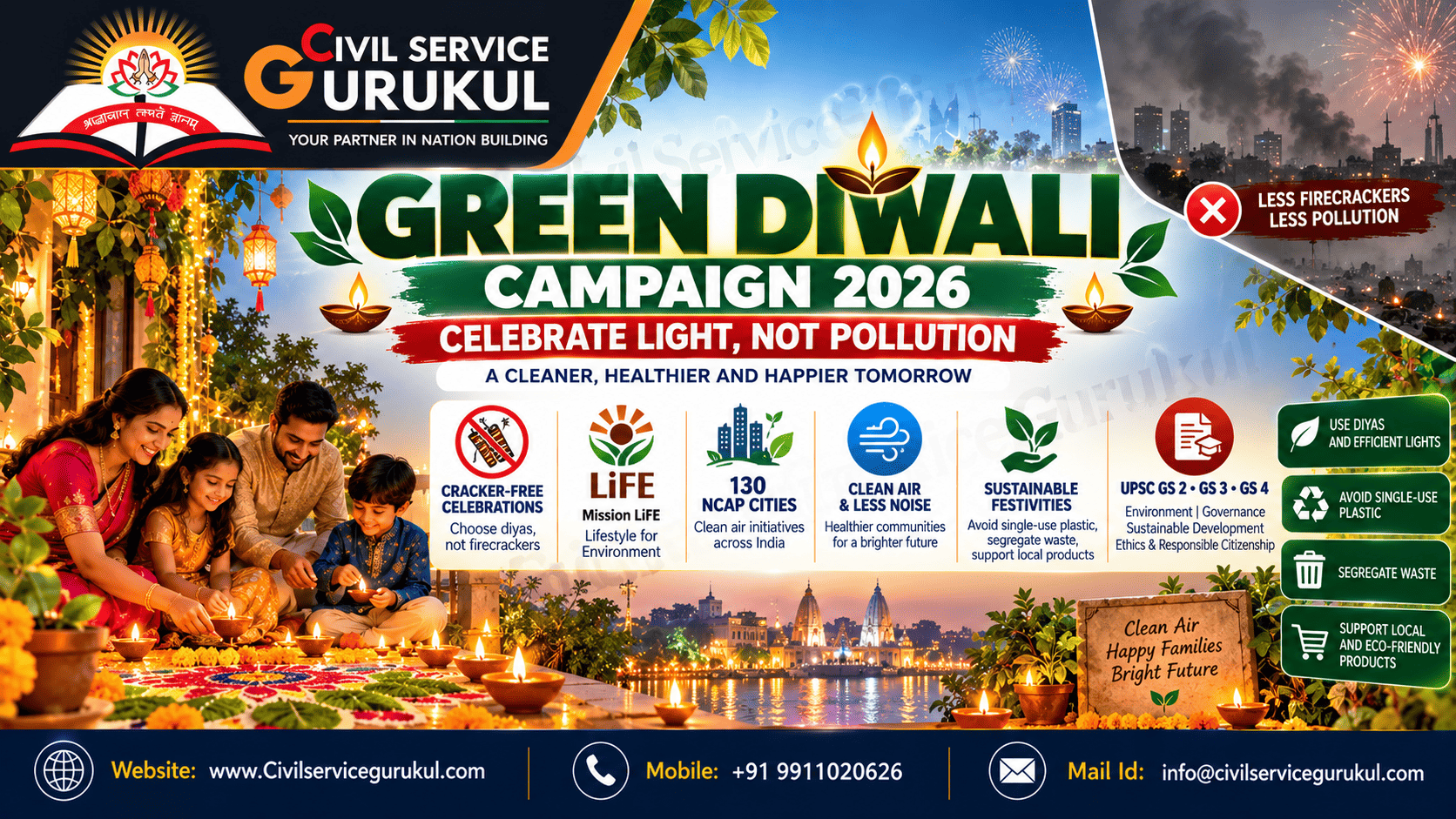
Green Diwali Campaign 2026: How Mission LiFE Is Turning Festive Celebrations into Environmental Action
Complete UPSC notes covering WWF-India, Mission LiFE, NCAP, air pollution, sustainable consumption, environmental governance and community participation.
Current Affairs: 21 October 2026 | GS Paper III: Environment | UPSC Prelims & Mains
1. Why Is the Green Diwali Campaign 2026 in the News?
Diwali is among India's most widely celebrated festivals, symbolising light, hope and the triumph of good.
Yet the festive season can also increase environmental pressures through firecracker emissions, high levels of noise, plastic waste and resource-intensive consumption.
In response, WWF-India's EIACP Programme Centre – Resource Partner, supported by the Ministry of Environment, Forest and Climate Change, launched the nationwide Green Diwali Campaign 2026.
The campaign runs from 20 October to 8 November 2026. It encourages citizens to celebrate without firecrackers and make environmentally responsible choices.
Schools, colleges, resident welfare associations and community organisations are important participants.
Special attention is directed towards 130 cities covered by the National Clean Air Programme.
2. GS Section and UPSC Syllabus Mapping
| Paper | Syllabus relevance |
|---|---|
| Prelims GS I | Environment, pollution, government initiatives and current affairs |
| GS Paper II | Government initiatives, NGOs, community participation and governance |
| GS Paper III | Environmental pollution, conservation and sustainable development |
| GS Paper IV | Environmental ethics, social responsibility and responsible behaviour |
| Essay | Sustainable lifestyles, public health and environmental citizenship |
3. What Is the Green Diwali Campaign 2026?
The Green Diwali Campaign is a nationwide environmental awareness and behavioural change initiative.
It seeks to reduce avoidable pollution during festive celebrations while encouraging sustainable lifestyle practices.
| Particulars | Details |
|---|---|
| Campaign | Green Diwali Campaign 2026 |
| Organiser | WWF-India EIACP Programme Centre – Resource Partner |
| Government support | Ministry of Environment, Forest and Climate Change |
| Campaign period | 20 October to 8 November 2026 |
| Special focus | 130 cities under the National Clean Air Programme |
| Behavioural framework | Mission LiFE |
| Principal message | Cracker-free celebrations and sustainable consumption |
Rather than treating environmental protection as a purely government-led responsibility, the initiative encourages households and communities to take practical action.
4. Major Objectives and Features
Cracker-Free Celebrations
Citizens are encouraged to avoid firecrackers and motivate family members and neighbours to make similar choices.
Green Diwali Pledge
Participants can pledge to celebrate sustainably through safer, cleaner and less wasteful practices.
Traditional Diyas and Efficient Lighting
The campaign encourages traditional festive lighting and energy-efficient lighting solutions.
Reduced Single-Use Plastics
Reusable materials and environmentally responsible decorations can reduce waste.
Waste Segregation
Separating wet, dry and other waste streams helps support appropriate processing and recycling.
Supporting Local Products
Choosing locally available products may support livelihoods and encourage thoughtful consumption.
5. Mission LiFE: Lifestyle for Environment
Mission LiFE stands for Lifestyle for Environment.
It promotes environmentally responsible individual and collective practices as part of a broader transition towards sustainable development.
Why Mission LiFE matters
- Encourages resource-efficient consumption.
- Promotes waste reduction.
- Supports energy and water conservation.
- Encourages sustainable food and lifestyle choices.
- Recognises the importance of citizens in climate action.
Mission LiFE connects local actions with larger environmental goals.
For example, avoiding single-use disposable products may reduce waste, while choosing efficient lighting can reduce electricity consumption.
The key idea is that small actions become meaningful when adopted consistently and widely.
6. Why Does the Campaign Focus on NCAP Cities?
The National Clean Air Programme, launched in 2019, provides a framework for improving air quality through coordinated action across participating cities.
The Green Diwali Campaign places special emphasis on 130 cities covered by NCAP.
Why urban centres need attention
Urban air pollution may result from multiple sources, including road dust, transport, industries, construction activities, waste burning and regional pollution.
During certain festive periods, firecracker emissions can add a short-term pollution burden.
The extent of their contribution varies by location, weather conditions and other concurrent emission sources.
Role of meteorology
Low wind speeds and unfavourable atmospheric conditions can prevent pollutants from dispersing effectively.
Thus, seasonal air-quality problems cannot be explained by firecrackers alone.
7. Environmental and Health Concerns Associated with Firecrackers
| Pollution category | Potential concern |
|---|---|
| PM2.5 | Fine particles can penetrate deep into the respiratory system. |
| PM10 | Inhalable particles contribute to respiratory exposure. |
| Gaseous pollutants | Combustion may release sulphur and nitrogen compounds. |
| Metal-containing particles | Some pyrotechnic formulations can release metal residues. |
| Noise | Sudden high-intensity sound may cause distress or hearing risks. |
| Solid waste | Packaging and combustion residues require collection and disposal. |
Public health implications
Short-term exposure to high pollution levels can be particularly concerning for people with respiratory or cardiovascular vulnerabilities.
Children, older adults and others with greater susceptibility may face additional risks.
Noise pollution can affect sleep, comfort and community wellbeing.
Why comprehensive pollution policy matters
Reducing festival-related pollution can help, but year-round air improvements require stronger action on transport, industrial emissions, dust and waste burning.
8. Carbon Footprint and Sustainable Consumption
WWF-India's campaign also encourages participation in a Carbon Footprint Survey.
A carbon footprint represents greenhouse gas emissions associated with an activity, product, individual or organisation, usually expressed as carbon dioxide equivalent.
What can affect a household footprint?
- Electricity and fuel consumption.
- Transport choices.
- Food production and dietary patterns.
- Purchases and product life cycles.
- Waste generation and disposal.
Surveys can support environmental awareness, although their estimates depend on assumptions and available data.
9. Community Participation and Environmental Governance
The campaign encourages schools, colleges, community groups and resident welfare associations to organise awareness activities.
These may include pledge drives, assemblies, rallies and community meetings.
Participating institutions may document their activities through reports and geo-tagged photographs.
Why community participation matters
- Social encouragement can reinforce positive habits.
- Schools can introduce environmental values early.
- Resident associations can coordinate local waste practices.
- Community engagement makes public programmes more visible.
- Participation may improve accountability and awareness.
However, campaign success should not be measured only by numbers of pledges or photographs submitted.
Long-term behavioural change and actual environmental outcomes are more meaningful indicators.
10. Connections with Sustainable Development Goals
| SDG | Connection with Green Diwali |
|---|---|
| SDG 3: Good Health and Well-being | Reduction of avoidable pollution exposure. |
| SDG 11: Sustainable Cities and Communities | Cleaner neighbourhoods and urban environmental awareness. |
| SDG 12: Responsible Consumption and Production | Waste minimisation and thoughtful festive consumption. |
| SDG 13: Climate Action | Promotion of sustainable lifestyles and resource efficiency. |
These links demonstrate the relevance of environmental citizenship to the wider sustainable development agenda.
11. Challenges in Implementing a Green Festival Campaign
Behavioural resistance
Long-established celebration practices may be difficult to change rapidly.
Limited awareness
Some citizens may not understand the environmental effects of different festive activities.
Availability and affordability
Sustainable alternatives need to be accessible across different income groups.
Waste-management constraints
Segregation efforts may have limited impact where collection and processing systems are weak.
Measuring outcomes
Changes in local air quality depend on multiple pollution sources and meteorological factors.
Social and cultural sensitivity
Environmental messaging should encourage constructive participation, respect cultural traditions and avoid unnecessarily stigmatising communities.
12. Way Forward: Making Green Celebrations a Lasting Habit
- Local-language awareness: Communicate clear, practical alternatives through schools and community groups.
- Accessible alternatives: Encourage sustainable, affordable decorations and celebrations.
- Better waste systems: Strengthen segregated collection and responsible processing.
- Scientific monitoring: Use transparent air-quality data to evaluate pollution trends.
- Citizen involvement: Engage resident associations, students and local institutions.
- Year-round action: Connect festival campaigns with consistent urban clean-air measures.
- Outcome-based evaluation: Track lasting behaviour change, not just participation totals.
13. Original UPSC Prelims Practice MCQs
Question 1
The Green Diwali Campaign 2026 was launched by:
(a) RBI and Ministry of Finance
(b) WWF-India EIACP Programme Centre with MoEFCC support
(c) National Disaster Management Authority alone
(d) Ministry of New and Renewable Energy alone
The campaign was launched by WWF-India's EIACP Programme Centre– Resource Partner, supported by MoEFCC.
Question 2
What does Mission LiFE stand for?
(a) Lifestyle for Environment
(b) Living in Forest Ecosystems
(c) Local Industry for Energy
(d) Learning for Environmental Economics
Mission LiFE promotes environmentally responsible lifestyle practices.
Question 3
The Green Diwali Campaign 2026 places special focus on how many NCAP cities?
(a) 75
(b) 100
(c) 130
(d) 200
Question 4
Consider the statements:
- PM2.5 particles are smaller than PM10 particles.
- Weather conditions can influence the concentration of pollutants.
- A carbon footprint and the Air Quality Index measure exactly the same phenomenon.
Which statements are correct?
(a) 1 only
(b) 1 and 2 only
(c) 2 and 3 only
(d) 1, 2 and 3
Carbon footprints measure associated greenhouse gas emissions, while AQI communicates ambient air pollution.
Question 5
Which of the following are encouraged under the Green Diwali Campaign?
- Avoiding firecrackers
- Reducing single-use plastics
- Segregating waste
- Supporting local products
(a) 1 and 2 only
(b) 2 and 3 only
(c) 1, 3 and 4 only
(d) 1, 2, 3 and 4
All four practices are encouraged under the campaign.
14. UPSC GS Paper III: Mains Practice Question
"Behavioural change and community participation are essential complements to regulatory measures for controlling urban air pollution." Discuss with reference to the Green Diwali Campaign 2026 and Mission LiFE.
Model Answer
Urban air pollution is a multidimensional problem involving transport, industries, dust, waste burning and seasonal activities. Regulatory action is necessary, but sustainable improvements also depend on public participation.
Campaign context: The Green Diwali Campaign 2026, led by WWF-India's EIACP Programme Centre with MoEFCC support, encourages cracker-free celebrations and environmentally responsible consumption, with special emphasis on 130 NCAP cities.
Role of behaviour: Avoiding firecrackers, reducing single-use plastics, adopting efficient lighting and segregating waste can reduce avoidable environmental pressures.
Community dimension: Schools, colleges and resident associations can spread awareness, reinforce sustainable habits and increase participation. Mission LiFE places individual responsibility within a wider collective environmental transition.
Limitations: Festive campaigns alone cannot solve year-round pollution originating from vehicles, industries and other sources. Moreover, awareness does not automatically translate into permanent behaviour change.
Way forward: India needs strong enforcement, scientific monitoring, affordable alternatives, better waste infrastructure and continued citizen engagement.
Conclusion: Clean-air governance is most effective when capable institutions and environmentally responsible citizens work together.
15. Frequently Asked Questions
What is the Green Diwali Campaign 2026?
A nationwide environmental awareness initiative promoting cracker-free festivals and sustainable lifestyles.
When does the campaign run?
From 20 October to 8 November 2026.
Who launched the campaign?
WWF-India's EIACP Programme Centre– Resource Partner, supported by MoEFCC.
What is the role of Mission LiFE?
Mission LiFE promotes environmentally responsible individual and community behaviour.
Why are 130 NCAP cities important?
The campaign specifically prioritises environmental awareness in these cities under India's clean-air framework.
Does the campaign legally ban all firecrackers?
No. It is an awareness and voluntary behavioural-change campaign. Legal restrictions are governed separately.
Which UPSC GS paper covers this topic?
Primarily GS Paper III under environment, with links to GS Paper II governance and GS Paper IV ethics.
16. Conclusion: Celebrate Light, Protect the Environment
The Green Diwali Campaign 2026 highlights an important idea in public policy: environmental protection is a shared responsibility.
Cleaner celebrations can preserve cultural joy while encouraging reduced pollution, responsible consumption and improved community wellbeing.
Its long-term significance will depend on whether temporary awareness leads to lasting changes in behaviour.
For UPSC aspirants, Green Diwali provides a relevant example of how Mission LiFE, environmental governance and citizen participation can work together towards sustainable development.
Prepare Smarter for UPSC Prelims & Mains
Civil Service Gurukul
Access original current affairs notes, UPSC Prelims MCQs, Mains model answers and concept-based GS study resources.
Visit Civil Service Gurukul Contact Us
Website: www.civilservicegurukul.com
Mobile: +91 9911020626
Email: info@civilservicegurukul.com
Educational disclaimer: This original UPSC article was prepared on 22 October 2026. Campaign dates, organisations and participation details reflect the official October 2026 announcement. Environmental effects depend on local emissions, weather and implementation.
Prepare with Mentors Who Cleared the Exam
Get personalized study plans, evaluated answer models, and test series access.