
Children in Election Campaigns: ECI Rules, Child Rights and UPSC Notes 2026
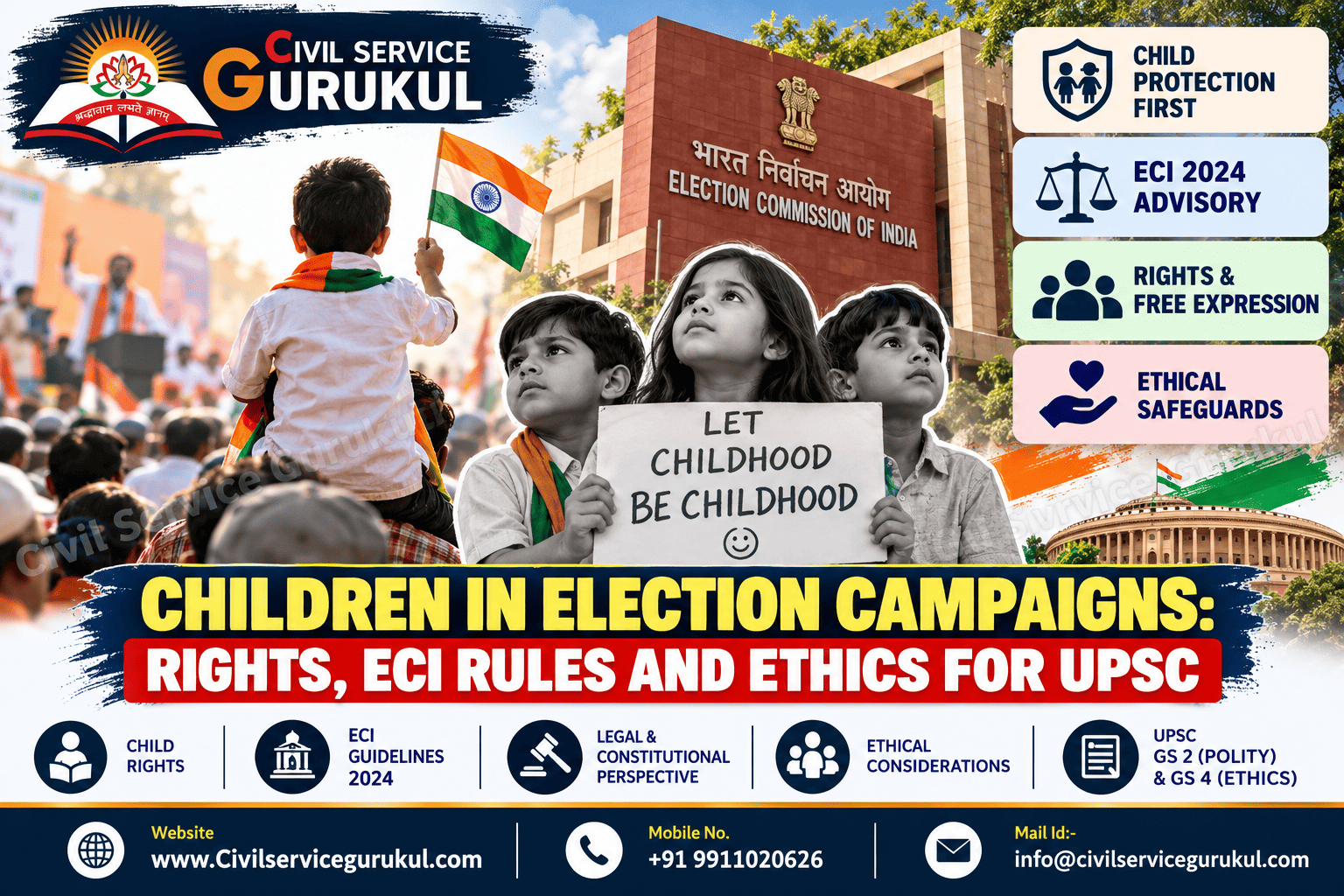
Children in Election Campaigns: ECI Guidelines, Constitutional Rights and the Ethics of Political Participation
Can a democracy encourage children to understand politics without allowing political parties to use them for election publicity?
UPSC GS Paper II | GS Paper IV | Prelims 2026
The Election Commission of India issued a zero-tolerance directive on 5 February 2024 concerning the use of children in election-related activities.
The guidance restricts the involvement of children in rallies, sloganeering, distribution of campaign materials and symbolic political promotion.
However, incidental presence with a parent or guardian, without active campaign participation, is treated differently.
For UPSC aspirants, this topic connects electoral governance, constitutional child protection, freedom of expression and administrative ethics.
1. Why Is This Topic Important?
Elections are central to democratic government. Political parties communicate with citizens, hold rallies and organise campaigns to seek public support.
However, the participation of children in these activities raises an important question.
Should children be used to promote political parties or candidates?
The issue is not whether children should learn about democracy.
The issue is whether adults should involve minors in partisan campaigning for political advantage.
2. What Did the Election Commission Say in 2024?
On 5 February 2024, the Election Commission of India issued directions expressing zero tolerance towards the use of children in election campaigns.
Political parties and candidates were instructed not to involve children in campaign-related work.
Activities Covered
- Participation in election rallies.
- Political marches and processions.
- Sloganeering for political parties.
- Distribution of election publicity material.
- Reciting political messages.
- Displaying political symbols for campaign promotion.
- Symbolic use of children to support or oppose candidates.
The guidance covers both direct participation and certain symbolic forms of campaigning.
3. Are Children Completely Prohibited from Political Events?
No. The distinction between incidental presence and campaign participation is important.
A child may accompany a parent or guardian near a political leader without actively participating in campaigning.
Such incidental presence is not automatically treated as a violation of the advisory.
However, parental presence does not automatically make active campaign participation permissible.
| Situation | Interpretation |
|---|---|
| Child accompanying a parent without campaigning | Incidental presence is treated differently. |
| Child distributing party leaflets | Covered by the ECI restriction. |
| Child shouting campaign slogans | Covered by the ECI restriction. |
| Child attending neutral civic education | Different from partisan campaigning. |
| Child used in symbolic election publicity | Covered by the ECI directive. |
4. Constitutional Provisions Related to Child Rights
The Constitution of India provides important safeguards for the protection and development of children.
| Article | Constitutional Provision | UPSC Relevance |
|---|---|---|
| Article 21 | Protection of life and personal liberty. | Human dignity and welfare. |
| Article 21A | Free and compulsory education for children aged 6 to 14. | Right to Education. |
| Article 24 | Prohibition of employment of children below 14 in factories, mines and other hazardous employment. | Protection from specified child labour. |
| Article 39(e) | Protection against abuse of the tender age of children. | Directive Principles. |
| Article 39(f) | Opportunities for healthy development and protection against exploitation. | Child welfare and dignity. |
5. Child Protection Laws: What Should Aspirants Know?
India has several legal frameworks concerned with child protection.
The Child and Adolescent Labour (Prohibition and Regulation) Act, 1986, as amended, addresses prohibited employment and work involving children.
The Juvenile Justice framework also forms part of India's broader child protection system.
However, every appearance of a child at a political event does not automatically amount to a criminal child-labour offence.
Legal responsibility depends on the specific facts, applicable statutory provisions and election instructions.
6. Children's Right to Express Their Views
Child protection must be balanced with children's ability to learn about public issues.
Article 12 of the United Nations Convention on the Rights of the Child recognises the importance of hearing children's views according to their age and maturity.
Children can participate in age-appropriate civic activities such as:
- School mock parliaments.
- Classroom discussions on democracy.
- Non-partisan civic education.
- Awareness programmes on constitutional values.
- Educational debates on public issues.
These activities should not be confused with organised partisan campaigning.
7. Why Is This an Ethics Question?
For UPSC GS Paper IV, the issue raises several ethical dilemmas.
Autonomy Versus Protection
Children may have opinions, but they may also face pressure from adults.
Political Freedom Versus Vulnerability
Political participation is important in democracy, but children require safeguards against manipulation.
Consent and Power Imbalance
A child's participation may be influenced by parents, political leaders or other adults.
Public Interest Versus Electoral Advantage
Political parties may gain publicity through children's appearances, but child welfare must remain a priority.
8. Social Media and Digital Campaigning
Digital platforms create additional concerns when children appear in political campaign content.
Photographs and videos may be shared widely and remain accessible beyond the original event.
This creates questions about privacy, consent, digital exposure and future welfare.
Political organisations should therefore consider safeguards for recording, publishing and distributing campaign material involving minors.
9. Policy Recommendations and the Way Forward
- Child Safeguarding Protocols: Political parties should adopt clear internal rules to prevent the use of children in campaign activities.
- Training for Election Officials: Officials should distinguish between incidental family presence and active campaign involvement.
- Neutral Civic Education: Schools should encourage democratic awareness without party branding.
- Digital Protection: Platforms should provide mechanisms for reporting exploitative campaign content involving minors.
- Fair Enforcement: Any action should follow applicable law, evidence and procedural fairness.
- Awareness Among Parents: Families should understand the difference between civic education and political campaigning.
10. UPSC Prelims: Quick Revision Notes
- The Election Commission issued its prominent directive on 5 February 2024.
- The advisory restricts the use of children in election campaigning.
- Incidental presence with a parent is different from active campaign participation.
- Article 21A relates to education for children aged 6 to 14.
- Article 24 addresses specified child employment.
- Article 39(e) and 39(f) contain important child protection principles.
- Article 12 of the UNCRC recognises children's right to express their views.
11. UPSC Prelims Practice MCQs
Which statement best reflects the Election Commission's 2024 guidance?
- Children cannot be near any political leader.
- Parental consent alone permits children to campaign.
- Children should not be used in election campaigns, but incidental presence is treated differently.
- Only pamphlet distribution is restricted.
The directive covers active and symbolic campaigning while distinguishing incidental non-campaign presence.
Which Article of the Constitution guarantees free and compulsory education for children aged 6 to 14?
- Article 19
- Article 21A
- Article 24
- Article 39
Article 21A provides for free and compulsory education for children between 6 and 14 years.
Article 39(f) is primarily associated with:
- Election expenditure limits.
- Protection and healthy development of children.
- Appointment of Election Commissioners.
- Adult voting rights.
Article 39(f) concerns opportunities for children's healthy development and protection against exploitation.
12. UPSC Mains Practice Question
"Examine how India can protect children from political exploitation without weakening their right to civic education and participation."
Word Limit: 150 words
Suggested Answer Framework
- Introduce the distinction between civic learning and partisan mobilisation.
- Mention the ECI February 2024 directive.
- Discuss Articles 21, 21A, 24 and 39.
- Explain consent, autonomy and power imbalance.
- Recommend safeguarding, neutral civic education and proportionate enforcement.
13. Frequently Asked Questions
Can children participate in election campaigns in India?
The Election Commission's 2024 guidance directs political parties and candidates not to use children in campaign activities.
When did the ECI issue its advisory?
The relevant directive was issued on 5 February 2024.
Does parental consent automatically permit campaigning?
No. Incidental presence with a parent is different from active or symbolic campaign participation.
Can schools teach children about democracy?
Yes. Age-appropriate, non-partisan civic education is different from electoral campaigning.
Which UPSC papers cover this topic?
The topic is relevant to GS Paper II for Polity, Governance and Social Justice, and GS Paper IV for Ethics. It is also useful for Prelims.
14. Conclusion: Democracy Must Protect Childhood
Democracy should encourage young people to understand citizenship, constitutional values and public affairs.
However, children should not be used as instruments of partisan electoral publicity.
India's approach must balance child protection with meaningful, age-appropriate civic education.
Final UPSC Takeaway: A mature democracy protects children from political exploitation while preparing them to become informed and responsible citizens.
Prepare for UPSC with Civil Service Gurukul
Strengthen your understanding of Indian Polity, Current Affairs, Governance, Ethics and Social Justice with structured UPSC-focused learning resources.
Website: www.civilservicegurukul.com
Mobile: +91 9911020626
Email: info@civilservicegurukul.com
Editorial Note: This article is an educational UPSC analysis based on the Election Commission's 2024 guidance and constitutional child protection principles. It distinguishes election campaign restrictions from legitimate civic education.
Prepare with Mentors Who Cleared the Exam
Get personalized study plans, evaluated answer models, and test series access.