Daily Current Affairs & News Analysis
Our daily news analysis consists of two integral parts — Daily News Analysis and Important Editorials curated rigorously from The Hindu, The Indian Express, LiveMint, PIB, and Sansad TV debates. Content is mapped directly to UPSC CSE and State PCS syllabi.
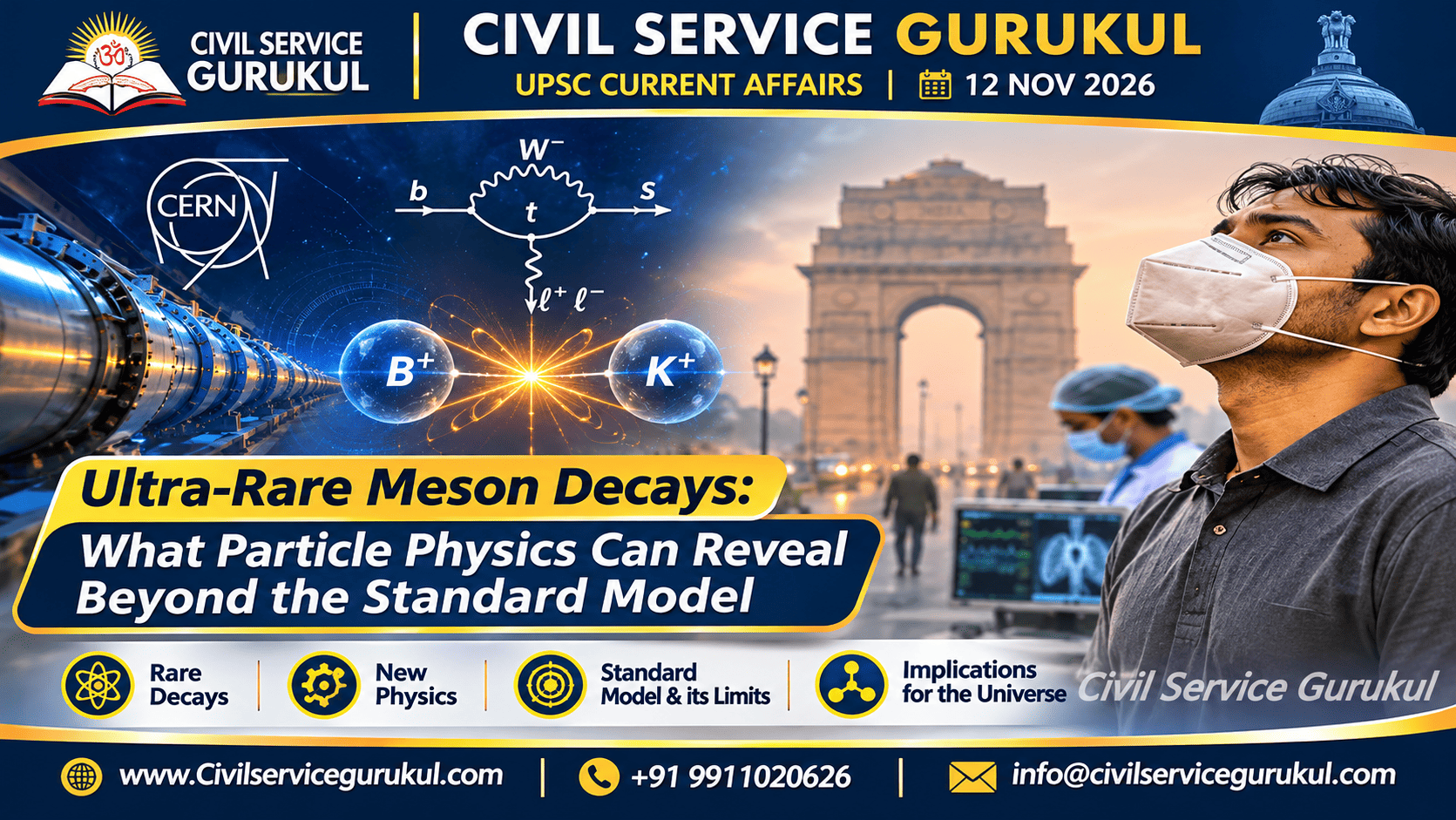
CERN Detects Evidence of Ultra-Rare B-Meson Decay: Standard Model, Muons and New Physics Explained for UPSC 2026
CERN's LHCb experiment announced evidence of the extremely rare decay of a neutral B meson into a muon–antimuon pair on 3 November 2026. The phenomenon occurs at roughly one in ten billion decays, and the combined analysis reached a significance of 3.2 sigma, below the 5-sigma benchmark used for a discovery. The result agrees with Standard Model predictions and places tighter constraints on possible new physics. This Civil Service Gurukul article explains mesons, quarks, leptons, muons, weak interactions, branching fractions, the Large Hadron Collider, statistical significance and the difference between evidence and discovery. It also examines India's particle-physics research ecosystem and includes UPSC Prelims MCQs and a GS-III Mains model answer.
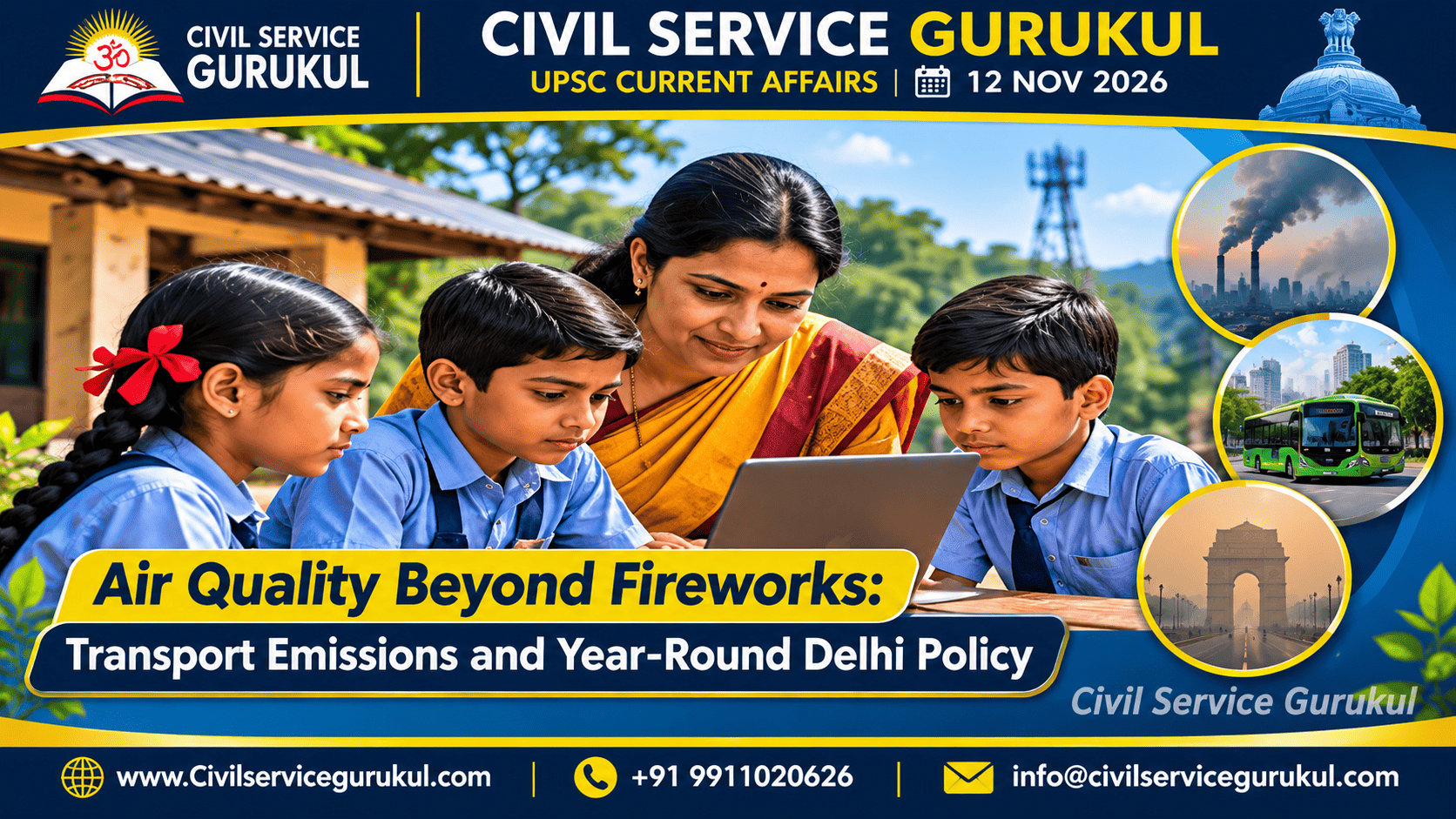
Delhi Air Pollution 2026: Why the Supreme Court Wants Action Beyond Firecrackers | UPSC GS-III
The Supreme Court's 6 November 2026 order placed renewed emphasis on vehicular emissions as a major concern in Delhi-NCR's air-pollution crisis. While fireworks and crop-residue burning can worsen seasonal pollution, the problem also involves road dust, construction, industry, waste burning, transport emissions and unfavourable winter meteorology. The Court sought enforcement details and time-bound action plans from Delhi and neighbouring states. This Civil Service Gurukul analysis explains the National Air Quality Index, PM2.5 and PM10, the Commission for Air Quality Management (CAQM), the Graded Response Action Plan (GRAP), the National Clean Air Programme (NCAP), constitutional environmental principles and year-round strategies. Includes UPSC Prelims revision, original MCQs and a GS-III Mains model answer.
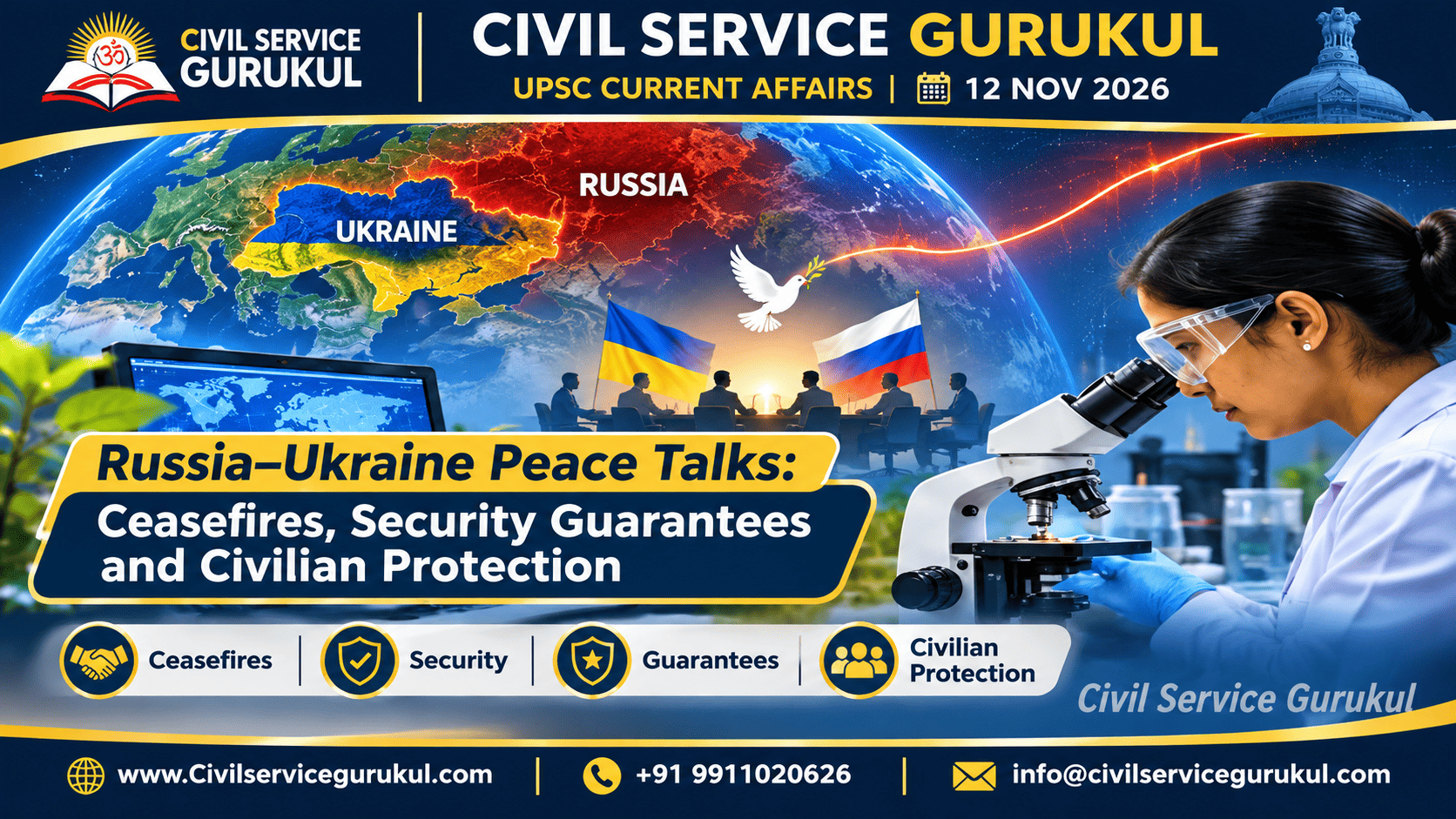
Russia–Ukraine Peace Talks 2026: Abu Dhabi Negotiations, Prisoner Exchange, Ceasefire and Security Guarantees
Russia and Ukraine resumed US-mediated peace negotiations in Abu Dhabi on 10–11 November 2026, leading to an agreement in principle on a major prisoner exchange but no comprehensive ceasefire. Fundamental differences remain over territorial control, security guarantees, Europe's participation and the conditions for lasting peace. This Civil Service Gurukul article examines the diplomatic developments, distinction between a ceasefire and a peace treaty, principles of the UN Charter, Geneva Conventions, international humanitarian law and India's strategic interests. It also discusses civilian protection, humanitarian corridors, energy security, global economic consequences and the requirements of a sustainable peace settlement. The article includes UPSC Prelims revision, original MCQs and a GS-II Mains model answer.
Ladakh Hill Council Elections 2026: December 4 Polls, Sixth Schedule Demands and Democratic Autonomy Explained for UPSC
The Ladakh administration has scheduled elections to eight Ladakh Autonomous Hill Development Councils for 4 December 2026, expanding local representative institutions across 100 constituencies. The elections follow the reorganisation of Ladakh into eight districts and coincide with continuing demands for statehood, Sixth Schedule safeguards, protection of land and employment rights, and greater democratic autonomy. Civil-society organisations have raised concerns about winter polling, delimitation and the adequacy of statutory local governance arrangements. This Civil Service Gurukul analysis examines the legal status of hill councils, the Sixth Schedule of the Indian Constitution, Ladakh's administration as a Union Territory without a legislature, democratic decentralisation, environmental challenges and the way forward. Includes Prelims revision facts, original practice MCQs and a GS-II Mains model answer.
US Court Order and India's Sovereignty: Hague Service Convention, Jurisdiction and Due Process Explained for UPSC
A US federal court's November 2026 order permitting alternative service of civil court documents on two Indian officials through Indian judicial channels has raised important questions about sovereignty, cross-border litigation, jurisdiction and due process. The case provides a valuable UPSC GS Paper II example of how international conventions interact with domestic procedural law. This Civil Service Gurukul analysis explains the 1965 Hague Service Convention, the role of India's Ministry of Law and Justice, relevant provisions of the Code of Civil Procedure, sovereign immunity and the distinction between procedural service and legal liability. It includes verified legal context, balanced India–US relations analysis, Prelims facts, practice MCQs and a model Mains answer.