
UPSC Current Affairs 14 October 2026: Top 9 Important Topics for Prelims & Mains 2027 | BIMSTEC, Article 22, TB-Free India, ULLAS Scheme & Practice MCQs
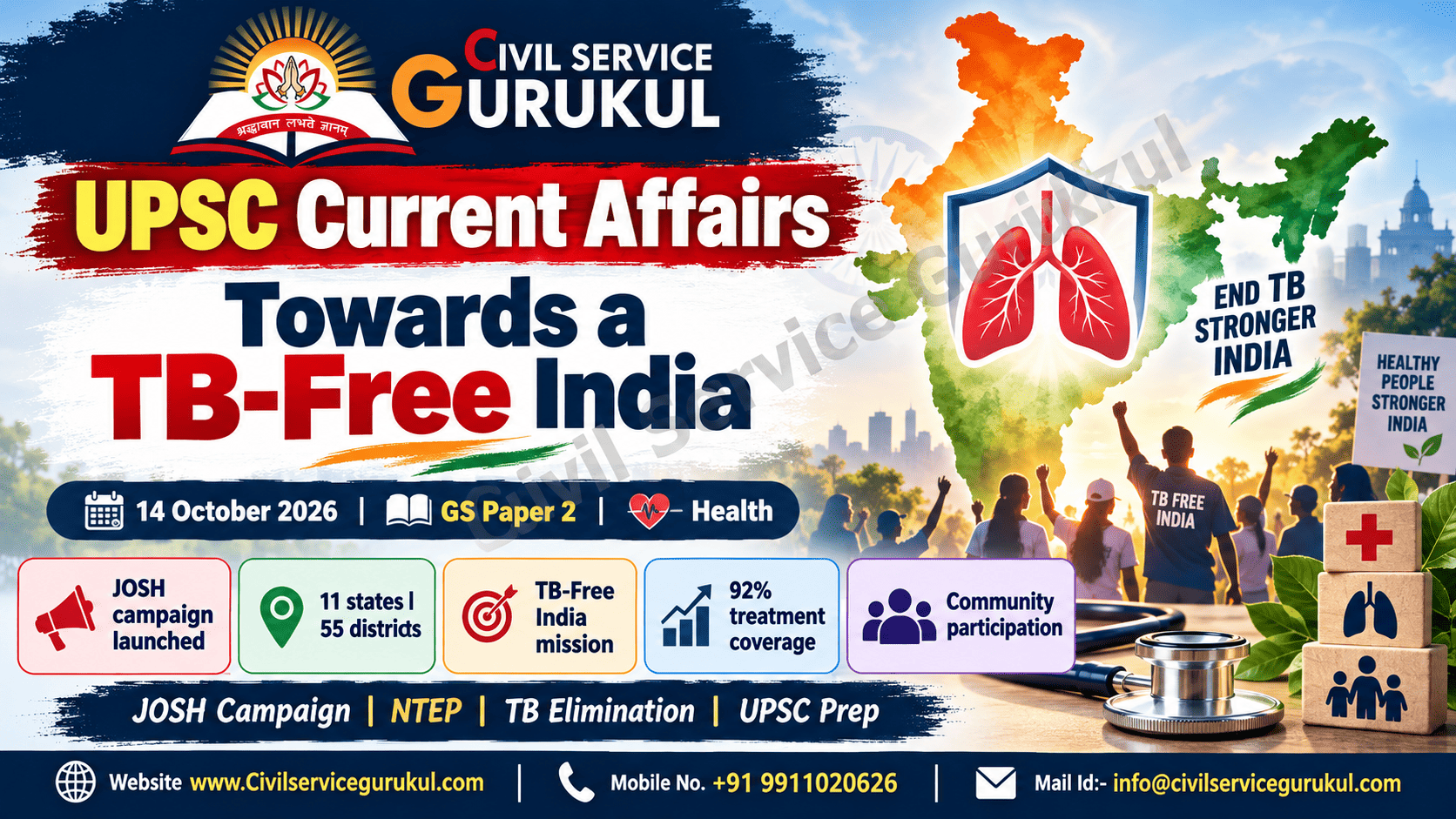
UPSC Current Affairs 14 October 2026: 9 Essential Topics for Prelims and Mains
Comprehensive, easy-to-revise current affairs notes with GS syllabus links, important facts, explanations, practice MCQs and Mains answer-writing questions.
Today's Current Affairs at a Glance
| Topic | UPSC Connection | Priority |
|---|---|---|
| TB-Free India | GS II: Health | Very High |
| Preventive Detention | GS II: Constitution | Very High |
| BIMSTEC Declaration | GS II: International Relations | Very High |
| ULLAS Scheme | GS II: Education | High |
| Soybean Varieties | GS III: Agriculture | High |
| IBSAMAR IX | GS III: Security | High |
| Javari Temple | GS I: Art and Culture | High |
| Agrivision 2026 | GS III: Agriculture | Medium |
| Costa Rica | Prelims: Geography | High |
1. Towards a TB-Free India: JOSH Campaign
Why in News? The Ministry of Health and Family Welfare launched the JOSH (Joint Squad for Health) campaign across 11 states and 55 districts to encourage youth and community participation in tuberculosis elimination.
Important Facts
- TB is caused by Mycobacterium tuberculosis.
- It spreads through airborne particles released by people with infectious pulmonary TB.
- Latent TB infection is not contagious; active pulmonary TB can be infectious.
- India's programme is called the National Tuberculosis Elimination Programme (NTEP).
- India's stated elimination target was 2025, ahead of the global 2030 SDG milestone.
- The Ni-kshay Poshan Yojana provides nutritional assistance to notified TB patients.
- BPaLM is an important shorter treatment regimen for eligible drug-resistant TB cases.
Prelims Focus: Mycobacterium tuberculosis, latent versus active TB, NTEP, Ni-kshay Mitra, BPaLM, and SDG 3.3.
2. Agrivision 2026: Moving Towards Market-Oriented Agriculture
Why in News? The 10th National Convention of Agrivision was held in New Delhi on 13–14 October 2026, highlighting agricultural entrepreneurship and stronger agri-food value chains.
Key Takeaways
- Promote demand-led rather than only production-led agriculture.
- Strengthen storage, processing, packaging and market access.
- Encourage agri-startups, rural innovation and youth participation.
- Connect farmers with research institutions, industry and markets.
- Improve farmer income through value addition and better price realisation.
Prelims and Mains Focus: FPOs, agriculture marketing, food processing, cold chains, value addition and rural entrepreneurship.
3. Soybean Varieties NRC 268 and NRC 270
Why in News? Improved soybean varieties NRC 268 and NRC 270 were showcased by the ICAR–National Soybean Research Institute, Indore, with encouraging field performance.
Key Facts
- Botanical name of soybean: Glycine max.
- Institution: ICAR–National Soybean Research Institute, Indore.
- Major soybean states include Madhya Pradesh and Maharashtra.
- Soybean is an important kharif oilseed and protein-rich crop.
- NRC 270 is noted for its bold-seeded characteristics.
- Improved varieties can support productivity and climate resilience.
Field demonstrations reported yields around 20 quintals per hectare. These are observations under particular conditions, not guaranteed yields for every farm.
4. Khajuraho's Javari Temple
Why in News? The Archaeological Survey of India reported tracing the missing head of a Vishnu idol associated with Javari Temple at Khajuraho.
Important Prelims Facts
- Location: Khajuraho, Chhatarpur district, Madhya Pradesh.
- Dynasty: Chandela.
- Deity: Lord Vishnu.
- Period: Approximately the late 11th century CE.
- Temple group: Eastern Group of Khajuraho temples.
- Khajuraho Group of Monuments: UNESCO World Heritage Site since 1986.
The temple is associated with the Nagara style of temple architecture, a curvilinear shikhara and decorative sculptural elements.
Architecture Terms: Garbhagriha means sanctum, mandapa means assembly hall, antarala means vestibule, and nirandhara refers to a shrine without an internal circumambulatory path.
5. Lakshadweep's Literacy Achievement and ULLAS Scheme
Why in News? Lakshadweep was declared a fully literate Union Territory under the ULLAS adult literacy initiative.
ULLAS: Essential Facts
- Full form: Understanding Lifelong Learning for All in Society.
- Also called Nav Bharat Saaksharta Karyakram or New India Literacy Programme.
- Ministry: Ministry of Education.
- Target group: Non-literate persons aged 15 years and above.
- Approved implementation period: FY 2022–23 to FY 2026–27.
- It is a Centrally Sponsored Scheme aligned with NEP 2020.
Five Components
- Foundational Literacy and Numeracy
- Critical Life Skills
- Basic Education
- Vocational Skills
- Continuing Education
ULLAS also encourages volunteers and community participation in adult learning.
6. BIMSTEC Delhi Declaration 2026
Why in News? The first BIMSTEC Home Ministers' Meeting in New Delhi adopted the Delhi Declaration, emphasising regional security cooperation.
Seven BIMSTEC Members
Bangladesh, Bhutan, India, Myanmar, Nepal, Sri Lanka and Thailand.
Major Security Priorities
- Counterterrorism and countering terror financing.
- Cybercrime and cross-border online fraud.
- Human trafficking and victim protection.
- Drug trafficking and organised crime.
- Intelligence sharing and cooperation among law-enforcement agencies.
- Legal assistance and stronger regional security mechanisms.
Prelims Focus: BIMSTEC membership, Bay of Bengal, regional groupings, cybercrime cooperation and India's Act East policy.
7. Preventive Detention: Article 22 and Personal Liberty
Why in News? Judicial scrutiny of detention and restrictions surrounding protests renewed attention to constitutional safeguards for personal liberty.
What Is Preventive Detention?
Preventive detention means detention intended to prevent anticipated harmful activity, rather than punishment following conviction for a past offence.
| Constitutional Provision | Meaning |
|---|---|
| Article 21 | Protection of life and personal liberty |
| Article 22(1)–(2) | Ordinary arrest and detention safeguards |
| Article 22(3) | Exceptions for enemy aliens and preventive detention |
| Article 22(4) | Constitutional limits and Advisory Board safeguards |
| Article 22(5) | Communication of grounds and opportunity for representation |
| Article 22(6) | Public-interest exception to disclosure of certain facts |
Important Distinction
Ordinary criminal detention concerns investigation or prosecution of an offence. Preventive detention seeks to prevent future prejudicial conduct under a specific law.
Detention powers remain subject to constitutional safeguards and judicial review.
Mains Focus: Liberty versus security, proportionality, procedural safeguards, judicial oversight and the protection of peaceful dissent.
8. Exercise IBSAMAR IX 2026
Why in News? INS Tarkash participated in the ninth edition of Exercise IBSAMAR in South Africa.
Important Facts
- Participants: India, Brazil and South Africa.
- Framework: IBSA Dialogue Forum.
- Type: Trilateral naval exercise.
- Host of ninth edition: South Africa.
- Indian naval platform: INS Tarkash.
- Activities include maritime drills, interoperability and search-and-rescue exercises.
9. Costa Rica: Mapping and International Relations
Why in News? India operationalised a resident diplomatic mission in San José, Costa Rica, effective 10 October 2026.
Geography Facts
- Region: Central America.
- Capital: San José.
- Land borders: Nicaragua and Panama.
- Water bodies: Pacific Ocean and Caribbean Sea.
- Costa Rica abolished its standing army in 1948; the principle was incorporated into its constitutional system in 1949.
- The country is known for biodiversity, ecotourism and protected areas.
UPSC Prelims Practice: 9 Original MCQs
These are newly created practice questions based on the topics discussed above. They are not represented as actual UPSC previous-year questions.
Q1. Tuberculosis is caused by which organism?
(a) Plasmodium vivax
(b) Mycobacterium tuberculosis
(c) Vibrio cholerae
(d) Salmonella Typhi
Q2. The principal objective of agricultural value-chain development is to:
(a) Eliminate all intermediaries by law
(b) Improve coordination, processing and market access
(c) Restrict food processing
(d) Replace all food crops with cash crops
Q3. NRC 268 and NRC 270 are associated with:
(a) Rice
(b) Wheat
(c) Soybean
(d) Cotton
Q4. Javari Temple is primarily associated with which dynasty?
(a) Pallava
(b) Chandela
(c) Chola
(d) Rashtrakuta
Q5. ULLAS primarily targets which age group?
(a) Children under 6 years
(b) Students of Classes 9–12 only
(c) Non-literate individuals aged 15 and above
(d) University teachers only
Q6. Which of the following is NOT a BIMSTEC member?
(a) Nepal
(b) Thailand
(c) Pakistan
(d) Sri Lanka
Q7. Which Article specifically provides safeguards concerning preventive detention?
(a) Article 17
(b) Article 22
(c) Article 32 alone
(d) Article 44
Q8. IBSAMAR is a naval exercise among:
(a) India, Bangladesh and Sri Lanka
(b) India, Brazil and South Africa
(c) India, Japan and Australia
(d) India, France and UAE
Q9. Costa Rica shares land borders with:
(a) Honduras and Guatemala
(b) Nicaragua and Panama
(c) Colombia and Venezuela
(d) Belize and Mexico
UPSC Mains Answer-Writing Practice
GS II | Health | 150 Words
Despite advances in treatment and diagnosis, tuberculosis elimination remains a major public-health challenge in India. Examine the role of nutrition, community participation and health-system strengthening.
GS II | Polity | 150 Words
Preventive detention is an exceptional power that must be reconciled with constitutional liberty. Discuss the safeguards under Article 22.
GS II | International Relations | 250 Words
Analyse the significance of BIMSTEC security cooperation for India's Neighbourhood First and Act East policies.
GS III | Agriculture | 150 Words
How can climate-resilient oilseed varieties and market-oriented agricultural value chains improve farmers' incomes and India's edible-oil security?
Final Revision Checklist for UPSC Aspirants
- JOSH campaign, NTEP and Ni-kshay Poshan Yojana
- Agricultural value addition and market linkages
- Soybean NRC 268 and NRC 270
- Chandela dynasty and Nagara architecture
- ULLAS scheme and its five components
- BIMSTEC's seven member countries
- Article 22(3) to Article 22(7)
- IBSAMAR and IBSA membership
- Costa Rica's capital, borders and surrounding seas
Conclusion
The current affairs of 14 October 2026 demonstrate how diverse developments connect with the UPSC syllabus. The TB elimination programme, BIMSTEC security cooperation and preventive detention have particular relevance for analytical Mains answers.
For Prelims, aspirants should memorise the institutional details of ULLAS, soybean variety names, Khajuraho architecture, IBSAMAR participants and Costa Rica's location.
Consistent revision, conceptual clarity and regular MCQ practice are more useful than collecting facts without connecting them to the syllabus.
Prepare with Mentors Who Cleared the Exam
Get personalized study plans, evaluated answer models, and test series access.