
Olive Ridley Turtle Conservation: WII Report 2026 UPSC
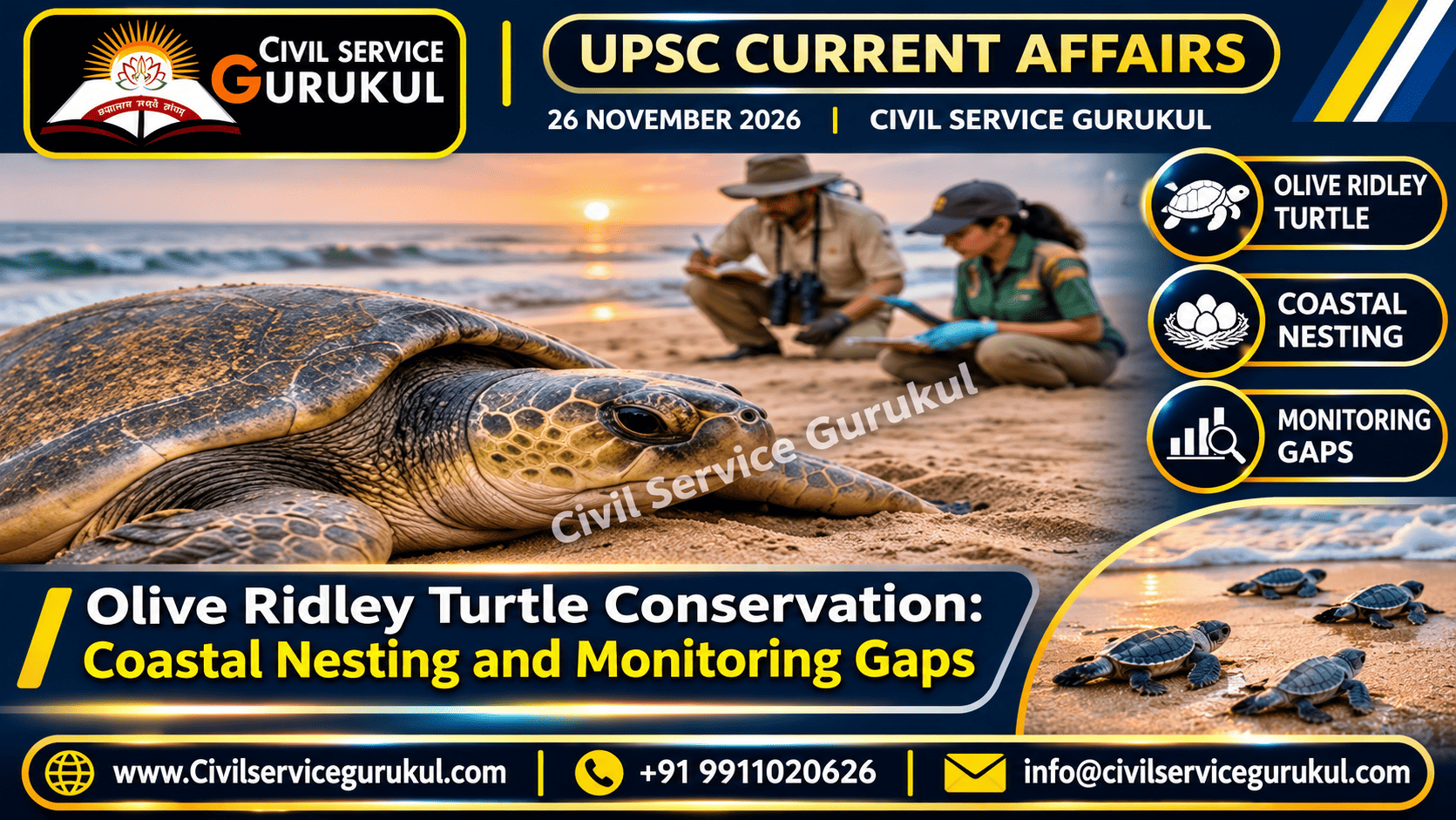
Olive Ridley Turtle Conservation in India: WII Report 2026, Coastal Nesting Challenges and the Roadmap for Marine Biodiversity Protection – UPSC 2027
A nationwide marine turtle assessment conducted by the Wildlife Institute of India has identified Olive Ridley turtles as the most widely distributed marine turtle species along India's mainland coastline.
The assessment recorded 18,713 solitary Olive Ridley nests during the 2024–25 nesting season. However, incomplete monitoring, fisheries-related mortality, coastal disturbances and habitat degradation remain important conservation concerns.
Protecting marine turtles requires an integrated approach that connects nesting beaches, migratory corridors, feeding grounds, sustainable fisheries and coastal development planning.
For UPSC aspirants, the issue connects biodiversity conservation, environmental legislation, coastal geography, climate change and community-based natural resource management.
UPSC Syllabus Relevance
| Examination Stage | Relevant Topics |
|---|---|
| Prelims | Marine turtles, threatened species, protected areas, biodiversity, environmental conventions and conservation programmes. |
| GS Paper I | Coastal geography, marine ecosystems, river mouths, climate change and geographical distribution of species. |
| GS Paper II | Environmental governance, institutional coordination and international environmental cooperation. |
| GS Paper III | Biodiversity conservation, environmental degradation, pollution, sustainable development and environmental impact assessment. |
| GS Paper IV | Environmental ethics, intergenerational equity and responsibility towards biodiversity. |
| Essay | Ecological sustainability, development versus conservation and human-nature relationships. |
1. Why in the News?
On 23 November 2026, the Union Environment Ministry released a nationwide assessment of marine turtles during the 92nd meeting of the Standing Committee of the National Board for Wildlife.
The assessment, undertaken by the Wildlife Institute of India under the Development of Wildlife Habitats scheme, examined three nesting seasons between 2022 and 2025.
Subsequent reporting on 26 November highlighted the widespread distribution of Olive Ridley turtles across India's mainland coast, alongside deficiencies in long-term monitoring.
Major Issues Highlighted
- Widespread solitary nesting of Olive Ridley turtles.
- Incomplete monitoring in remote island territories.
- Insufficient assessment of nest predation.
- Need for improved tagging and movement tracking.
- Importance of protecting natural nesting habitats.
- Need for coordinated coastal and marine conservation.
2. Key Findings of the Wildlife Institute of India Report 2026
| Indicator | Reported Findings |
|---|---|
| Research Organisation | Wildlife Institute of India |
| Assessment Period | December 2022 to May 2025 |
| Number of Nesting Seasons | Three |
| Beach Stretches Surveyed | 360 |
| Approximate Coastline Surveyed | 1,300 kilometres |
| Olive Ridley Distribution | At least 300 surveyed beach stretches |
| Solitary Nests in 2024–25 | 18,713 |
| Estimated Solitary-Nesting Females | Approximately 8,000 |
| Marine Turtle Species with Nesting Information | Four species |
| Major Data Gaps | Remote island monitoring and underestimation of nest predation |
Reported Hatchling Emergence Success
Reported averages from the assessment. Local nesting outcomes may vary according to habitat conditions, survey coverage and conservation measures.
3. About Olive Ridley Sea Turtles
Olive Ridley turtles are relatively small marine turtles named after the olive-green colour of their shells. They inhabit tropical and subtropical waters and undertake extensive migrations between feeding and breeding habitats.
| Particulars | Important Facts |
|---|---|
| Common Name | Olive Ridley Sea Turtle |
| Scientific Name | Lepidochelys olivacea |
| Animal Class | Reptilia |
| Family | Cheloniidae |
| Habitat | Tropical and subtropical marine waters |
| Feeding Behaviour | Omnivorous; consumes marine invertebrates and other suitable food |
| Special Behaviour | Arribada or synchronised mass nesting |
| IUCN Global Conservation Status | Vulnerable |
| CITES Classification | Appendix I |
| Indian Legal Protection | Schedule I of the Wild Life (Protection) Act, 1972 |
| Major Indian Nesting Region | Odisha coast |
4. What Is Arribada?
Arribada is a Spanish term meaning arrival. In marine turtle ecology, it describes a synchronised mass-nesting event during which large numbers of female turtles come ashore within a relatively short period.
Olive Ridley turtles are particularly well known for this reproductive behaviour.
Arribada vs Solitary Nesting
| Parameter | Arribada | Solitary Nesting |
|---|---|---|
| Nesting Pattern | Synchronised mass nesting | Individual nesting events |
| Timing | Large aggregations during concentrated periods | Dispersed throughout the nesting season |
| Monitoring | Requires specialised estimation methods for dense nesting events | Individual nests can often be documented through beach surveys |
| Conservation Focus | Protection of mass-nesting beaches | Protection of dispersed coastal nesting habitats |
5. Major Olive Ridley Turtle Nesting Sites in India
Odisha's coastline contains internationally important Olive Ridley mass-nesting habitats.
| Nesting Location | State | Significance |
|---|---|---|
| Gahirmatha Marine Sanctuary | Odisha | Globally significant Olive Ridley mass-nesting habitat. |
| Rushikulya River Mouth | Odisha | Major arribada site and important marine turtle conservation area. |
| Devi River Mouth | Odisha | Historically important Olive Ridley nesting region. |
| Other Mainland Coastal Beaches | Multiple Coastal States | Important dispersed and solitary nesting habitats. |
| Andaman and Nicobar Islands | Union Territory | Important marine turtle nesting habitats supporting several species. |
Why Are River Mouths Important for Turtle Nesting?
River mouths influence sediment movement, sand deposition, beach formation and nearshore ecological conditions.
Suitable sandy beaches near river mouths may provide favourable nesting environments, although habitat quality depends on local geomorphology, flooding, erosion and human disturbance.
Important Geography Linkages
- Bay of Bengal coastal ecosystems.
- River mouths and estuarine processes.
- Coastal erosion and sediment deposition.
- Mangroves and marine protected areas.
- Climate-related changes in coastal habitats.
6. Five Marine Turtle Species Found in Indian Waters
Five of the world's seven recognised sea turtle species occur in Indian waters.
| Species | Scientific Name | Important Characteristics |
|---|---|---|
| Olive Ridley Turtle | Lepidochelys olivacea | Known for mass nesting and widespread coastal distribution. |
| Green Turtle | Chelonia mydas | Adults predominantly feed on seagrass and algae. |
| Hawksbill Turtle | Eretmochelys imbricata | Associated with coral reef ecosystems. |
| Leatherback Turtle | Dermochelys coriacea | Largest living sea turtle species, with a flexible leathery shell. |
| Loggerhead Turtle | Caretta caretta | Recognised by its relatively large head and powerful jaws. |
7. Life Cycle and Ecological Significance of Marine Turtles
Marine turtles have complex life cycles that connect terrestrial nesting habitats with coastal and offshore marine ecosystems.
Ecological Importance
- Contribute to marine food-web dynamics.
- Support nutrient cycling between marine and coastal ecosystems.
- Help regulate populations of certain marine organisms.
- Provide ecological and conservation research opportunities.
- Connect geographically separated marine habitats through migration.
Different marine turtle species perform different ecological functions depending on their feeding behaviour and habitat preferences.
8. Major Threats to Olive Ridley Turtle Conservation
| Threat | Environmental Impact |
|---|---|
| Fishing Bycatch | Accidental capture in trawls, gillnets and other fishing gear may cause injury or drowning. |
| Marine Plastic Pollution | Plastic ingestion, entanglement and obstruction of nesting habitats. |
| Artificial Lighting | May disorient nesting females and hatchlings. |
| Coastal Infrastructure | May alter beach habitats, sediment movement and nearshore conditions. |
| Beach Erosion | Can reduce available nesting space or destroy nests. |
| Climate Change | May alter incubation temperatures, sea levels and habitat suitability. |
| Predation | Eggs and hatchlings may be lost to natural or human-influenced predators. |
| Illegal Collection | Unlawful harvesting of turtles or eggs can undermine conservation. |
| Ghost Fishing Gear | Abandoned nets and ropes may continue trapping marine animals. |
| Monitoring Deficiencies | Incomplete information may weaken conservation planning and evaluation. |
9. Scientific Monitoring Gaps and Population Assessment
Counting marine turtles is scientifically challenging because they spend most of their lives underwater and may migrate over considerable distances.
Nesting records therefore provide useful but incomplete evidence about population trends.
What Is Detection Probability?
Detection probability refers to the likelihood that a species, nest or ecological event will be observed during a survey when it is actually present.
Changes in observer effort, weather, beach accessibility and survey frequency can influence the number of recorded nests.
Major Monitoring Challenges
- Unequal survey coverage between States and Union Territories.
- Limited monitoring of remote island beaches.
- Difficulty distinguishing repeat nesting by the same female.
- Incomplete documentation of nest predation.
- Differences in observation and recording methods.
- Insufficient long-term information on migration and survival.
Recommended Scientific Monitoring Framework
| Monitoring Method | Purpose |
|---|---|
| Standardised Beach Surveys | Improve consistency in recording nesting activity. |
| Georeferenced Nest Records | Support authorised scientific analysis of habitat distribution. |
| Flipper Tagging | Assist identification of individual turtles during subsequent observations. |
| Satellite Tracking | Provide information on migration and marine habitat use. |
| Hatching Success Monitoring | Measure the proportion of eggs producing hatchlings. |
| Emergence Success Monitoring | Evaluate the proportion of eggs resulting in hatchlings emerging from the nest. |
| Bycatch and Stranding Records | Improve understanding of marine mortality and injury. |
10. Operation Olivia: Indian Coast Guard Initiative
Operation Olivia is an annual marine conservation initiative conducted by the Indian Coast Guard to protect Olive Ridley turtles and their breeding habitats, particularly along Odisha's coastline.
The operation generally runs from November to May and supports safe breeding and nesting conditions through coordinated maritime protection.
Major Objectives of Operation Olivia
- Protect marine turtles during breeding and nesting periods.
- Support enforcement of applicable fishing restrictions.
- Reduce accidental capture in prohibited fishing activities.
- Coordinate with State forest and fisheries authorities.
- Promote awareness among fishing communities.
- Support rescue of distressed or entangled marine turtles.
Operation Olivia — Indian Coast Guard — Olive Ridley Turtle Conservation.
11. What Is a Turtle Excluder Device?
A Turtle Excluder Device, commonly known as TED, is a modification installed in suitable trawl fishing nets that allows accidentally captured sea turtles to escape while retaining the intended catch.
Benefits of Turtle Excluder Devices
- Reduce accidental capture and drowning of marine turtles.
- Support more sustainable fishing practices.
- Improve compatibility between fisheries and biodiversity conservation.
- Potentially reduce ecological damage associated with fishing activities.
Effective adoption depends on appropriate equipment design, correct installation, fisher training, enforcement and consideration of livelihood impacts.
12. Legal and International Protection of Olive Ridley Turtles
| Legal Framework | Conservation Significance |
|---|---|
| Wild Life (Protection) Act, 1972 | Olive Ridley turtles receive Schedule I protection in India. |
| Environment (Protection) Act, 1986 | Provides an overarching statutory framework for environmental protection. |
| Coastal Regulation Zone Notification | Regulates activities in notified coastal areas, including ecologically sensitive habitats. |
| State Marine Fisheries Regulation Laws | Provide mechanisms for regulating fishing activities and protecting relevant marine habitats. |
| CITES Appendix I | Provides stringent restrictions on international commercial trade in listed species and their specimens. |
| Convention on Migratory Species (CMS) | Promotes international cooperation for the conservation of migratory wildlife. |
| IOSEA Marine Turtle Memorandum of Understanding | Supports regional cooperation for marine turtle conservation across the Indian Ocean and South-East Asia. |
IUCN vs CITES vs Indian Wildlife Law
| Framework | Olive Ridley Classification | Primary Purpose |
|---|---|---|
| IUCN Red List | Vulnerable | Scientific assessment of extinction risk. |
| CITES | Appendix I | Regulation of international trade. |
| Wild Life (Protection) Act | Schedule I | Domestic statutory protection. |
13. National Marine Turtle Action Plan
The Ministry of Environment, Forest and Climate Change launched the National Marine Turtle Action Plan in January 2021 to strengthen conservation of marine turtles and their habitats.
The 2021–2026 action plan provides a coordinated framework for research, monitoring, habitat conservation and management of human-induced threats.
Major Conservation Priorities
- Protection and management of marine turtle habitats.
- Reduction of fishing-related mortality.
- Scientific monitoring and population assessment.
- Strengthening of conservation-related institutional capacity.
- Community participation and public awareness.
- Regional and international conservation cooperation.
The November 2026 release of technical publications on marine turtle marking, tracking and species identification supports more consistent research and monitoring.
14. Great Nicobar Island, Galathea Bay and Marine Conservation
The nationwide WII assessment also highlighted the ecological importance of Galathea Bay on Great Nicobar Island as a Leatherback turtle nesting habitat.
The location is associated with a proposed transshipment port under the Great Nicobar Island development project, raising questions about the relationship between coastal infrastructure and marine biodiversity conservation.
Reported Leatherback Nesting Records at Galathea Bay
| Nesting Season | Reported Leatherback Nests |
|---|---|
| 2023–24 | 643 |
| 2024–25 | 478 |
| November 2025 – March 2026 | 889, according to subsequently reported Forest Department records |
These records should be interpreted in light of differences in monitoring periods and survey effort.
Development and Conservation Considerations
- Environmental impact assessment.
- Protection of critical nesting habitats.
- Management of artificial lighting and coastal disturbances.
- Long-term ecological monitoring.
- Infrastructure design and environmental safeguards.
- Independent evaluation of mitigation measures.
Development decisions should consider strategic and economic objectives alongside ecological sensitivity, legal obligations and the effectiveness of proposed conservation safeguards.
15. Climate Change and Olive Ridley Turtle Conservation
Marine turtles are sensitive to changing environmental conditions because their survival depends on both terrestrial nesting beaches and marine habitats.
Temperature-Dependent Sex Determination
In sea turtles, incubation temperature influences the sex of developing hatchlings. Warmer incubation conditions generally produce a greater proportion of females, while cooler conditions generally produce more males within viable temperature ranges.
Extreme temperatures may also reduce egg survival.
Major Climate-Related Challenges
- Sea-level rise and loss of nesting beaches.
- Increased coastal erosion and flooding.
- Changes in sand temperatures.
- Potential imbalance in hatchling sex ratios.
- Changes in marine food availability and migration conditions.
- Damage to coastal habitats from extreme weather events.
16. Way Forward: An Integrated Marine Turtle Conservation Strategy
A. Standardised National Monitoring
Develop consistent survey methods and reporting protocols across mainland and island nesting habitats.
B. Protection of Dispersed Nesting Sites
Conservation programmes must cover solitary nesting beaches in addition to internationally recognised mass-nesting sites.
C. Sustainable Fisheries Management
Promote appropriate fishing gear, Turtle Excluder Devices and scientifically justified seasonal restrictions.
D. Community-Based Conservation
Involve fishers, coastal communities, local institutions and researchers in monitoring and conservation decisions.
E. Responsible Coastal Development
Evaluate potential effects of infrastructure on nesting beaches, sediment movement, lighting and marine habitats.
F. Marine Pollution Control
Reduce plastic pollution, abandoned fishing gear and other coastal waste through effective waste management.
G. Natural Nest Protection
Prioritise protection of nests in their original habitats where feasible. Relocation to appropriately managed hatcheries should be based on documented ecological need.
H. Climate-Resilient Conservation
Monitor beach temperatures, erosion patterns and changing habitat conditions to support adaptive conservation planning.
I. Outcome-Based Evaluation
Measure conservation performance through nesting trends, hatching success, emergence success, mortality indicators, habitat quality and fisher participation.
17. UPSC Prelims 2027 – Quick Revision
- Olive Ridley scientific name: Lepidochelys olivacea.
- Animal class: Reptilia.
- Family: Cheloniidae.
- Global IUCN status: Vulnerable.
- CITES classification: Appendix I.
- Indian legal protection: Schedule I.
- Arribada means synchronised mass nesting.
- Major Odisha nesting sites: Gahirmatha, Rushikulya and Devi River Mouth.
- Operation Olivia is conducted by the Indian Coast Guard.
- TED stands for Turtle Excluder Device.
- TEDs help reduce turtle bycatch in suitable trawl nets.
- Five marine turtle species occur in Indian waters.
- Four species regularly nest along Indian mainland or island coastlines.
- The Leatherback is the largest living sea turtle species.
- Galathea Bay is an important Leatherback nesting habitat.
- National Marine Turtle Action Plan was launched in 2021.
- WII's 2026 assessment covered 360 beach stretches.
- The reported 18,713 figure refers to solitary nests, not the entire turtle population.
- Sea turtles exhibit temperature-dependent sex determination.
- Conservation must cover both terrestrial nesting habitats and marine ecosystems.
18. UPSC Prelims Practice MCQs
Question 1
With reference to Olive Ridley turtles, consider the following statements:
- They are classified as Vulnerable on the IUCN Red List.
- They exhibit a synchronised mass-nesting phenomenon known as arribada.
- They are marine mammals.
Which of the statements given above are correct?
- 1 only
- 1 and 2 only
- 2 and 3 only
- 1, 2 and 3
Reveal Correct Answer and Explanation
Statements 1 and 2 are correct. Olive Ridley turtles are globally classified as Vulnerable and are known for arribada.
Statement 3 is incorrect because sea turtles are reptiles.
Question 2
Consider the following pairs:
| Location | State or Union Territory |
|---|---|
| 1. Gahirmatha | Odisha |
| 2. Rushikulya River Mouth | Odisha |
| 3. Galathea Bay | Andaman and Nicobar Islands |
How many of the above pairs are correctly matched?
- Only one
- Only two
- All three
- None
Reveal Correct Answer and Explanation
Gahirmatha and Rushikulya are important Olive Ridley nesting habitats in Odisha. Galathea Bay is located on Great Nicobar Island and is important for Leatherback turtle nesting.
Question 3
Operation Olivia is primarily associated with which of the following?
- Conservation of Olive Ridley turtles by the Indian Coast Guard.
- Protection of Asiatic lions by State forest departments.
- Restoration of Himalayan glaciers.
- Reintroduction of cheetahs in Indian grasslands.
Reveal Correct Answer and Explanation
Operation Olivia is an annual Indian Coast Guard initiative supporting the protection of Olive Ridley turtles and their breeding habitats.
Question 4
Consider the following statements regarding marine turtle conservation:
- Turtle Excluder Devices can reduce accidental capture of turtles in suitable trawl nets.
- Artificial coastal lighting may disorient turtle hatchlings.
- Protecting nesting beaches alone eliminates all major threats to marine turtles.
Which of the statements given above are correct?
- 1 and 2 only
- 2 and 3 only
- 1 and 3 only
- 1, 2 and 3
Reveal Correct Answer and Explanation
TEDs reduce fishing-related risks, while artificial lighting can interfere with natural hatchling orientation.
Statement 3 is incorrect because marine turtles also face threats in feeding, breeding and migratory habitats at sea.
Question 5
With reference to marine turtle monitoring, consider the following statements:
- An individual female turtle may nest more than once during a breeding season.
- Survey coverage and detection probability can influence recorded nesting numbers.
- The number of recorded nests always equals the total population of the species.
Which of the statements given above are correct?
- 1 only
- 2 only
- 1 and 2 only
- 1, 2 and 3
Reveal Correct Answer and Explanation
Nest counts are influenced by repeat nesting, survey effort and detection probability. They cannot automatically be equated with total species population.
19. UPSC Mains Answer Writing Practice
Question: Explain why protecting nesting beaches alone is insufficient for marine turtle conservation. Discuss in the context of the recent Wildlife Institute of India assessment.
Marks: 15 | Word Limit: 250 Words
Reveal Model Answer
Introduction
Marine turtles are migratory reptiles whose life cycles connect coastal nesting beaches with extensive marine feeding and breeding habitats. The recent Wildlife Institute of India assessment highlights the widespread nesting distribution of Olive Ridley turtles and significant monitoring deficiencies.
Body
Beach protection is essential for safeguarding eggs and hatchlings. However, marine turtle conservation requires a wider approach because:
- Accidental capture in fishing gear threatens juveniles and breeding adults.
- Marine pollution and abandoned fishing nets cause ingestion and entanglement risks.
- Migratory turtles move across multiple administrative and national boundaries.
- Coastal development and artificial lighting affect nesting habitats and hatchling orientation.
- Climate change can alter nesting temperatures, sea levels and habitat suitability.
- Incomplete monitoring may conceal changes in population trends.
India should strengthen conservation through standardised beach surveys, satellite tracking, sustainable fishing practices, Turtle Excluder Devices, appropriate coastal regulation and community participation.
Operation Olivia and the National Marine Turtle Action Plan provide important foundations for institutional coordination.
Conservation should include both mass-nesting beaches and dispersed solitary nesting habitats while addressing livelihood concerns of fishing communities.
Conclusion
Effective marine turtle conservation requires an integrated land-to-sea approach. By combining scientific monitoring, responsible coastal development, sustainable fisheries and participatory governance, India can protect marine biodiversity while supporting coastal livelihoods and ecological resilience.
Question: Examine the role of scientific monitoring and community participation in strengthening marine biodiversity conservation in India.
Marks: 10 | Word Limit: 150 Words
Reveal Suggested Answer
Marine biodiversity conservation requires reliable ecological information and effective cooperation among institutions and coastal communities.
Scientific monitoring helps identify nesting habitats, migration patterns, mortality risks and changes in species distribution. Standardised surveys, tagging and statistical quality controls improve the reliability of conservation decisions.
Community participation is equally important because fishing communities possess local ecological knowledge and directly interact with marine habitats. Appropriate fishing gear, awareness programmes and livelihood-sensitive regulations can reduce conflict between conservation objectives and economic needs.
The Wildlife Institute of India, State forest departments, fisheries authorities and Indian Coast Guard can support coordinated implementation.
Therefore, evidence-based planning and participatory governance should form the foundation of India's marine conservation strategy, ensuring biodiversity protection alongside sustainable coastal livelihoods.
20. Important Essay Topics for UPSC
- Economic development and environmental conservation must progress together.
- Marine biodiversity is a foundation of ecological security.
- Scientific knowledge and community participation are essential for sustainable development.
- Intergenerational equity and the responsibility to protect nature.
- Healthy oceans are essential for a sustainable human future.
21. Frequently Asked Questions
What is the scientific name of the Olive Ridley turtle?
Lepidochelys olivacea.
What is the IUCN status of Olive Ridley turtles?
The species is globally classified as Vulnerable on the IUCN Red List.
What is arribada?
Arribada is the synchronised mass-nesting behaviour exhibited by certain sea turtles, particularly Ridley turtles.
Which Indian State is famous for Olive Ridley mass nesting?
Odisha, particularly the Gahirmatha and Rushikulya coastal nesting regions.
What is Operation Olivia?
It is an Indian Coast Guard conservation initiative supporting the protection of Olive Ridley turtles and their breeding habitats.
What is a Turtle Excluder Device?
A TED is a modification in suitable trawl fishing nets that allows accidentally captured sea turtles to escape.
How many marine turtle species occur in Indian waters?
Five species: Olive Ridley, Green, Hawksbill, Leatherback and Loggerhead turtles.
How many Olive Ridley solitary nests were recorded in 2024–25?
The reported WII assessment recorded 18,713 solitary nests. This is not the total Olive Ridley population.
When was the WII marine turtle assessment released?
It was released on 23 November 2026 during the 92nd meeting of the Standing Committee of the National Board for Wildlife.
Which is the largest living marine turtle species?
The Leatherback turtle, scientifically known as Dermochelys coriacea.
What is the importance of Galathea Bay?
Galathea Bay on Great Nicobar Island is an important Leatherback turtle nesting habitat.
When was the National Marine Turtle Action Plan launched?
It was launched in January 2021 by the Ministry of Environment, Forest and Climate Change.
How does climate change affect marine turtles?
Climate change can influence nesting temperatures, hatchling sex ratios, beach erosion, sea levels and marine habitat conditions.
Why is Olive Ridley conservation important for UPSC?
It connects biodiversity, environmental legislation, marine ecology, coastal geography, sustainable fisheries and conservation governance.
22. Conclusion
The Wildlife Institute of India's 2026 marine turtle assessment provides an important foundation for understanding the geographical distribution and conservation requirements of India's marine turtles.
Although Olive Ridley turtles are widely distributed across the mainland coastline, persistent monitoring gaps, marine pollution, fisheries bycatch and habitat degradation require sustained conservation action.
India must move beyond isolated beach protection towards an integrated conservation strategy encompassing marine habitats, sustainable fisheries, responsible infrastructure development and community participation.
The future of Olive Ridley turtle conservation depends not merely on protecting nesting beaches, but on safeguarding the complete ecological journey from egg to adult and from coastal habitats to the open ocean.
Prepare for UPSC CSE 2027 with Civil Service Gurukul
Develop conceptual clarity, analytical thinking and examination-oriented preparation through structured learning.
Daily Current Affairs | Prelims Test Series | Mains Answer Writing | NCERT Foundation | Environment and Ecology | Indian Geography | Science and Technology | UPSC Mentorship
Visit Our Website Connect on WhatsAppWebsite: www.Civilservicegurukul.com
Mobile No.: +91 9911020626
Email: info@civilservicegurukul.com
Prepare with Mentors Who Cleared the Exam
Get personalized study plans, evaluated answer models, and test series access.