
India’s Delimitation Debate: Balancing Democracy, Population and Federalism After 2026
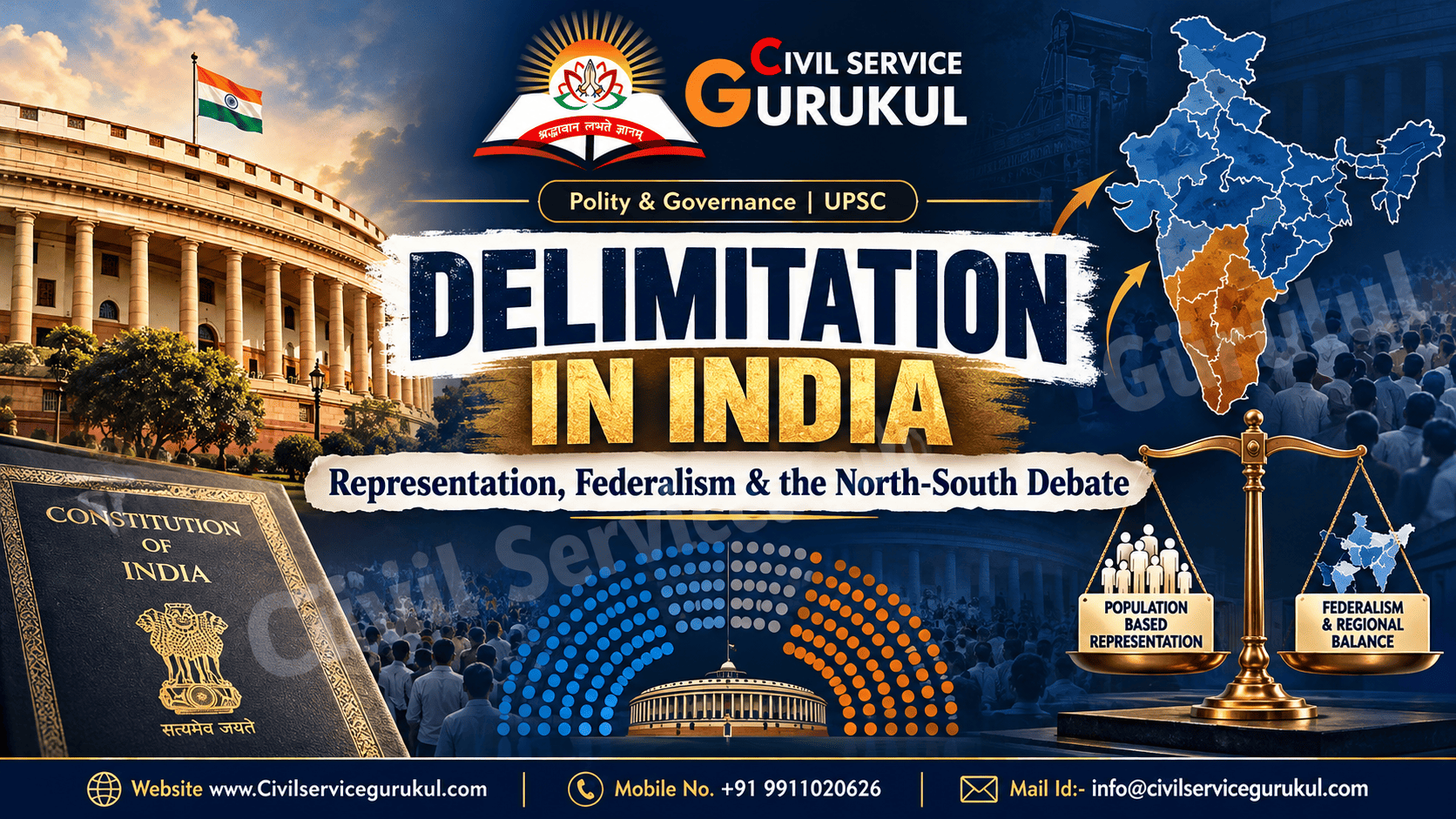
India's Delimitation Debate: Balancing Democratic Representation and Federalism After 2026
Constitutional Framework | Lok Sabha Representation | North–South Concerns | Judicial Review | Electoral Reforms
The debate over delimitation in India has revived an important constitutional question: How should a democracy balance equal representation based on population with fairness to states that have successfully controlled population growth? The answer will influence India's parliamentary representation, electoral governance and cooperative federalism.
Several southern states have raised concerns about a future population-based redistribution of Lok Sabha seats. Their argument is that states which successfully reduced fertility rates should not lose relative political influence because of their demographic achievements.
This debate is also connected to fiscal federalism, as population and demographic performance feature in Finance Commission devolution criteria. However, delimitation and tax devolution are legally distinct processes.
1. What is Delimitation?
Delimitation refers to the process of determining or redrawing the boundaries of electoral constituencies. In the Indian context, the broader delimitation framework also concerns the allocation and readjustment of seats among states, subject to constitutional and statutory provisions.
Its fundamental objective is to ensure that electoral representation reflects population distribution while preserving constitutional principles.
Who conducts delimitation?
The Delimitation Commission, sometimes called the Boundary Commission, is constituted under legislation enacted by Parliament.
The Commission performs its functions according to the applicable Delimitation Act, and its orders ordinarily have the force of law after publication.
The traditional institutional arrangement includes a judicial chairperson and election-related officials, with associated members from the legislatures concerned.
2. Historical Evolution of Delimitation in India
| Year | Legal Framework | Historical Importance |
|---|---|---|
| 1952 | Delimitation Commission Act, 1952 | Early post-independence delimitation |
| 1963 | Delimitation Commission Act, 1962 | Readjustment following demographic changes |
| 1973 | Delimitation Act, 1972 | Reorganization after the 1971 Census |
| 2002 | Delimitation Act, 2002 | Constituency boundary revision, ultimately based on the 2001 Census |
Special Case: Jammu and Kashmir
The delimitation exercise finalized in 2022 reorganized the Union Territory of Jammu and Kashmir into 90 elected Assembly constituencies:
- 43 constituencies in the Jammu region.
- 47 constituencies in the Kashmir region.
- Five parliamentary constituencies.
This was a separate exercise under the applicable legal framework following the Jammu and Kashmir Reorganisation Act, 2019.
3. Constitutional Provisions for Delimitation
The Constitution establishes the framework governing constituency allocation, representation and electoral boundaries.
| Article | Subject | UPSC Significance |
|---|---|---|
| Article 82 | Readjustment after each Census relating to Lok Sabha representation and constituencies, subject to constitutional restrictions. | Core provision for parliamentary delimitation. |
| Article 170 | Composition of State Legislative Assemblies and readjustment of constituencies. | State-level legislative representation. |
| Article 330 | Reservation of seats for Scheduled Castes and Scheduled Tribes in the Lok Sabha. | Political representation of historically disadvantaged groups. |
| Article 332 | Reservation of seats for Scheduled Castes and Scheduled Tribes in State Assemblies. | Inclusive democratic representation. |
| Article 327 | Parliamentary power to legislate on elections, including delimitation. | Legislative competence. |
| Article 329(a) | Restriction on judicial challenges to laws relating to delimitation and seat allocation. | Election law and judicial review. |
Articles 82 and 170 must be studied alongside the constitutional amendments that have postponed certain readjustments until figures from the first Census taken after 2026 become available.
Status of Delimitation Commission Orders
- Orders are published in the prescribed official gazettes.
- They acquire the force of law.
- They are placed before the Lok Sabha and the relevant State Legislative Assembly.
- The legislatures cannot modify the Commission's published orders through this laying procedure.
- The date of operation is determined according to the applicable statutory framework.
These orders enjoy strong legal finality, although the Supreme Court has clarified that a limited sphere of constitutional judicial review remains available.
4. Why is the Post-2026 Delimitation Debate Important?
The Constitutional Freeze
The 42nd Constitutional Amendment Act, 1976 froze important aspects of parliamentary seat redistribution using the 1971 Census as the benchmark.
The 84th Constitutional Amendment Act, 2001 extended the relevant freeze until population figures from the first Census taken after 2026 become available.
The 87th Constitutional Amendment Act, 2003 permitted readjustment of constituency boundaries using the 2001 Census without changing the allocation of Lok Sabha seats among states.
The expression "delimitation after 2026" does not mean that redistribution must automatically occur on 1 January 2027. The constitutional wording refers to figures from the first Census taken after 2026 being published, and any exercise must follow the applicable constitutional and statutory framework.
Why Are Southern States Concerned?
Many southern states have achieved comparatively lower fertility rates through investments in education, healthcare, women's empowerment and population stabilization.
A strictly population-based redistribution could increase the relative parliamentary weight of states with faster population growth.
The concern is therefore not merely electoral. It raises a larger debate over whether successful demographic policies should result in comparatively reduced political influence.
5. Important Supreme Court Judgments on Delimitation
A. Meghraj Kothari v. Delimitation Commission (1966)
The Supreme Court emphasized the finality of properly published delimitation orders and the importance of preventing continuous litigation from obstructing elections.
The principle reflects the need for certainty and timely election administration.
B. Kishorchandra Chhanganlal Rathod v. Union of India (2024)
The Supreme Court clarified that the constitutional restriction on judicial interference does not create absolute immunity for every action of a Delimitation Commission.
Constitutional courts can examine orders in the limited circumstances recognized by law, including where an order is manifestly arbitrary and inconsistent with constitutional values.
Finality of delimitation orders does not mean complete exclusion of constitutional judicial review.
The courts must nevertheless exercise restraint so that electoral processes are not unnecessarily disrupted.
This distinction is especially relevant for UPSC questions involving Articles 226, 329 and the rule of law.
6. Significance of Delimitation in a Democracy
1. Political Equality
Delimitation seeks to advance the democratic principle of "one person, one vote, one value" by limiting unreasonable population differences between constituencies.
2. Constitutional Representation
It operationalizes the constitutional requirement to reassess legislative representation according to demographic realities, subject to the constitutional freeze.
3. Reduction of Malapportionment
When population shifts are not reflected in constituency arrangements, some representatives may serve substantially more people than others.
4. Protection Against Gerrymandering
Transparent and objective boundary-setting can reduce opportunities to manipulate constituencies for partisan advantage.
5. Federal Balance
The distribution of Lok Sabha seats affects each state's influence over national legislation and government formation.
6. Effective Public Representation
Well-designed constituencies can support accessibility, constituent engagement and responsiveness to local public needs.
7. Major Challenges of Delimitation in India
A. Federal Imbalance
Population-based allocation may increase the representation of faster-growing states, including Uttar Pradesh and Bihar, while reducing the relative influence of states with slower population growth.
This creates a tension between numerical equality of citizens and equality of influence among states within India's federal structure.
B. Population Control and Fairness
States with lower fertility rates argue that successful population stabilization should not lead to political disadvantages.
C. Representation of SCs and STs
Reserved constituencies must be determined in accordance with constitutional provisions and relevant population patterns. Fair placement and representation remain important administrative considerations.
D. Public Consultation and Trust
Although the delimitation framework provides procedures for publication and consideration of objections, the quality, accessibility and transparency of participation can be improved.
E. Changing Demographic Patterns
Migration, urbanization and uneven regional growth may create significant differences in the population represented by individual elected members.
F. Administrative and Political Disruption
Redrawing constituencies can require substantial adjustment in electoral administration, political organization and public understanding of constituency boundaries.
Should political power depend exclusively on population, or should India also recognize demographic performance, regional diversity and the stability of its federal structure?
8. International Practices: Comparative Analysis
| System | Approach | Lesson for India |
|---|---|---|
| European Union | Degressive proportionality gives smaller member states proportionately greater representation in the European Parliament. | Population need not be the sole determinant where constituent units require protection. |
| United States | The House of Representatives has 435 voting seats, apportioned among states following each decennial Census through the method of equal proportions. | Periodic redistribution can occur without continuously expanding the size of the legislative chamber. |
| India | Parliamentary representation operates within constitutional rules governing readjustment and the post-2026 Census trigger. | India must reconcile population equality with its own constitutional and federal needs. |
Analytical insight: International examples offer useful institutional design ideas, but India cannot directly import a foreign formula without considering its Constitution, state structure and democratic requirements.
9. Finance Commission and Fiscal Federalism
The debate on parliamentary delimitation is frequently linked to Finance Commission transfers because both involve the relationship between population, state performance and federal equity.
However, the allocation of Lok Sabha seats and the allocation of tax revenue are separate constitutional questions.
Important Fiscal Devolution Criteria
- Income Distance: Helps address differences in fiscal capacity among states.
- Population: Recognizes differences in expenditure needs associated with population size.
- Demographic Performance: Can recognize improvements in population stabilization.
- Area and Other Indicators: Reflect geographic and developmental needs, depending on the Finance Commission's recommended formula.
Population from the 1971 Census and the 2011 Census has featured differently across Finance Commission methodologies. The specific criteria and weights should always be examined with reference to the relevant Commission.
Delimitation concerns the distribution of political representation, whereas Finance Commission devolution concerns the distribution of fiscal resources.
Both should be evaluated through the lenses of constitutional equity, demographic changes and cooperative federalism.
10. Way Forward: A Balanced Delimitation Framework
1. Consider Demographic Performance
Policymakers may evaluate formulas that take fertility reduction and population stabilization into account. Any TFR-adjusted mechanism is a policy proposal, not an existing constitutional seat-allocation formula.
2. Strengthen Public Consultation
Detailed proposals, accessible constituency maps, transparent objections and meaningful hearings can strengthen procedural legitimacy.
3. Protect Constitutional Equality
Any reform must carefully consider the balance between approximately equal representation of citizens and legitimate concerns about state-level fairness.
4. Ensure Evidence-Based Delimitation
Reliable Census information, migration trends, settlement patterns and administrative data should inform boundary decisions.
5. Improve Representation of Vulnerable Groups
Boundary design and reservation arrangements should respect relevant constitutional requirements and accurately reflect demographic patterns.
6. Maintain Administrative Practicality
Constituencies should, where possible, preserve geographical continuity, accessibility and recognizable community relationships.
7. Build Federal Consensus
Consultation between the Union and states can reduce political tensions and improve confidence in future reforms.
8. Coordinate Political and Fiscal Reforms
Delimitation and tax devolution must remain constitutionally distinct, but policymakers should evaluate their combined consequences for federal stability.
India needs a credible institutional solution combining democratic equality, population realities, demographic achievements and cooperative federalism.
11. UPSC Prelims and Mains Preparation
Prelims: Important Facts to Remember
| Topic | Key Fact |
|---|---|
| Article 82 | Parliamentary readjustment after Census |
| Article 170 | State Assembly readjustment |
| Article 329(a) | Restriction on judicial interference with delimitation laws |
| 84th Amendment | Extended the relevant freeze until the first post-2026 Census figures |
| 87th Amendment | Enabled use of the 2001 Census for constituency readjustment |
| 2002 | Latest nationwide Delimitation Commission constituted |
| 2024 judgment | Limited constitutional review of delimitation orders remains possible |
UPSC Prelims Practice Question 1
Consider the following statements:
- Article 82 deals with readjustment of parliamentary constituencies after the Census.
- Article 170 deals with the composition and readjustment of State Legislative Assembly constituencies.
- Every order of a Delimitation Commission is completely immune from constitutional judicial review.
Which of the statements given above are correct?
(a) 1 and 2 only
(b) 2 and 3 only
(c) 1 and 3 only
(d) 1, 2 and 3
View Answer and Explanation
Correct Answer: (a) 1 and 2 only.
Statement 3 is incorrect. The Supreme Court's 2024 ruling recognizes a limited sphere of constitutional judicial review in delimitation matters.
UPSC Prelims Practice Question 2
Which of the following best explains degressive proportionality?
(a) All states receive equal seats regardless of population.
(b) Larger constituent units have more seats but fewer seats per person than smaller units.
(c) Seats are determined exclusively by economic output.
(d) Parliamentary seats change automatically every year.
View Answer and Explanation
Correct Answer: (b).
Degressive proportionality provides representation that increases with population, but less than proportionately.
UPSC Mains GS-II Practice Questions
Question 1 — 150 Words
"Delimitation in India represents a tension between political equality and federal equity." Examine.
Question 2 — 250 Words
Discuss the constitutional framework governing delimitation in India. Evaluate the potential implications of population-based redistribution of Lok Sabha seats for cooperative federalism.
Mains Answer-Writing Framework
Define delimitation and briefly identify the constitutional provisions and demographic debate.
Body- Explain Articles 82, 170 and the constitutional freeze.
- Discuss democratic equality and proportional representation.
- Analyze the North–South demographic concerns.
- Include the Supreme Court's position on judicial review.
- Examine international practices and possible reforms.
Recommend evidence-based, transparent and constitutionally sound reform that accommodates both representation and federal stability.
Keywords for High-Scoring Mains Answers
12. Frequently Asked Questions
What is delimitation in India?
Delimitation is the process of determining electoral constituency boundaries and related representation arrangements under the Constitution and applicable laws.
Which constitutional articles govern delimitation?
Articles 82 and 170 are central, while Articles 327, 329, 330 and 332 are also relevant to the broader legal framework.
Will delimitation automatically take place in 2027?
No. The constitutional framework refers to population figures from the first Census taken after 2026, and implementation depends on the relevant legal arrangements.
Why are southern states concerned about delimitation?
They are concerned that a primarily population-based redistribution may reduce their relative parliamentary influence despite comparatively successful population stabilization.
Can Delimitation Commission orders be challenged?
Such orders enjoy strong legal finality. However, the Supreme Court clarified in 2024 that limited constitutional judicial review is not entirely excluded.
How is the Finance Commission debate different?
Delimitation concerns electoral representation, while Finance Commission transfers concern financial distribution between governments. Their criteria and constitutional functions differ.
13. Conclusion: Representation with Federal Fairness
India's delimitation debate reflects a deeper question about the meaning of equality in a large and diverse federal democracy.
A legitimate electoral system must respect population-based representation while remaining attentive to regional diversity, democratic stability and the consequences of demographic transitions.
The most sustainable way forward is a transparent, consultative and evidence-based process that strengthens public trust and operates within constitutional boundaries.
India's future delimitation framework should strive to reconcile the principle of equal political representation with the constitutional values of federalism, inclusiveness and democratic accountability.
Prepare with Mentors Who Cleared the Exam
Get personalized study plans, evaluated answer models, and test series access.