
India Exports Rise 23.04% in September 2026 | UPSC Notes
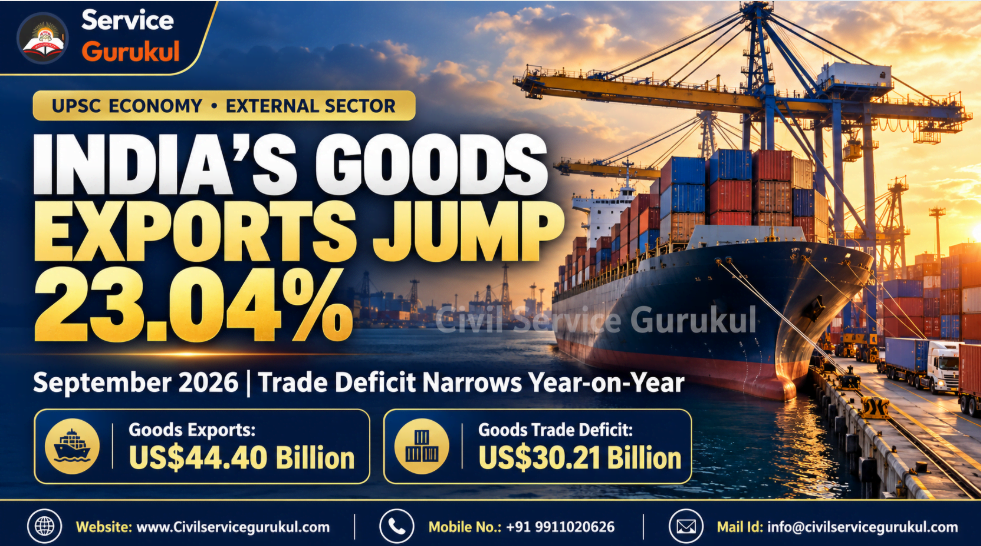
India’s Goods Exports Jump 23.04% in September 2026: Trade Deficit and UPSC Analysis
Excerpt / Brief Summary: India’s merchandise exports increased sharply in September 2026, helping narrow the goods trade deficit compared with the same month a year earlier. For UPSC aspirants, the development illustrates the importance of distinguishing goods from services, annual comparisons from monthly movements, and the trade balance from the current account.
UPSC Relevance: Prelims — Indian Economy and External Sector; GS Paper III — Economic Growth, Industrial Development and Effects of Liberalisation; GS Paper II — Economic Dimensions of International Relations.
1. Why Is This in the News?
Trade figures released on 15 October 2026 showed that India’s merchandise exports rose 23.04% year-on-year to US$44.40 billion in September 2026. Goods imports increased by approximately 8% to US$74.61 billion.
The merchandise trade deficit consequently narrowed to US$30.21 billion, compared with US$33.00 billion in September 2025. However, it was wider than the US$26.86 billion deficit recorded in August 2026.
Read the comparison carefully: The deficit narrowed year-on-year but widened month-on-month. Both statements can be correct because they use different comparison periods.
2. September Trade Figures at a Glance
All values below are in US$ billion.
| Indicator | September 2026 | September 2025 |
|---|---|---|
| Goods exports | 44.40 | 36.08 |
| Goods imports | 74.61 | 69.08 |
| Goods trade deficit | 30.21 | 33.00 |
| Combined goods and services exports | 80.75 | 72.76 |
| Combined goods and services imports | 94.05 | 86.93 |
| Combined trade deficit | 13.30 | 14.17 |
Data note: September 2026 services figures were estimates at the time of release because the latest available RBI services data covered August. Combined totals are therefore subject to revision.
3. Which Sectors Supported Export Growth?
Reported contributors included electronic goods, petroleum products, engineering goods, chemicals and agricultural products.
For economic analysis, sectoral growth should be examined alongside export volumes, prices and domestic value addition. A rise in dollar earnings alone does not reveal how much additional production occurred within India.
Electronics and Manufacturing
Expanding electronics exports can create opportunities for component suppliers, logistics providers and skilled workers. The development benefit depends partly on how extensively domestic firms participate in the production chain.
Petroleum Products
Refined-product export earnings are influenced by international prices, shipment volumes and refining margins. Since refining can use imported crude, gross export receipts should be distinguished from domestic value addition.
Engineering, Chemicals and Agriculture
These sectors have different production structures and market requirements. Assessing their performance requires attention to product quality, input costs, standards compliance and the reliability of market access.
4. How Can a Deficit Narrow While Imports Rise?
A trade deficit depends on the difference between imports and exports. It can shrink even when imports increase, provided exports increase by a larger absolute amount.
Using the rounded reported figures:
- Increase in exports: 44.40 − 36.08 = US$8.32 billion.
- Increase in imports: 74.61 − 69.08 = US$5.53 billion.
- Reduction in the deficit: 8.32 − 5.53 = US$2.79 billion.
Exam insight: Comparing growth percentages alone can be misleading when exports and imports begin from different base values.
5. Merchandise Trade, Services Trade and the Current Account
Merchandise Trade Balance
This is the difference between exports and imports of physical goods. A negative balance represents a merchandise trade deficit.
Services Trade Balance
Services trade covers transactions such as software services, transport, travel and business services. A services surplus can offset part of a goods deficit.
Current Account Balance
The current account includes goods, services, primary income and secondary income. Primary income includes items such as investment income, while secondary income includes personal transfers such as remittances.
Therefore, neither the merchandise deficit nor the combined goods-and-services deficit should automatically be described as the current account deficit. Official balance-of-payments compilation also involves relevant statistical adjustments.
6. Economic Significance: What the Figures Can Indicate
The following are analytical implications rather than outcomes established by one month’s trade data.
- Production and employment: Sustained growth in export volumes can support production, investment and employment in exporting industries.
- Foreign-exchange receipts: Export earnings help meet external payment requirements, although the net impact also depends on imports and other flows.
- Supplier opportunities: Export expansion can benefit smaller enterprises when they participate in domestic supply networks.
- External resilience: A smaller trade gap may ease one source of external financing pressure, holding other factors constant.
- Diversification: A broader mix of products and destinations can reduce dependence on a narrow set of markets.
7. Why a Trade Deficit Is Not Automatically Harmful
The composition and financing of a deficit matter. Imports of machinery, technology and intermediate inputs may strengthen productive capacity and support future exports.
Conversely, persistent external imbalances can create vulnerabilities if they are financed through unstable flows or accompanied by weak export capacity. Analysis should consider sustainability rather than treating every increase in imports as an economic setback.
8. Important Limitations When Reading Export Headlines
Nominal Values Versus Physical Volumes
Export values can rise because of higher prices, larger shipment volumes, or a change in the product mix. Value growth does not establish an equivalent increase in real output.
Base Effects
A weak comparison month can produce a high annual growth rate. Multi-month trends provide a stronger basis for assessing momentum.
Gross Exports Versus Domestic Value Addition
A product may contain imported components. The export’s full sale value is not necessarily equal to the income generated domestically.
Exchange-Rate Effects
Currency depreciation can improve price competitiveness for some exporters while increasing the cost of imported inputs. Its net effect depends on production structures, contracts and demand.
Monthly Volatility and Revisions
Shipment timing can affect monthly figures. Initial estimates and subsequent revisions also need to be distinguished.
9. Policy Priorities for Sustained Export Competitiveness
A durable export strategy should focus on productivity and reliable participation in international markets. Relevant policy priorities include:
- Improve logistics: Reduce delays and uncertainty in transport, ports and customs processes.
- Develop domestic supplier networks: Help firms meet the quality, scale and delivery requirements of export production.
- Strengthen standards infrastructure: Expand access to testing, certification and quality assurance.
- Support smaller exporters: Improve access to working capital, market information and risk-management tools.
- Diversify markets: Reduce exposure to disruptions affecting a single destination or product category.
- Invest in capabilities: Promote skills, technology, design and innovation that strengthen long-term competitiveness.
10. UPSC Prelims: Key Takeaways
- Merchandise trade concerns physical goods.
- A trade balance equals exports minus imports.
- A deficit can narrow even when imports increase.
- Year-on-year and month-on-month movements can differ.
- A services surplus can partially offset a merchandise deficit.
- The current account includes more than goods and services.
- Export value growth is different from export volume growth.
11. UPSC Mains Practice Question
Question: “Strong export growth can support economic resilience, but headline trade figures alone do not establish external-sector sustainability.” Discuss with reference to India’s September 2026 trade performance. (250 words)
Suggested Answer Framework
Introduction: Briefly describe the export increase and identify the relevant comparison period for the deficit.
Body: Explain possible benefits for production and foreign-exchange receipts. Distinguish nominal growth from volumes, gross exports from domestic value addition, and the merchandise balance from the current account. Discuss import composition and external financing.
Conclusion: Emphasise productivity, diversification and domestic capabilities as foundations of sustained competitiveness.
12. Frequently Asked Questions
What does the 23.04% figure measure?
It measures year-on-year growth in merchandise export value for September 2026, rather than growth in all exports or physical export volumes.
Why can reports say the deficit both narrowed and widened?
They may use different comparison periods. September’s goods deficit was smaller than a year earlier but larger than in August 2026.
Does stronger export growth automatically strengthen the rupee?
No. Exchange rates also respond to imports, capital flows, interest-rate expectations, global financial conditions and other influences.
Does a smaller goods deficit guarantee a smaller current account deficit?
No. Changes in services, income flows and transfers can alter the current account outcome.
Conclusion
September’s export performance provides a useful case study in external-sector analysis. A sound assessment combines the headline growth rate with evidence on volumes, value addition, import composition and trends over time. For India, the policy objective is sustained competitiveness that translates international sales into productive capacity and domestic incomes.
SEO Tags: India Exports September 2026, Merchandise Exports, India Trade Deficit, UPSC Economy, External Sector, Balance of Payments, Current Account, Services Trade, Civil Service Gurukul
Prepare with Mentors Who Cleared the Exam
Get personalized study plans, evaluated answer models, and test series access.