
Greenland Dispute 2026: US, NATO & Arctic Geopolitics | UPSC
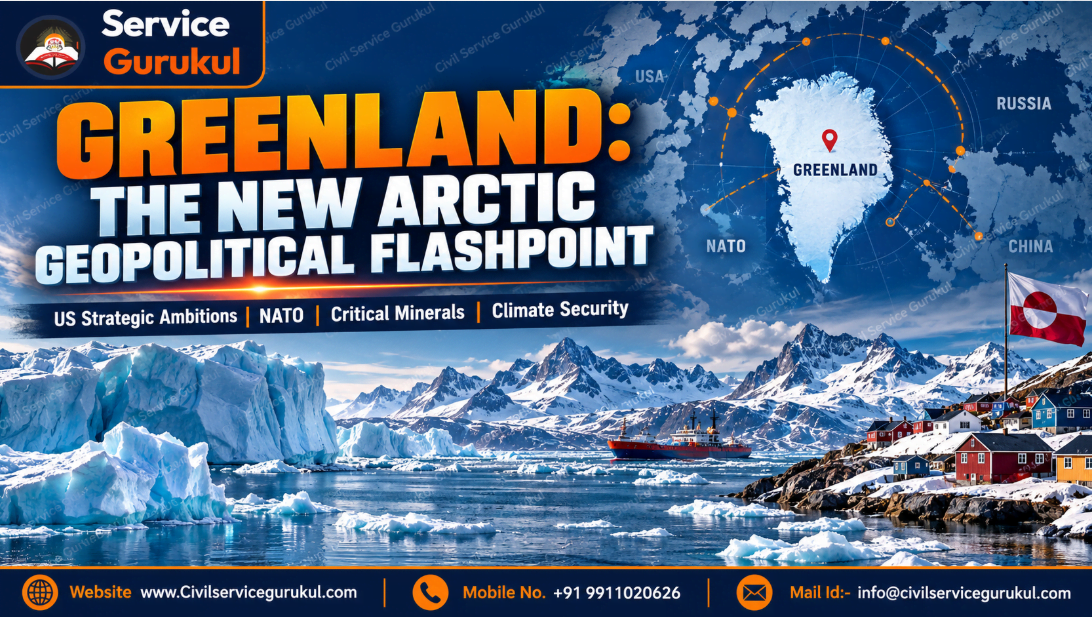
Greenland: The Arctic Island Reshaping US Strategy, NATO Security and Global Geopolitics
From missile defence and rare earth minerals to the changing Arctic climate, Greenland has become an important test of sovereignty, strategic competition and international cooperation.
1. Why Is Greenland in the News?
Greenland, the world's largest island, has become a major geopolitical flashpoint following renewed American interest in expanding its strategic influence over the Arctic territory.
In January 2026, US President Donald Trump threatened additional tariffs against several European countries that opposed his efforts to acquire Greenland. On 21 January, following discussions with NATO Secretary-General Mark Rutte in Davos, the United States withdrew the proposed tariffs and announced that a framework for future cooperation had been discussed.
The dispute entered a new phase on 22 September 2026, when the United States, Denmark and Greenland signed a trilateral Arctic security agreement.
The agreement expands American military access to Greenland, strengthens its role in Arctic security and establishes additional safeguards regarding certain foreign military activities and sensitive investments.
Crucially, it does not make Greenland American territory. Danish sovereignty and Greenlandic self-determination remain central to the arrangement.
Timeline of Major Developments
2. Greenland: Geographical and Political Background
Greenland lies between the Arctic Ocean and the North Atlantic Ocean, northeast of North America. Geographically, it is part of North America; politically, it is a self-governing territory within the Kingdom of Denmark.
| Feature | Important Information |
|---|---|
| Political status | Self-governing territory within the Kingdom of Denmark |
| Capital | Nuuk |
| Location | Between the Arctic Ocean and North Atlantic Ocean |
| Geographical identity | World's largest island, excluding Australia, which is generally classified as a continent |
| Population | Approximately 57,000 people |
| Major indigenous population | Greenlandic Inuit |
| Political framework | Extensive self-government under the 2009 Self-Government Act |
| Defence and foreign affairs | Shared constitutional framework within the Danish Realm, with Denmark retaining major responsibilities |
| Strategic US installation | Pituffik Space Base |
Greenland is not an independent sovereign state and is not a US territory. It has substantial autonomy within the Danish Realm. Its people possess a recognised right to self-determination.
3. Why Is Greenland Strategically Important to the United States?
Geostrategic Position
Greenland occupies a critical location between North America, Europe and the Arctic. Its position makes it valuable for monitoring transatlantic and polar approaches.
Missile Early Warning
Pituffik Space Base supports missile warning, space surveillance and broader North American defence capabilities.
Critical Minerals
Greenland possesses substantial rare earth mineral potential, which could support diversification of global supply chains.
Arctic Power Competition
Reduced sea ice and increased Arctic activity have raised the strategic importance of maritime surveillance, infrastructure and the regional military balance.
A. The GIUK Gap
The Greenland–Iceland–United Kingdom Gap, commonly known as the GIUK Gap, is a strategically important maritime corridor connecting the Norwegian and Arctic seas with the wider North Atlantic.
During the Cold War, this region was central to NATO's monitoring of Soviet naval movements, particularly submarines. It remains relevant to transatlantic maritime security.
B. Pituffik Space Base and Missile Defence
Formerly known as Thule Air Base, Pituffik Space Base supports the United States' missile-warning and space-surveillance missions. Its Arctic location makes it valuable for detecting threats travelling over high northern latitudes.
The proposed American Golden Dome missile-defence architecture has also featured in discussions about Arctic security. The initiative envisages a multilayered defence system involving ground-based and potentially space-based components.
However, proposals concerning specific deployments should not be confused with systems already operating at the base.
C. Competition Involving Russia and China
Russia maintains extensive military capabilities and infrastructure across its Arctic territory. China, although not an Arctic coastal state, has developed growing scientific, commercial and strategic interests in the region.
From Washington's perspective, stronger cooperation with Greenland and Denmark can help limit hostile military access, improve maritime domain awareness and protect sensitive infrastructure.
4. Greenland's Natural Resources: The Economic Dimension
A. Rare Earth Elements
Greenland contains significant deposits of rare earth elements, a group of minerals important for advanced manufacturing, renewable energy technologies and defence applications.
Important deposits in southern Greenland include Kuannersuit (Kvanefjeld) and Kringlerne (Tanbreez).
Rare earth elements are used in:
- Permanent magnets for electric vehicles and wind turbines.
- Advanced electronics and industrial machinery.
- Military technologies, radar systems and aerospace equipment.
- Selected clean-energy and high-technology applications.
The existence of mineral resources does not automatically make extraction commercially viable. Remote infrastructure, harsh weather, environmental regulations, financing requirements and Greenlandic political decisions influence actual production.
China is particularly dominant in several stages of rare earth processing and magnet manufacturing. Greenland's resources could contribute to supply-chain diversification, but cannot independently eliminate global dependence on China.
B. Uranium and Environmental Challenges
Some rare earth deposits, particularly Kvanefjeld, are associated with uranium-bearing minerals. This has created debates over mining safety, environmental protection and radioactive waste management.
Mining projects must operate within Greenland's laws, environmental requirements and political decision-making processes.
C. Oil and Natural Gas
The wider Arctic is considered a potentially important hydrocarbon region. However, Greenland has not established large-scale commercial oil and gas production.
Resource estimates should be distinguished from proved, economically recoverable reserves.
In addition, Greenland's government decided in 2021 to stop issuing new oil and gas exploration licences, reflecting environmental and economic concerns. Any future development must be assessed against the applicable regulatory framework.
5. Greenland and Global Climate Change
Greenland plays a central role in Earth's climate system because it contains one of the planet's two major continental ice sheets, alongside Antarctica.
A. The Ice-Albedo Feedback
The term albedo describes the proportion of incoming solar radiation reflected by a surface.
Snow and ice possess relatively high albedo, while exposed land and open ocean absorb more solar energy.
Rising temperatures → melting snow and ice → lower surface reflectivity → greater solar absorption → additional regional warming.
This is an important example of positive climate feedback.
B. Sea-Level Rise
Greenland's ice sheet stores enough frozen water to raise global mean sea level by approximately 7.4 metres if it melted completely. Such a complete loss would occur over a very long timescale, not as an immediate outcome of present-day warming.
Its ongoing ice loss nevertheless contributes to current global sea-level rise, threatening low-lying coastal settlements, ports, infrastructure and ecosystems.
C. The Difference Between Sea Ice and Land Ice
| Arctic Sea Ice | Greenland Ice Sheet |
|---|---|
| Floating frozen seawater | Ice resting on land |
| Direct melting has little effect on sea level | Loss of land ice adds water to oceans and raises sea level |
| Important for albedo and ocean-atmosphere interactions | Important for sea-level rise and freshwater input into the North Atlantic |
D. Climate Archives
Scientists extract ice cores from Greenland's ice sheet to examine past temperature conditions, atmospheric composition, snowfall and volcanic events.
Trapped air bubbles and chemical signals preserved in the ice provide valuable evidence about historical climate variability.
E. Implications for Ocean Circulation
Freshwater released by Greenland's melting ice can alter North Atlantic salinity and density patterns. This is relevant to scientific investigations of the Atlantic Meridional Overturning Circulation (AMOC).
Changes in AMOC could affect regional temperatures, rainfall and marine ecosystems, although the precise timing and magnitude of future changes remain uncertain.
6. Denmark, Greenland and NATO: The Sovereignty Question
A. Denmark's Position
Denmark has consistently opposed any forced transfer of Greenland to another country. It supports cooperation on security while maintaining the constitutional position of the Danish Realm.
B. Greenland's Position
Greenlandic leaders have stressed that decisions affecting the island must involve Greenland's own democratic institutions and people.
The principle of self-determination is especially important because Greenland has a predominantly Inuit population and a history of colonial administration.
C. NATO and Article 5
Article 5 of the North Atlantic Treaty provides for collective defence when an armed attack occurs against a member within the treaty's applicable geographical scope.
However, describing Article 5 as an automatic solution to a hypothetical military confrontation between NATO members would be misleading. Such a situation would raise difficult legal and political questions.
The dispute demonstrated that strategic disagreements within an alliance can weaken mutual trust even when its members share common security interests.
D. Arctic Military Cooperation
NATO members have discussed stronger Arctic surveillance, greater interoperability and improved monitoring of submarine activity.
Proposals for expanded basing arrangements must be distinguished from the terms of agreements that have actually been signed. The September 2026 trilateral arrangement represents an important development in this context.
7. International Law and the Greenland Dispute
The dispute brings several principles of international law into focus.
- Sovereign equality: States possess equal legal standing under the UN Charter.
- Territorial integrity: The use of force against another state's territorial integrity is generally prohibited.
- Self-determination: Peoples have a recognised right to determine their political future in accordance with applicable international law.
- Peaceful settlement: International disputes should be resolved through peaceful means.
- Law of the Sea: Maritime rights and obligations in Arctic waters are governed substantially by international maritime law.
These principles explain why Greenland cannot simply be treated as an uninhabited strategic asset available for acquisition.
The 'Donroe Doctrine' Debate
Some commentators have used the term Donroe Doctrine to describe an assertive interpretation of American predominance in the Western Hemisphere, combining Donald Trump's approach with a reference to the historical Monroe Doctrine.
This is a political label rather than a formally established principle of international law.
8. The Arctic Council: An Important UPSC Topic
The Arctic Council is a high-level intergovernmental forum established through the Ottawa Declaration in 1996.
It promotes cooperation among Arctic states, especially on sustainable development and environmental protection, with the involvement of Arctic Indigenous communities.
| Feature | Details |
|---|---|
| Established | 1996 |
| Founding declaration | Ottawa Declaration |
| Members | Canada, Denmark, Finland, Iceland, Norway, Russia, Sweden and United States |
| India's position | Observer state |
| Principal focus | Arctic cooperation, environment and sustainable development |
| Military security | Outside the Council's formal mandate |
9. Why Does Greenland Matter to India?
Although India is not an Arctic coastal country, developments in Greenland and the wider Arctic can affect India's climate, economy and strategic interests.
A. India's Arctic Policy
India released its Arctic Policy in 2022, highlighting scientific research, climate protection, economic cooperation, connectivity, governance and national capacity building.
B. Climate and the Indian Monsoon
Arctic warming can influence large-scale atmospheric and oceanic circulation. Researchers continue to study its possible effects on Indian monsoon variability and extreme weather.
However, individual extreme weather events should not be attributed solely to Arctic warming without specific scientific evidence.
C. Critical Mineral Security
India's clean-energy transition and advanced manufacturing sectors require reliable supplies of critical minerals. Potential Arctic mineral development could contribute to broader international supply-chain diversification.
D. Shipping and Connectivity
Changes in seasonal Arctic sea ice may alter the commercial attractiveness of northern shipping routes. But navigational risks, infrastructure gaps, insurance costs and environmental challenges remain substantial.
E. Strategic Autonomy
India has interests in scientific cooperation with Arctic countries, stable trade networks and peaceful management of great-power competition.
A balanced Arctic engagement supports India's wider goal of maintaining constructive relationships with multiple international partners.
10. Challenges and the Way Forward
Respect Territorial Sovereignty
Security arrangements must recognise Denmark's legal position and Greenland's self-government and right to self-determination.
Strengthen Arctic Diplomacy
Dialogue among allies and Arctic stakeholders can reduce misperceptions and prevent military escalation.
Protect Fragile Ecosystems
Mining, shipping and infrastructure should be subject to meaningful environmental safeguards.
Support Indigenous Participation
Greenlandic communities must have a meaningful role in decisions affecting their land, resources and livelihoods.
A stable Arctic security framework should reconcile legitimate defence concerns with international law, democratic participation and environmental sustainability.
11. UPSC Prelims: Quick Revision Notes
- Greenland is the world's largest island.
- Its capital is Nuuk.
- It is a self-governing territory within the Kingdom of Denmark.
- It is geographically associated with North America.
- The GIUK Gap is important for North Atlantic naval surveillance.
- Pituffik Space Base is an important US missile-warning installation.
- Rare earth deposits include Kvanefjeld and Kringlerne.
- Greenland's continental ice sheet contributes to sea-level rise when it loses ice.
- The Arctic Council was established in 1996.
- India is an observer in the Arctic Council.
- NATO and the Arctic Council are different institutions.
- The September 2026 security agreement did not transfer Greenland's sovereignty to the US.
12. UPSC Previous Year Questions: Mains
The following are actual UPSC Civil Services Mains questions related to the geographical and environmental themes covered in this article. The answer outlines are original study material. Mains questions are descriptive and therefore have no option letters.
PYQ 1. How do the melting of the Arctic ice and glaciers of the Antarctic differently affect the weather patterns and human activities on the Earth? Explain.
The Arctic consists largely of an ocean surrounded by continents, while Antarctica is a landmass covered by a massive ice sheet.
Arctic sea-ice loss reduces surface albedo, amplifying regional warming and influencing atmospheric and oceanic systems. It can also increase seasonal maritime accessibility.
Antarctic land-ice loss contributes directly to global sea-level rise. It also changes freshwater input into the Southern Ocean and may influence ocean circulation.
Greenland illustrates the significance of land ice within the Arctic region: its melting contributes directly to rising sea levels.
PYQ 2. Discuss the multi-dimensional implications of uneven distribution of mineral oil in the world.
Petroleum resources are distributed unevenly because their formation depends on suitable geological conditions over millions of years.
This uneven distribution shapes energy trade, industrial development, geopolitical alliances, maritime security and global price vulnerability.
Countries with substantial production capacity may gain revenue and geopolitical influence, while import-dependent economies face external price and supply risks.
Arctic hydrocarbon potential adds another strategic dimension, but commercial viability, environmental concerns and regulatory restrictions limit development.
PYQ 3. What do you understand by the theory of 'continental drift'? Discuss the prominent evidences in its support.
Alfred Wegener proposed that today's continents were once joined in the supercontinent Pangaea and subsequently moved apart.
Supporting evidence includes the approximate fit of continental margins, corresponding geological formations, similar fossils across separated continents and evidence of ancient climatic conditions.
Modern plate tectonics provides the accepted physical explanation for large-scale continental movement. Greenland's position within the North American tectonic setting makes it relevant to studying North Atlantic geological history.
13. UPSC Prelims-Style Practice MCQs
Question 1. Consider the following statements about Greenland:
1. Greenland is geographically part of North America.
2. Greenland is a sovereign member state of the European Union.
3. Greenland exercises extensive self-government within the Kingdom of Denmark.
Which of the statements given above are correct?
- 1 and 2 only
- 1 and 3 only
- 2 and 3 only
- 1, 2 and 3
Greenland is geographically part of North America and is a self-governing territory within the Kingdom of Denmark. It is not a sovereign EU member state. Greenland left the European Economic Community in 1985.
Question 2. Consider the following statements about the GIUK Gap:
1. It is associated with Greenland, Iceland and the United Kingdom.
2. It is strategically important for tracking naval and submarine movements.
3. It is a formal military organisation established under the Arctic Council.
Which of the statements given above are correct?
- 1 only
- 2 and 3 only
- 1 and 2 only
- 1, 2 and 3
The GIUK Gap is a strategic maritime corridor linking the northern seas with the North Atlantic. It is important for maritime surveillance, particularly submarine monitoring. It is neither an organisation nor a body created by the Arctic Council.
Question 3. With reference to the Arctic Council, consider the following statements:
1. It was established through the Ottawa Declaration in 1996.
2. India is one of its eight member states.
3. Military security is outside its formal mandate.
Which of the statements given above are correct?
- 1 and 3 only
- 1 and 2 only
- 2 and 3 only
- 1, 2 and 3
The Arctic Council was established in 1996. Its eight members are Arctic states. India participates as an observer, not as a member state. The Council addresses environmental protection, sustainable development and cooperation, while military security falls outside its mandate.
Question 4. Consider the following statements:
1. Melting floating sea ice directly causes a large rise in global sea level.
2. Melting land-based ice on Greenland contributes to sea-level rise.
3. Loss of ice cover can reduce surface albedo and amplify warming.
Which of the statements given above are correct?
- 1 and 2 only
- 2 and 3 only
- 1 and 3 only
- 1, 2 and 3
Floating sea ice already displaces seawater, so its direct melting has little effect on sea level. In contrast, melting of land-based ice adds water to the oceans. Loss of reflective ice and snow also lowers albedo, causing additional warming.
14. Potential UPSC Mains Questions for 2027
"The Greenland dispute highlights the tension between national security interests and the principles of sovereignty and self-determination." Critically examine. (250 words)
Discuss how Arctic climate change is transforming global resource competition, maritime connectivity and strategic security. (250 words)
Evaluate the significance of India's Arctic Policy in the context of climate science, strategic autonomy and emerging critical mineral supply chains. (150 words)
15. Conclusion: Greenland and the Future of Arctic Governance
The Greenland dispute demonstrates that the Arctic is no longer viewed simply as a remote polar region. It has become a significant arena of strategic competition, critical resource interests and climate-related risks.
Greenland's geographical position gives it importance for military surveillance and transatlantic security. Its mineral deposits attract economic interest, while its ice sheet is essential to understanding global climate change and sea-level rise.
The September 2026 trilateral security agreement illustrates how negotiated arrangements can address defence concerns without necessarily changing territorial sovereignty.
For the international community, the central challenge is to ensure that Arctic cooperation protects security, the environment, Indigenous rights and the principle of peaceful dispute settlement.
Greenland should be studied through five connected dimensions: geography, great-power competition, critical minerals, international law and climate change. Together, these themes make it an important interdisciplinary topic for UPSC Prelims and Mains.
Frequently Asked Questions
Why does the United States consider Greenland strategically important?
Greenland supports North American missile warning, occupies a valuable location near transatlantic maritime routes and possesses significant critical mineral potential.
Is Greenland part of the United States?
No. Greenland remains a self-governing territory within the Kingdom of Denmark. The 2026 defence agreement did not transfer its sovereignty.
What is the GIUK Gap?
The Greenland-Iceland-United Kingdom Gap is a strategic maritime corridor important for North Atlantic naval surveillance.
Why is Greenland important for climate change?
Its continental ice sheet contributes to global sea-level rise as it melts. Ice loss also affects surface reflectivity, freshwater supply and regional climate processes.
Is India a member of the Arctic Council?
India is an observer state. The Arctic Council has eight Arctic member states.
UPSC Syllabus Relevance
Prepare with Mentors Who Cleared the Exam
Get personalized study plans, evaluated answer models, and test series access.