GM Crops & CRISPR in India 2026: GEAC and UPSC Notes
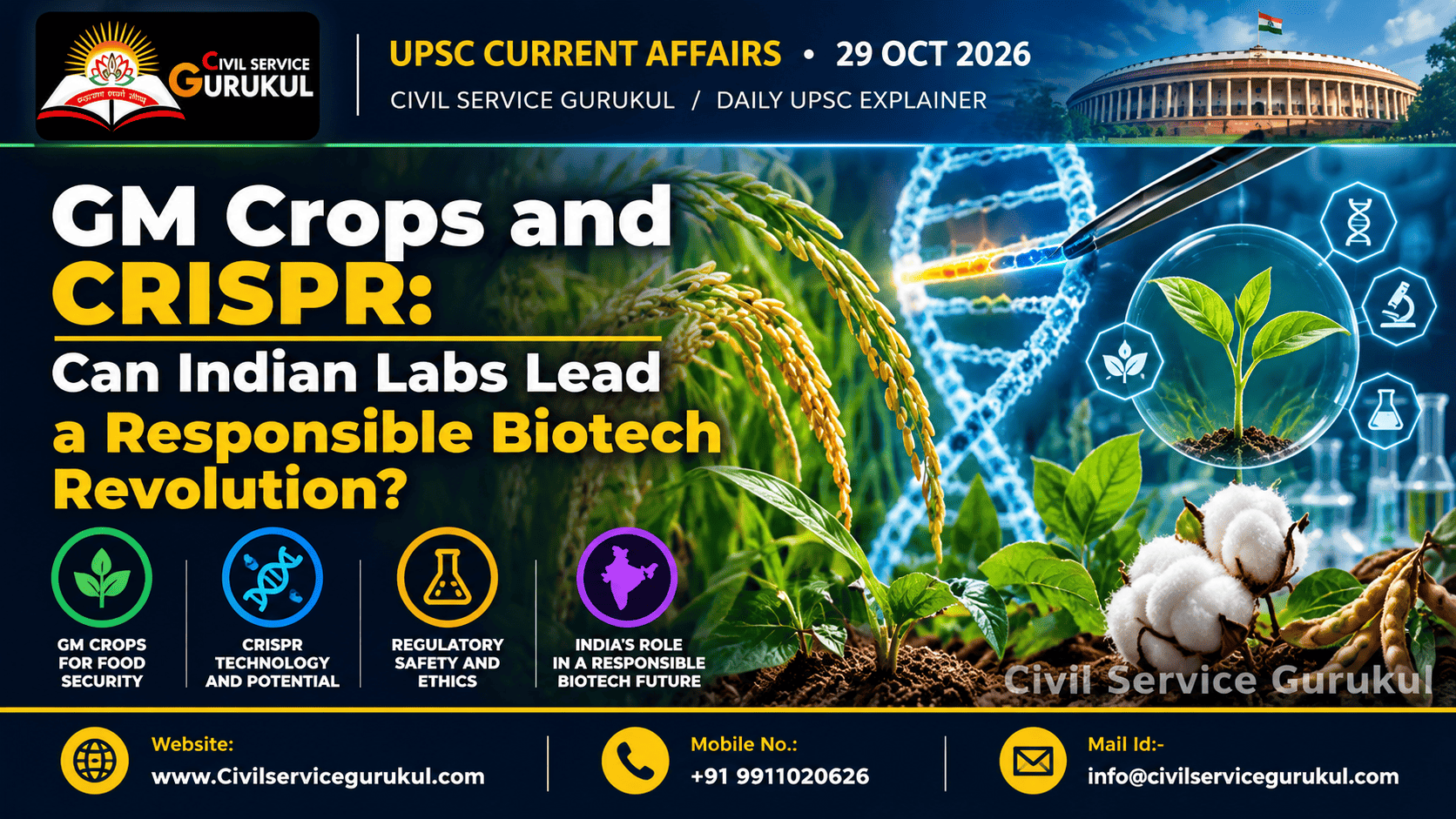
India's GM Crops and CRISPR Revolution: Indigenous Biotechnology, GEAC Regulation and the Future of Food Security
An in-depth UPSC analysis of genetically modified crops, genome editing, indigenous research, biosafety, farmers' rights and sustainable agriculture.
India's agricultural biotechnology debate has gained renewed attention following remarks attributed to Nobel laureate Richard J. Roberts at an October 2026 science conclave.
The discussion highlights India's potential to develop indigenous GM and genome-edited crops while addressing food security, climate resilience, biosafety and farmers' interests.
GS Paper III: Science and Technology, Biotechnology, Agriculture, Food Security and Climate Resilience.
GS Paper IV: Precautionary Ethics, Public Accountability and Responsible Innovation.
Prelims: CRISPR-Cas, GEAC, Bt Cotton, SDN-1 and SDN-2, Genome-Edited Crops.
Why Are GM Crops and CRISPR in the News?
At a science conclave in October 2026, Nobel laureate Richard J. Roberts reportedly argued that Indian researchers could develop and own biotechnology-based crop innovations.
The argument emphasises the importance of domestic scientific capability rather than complete dependence on multinational seed technology.
However, scientific advocacy should not be confused with regulatory approval for commercial cultivation.
India's experience with Bt cotton and genome-edited rice provides important context for this debate.
What Are Genetically Modified Crops?
Genetically modified crops are plants whose genetic material has been altered using biotechnology.
Some conventional transgenic approaches introduce genetic material from another organism to produce a desired trait.
Potential objectives include improved pest resistance, nutritional quality, yield stability and environmental stress tolerance.
The outcomes depend on the specific crop, trait, growing conditions and management practices.
What Is CRISPR-Cas Genome Editing?
CRISPR-Cas is a technology that allows scientists to make targeted changes to DNA sequences.
A guide RNA helps direct a Cas enzyme to a selected genetic location.
The resulting DNA modification can alter a biological trait.
Some genome-editing methods can change an organism's existing DNA without introducing foreign genetic material.
CRISPR is a genome-editing tool. It should not automatically be equated with conventional transgenic modification.
GM Crops vs Genome-Edited Crops: Key Differences
| Aspect | Conventional Transgenic Approach | Genome Editing |
|---|---|---|
| Technique | May introduce DNA from another organism. | Can make targeted changes to existing DNA. |
| Foreign DNA | May be introduced. | Not necessarily introduced. |
| Example | Bt cotton. | Selected CRISPR-edited crop traits. |
| Assessment | Requires applicable biosafety review. | Regulatory treatment depends on the editing category and applicable rules. |
The distinction is important because different technologies and resulting traits may involve different risks and regulatory requirements.
India's Experience with Agricultural Biotechnology
Bt Cotton
Bt cotton has been commercially cultivated in India since 2002.
Its insect-resistance trait is derived from the bacterium Bacillus thuringiensis.
It remains an important example of commercial agricultural biotechnology in India.
Genome-Edited Rice
In 2025, the Indian Council of Agricultural Research announced two genome-edited rice varieties:
- DRR Rice 100 (Kamala)
- Pusa DST Rice 1
These developments highlight India's domestic capacity to pursue crop improvement using modern biotechnology.
What Is GEAC? Biotechnology Regulation in India
GEAC stands for the Genetic Engineering Appraisal Committee.
It is an important regulatory body involved in environmental release decisions concerning genetically engineered organisms.
Regulatory assessment must consider the applicable legal framework and the specific technology and trait.
SDN-1 and SDN-2
Site-directed nuclease categories such as SDN-1 and SDN-2 describe particular forms of genome editing.
These categories can be treated differently from conventional transgenic approaches under India's regulatory framework.
GEAC is a biotechnology regulatory body, not a general agricultural marketing agency.
Potential Benefits of GM Crops and Genome Editing for India
- Food Security: Development of crop traits that may support stable production.
- Climate Resilience: Research into drought, salinity and other stress-tolerance traits.
- Pest Resistance: Potential reduction in damage from particular pests.
- Nutritional Improvement: Crop breeding for desirable nutritional traits.
- Domestic Innovation: Greater capacity for indigenous research and technology ownership.
- Local Adaptation: Crop improvement suited to regional agroecological conditions.
These are potential benefits, not guaranteed outcomes of every biotechnology application.
Environmental, Economic and Ethical Challenges
Environmental Concerns
- Potential effects on biodiversity.
- Development of resistance in target pests.
- Possible ecological effects requiring assessment.
- Need for post-release monitoring.
Farmer and Economic Concerns
- Seed affordability and access.
- Dependence on proprietary technologies.
- Intellectual-property and licensing arrangements.
- Availability of independent crop information.
Governance Concerns
- Transparency of scientific evidence.
- Public consultation and trust.
- Regulatory capacity.
- Balancing innovation with precaution.
Seed Sovereignty and Indigenous Biotechnology
Developing technology within India can help reduce dependence on imported crop innovations.
However, seed sovereignty involves more than domestic laboratory research.
It also depends on licensing arrangements, farmer access, competition, extension services and local seed systems.
Public research institutions can play a valuable role in developing traits that serve smallholder farmers and regions with limited commercial research incentives.
Way Forward: Responsible Agricultural Biotechnology in India
- Expand publicly funded research into climate-resilient crop traits.
- Conduct transparent, trait-specific biosafety assessments.
- Strengthen independent field evaluation and post-release monitoring.
- Protect farmer choice and affordable access to seeds.
- Improve public communication about transgenic and genome-editing technologies.
- Ensure genuine consultation among farmers, scientists, ecologists and consumers.
- Balance innovation incentives with public-interest safeguards.
UPSC Prelims Quick Revision Capsule
| Topic | Important Fact |
|---|---|
| CRISPR-Cas | Uses guide RNA and a nuclease to edit DNA. |
| Bt Cotton | Contains an insect-resistance trait derived from Bacillus thuringiensis. |
| GEAC | Genetic Engineering Appraisal Committee. |
| SDN-1 and SDN-2 | Categories of site-directed genome editing. |
| DRR Rice 100 | Genome-edited rice variety named Kamala. |
| Pusa DST Rice 1 | Genome-edited rice variety highlighted by ICAR. |
| Richard J. Roberts | 1993 Nobel Prize in Physiology or Medicine. |
UPSC Prelims Practice MCQs
With reference to CRISPR-based genome editing, which of the following statements is correct?
(A) Every genome-edited crop necessarily contains foreign DNA.
(B) Genome editing can make targeted changes without introducing foreign DNA.
(C) CRISPR is a method of measuring soil moisture only.
(D) CRISPR cannot be used in plants.
Some CRISPR-based methods make targeted changes within existing DNA without adding foreign genetic material.
Consider the following statements:
- GEAC is associated with the regulation of genetically engineered organisms.
- Bt cotton contains a trait derived from Bacillus thuringiensis.
- SDN-1 and SDN-2 are categories of genome editing.
Which statements are correct?
(A) 1 only
(B) 1 and 2 only
(C) 2 and 3 only
(D) 1, 2 and 3
All three statements are correct.
Which of the following is the most appropriate principle for regulating crop biotechnology?
(A) Approve every crop without assessment.
(B) Reject all biotechnology without examining evidence.
(C) Use transparent, trait-specific risk assessment and monitoring.
(D) Ignore farmer access and biodiversity concerns.
Evidence-based and proportionate regulation can support innovation while addressing biosafety and public-interest concerns.
UPSC Mains Answer Writing Practice
Assess the opportunities and risks of indigenous crop biotechnology for India's food security and climate resilience.
How should regulation balance scientific innovation with the precautionary principle?
Suggested Answer Structure- Define GM crops and genome editing.
- Explain potential benefits for agriculture.
- Discuss biosafety and farmer-rights concerns.
- Examine the role of regulation and public research.
- Recommend transparent and proportionate safeguards.
Model Answer Framework
Agricultural biotechnology can support crop improvement by developing traits associated with pest resistance, stress tolerance and nutritional quality.
Indigenous research may help India develop solutions suited to regional farming conditions while reducing excessive technology dependence.
However, environmental uncertainties, seed affordability, intellectual-property issues and regulatory transparency require careful attention.
India should strengthen public research, independent biosafety assessment, farmer participation and post-release monitoring.
Such an approach can promote scientific innovation without neglecting ecological and social responsibilities.
Frequently Asked Questions
What is CRISPR-Cas technology?
It is a genome-editing technology used to make targeted changes in DNA.
Are genome-edited crops always transgenic?
No. Some genome-editing methods do not introduce foreign DNA.
What is GEAC?
GEAC stands for Genetic Engineering Appraisal Committee. It is involved in the regulatory framework for genetically engineered organisms.
Which genome-edited rice varieties were highlighted by ICAR in 2025?
DRR Rice 100 (Kamala) and Pusa DST Rice 1.
Why is this topic important for UPSC?
It connects biotechnology, agriculture, food security, environmental governance and ethics.
Key Takeaway for UPSC Aspirants
India's agricultural biotechnology future depends on scientific capability, responsible regulation and public trust.
For UPSC, remember that GM crops and genome-edited crops require careful conceptual distinction, and potential benefits must be assessed alongside ecological and farmer-related risks.
Prepare Science & Technology with Civil Service Gurukul
Build a stronger UPSC foundation with current affairs analysis, biotechnology notes, agriculture topics, Prelims practice and Mains answer-writing guidance.
Website: www.civilservicegurukul.com
Mobile: +91 9911020626
Email: info@civilservicegurukul.com
Editorial note: The October 2026 remarks attributed to Richard J. Roberts are described according to the supplied article. This publication draft does not independently verify the conclave report. Scientific advocacy should not be interpreted as regulatory approval.
Prepare with Mentors Who Cleared the Exam
Get personalized study plans, evaluated answer models, and test series access.