
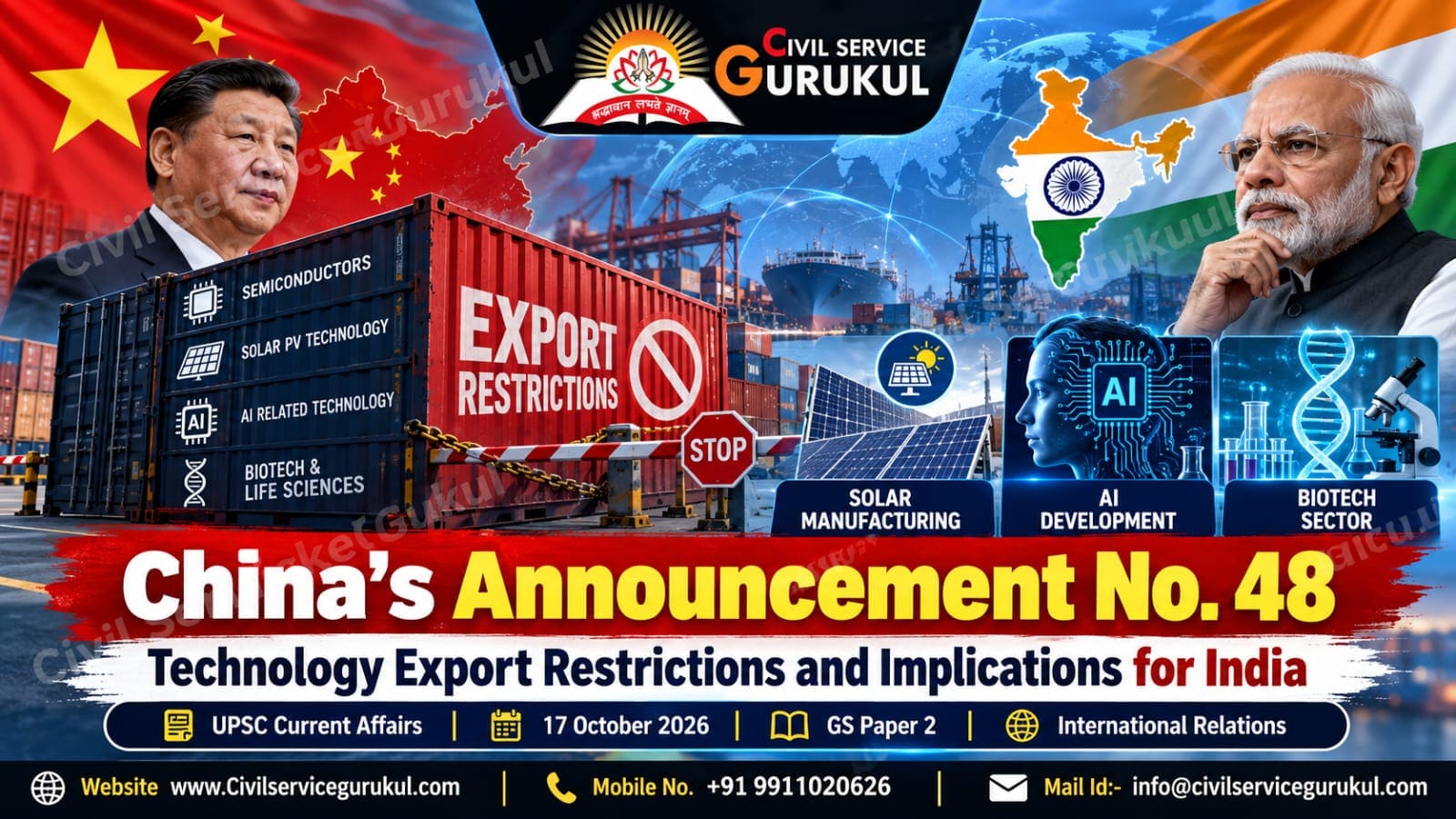
Technology has become an important instrument of economic power, national security and international diplomacy. China's proposed Announcement No. 48, which seeks to expand controls on the export of selected advanced technologies, highlights how countries increasingly treat technological knowledge as a strategic asset. For India, the development raises questions about solar manufacturing, artificial intelligence, biotechnology and the ability to build reliable domestic supply chains.
1. What Is China’s Announcement No. 48?
Announcement No. 48 refers to a proposed revision of China's catalogue governing technologies prohibited or restricted from export. The draft, announced by China's Ministry of Commerce and Ministry of Science and Technology in October 2026, covers technologies in three strategically important sectors: artificial intelligence, photovoltaic energy and biomedicine.
The proposed controls distinguish between technologies that would face outright export prohibitions and technologies whose transfer would require permission or licensing. Such measures can influence not only the movement of physical products but also the transfer of specialised know-how, manufacturing processes and intellectual property.
2. Major Features of the Proposed Controls
| Sector | Proposed coverage | Why it matters |
|---|---|---|
| Artificial intelligence | 23 technologies, including selected advanced models, intelligent agents, computing systems and chip-design technologies. | Access to advanced technical capabilities, model development and computing infrastructure may become more complex. |
| Solar photovoltaics | 12 technologies involving aspects of polysilicon processing, wafers and advanced solar-cell manufacturing. | Countries developing domestic solar supply chains may face additional technology-transfer and equipment-related challenges. |
| Biomedicine | 5 technologies linked to selected advanced biomedical processes and therapies. | Cross-border research, specialist manufacturing and technology licensing could be affected. |
The proposal also distinguishes technologies that are already publicly available through academic publications or open-source channels from sensitive technologies subject to controls. The precise scope and application of any exemption must be assessed against the final rules.
3. Why Is China Tightening Technology Export Controls?
A. National security
Advanced AI, semiconductor design, biotechnology and high-efficiency energy technologies may have both civilian and defence-related applications. Governments increasingly scrutinise the transfer of technologies that could be used in cyber operations, critical infrastructure or sensitive strategic systems.
B. Protection of technological advantages
A country that leads in a strategic technology may seek to preserve its competitive advantage by limiting access to specialised processes, industrial expertise or intellectual property. Export controls can therefore become instruments of industrial policy as well as national security policy.
C. Strategic competition among major powers
Technology restrictions are part of a wider pattern of competition involving advanced chips, AI computing, clean-energy supply chains and sensitive research. Restrictions imposed by one country can encourage other countries to respond with their own controls, incentives or domestic manufacturing programmes.
4. Implications for India’s Solar Manufacturing Industry
India is expanding renewable energy generation and domestic solar manufacturing. However, producing finished solar modules does not automatically create a fully integrated supply chain. The country also needs competitive capacity in upstream materials, wafers, cells, manufacturing equipment and specialised production know-how.
A. Challenges in building an integrated supply chain
If access to particular manufacturing technologies or technical licensing becomes more difficult, Indian companies may face higher costs, longer project timelines or a need to identify alternative suppliers. The impact would vary by technology and by each company's dependence on Chinese expertise.
B. Risks to the clean-energy transition
Delays in establishing domestic production facilities can affect investment schedules and the availability of locally manufactured components. If domestic production cannot respond quickly, developers may have to rely on other suppliers or imported components, potentially increasing costs.
C. Opportunities for Indian innovation
The development also reinforces the case for investment in domestic research, advanced materials, manufacturing equipment and next-generation solar technologies. Universities, research institutions and industry can collaborate to reduce dependence on externally controlled technological processes.
Policy connection: Domestic solar manufacturing
India's production-linked incentive initiatives for high-efficiency solar photovoltaic modules aim to expand domestic manufacturing. However, long-term resilience requires capabilities across the value chain—not just the assembly of finished modules.
5. Implications for India’s Artificial Intelligence Ecosystem
AI capabilities depend on a combination of computing infrastructure, chips, algorithms, high-quality data, technical expertise and research ecosystems. Restrictions on selected technologies may complicate some cross-border transfers or specialised partnerships, although they do not automatically imply that all AI services or models will become unavailable.
- Research and development: Indian institutions need to strengthen indigenous AI research and engineering.
- Compute infrastructure: Diversified access to chips, servers and computing facilities can reduce exposure to single-source risks.
- Responsible AI: Safety, accountability, privacy and cybersecurity should remain central to AI development.
- International partnerships: India can broaden cooperation with trusted partners while maintaining its own technological capacity.
India's objective should not be complete isolation from global technology networks. Instead, it should aim for reliable access, stronger domestic capabilities and the ability to develop alternatives when geopolitical disruptions occur.
6. Biomedicine and Research Collaboration
Modern biomedicine relies on international scientific collaboration, specialised equipment, intellectual property and complex research processes. Proposed restrictions on selected biomedical technologies could affect some technology-transfer arrangements or commercial partnerships.
India can reduce these vulnerabilities by supporting domestic biotechnology research, expanding research infrastructure, developing skilled scientific talent and building diversified international partnerships. Any response should preserve legitimate scientific collaboration while protecting sensitive research and public interests.
7. Strategic Autonomy and India’s Foreign Policy
Strategic autonomy refers to a country's ability to make independent foreign-policy and economic decisions without excessive dependence on another power. It does not require disengagement from international cooperation; rather, it requires enough capacity and flexibility to choose among partners.
Technology dependence can create vulnerabilities when access to equipment, technical knowledge or intellectual property becomes subject to political conditions. The proposed Chinese controls illustrate why India must combine international engagement with domestic capability-building.
- Strengthen domestic research and development in critical sectors.
- Diversify technology suppliers and strategic partnerships.
- Develop resilient supply chains for energy, semiconductors and AI.
- Improve coordination between industry, universities and government.
- Use trade diplomacy to preserve legitimate and predictable technology flows.
8. Challenges India Must Address
- High research costs: Advanced manufacturing and frontier research require long-term investment.
- Skills gaps: Specialist engineers, scientists and manufacturing professionals are essential.
- Technology bottlenecks: Domestic production may remain dependent on imported machinery, components or intellectual property.
- Scale and competitiveness: Local production must achieve consistent quality and viable costs.
- Policy coordination: Industrial incentives, trade policy, research funding and skill development need to work together.
9. Way Forward for India
1. Move from assembly to end-to-end manufacturing
Incentives should encourage capability across materials, components, equipment, testing and advanced production processes. Performance evaluation should consider technological depth and supply-chain resilience alongside manufacturing capacity.
2. Increase public and private R&D
Predictable research funding, industry-academia partnerships and support for technology commercialisation can help turn scientific discoveries into globally competitive products.
3. Diversify international partnerships
India should deepen cooperation with multiple countries and trusted institutions. Diversification can reduce concentration risks without sacrificing the benefits of global trade.
4. Build strategic technology assessments
Government and industry should regularly identify critical import dependencies, evaluate possible disruptions and develop alternative sourcing or domestic-production plans.
5. Strengthen skilled human capital
Technical education, advanced research training and practical manufacturing skills are necessary to sustain domestic innovation beyond short-term incentives.
6. Maintain balanced economic diplomacy
India should monitor the final status of the proposed Chinese measures, engage relevant partners and avoid assuming that every technology transfer will be prohibited. Evidence-based assessment is essential before designing policy responses.
10. UPSC Examination Relevance
| Examination area | Relevant themes |
|---|---|
| GS Paper 2 | India-China relations, bilateral relations, foreign-policy interests and the impact of other countries' policies on India. |
| GS Paper 3 | Indigenisation of technology, industrial policy, renewable energy, biotechnology, AI and economic security. |
| Prelims | Announcement No. 48, export-control terminology, photovoltaic technology, polysilicon, AI and biotechnology. |
| Essay | Technology and sovereignty, globalisation and resilience, innovation-led development, and strategic autonomy. |
11. Prelims Quick Revision
- Announcement No. 48: A proposed revision of China's technology export-control framework.
- Authorities involved: China's Ministry of Commerce and Ministry of Science and Technology.
- Technologies covered: 40 proposed additions across AI, photovoltaics and biomedicine.
- Proposed categories: 14 technologies for prohibition and 26 for restricted, licensed export.
- Photovoltaics: Technology for converting sunlight into electricity.
- Polysilicon: A key material used in conventional crystalline-silicon solar manufacturing.
- Strategic autonomy: The ability to make independent policy choices while engaging internationally.
Exam tip: Remember that the figures above describe the proposal, not a guarantee that all restrictions have entered into force. Check subsequent official updates before using implementation dates or compliance requirements in an examination answer.
12. UPSC Mains Practice Question
GS Paper 2 / GS Paper 3 — 15 Marks
“Technology export controls are increasingly shaping international relations and economic security.” Discuss the implications of China's proposed technology export restrictions for India. Suggest measures to strengthen India's technological self-reliance while preserving international cooperation.
Suggested answer framework
- Introduction: Explain the growing connection between technology, economic power and national security.
- Developments: Briefly describe the proposed controls and the sectors involved.
- Implications: Discuss solar manufacturing, AI, biotechnology, supply chains and strategic autonomy.
- Challenges: Examine R&D costs, skill gaps, imported equipment and production scale.
- Way forward: Recommend innovation, diversification, domestic manufacturing and balanced diplomacy.
- Conclusion: Emphasise resilient self-reliance combined with constructive global engagement.
13. Frequently Asked Questions
What is China's Announcement No. 48?
It is a proposed revision of China's technology export-control catalogue covering 40 technologies across artificial intelligence, solar photovoltaics and biomedicine.
How many technologies are covered by the proposal?
The proposal covers 40 technologies: 23 related to AI, 12 to photovoltaics and 5 to biomedicine. It proposes prohibitions for 14 and licensing-based restrictions for 26.
Why is the proposal important for India?
It highlights potential vulnerabilities in access to specialised manufacturing know-how and critical technologies, particularly where Indian industry depends on overseas suppliers or expertise.
Does the proposal mean all Chinese AI and solar technologies are banned?
No. The proposal concerns specified technologies and distinguishes between prohibited and restricted exports. Its final effect depends on the adopted rules and their application.
Which UPSC papers are relevant to this topic?
GS Paper 2 covers international relations and the implications of other countries' policies for India. GS Paper 3 covers technology, industrial development, energy and indigenisation. Related facts can also be useful for Prelims.
Conclusion
China's proposed technology export controls underline the growing strategic importance of advanced manufacturing, AI, biotechnology and clean-energy technology. For India, the issue is not simply whether individual technologies remain available, but whether the country can build the capabilities required to innovate, manufacture and respond to external disruptions.
A durable response will combine research investment, competitive domestic production, diversified international partnerships and pragmatic diplomacy. Strengthening technological capacity can help India pursue its development goals while preserving strategic autonomy in an increasingly competitive global environment.