
Caste Census 2027: Methodology, Social Justice & UPSC
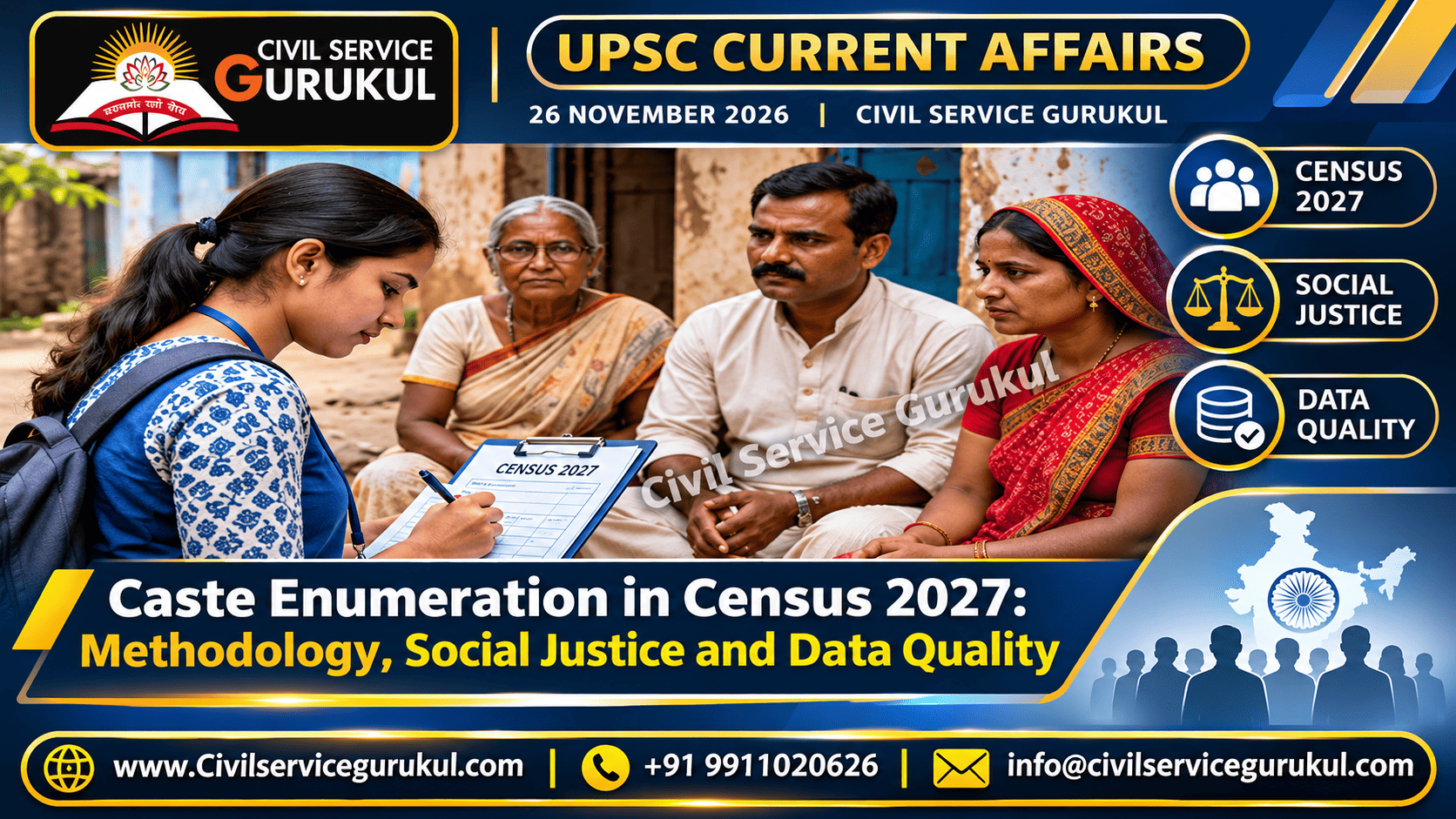
Caste Census 2027: India's Roadmap Towards Social Justice, Inclusive Governance and Reliable Caste Data – UPSC Special Analysis
Caste enumeration in India's Census 2027 represents a significant opportunity to strengthen evidence-based policymaking, social justice and inclusive development.
However, collecting caste information through open-ended responses raises important questions regarding self-identification, regional variations, statistical classification and data privacy.
The challenge is to develop reliable and comparable demographic statistics without reinforcing discrimination, compromising confidentiality or confusing statistical measurement with legal entitlement.
For UPSC aspirants, the issue connects Indian society, constitutional equality, affirmative action, governance, public administration and ethical data management.
UPSC Syllabus Relevance
| Examination Stage | Relevant Topics |
|---|---|
| Prelims | Census, constitutional provisions, demographic indicators, statutory institutions and affirmative action. |
| GS Paper I | Indian society, caste system, social diversity, population and social empowerment. |
| GS Paper II | Social justice, governance, welfare schemes, constitutional safeguards and vulnerable sections. |
| GS Paper III | Inclusive growth, human development and evidence-based resource allocation. |
| GS Paper IV | Equality, dignity, impartiality, confidentiality, integrity and ethical governance. |
| Essay | Social justice, equality of opportunity, inclusive development and democratic citizenship. |
1. Why in the News?
The forthcoming Census 2027 has renewed discussion about how India should collect and classify caste-related demographic information.
Following the Cabinet Committee on Political Affairs decision of 30 April 2025, comprehensive caste enumeration has been included in Census 2027.
The current debate concerns the reliability of collecting caste identities through an open-ended question, particularly for communities outside existing Scheduled Caste and Scheduled Tribe classification arrangements.
Important Questions in the Current Debate
- How should locally varying caste names be recorded?
- How can multilingual responses be standardised?
- Should caste identity and administrative reservation category be recorded separately?
- How can statistical accuracy be ensured?
- How should individual privacy be protected?
- Can demographic data improve social justice without increasing social divisions?
2. What Is the Census of India?
A population census is a comprehensive statistical exercise undertaken to collect, compile and analyse demographic, social and economic information about the population of a defined territory.
India generally conducts its population census once every ten years.
Important Facts About the Census of India
| Particulars | Details |
|---|---|
| First Non-Synchronous Census | 1872 |
| First Synchronous Census | 1881 |
| First Census After Independence | 1951 |
| Last Completed Decennial Census | 2011 |
| Upcoming Census | Census 2027 |
| Governing Legislation | Census Act, 1948 |
| Supporting Rules | Census Rules, 1990, as amended |
| Administrative Ministry | Ministry of Home Affairs |
| Responsible Office | Office of the Registrar General and Census Commissioner, India |
| Constitutional List | Entry 69 of the Union List under the Seventh Schedule |
3. Historical Background of Caste Enumeration in India
| Year | Historical Development |
|---|---|
| 1872 | Early non-synchronous population enumeration in British India. |
| 1881 | First synchronous Census of India. |
| 1931 | Last Census in which comprehensive caste-wise statistics were collected and published in detail. |
| 1941 | Caste information was collected, but comprehensive tabulation and publication were limited during the wartime period. |
| 1951 | Post-independence Census continued enumeration of Scheduled Castes and Scheduled Tribes without comprehensive enumeration of all castes. |
| 1979 | Second Backward Classes Commission, popularly known as the Mandal Commission, constituted. |
| 1980 | Mandal Commission submitted its report. |
| 2011 | Socio-Economic and Caste Census conducted separately from the regular population Census. |
| 30 April 2025 | Decision to include caste enumeration in the upcoming Census. |
| 2026–27 | Digital Census operations, including caste enumeration during Population Enumeration. |
4. Census 2027: Timeline, Phases and Latest Schedule
Census 2027 is being conducted in two principal phases using digital data collection and an additional self-enumeration facility.
| Phase | Purpose |
|---|---|
| Phase I: Houselisting and Housing Census | Collects information about housing conditions, household amenities, assets and related particulars. |
| Phase II: Population Enumeration | Collects individual demographic, social and economic information, including caste-related particulars. |
Revised Census Schedule as of 26 November 2026
| Region | Population Enumeration Schedule | Reference Date |
|---|---|---|
| Uttar Pradesh, Punjab, Goa and non-snow-bound areas of Uttarakhand | Self-enumeration: 16–30 November 2026. Household visits: 1 December 2026–4 January 2027. Revision: 5–9 January 2027. | 5 January 2027 |
| Most remaining States and Union Territories | Self-enumeration: 10–24 January 2027. Household visits: 25 January–28 February 2027. Revision: 1–5 March 2027. | 1 March 2027 |
| Ladakh and designated snow-bound non-synchronous areas | Separate early enumeration arrangements during September and October 2026. | 1 October 2026 |
Special or subsequently revised local arrangements must be checked against the latest applicable government notifications.
Important Features of Census 2027
- India's first fully digital population census.
- Mobile application-based data collection.
- Online self-enumeration facility.
- Comprehensive caste enumeration.
- Forty notified Population Enumeration questions.
- Multilingual digital participation facilities.
- Continued door-to-door coverage by authorised enumerators.
5. What Is Caste Enumeration?
Caste enumeration refers to the systematic collection of information concerning the caste identities of individuals within a population.
It can provide demographic information that helps researchers and policymakers examine social composition, inequality and representation.
Enumeration vs Classification
| Concept | Meaning |
|---|---|
| Enumeration | Recording information provided by respondents. |
| Classification | Organising recorded responses into consistent statistical categories. |
| Aggregation | Combining individual records to produce population statistics. |
| Administrative Classification | Determining categories recognised under applicable government lists and legal rules. |
A person's self-reported caste identity may not automatically correspond to a single administrative category across different States.
Therefore, accurate enumeration requires both faithful recording of responses and careful statistical interpretation.
6. Open-Ended Caste Enumeration Methodology
An open-ended question allows respondents to provide a caste name in their own words rather than selecting exclusively from a predefined list.
This approach can preserve locally recognised identities, but it creates challenges when converting raw responses into nationally comparable statistics.
Illustrative Statistical Processing Framework
This framework illustrates recommended statistical practices. It should not be interpreted as the final officially prescribed classification algorithm for Census 2027.
Why Can Open-Ended Responses Be Difficult to Classify?
- Different spellings of the same caste name.
- Regional and linguistic variations.
- Use of surnames instead of caste names.
- Multiple subgroups within a broader community.
- Identical names referring to different communities.
- Differences between Central and State administrative lists.
- Incomplete or ambiguous responses.
7. Open-Ended Responses vs Pre-Coded Classification
| Parameter | Open-Ended Responses | Pre-Coded Classification |
|---|---|---|
| Identity Recording | Respondent describes identity directly. | Respondent selects from defined categories. |
| Flexibility | High flexibility for local identities. | Depends on completeness of the list. |
| Statistical Processing | Requires extensive coding and validation. | Generally easier to aggregate. |
| Risk of Exclusion | May preserve unlisted identities. | Unlisted communities may be difficult to record. |
| Risk of Misclassification | Arises during interpretation and coding. | Arises when respondents are assigned unsuitable categories. |
| Comparability | Depends on consistent classification protocols. | Potentially stronger if categories are properly designed. |
One possible methodological reform is to preserve the original self-reported caste name while maintaining a separate, carefully validated statistical classification field.
Recording administrative category in an additional field has also been suggested in public discussion. Such an approach would require appropriate legal and methodological safeguards.
8. Difference Between Population Census and SECC 2011
The Socio-Economic and Caste Census of 2011 was a separate nationwide exercise aimed at collecting socioeconomic and caste-related information.
It should not be confused with the regular statutory Population Census conducted in the same year.
| Parameter | Population Census | SECC 2011 |
|---|---|---|
| Primary Objective | Comprehensive population and demographic statistics. | Socioeconomic conditions, deprivation and caste-related information. |
| Frequency | Generally decennial. | Separate exercise without an equivalent decennial requirement. |
| Administrative Responsibility | Registrar General and Census Commissioner under the Ministry of Home Affairs. | Rural Development and the then Housing and Urban Poverty Alleviation ministries, with technical support from the Registrar General. |
| Legal Framework | Census Act, 1948. | Separate administrative framework. |
| Use of Data | Population statistics, development planning and research. | Socioeconomic assessment and identification of eligible households under relevant welfare programmes. |
| Publication of Caste Data | Detailed SC/ST statistics published in earlier post-independence censuses. | Socioeconomic data published; comprehensive caste data not established as publicly released in the reviewed government disclosures. |
9. Constitutional and Legal Framework for Social Justice
The Indian Constitution establishes equality, dignity and social justice as central principles of democratic governance.
Caste-related demographic information may support the evaluation of inequalities and the design of constitutionally permissible policies.
| Article or Provision | Subject |
|---|---|
| Article 14 | Equality before law and equal protection of laws. |
| Article 15 | Prohibition of discrimination on specified grounds, including caste. |
| Article 15(4) | Special provisions for the advancement of socially and educationally backward classes and SCs/STs. |
| Article 15(5) | Special provisions concerning admission to educational institutions, subject to constitutional conditions and exceptions. |
| Article 16(4) | Reservation in appointments or posts for backward classes inadequately represented in State services, subject to constitutional requirements. |
| Article 17 | Abolition of untouchability. |
| Article 21 | Protection of life and personal liberty, including constitutional protection of privacy. |
| Article 38 | Promotion of a social order based on justice and reduction of inequalities. |
| Article 46 | Promotion of educational and economic interests of weaker sections, particularly SCs and STs. |
| Article 338 | National Commission for Scheduled Castes. |
| Article 338A | National Commission for Scheduled Tribes. |
| Article 338B | National Commission for Backward Classes. |
| Article 340 | Appointment of a commission to investigate the conditions of backward classes. |
| Article 341 | Identification of Scheduled Castes. |
| Article 342 | Identification of Scheduled Tribes. |
| Article 342A | Constitutional framework concerning socially and educationally backward classes. |
| Entry 69, Union List | Census as a subject of Union legislative competence. |
Important Constitutional Amendments
| Amendment | Significance |
|---|---|
| 1st Amendment, 1951 | Inserted Article 15(4). |
| 93rd Amendment, 2005 | Inserted Article 15(5). |
| 102nd Amendment, 2018 | Granted constitutional status to the National Commission for Backward Classes. |
| 103rd Amendment, 2019 | Introduced constitutional provisions for reservation for Economically Weaker Sections. |
| 105th Amendment, 2021 | Expressly restored the power of States and Union Territories to maintain their own lists of socially and educationally backward classes for their purposes. |
10. Significance of Caste Enumeration for Social Justice
Evidence-Based Policymaking
Reliable demographic information can help policymakers understand the distribution of social and economic disadvantages.
Identification of Inequalities
Disaggregated statistics may reveal differences in educational attainment, employment, housing and access to public services.
Improved Welfare Planning
Better information can support the design and evaluation of welfare programmes aimed at reducing exclusion.
Inclusive Development
Policymakers may be better equipped to identify communities that face barriers to economic and social participation.
Evaluation of Affirmative Action
Reliable statistics can inform assessments of existing policies, subject to their constitutional and legal requirements.
Academic and Social Research
Appropriately anonymised and aggregated information may support research on social mobility, inequality and development.
11. Major Challenges Associated with Caste Census 2027
| Challenge | Explanation |
|---|---|
| Classification Complexity | Regional names, synonyms and subgroups may create difficulties in forming consistent categories. |
| Data Accuracy | Incorrect recording or interpretation may distort aggregate population estimates. |
| Political Contestation | Different groups may disagree over the interpretation and policy use of demographic statistics. |
| Social Stigmatisation | Inappropriate disclosure or interpretation could reinforce stereotypes and discrimination. |
| Privacy Concerns | Individual caste information requires robust confidentiality safeguards. |
| Digital Divide | Unequal access to devices and digital literacy may affect self-enumeration participation. |
| Administrative Capacity | Large-scale data collection requires trained enumerators and effective supervision. |
| Historical Comparability | Changes in definitions, boundaries and survey methods may limit comparisons with earlier exercises. |
| Policy Interpretation | Population share alone does not establish backwardness or entitlement to reservation. |
Supporters emphasise the value of accurate data for addressing inequality, while critics highlight risks relating to social cohesion, privacy and political misuse.
A balanced policy approach should evaluate these concerns without assuming that data collection necessarily produces either social justice or social division.
12. Data Quality and Statistical Classification
The success of caste enumeration depends not merely on collecting a large volume of information but on producing statistics that are reliable, interpretable and comparable.
| Data Quality Dimension | Meaning |
|---|---|
| Accuracy | Information correctly reflects the response or characteristic being measured. |
| Completeness | Relevant population groups and data fields are adequately covered. |
| Consistency | Similar responses are handled according to consistent statistical rules. |
| Validity | Recorded information meets appropriate classification requirements. |
| Comparability | Statistics can be compared across locations or periods when definitions are compatible. |
| Timeliness | Information becomes available within a useful planning period. |
| Confidentiality | Individual information is protected from unauthorised access and disclosure. |
Recommended Quality Control Measures
- Develop a multilingual statistical data dictionary.
- Preserve original respondent-provided names.
- Use documented coding and classification protocols.
- Train enumerators in neutral questioning.
- Conduct independent statistical quality assessments.
- Provide mechanisms to identify and correct classification errors.
- Disclose relevant methodological limitations when publishing aggregate data.
13. Data Privacy, Confidentiality and Ethical Governance
Caste information is socially sensitive and requires careful handling throughout the data collection and publication process.
Section 15 of the Census Act, 1948
Section 15 restricts public inspection of census records and their admissibility as evidence, subject to the statutory framework.
The confidentiality of individual census information is essential for maintaining public trust and encouraging accurate participation.
Right to Privacy
In K. S. Puttaswamy v. Union of India, 2017, the Supreme Court recognised privacy as a constitutionally protected Fundamental Right.
Government data collection and processing must respect constitutional requirements, including legitimate purpose and appropriate safeguards.
Recommended Data Protection Measures
- Collect information only for legitimate and defined purposes.
- Restrict access to authorised personnel.
- Protect stored and transmitted information.
- Maintain appropriate system access logs.
- Prevent unauthorised sharing of individual records.
- Publish aggregated statistics with disclosure controls.
- Reduce re-identification risks in small population groups.
14. Will Caste Census Automatically Change Reservation Policy?
No. The collection and publication of caste-related demographic information do not automatically create new reservation entitlements or alter existing quotas.
Reservation policy operates through constitutional provisions, applicable legislation, government decisions and judicial requirements.
Important Supreme Court Judgments
| Judgment | Significance |
|---|---|
| Indra Sawhney v. Union of India, 1992 | Major judgment concerning OBC reservation, creamy layer exclusion and limits on reservation under Article 16(4). |
| M. Nagaraj v. Union of India, 2006 | Examined constitutional conditions associated with reservation in promotions. |
| Jarnail Singh v. Lachhmi Narain Gupta, 2018 | Clarified aspects of the requirements relating to reservation in promotions. |
| Janhit Abhiyan v. Union of India, 2022 | Upheld the constitutional validity of the 103rd Constitutional Amendment concerning EWS reservation. |
| State of Punjab v. Davinder Singh, 2024 | Recognised the constitutional permissibility of sub-classification within Scheduled Castes, subject to relevant legal and evidentiary requirements. |
15. Way Forward: Building a Reliable and Inclusive Census
Scientific Questionnaire Design
Questionnaires and coding protocols should be tested across diverse linguistic, geographical and social settings.
Transparent Statistical Classification
Classification criteria should be documented and communicated clearly enough to support public confidence and statistical interpretation.
Separate Identity from Legal Status
Self-reported caste names should be distinguished from administrative classifications used for welfare and reservation purposes.
Enumerator Training
Field personnel should receive appropriate training in neutral questioning, accurate recording, privacy and respectful communication.
Digital Inclusion
Online facilities should complement rather than replace assisted and door-to-door enumeration for people facing digital access barriers.
Data Confidentiality
Strong legal, technical and organisational safeguards should protect individual information throughout the census lifecycle.
Independent Quality Assessment
Statistical assessments, post-enumeration checks and transparent correction procedures can improve confidence in published results.
Responsible Policy Use
Aggregated census information should be used to advance equality, improve public services and evaluate policy outcomes while avoiding discriminatory interpretation.
16. UPSC Prelims 2027 – Quick Revision
- First non-synchronous Census: 1872.
- First synchronous Census: 1881.
- First post-independence Census: 1951.
- Last completed decennial Census: 2011.
- Last detailed publication of comprehensive caste-wise Census data: 1931.
- Census is included under Entry 69 of the Union List.
- Census Act was enacted in 1948.
- Census Rules were framed in 1990.
- Registrar General and Census Commissioner functions under the Ministry of Home Affairs.
- SECC 2011 was separate from Population Census 2011.
- Caste enumeration was approved on 30 April 2025.
- Caste information is collected during Phase II of Census 2027.
- Section 15 of the Census Act protects confidentiality of census records.
- Article 340 concerns commissions investigating backward classes.
- Article 338B concerns the National Commission for Backward Classes.
- Article 341 concerns Scheduled Castes.
- Article 342 concerns Scheduled Tribes.
- The 105th Amendment concerns State and Union Territory SEBC lists.
- Statistical caste classification does not automatically establish legal reservation eligibility.
17. UPSC Prelims Practice MCQs
Question 1
With reference to the Census of India, consider the following statements:
- Census is included in the Union List of the Seventh Schedule.
- The statutory framework for Population Census is provided by the Census Act, 1948.
- The Registrar General and Census Commissioner functions under the Ministry of Statistics and Programme Implementation.
Which of the statements given above are correct?
- 1 only
- 1 and 2 only
- 2 and 3 only
- 1, 2 and 3
Reveal Correct Answer and Explanation
Statement 1 is correct because Census is a Union List subject under Entry 69.
Statement 2 is correct because the Census Act, 1948, provides the statutory framework.
Statement 3 is incorrect because the Registrar General and Census Commissioner functions under the Ministry of Home Affairs.
Question 2
Consider the following statements regarding Census 2027:
- It introduces digital data collection and a self-enumeration facility.
- Caste-related particulars are collected during Population Enumeration.
- Online self-enumeration eliminates the need for door-to-door census operations.
Which of the statements given above are correct?
- 1 and 2 only
- 2 and 3 only
- 1 and 3 only
- 1, 2 and 3
Reveal Correct Answer and Explanation
Digital collection and self-enumeration are important features of Census 2027. Caste information forms part of Population Enumeration. Self-enumeration supplements rather than eliminates household visits by authorised enumerators.
Question 3
Consider the following pairs:
| Article | Subject |
|---|---|
| 1. Article 338B | National Commission for Backward Classes |
| 2. Article 340 | Commission to investigate the conditions of backward classes |
| 3. Article 341 | Scheduled Tribes |
How many of the pairs given above are correctly matched?
- Only one
- Only two
- All three
- None
Reveal Correct Answer and Explanation
Pairs 1 and 2 are correctly matched. Article 341 concerns Scheduled Castes, while Article 342 concerns Scheduled Tribes.
Question 4
Which of the following represents a major statistical challenge associated with open-ended caste enumeration?
- It prevents respondents from identifying their communities.
- It eliminates the need for enumerator training.
- It requires careful classification of varying local names, spellings and subgroups.
- It automatically determines reservation eligibility.
Reveal Correct Answer and Explanation
Open-ended responses may produce different spellings, synonyms and subgroup names. These require careful standardisation and validation before meaningful statistical aggregation.
Question 5
With reference to caste enumeration and social justice, consider the following statements:
- Statistical caste classification and legal reservation eligibility are identical.
- Section 15 of the Census Act, 1948, restricts access to individual census records.
- The 105th Constitutional Amendment concerns the power of States and Union Territories to maintain their own SEBC lists for their purposes.
Which of the statements given above are correct?
- 1 and 2 only
- 1 and 3 only
- 2 and 3 only
- 1, 2 and 3
Reveal Correct Answer and Explanation
Statement 1 is incorrect because statistical classification does not automatically determine legal entitlement.
Statement 2 is correct because Section 15 provides important restrictions concerning census records.
Statement 3 is correct because the 105th Amendment expressly restored State and Union Territory powers concerning their own SEBC lists.
18. UPSC Mains Answer Writing Practice
Question: Caste enumeration in Census 2027 offers an opportunity for evidence-based social justice but also presents challenges relating to statistical accuracy, privacy and social cohesion. Discuss.
Marks: 15 | Word Limit: 250 Words
Reveal Model Answer
Introduction
The inclusion of comprehensive caste enumeration in Census 2027 marks an important development in India's demographic and social policy framework. Reliable caste-related information can strengthen evidence-based policymaking and help identify structural inequalities.
Body
Caste enumeration can contribute to social justice by revealing disparities in education, employment, living conditions and access to public services. It may also support welfare planning, evaluation of affirmative action and more inclusive development.
However, the exercise presents significant challenges:
- Regional variations and multiple caste names may complicate statistical classification.
- Inaccurate coding can distort demographic estimates.
- Unauthorised disclosure of individual information may violate privacy and dignity.
- Political misuse of statistics may weaken social cohesion.
- Population shares may be incorrectly equated with reservation entitlements.
India should adopt multilingual classification protocols, trained enumerators, independent statistical assessments and robust confidentiality safeguards. Original self-reported identities should be preserved while developing transparent coding mechanisms.
The exercise must distinguish demographic measurement from administrative eligibility and ensure that policy decisions remain consistent with constitutional principles and judicial requirements.
Conclusion
Caste enumeration can strengthen inclusive governance when supported by scientific methodology, transparent institutions and ethical data management. Its ultimate purpose should be to reduce social exclusion and promote substantive equality while preserving individual dignity and national fraternity.
Question: Examine the significance of caste enumeration in understanding the changing nature of social stratification in contemporary India.
Marks: 10 | Word Limit: 150 Words
Reveal Suggested Answer
Caste remains an important dimension of Indian social stratification, although its influence varies across regions, occupations and socioeconomic contexts.
Comprehensive caste enumeration may help researchers examine educational attainment, occupational mobility, urbanisation and access to economic opportunities among different communities.
Such information can reveal both persistent inequalities and changes in traditional social structures. However, caste should not be treated as the sole determinant of disadvantage, since gender, income, disability, geography and other factors also influence social outcomes.
Reliable classification, privacy protection and careful interpretation are essential. Data should support social empowerment without reinforcing stereotypes or treating communities as internally homogeneous.
Therefore, caste enumeration can contribute to a deeper understanding of contemporary Indian society when combined with multidimensional analysis and constitutional commitments to equality and dignity.
19. GS Paper IV – Ethics Case Study
You are a district-level officer supervising Census 2027 operations. Certain influential community representatives request access to individual household caste records to prepare a community-specific political campaign.
At the same time, several households complain that enumerators have incorrectly classified their self-reported caste names.
Questions
- Identify the ethical issues involved.
- Identify the major stakeholders.
- What course of action should you adopt?
Reveal Suggested Case Study Solution
Ethical Issues
- Confidentiality of personal census information.
- Individual privacy and dignity.
- Political neutrality of public administration.
- Accuracy and integrity of statistical records.
- Public trust and administrative accountability.
- Fairness in the treatment of respondents.
Stakeholders
- Households participating in the Census.
- Enumerators and census supervisors.
- District administration.
- Community representatives.
- Office of the Registrar General and Census Commissioner.
- Researchers and policymakers relying on census statistics.
Appropriate Course of Action
- Decline unauthorised access to individual census records.
- Explain the statutory confidentiality obligations to community representatives.
- Review classification complaints through authorised correction procedures.
- Preserve the confidentiality of affected respondents during verification.
- Provide additional training and supervision to enumerators where necessary.
- Document decisions and escalate significant irregularities to competent authorities.
- Communicate the legitimate statistical purpose of census operations to citizens.
Ethical Justification: The proposed action upholds integrity, impartiality, confidentiality, constitutional morality and responsibility towards citizens.
20. Important Essay Topics for UPSC
- Social justice begins with recognising invisible inequalities.
- Data-driven governance must not compromise human dignity.
- Equality of opportunity is the foundation of inclusive development.
- Technology and ethics must progress together.
- Democracy requires both recognition of diversity and commitment to fraternity.
- Evidence-based policymaking is essential for meaningful social transformation.
21. Frequently Asked Questions
What is Caste Census 2027?
It refers to comprehensive caste enumeration being included within India's Census 2027 Population Enumeration exercise.
When was comprehensive caste enumeration approved?
The Cabinet Committee on Political Affairs decided to include caste enumeration on 30 April 2025.
When was the last detailed all-caste Census publication?
The 1931 Census was the last Census in which comprehensive caste-wise statistics were collected, tabulated and published in detail.
Which ministry conducts the Census of India?
The Census is administered by the Office of the Registrar General and Census Commissioner under the Ministry of Home Affairs.
Which legislation governs the Population Census?
The Census Act, 1948, along with the Census Rules, 1990, as amended.
How many phases are included in Census 2027?
Two principal phases: Houselisting and Housing Census, followed by Population Enumeration.
Is the Census 2027 reference date identical across India?
No. Most States and Union Territories have a reference date of 1 March 2027, while specified States and snow-bound areas follow separate arrangements.
What is open-ended caste enumeration?
It involves recording caste identities through respondent-provided names rather than restricting all responses to a predetermined list.
What is the difference between Census and SECC?
The statutory Population Census collects comprehensive demographic statistics, whereas SECC 2011 was a separate socioeconomic and caste-related administrative exercise.
Will Caste Census automatically increase reservation?
No. Reservation decisions require independent compliance with applicable constitutional provisions, legislation and judicial requirements.
Which constitutional article concerns the Backward Classes Commission?
Article 340 provides for the appointment of a commission to investigate the conditions of backward classes. Article 338B concerns the National Commission for Backward Classes.
How is individual census information protected?
The Census Act, 1948, particularly Section 15, provides important statutory safeguards concerning access to and use of census records.
Why is Caste Census 2027 important for UPSC?
It connects Indian society, constitutional provisions, affirmative action, social justice, governance, demographic statistics and ethical data management.
22. Conclusion
Caste enumeration in Census 2027 presents an opportunity to develop a more comprehensive understanding of India's social composition and persistent inequalities.
However, the usefulness of the exercise will depend on scientific questionnaire design, accurate recording, transparent classification and responsible interpretation of statistical information.
Demographic data should support the constitutional objectives of equality, justice and dignity rather than reinforce social discrimination or create new barriers.
India must combine evidence-based policymaking with robust confidentiality safeguards, institutional accountability and respect for social diversity.
The ultimate success of caste enumeration should be measured not merely by the number of identities recorded, but by the quality of information produced and its responsible contribution to social justice, inclusive development and constitutional fraternity.
Prepare for UPSC CSE 2027 with Civil Service Gurukul
Develop conceptual clarity, analytical thinking and examination-oriented preparation through structured learning.
Daily Current Affairs | Prelims Test Series | Mains Answer Writing | NCERT Foundation | Indian Society | Indian Polity | Social Justice | Ethics and Governance | UPSC Mentorship
Visit Our Website Connect on WhatsAppWebsite: www.Civilservicegurukul.com
Mobile No.: +91 9911020626
Email: info@civilservicegurukul.com
Prepare with Mentors Who Cleared the Exam
Get personalized study plans, evaluated answer models, and test series access.